


















ToupTek’s New Astrograph HOPE D60: Launching on October 15
Oct 14, 2025
Soumyadeep Mukherjee
Soumyadeep Mukherjee is an award-winning astrophotographer from India. He has a doctorate degree in Linguistics. His work extends to the sub-genres of nightscape, deep sky, solar, lunar and optical phenomenon photography. He is also a photography educator and has conducted numerous workshops. His works have appeared in over 40 books & magazines including Astronomy, BBC Sky at Night, Sky & Telescope among others, and in various websites including National Geographic, NASA, Forbes. He was the first Indian to win “Astronomy Photographer of the Year” award in a major category.
Share:
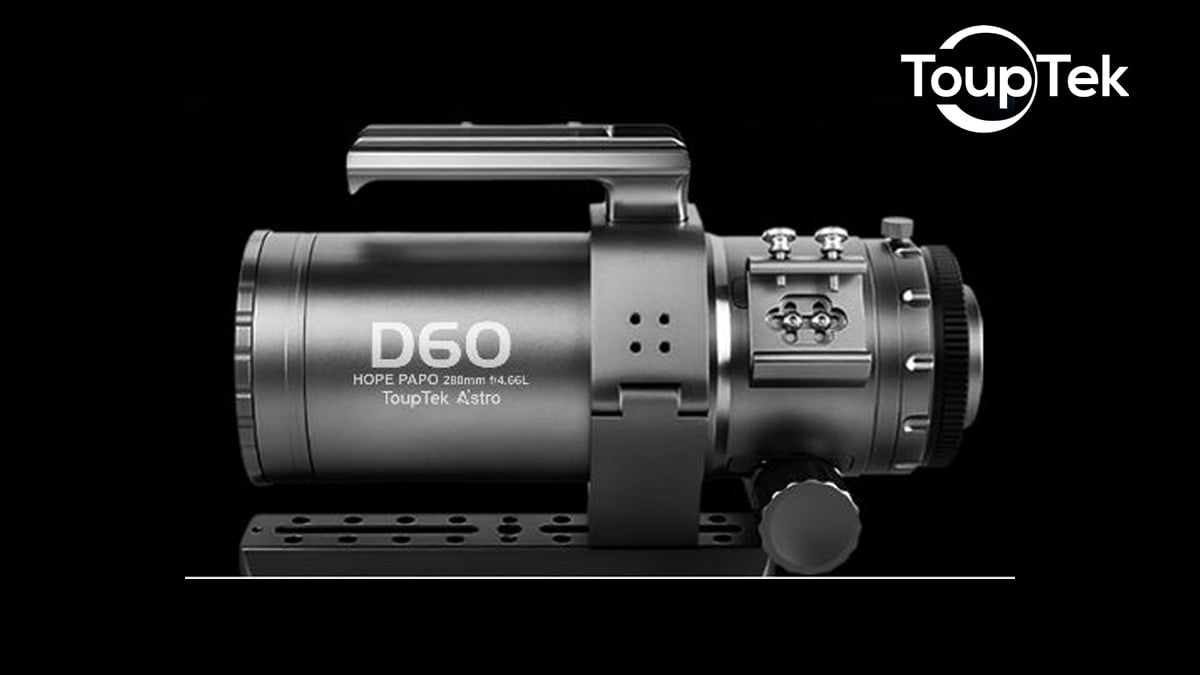
Astrophotography often starts with a simple question: how much performance can you fit into a small telescope? The HOPE D60 from ToupTek is one such answer. It’s a compact 60 mm astrograph built with a clear purpose. And the purpose is to deliver a flat, wide, and sharp field for imaging without the need for extra optics. Instead of chasing large apertures, it focuses on precision, portability, and balance. Designed as a ready-to-use instrument for digital sensors, the D60 shows how far small refractors have come in recent years.
A fresh entry: ToupTek HOPE D60
ToupTek markets the HOPE D60 as a PAPO (Planar-APO) professional astrophotography telescope. The basic specs are simple: 60 mm aperture, 280 mm focal length, giving an effective f/4.66 focal ratio. But what sets it apart is how ToupTek has packaged the optical corrections, mechanical design, and imaging support into one system. The claim is that the D60 offers native flat-field imaging coverage without needing extra flatteners or correctors. In practical terms, it aims to be a compact, “ready-to-go” astrograph. You can mount it, attach your camera, focus it, and you should get good star shapes from edge to edge, if everything holds in real life.
ToupTek has positioned the HOPE D60 as a versatile tool. Not only for deep-sky astrophotography but also as a fast telephoto-style lens when paired with DSLR or mirrorless cameras. Interestingly, ToupTek has also stated that for visual use, the D60 is not recommended. The optical path and back-focus distances are tailored for imaging, not for human-eye viewing.
Optical philosophy and design details
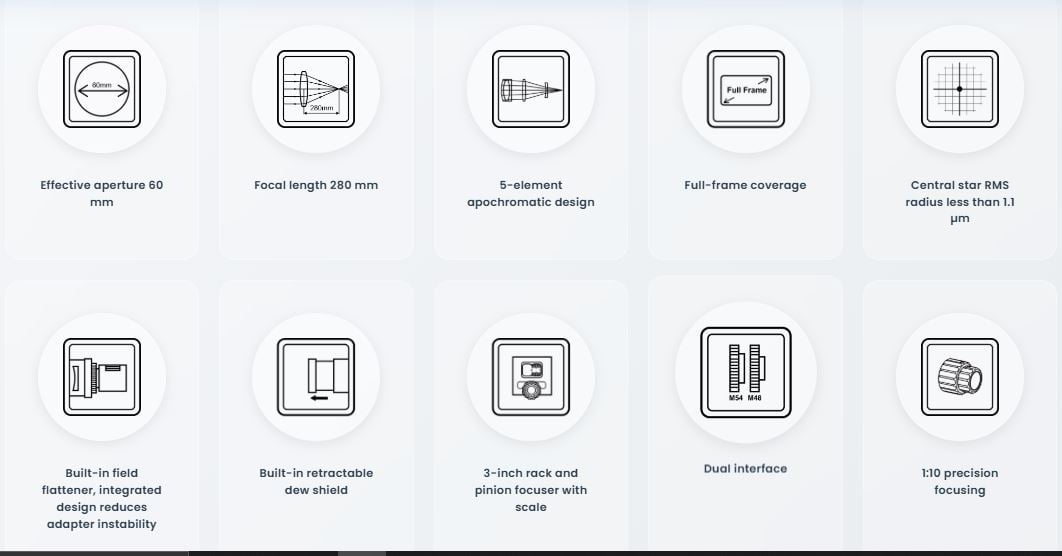
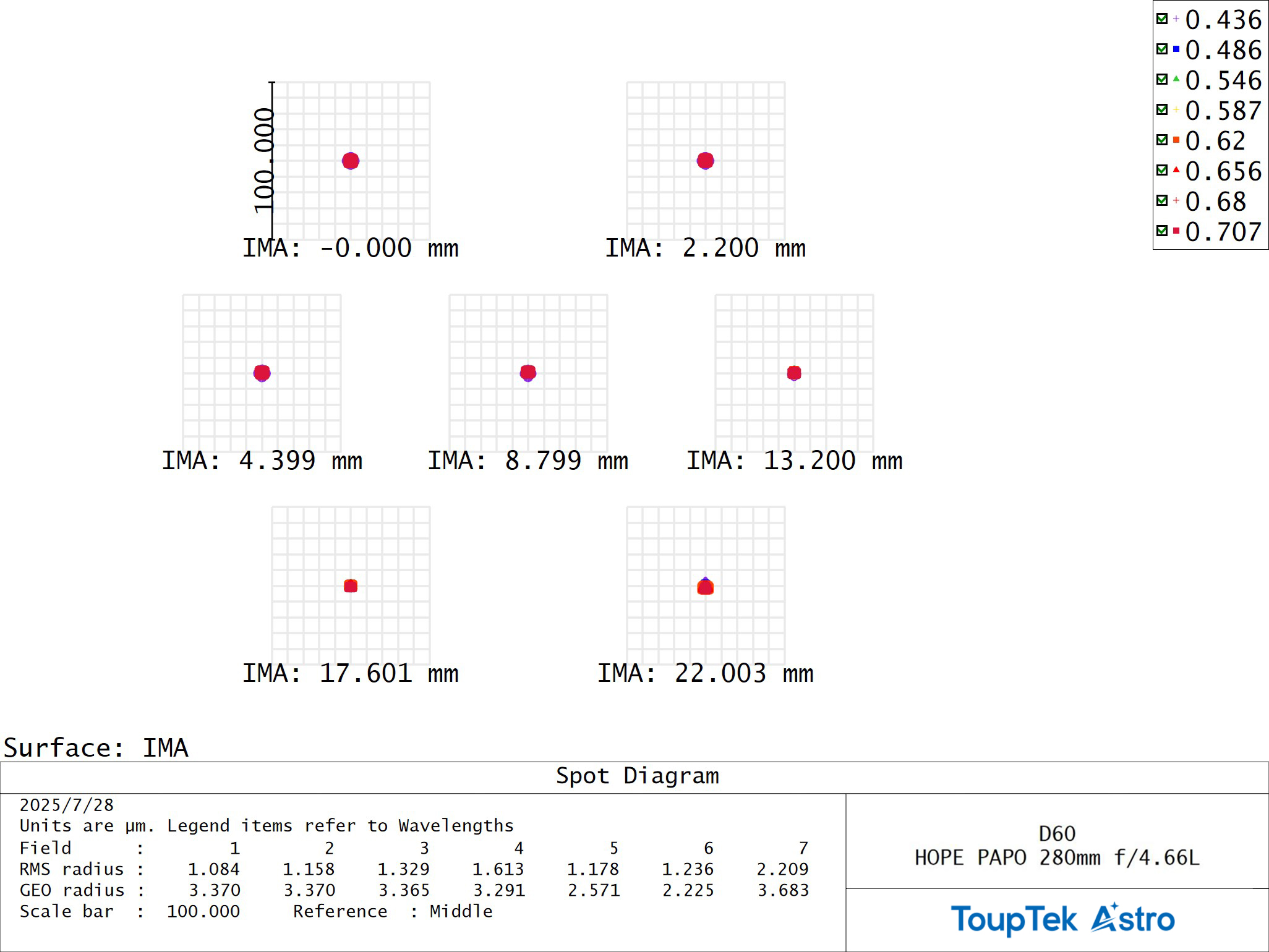
Any astrograph is judged by how it handles stars at the edge of the field. The D60 tackles this head-on. Its optical layout is a 5-element apochromatic design with a built-in field flattener. ToupTek provides spot diagrams showing that near the center, the RMS star radius is below 1.1 µm. At the edges, it may grow to 2.3 µm. They also supply Modulation Transfer Function curves that hold well across the field, and longitudinal aberration plots showing tight wavelength focal alignment.
A key optical metric they highlight is relative illumination. They claim that even at the 44 mm full-frame edge, the illumination remains over 90%. That suggests minimal vignetting and uniform brightness across a full-frame sensor. By folding the field-flattening correction into the telescope’s optical path, the D60 removes a common weak point in many small astrographs: the external flattener adapter chain. ToupTek claims this integrated design reduces the potential for adapter instability or back-focus errors.
Mechanical build, features & practical design
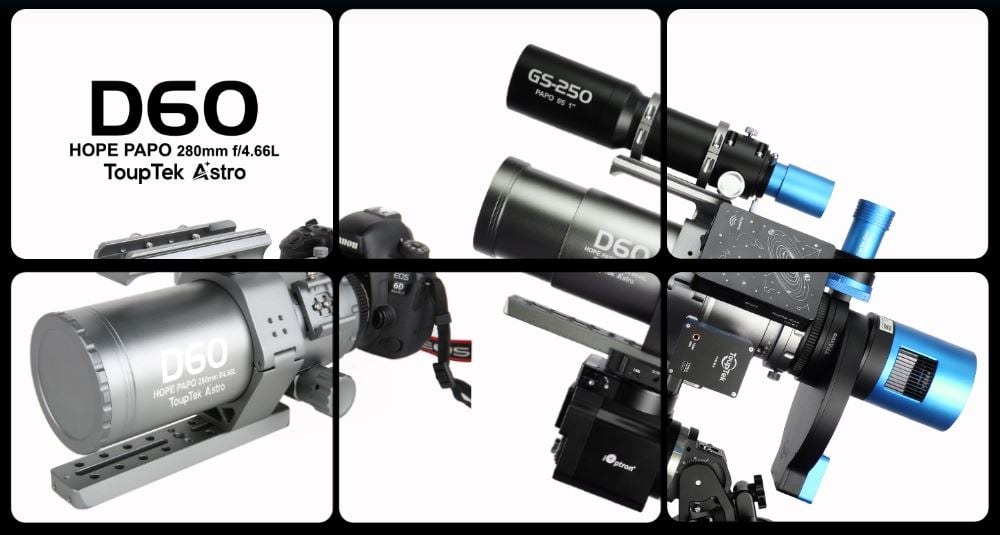
An astrograph’s mechanical design is just as important as its optics. Even the sharpest lens is useless if it flexes, drifts, or can’t be aligned. The HOPE D60 pays attention to details here. The tube structure is made from precision-machined aluminum alloy, ensuring strength, rigidity, and thermal stability. The interior surfaces are blackened to suppress stray light. A retractable dew shield is built in; it can extend or retract magnetically, which is convenient for packing or adjusting field-of-view constraints.
The focuser is a 3-inch rack & pinion type, with about 30 mm of travel, and supports both coarse and fine focusing. It also has a scale window so you can note your focus position. The manual knob is removable; you can substitute an electric focuser (like ToupTek’s AAF, ZWO EAF, etc.). Another nice feature is the 360° camera-angle rotator: you can swivel the camera orientation around the optical axis without disassembling anything. That’s useful when you want to frame a nebula or align a mosaic.
For mounting, there’s a Vixen-style dovetail bar with side slots, plus a central socket (3/8″ with an insert for 1/4″) to allow tripod attachment. The base includes riser blocks and positioning slots for accessory flexibility. With the dew shield retracted, the total tube length is just 255 mm. That makes it quite compact, which helps with portability and layout in imaging rigs. The standard camera interface is M48 × 0.75 mm threads, and ToupTek offers an optional M54 adapter for larger-format setups.
Intended use, application scenarios & versatility
The D60 is fundamentally an imaging instrument, and its intended use cases reflect that. ToupTek describes several modes:
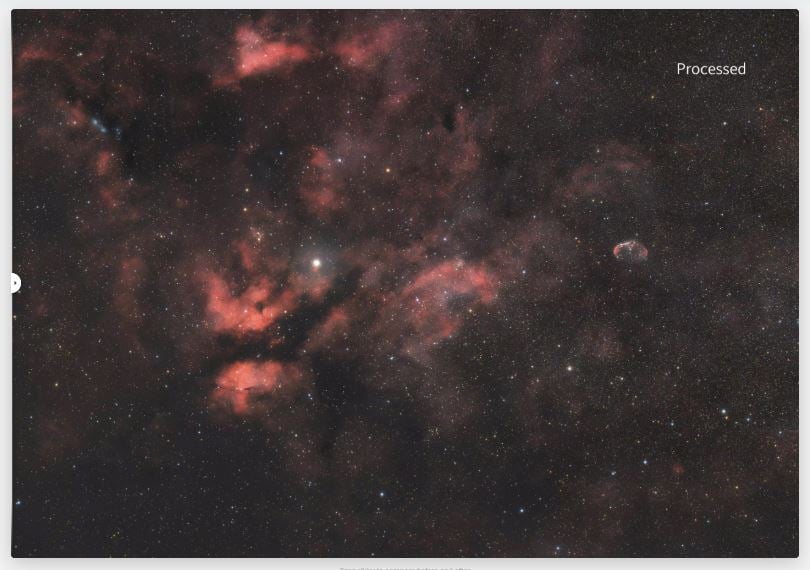
- Deep-sky astrophotography: The design is suited for capturing wide-field nebulae, clusters, the Milky Way, or large galaxies. The fast f/4.66 helps in reducing exposure time demands (though you still need precise tracking and guiding).
- Nightscape / wide-field combined imaging: Because of its full-frame coverage and compatibility with DSLR / mirrorless cameras, the D60 can double as a fast telephoto or astro-lens for nightscapes, capturing stars, Milky Way panoramas, low-light landscapes, etc.
- Compact imaging rigs / portable setups: Its short length and integrated design make it attractive for field or travel-oriented astrophotographers who want minimal fuss in packing, setup, or balance.
- Educational / outreach setups: For educators or presenters who want something manageable yet capable of showing wide-field celestial objects, the D60 may bridge the gap between small refractors and bulkier, expensive astrographs.
Price and availability
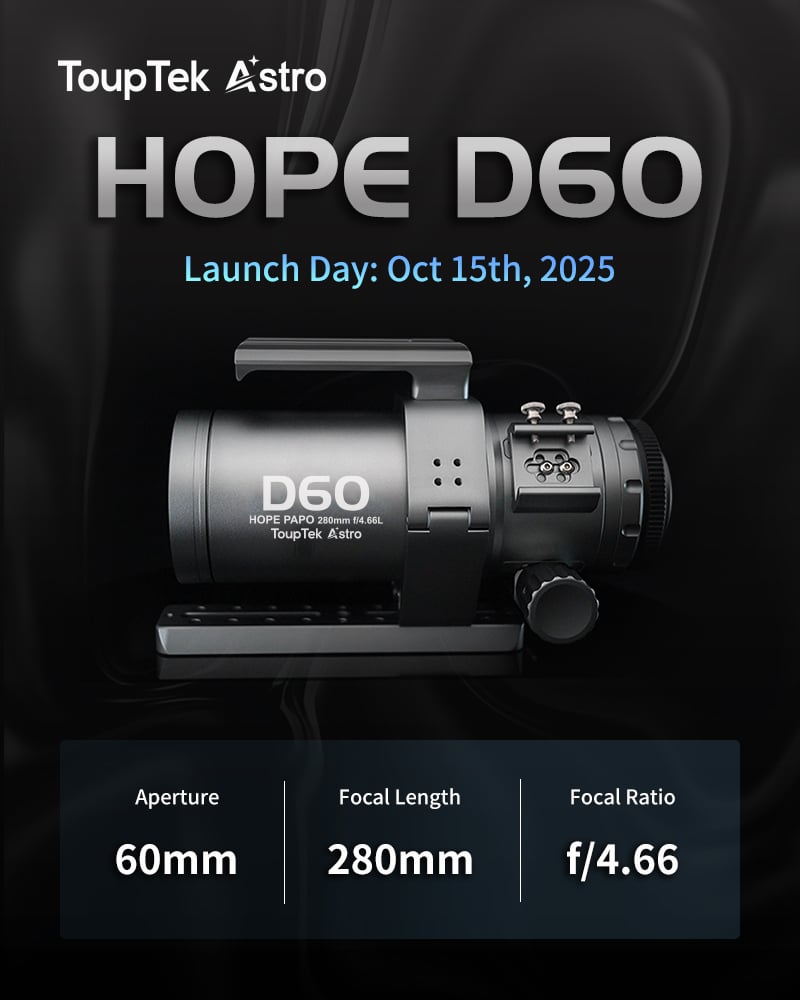
The ToupTek HOPE D60 will be launched tomorrow, on 15th October 2025. We do not have any words on the pricing, but we assume the price to be around $1500. It will be made available via the official website and multiple retailers, following the launch.
The D60’s pitch is “all the correction built-in, minimal extra complexity, compact size, and full-frame performance.” If it lives up to that, it becomes appealing for astrophotographers who want serious results without large, costly optics. Its strength lies in reducing external adapters, reducing alignment headaches, and packaging everything in a compact tube. That is a real advantage in field setups where space, balance, and portability are important.
Clear skies!
See more from DIYPhotography.net on Google
Add DIYPhotography.net as a trusted source. This makes
our stories more likely to appear in your Google Search results.
 Add as a preferred source on Google

Soumyadeep Mukherjee
Soumyadeep Mukherjee is an award-winning astrophotographer from India. He has a doctorate degree in Linguistics. His work extends to the sub-genres of nightscape, deep sky, solar, lunar and optical phenomenon photography. He is also a photography educator and has conducted numerous workshops. His works have appeared in over 40 books & magazines including Astronomy, BBC Sky at Night, Sky & Telescope among others, and in various websites including National Geographic, NASA, Forbes. He was the first Indian to win “Astronomy Photographer of the Year” award in a major category.

Join the Discussion
DIYP Comment Policy
Be nice, be on-topic, no personal information or flames.