




















Askar SQA130 Launched: A Fast 130 mm Quintuplet Astrograph
Nov 19, 2025
Soumyadeep Mukherjee
Soumyadeep Mukherjee is an award-winning astrophotographer from India. He has a doctorate degree in Linguistics. His work extends to the sub-genres of nightscape, deep sky, solar, lunar and optical phenomenon photography. He is also a photography educator and has conducted numerous workshops. His works have appeared in over 40 books & magazines including Astronomy, BBC Sky at Night, Sky & Telescope among others, and in various websites including National Geographic, NASA, Forbes. He was the first Indian to win “Astronomy Photographer of the Year” award in a major category.
Share:

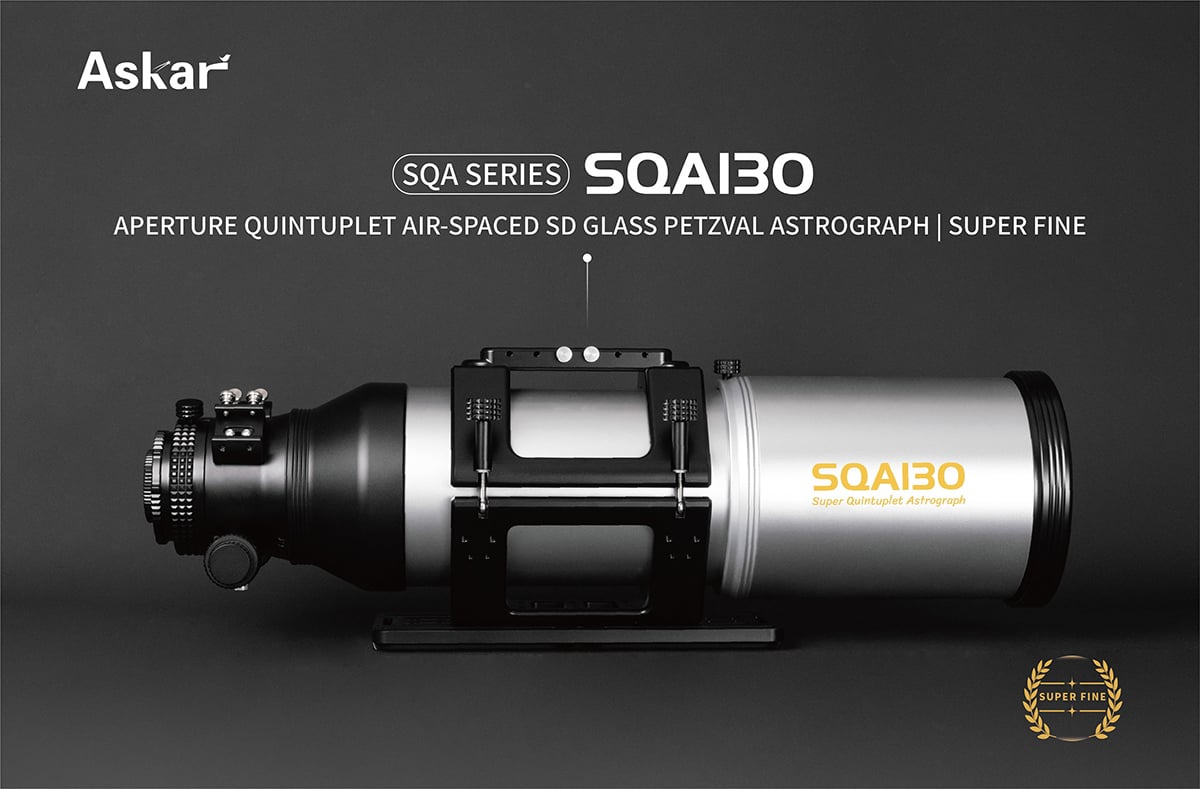
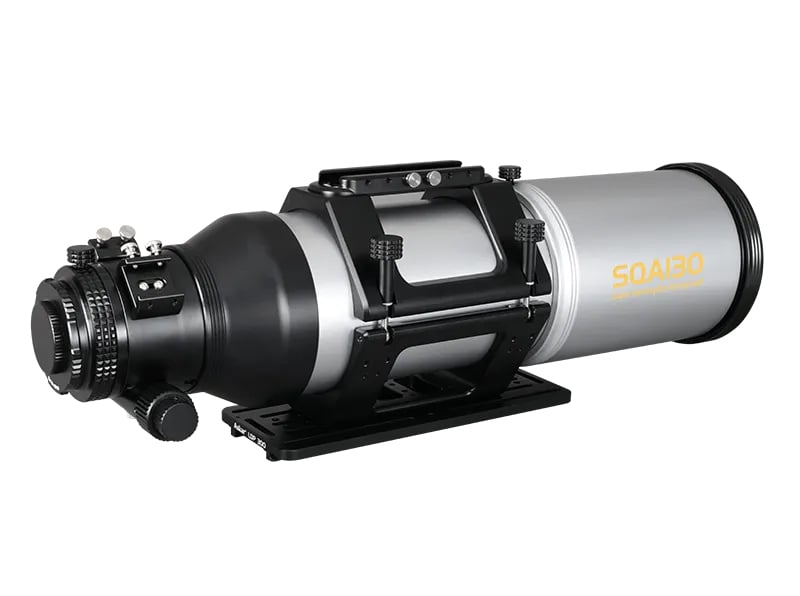
The Askar SQA130 sits in a very particular space in today’s astrophotography market. It is not a lightweight travel refractor. It is also not a slow, traditional apochromat that needs multiple accessories to perform at its best. Instead, it arrives as a large, fast, and carefully corrected astrograph designed for modern imaging sensors. With a 130 mm aperture and a native focal ratio of f/4.8, it aims to give photographers clean, flat, and consistent results across the entire frame. The design uses a quintuplet Petzval layout with two super-low dispersion elements.
The SQA130 promises high resolution from a 130 mm front lens, wide framing from a 624 mm focal length, and strong field correction through its internal optical group. For anyone who shoots with a full-frame or medium-format camera, these qualities are of great importance. They decide whether stars remain tight in the corners and whether the frame stays usable without heavy cropping.
A Petzval optical system
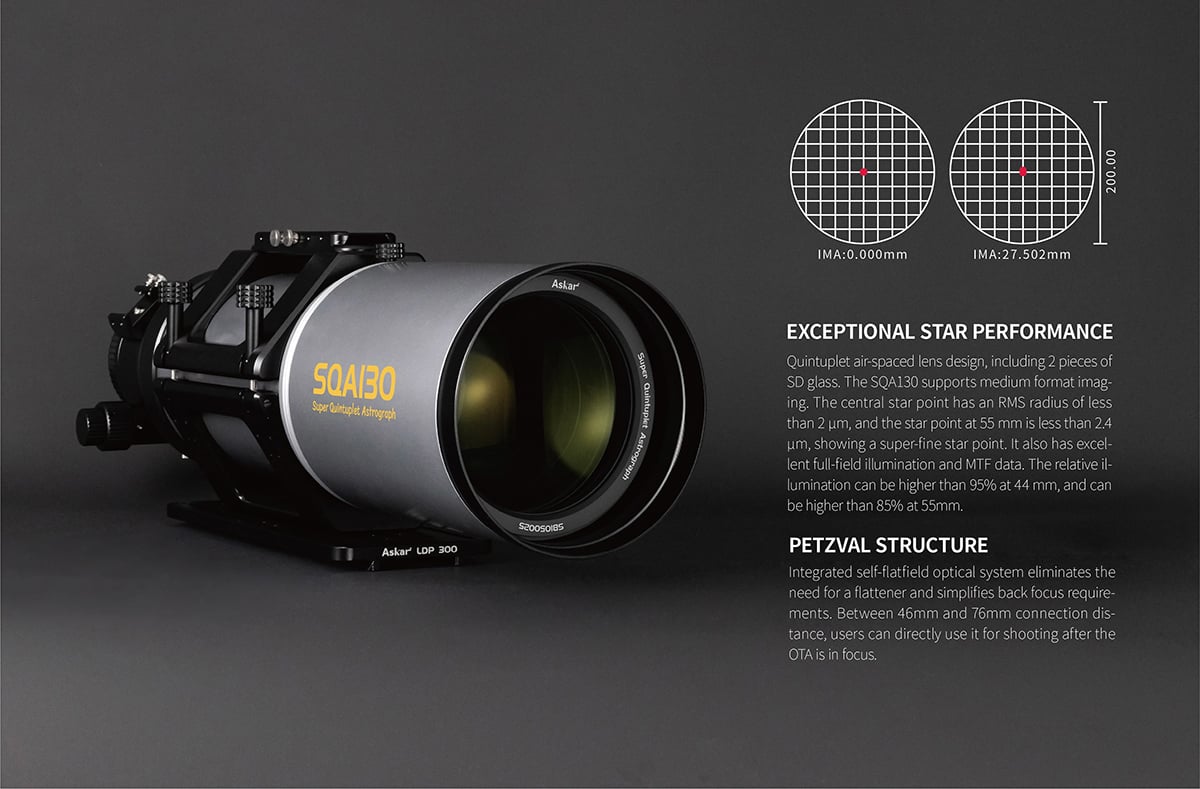
The core of the SQA130 is its optical design. Askar uses five elements in total. Two of them are SD glass elements that help control chromatic aberration. The remaining elements form a fixed rear group that flattens the field. This Petzval approach means the telescope does not need an external flattener. The field stays even across the frame because the correction is built into the body of the instrument. That makes the system more stable in long-term use because you remove a common source of alignment issues.
A 130 mm aperture provides solid light-gathering ability. When paired with the f/4.8 speed, the telescope delivers bright frames in shorter exposures. This is helpful when the target is faint or when the imaging window is short. Many astrophotographers prefer fast optics because they improve efficiency. Shorter exposures also reduce the chance of tracking errors, wind shake, or unexpected guiding deviations. The SQA130’s speed helps in all these situations.
The 624 mm focal length gives a comfortable field of view for nebulae, star clusters, and galaxies. Many popular targets sit well within this range. At the same time, the focal length is long enough to reveal structure and detail in mid-sized objects.
Askar also designs the telescope to support a large image circle. Full-frame cameras work without major corner issues. Medium-format mirrorless systems also fit within the intended coverage. This level of correction is rare at this speed and aperture. Many telescopes that cover such large sensors operate at slower f-ratios or use very heavy optics. The SQA130 avoids those constraints by keeping its layout relatively compact.
Mechanical design
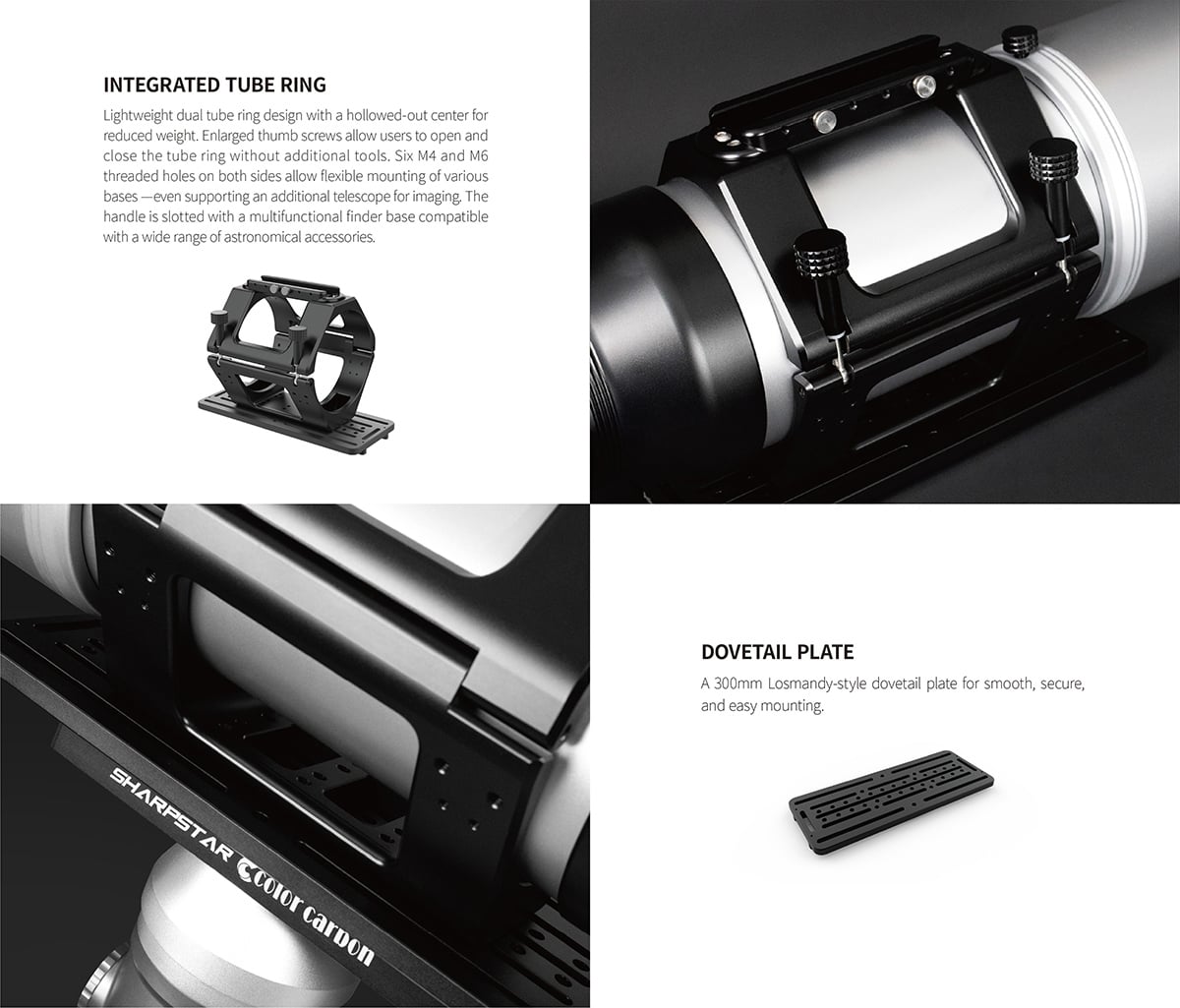
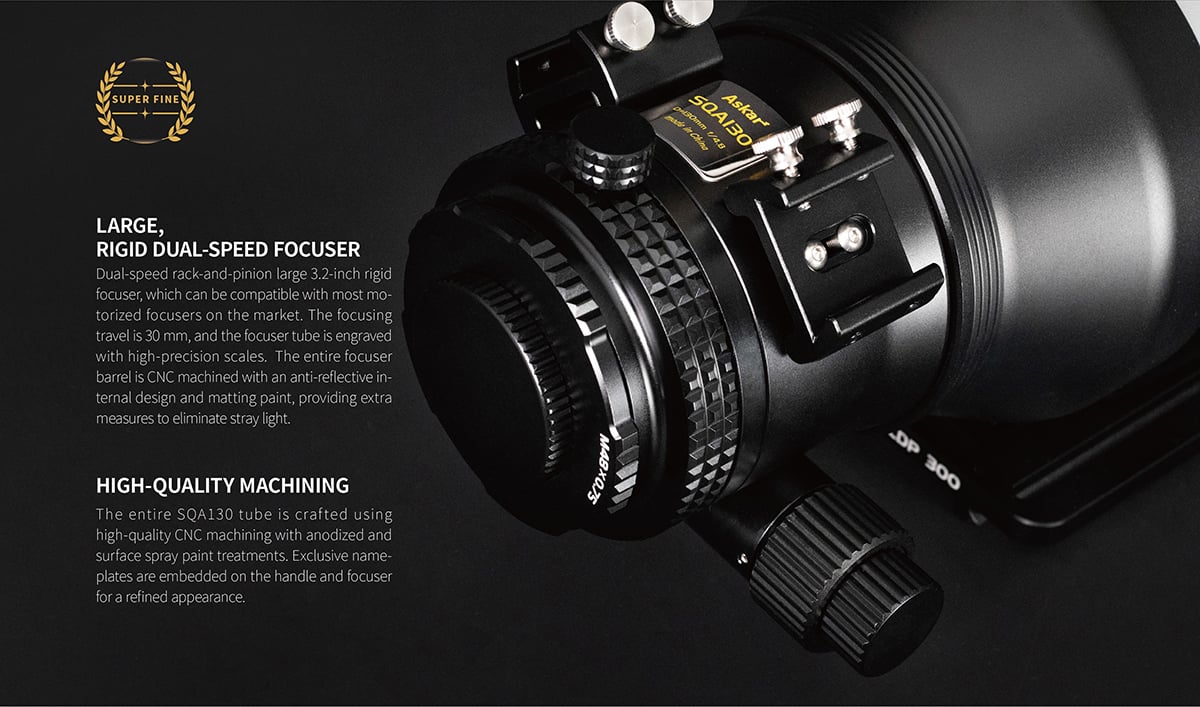
The SQA130 arrives with a solid mechanical build. Askar provides a strong set of tube rings and a 300mm Losmandy-style dovetail plate. These components help create a firm connection with the mount. The focuser offers dual-speed control and supports rotation. A rotating focuser helps when framing targets or adjusting camera angle. It also makes the imaging workflow smoother, especially during long nights when small adjustments matter.
The dew shield extends smoothly and locks in place. It helps protect the front element and reduces stray light from nearby sources. The rear of the telescope includes an internal 2-inch filter thread. Many users appreciate this because it keeps the imaging train compact. You do not need to add a separate filter drawer unless your setup requires quick swaps.
The SQA130 includes multiple thread adapters. M48, M54, and M68 connections cover the most common imaging setups. These adapters simplify the transition between cameras, filter wheels, and off-axis guiders. As long as your accessories follow standard dimensions, you can build a stable train without unusual hardware.
Weight is one area where users need awareness. The OTA alone weighs around 9.18 kg. With rings and the dovetail, the total mass increases to about 11.76 kg. Once you add a camera, filters, and a guide system, the final weight can cross 14–15 kg easily. This means the SQA130 needs a capable mount. Lightweight travel mounts will not perform well here. A mid-range or high-end equatorial mount with a healthy payload margin is a better match. Tracking stability directly influences star shape, so it makes sense to pair the telescope with equipment that can carry it without strain.
Imaging performance
The SQA130’s performance centers on its flat field and wide corrected circle. Askar designs the telescope to maintain star shapes across the frame. The combination of SD glass and a fixed Petzval rear group helps keep chromatic aberration under control. This is particularly important when using high-resolution sensors that reveal small optical flaws. Modern full-frame and medium-format systems demand tight correction, and the SQA130 aims to provide it.
The telescope supports a range from 46 mm to 76 mm back-focus. Askar recommends around 55 mm for optimal performance. You must ensure that your camera and accessories fit this distance precisely. If you build the train too short or too long, the correction will not behave as intended. Most experienced astrophotographers already track this closely, but the SQA130 makes it especially important because its optical group is fixed. When the correction is internal, the back-focus distance becomes the final piece of the system that locks the image quality into place.
The telescope also handles bright stars well. The SD elements help reduce color fringing and halos around high-intensity points. This makes the SQA130 suitable for targets that include bright stars within or near the field. Clean star profiles improve the aesthetic and scientific value of the frame.
Key specifications
Here are some of the key specifications of Askar SQA130:
| Aperture size | 130mm |
| Focal length | 624mm |
| Focal ratio | f/4.8 |
| Objective lens | Quintuplet petzval APO |
| Total length | 650mm(when the dew shield is contracted) 764mm(when the dew shield is stretched) |
| OTA weight | 9.18kg |
| Gross weight | 11.76kg |
Price and availability
The Askar SQA130 is priced at $4,799. It is available for pre-order via online retailers.
The Askar SQA130 presents itself as a high-end astrophotography tool. Its quintuplet Petzval design, dual SD elements, large aperture, and fast f/4.8 speed give it a clear identity. It targets serious imaging work, not casual stargazing. When paired with a capable mount and a stable imaging train, it delivers results that match modern camera sensors and demanding workflows.
Clear skies!
See more from DIYPhotography.net on Google
Add DIYPhotography.net as a trusted source. This makes
our stories more likely to appear in your Google Search results.
 Add as a preferred source on Google

Soumyadeep Mukherjee
Soumyadeep Mukherjee is an award-winning astrophotographer from India. He has a doctorate degree in Linguistics. His work extends to the sub-genres of nightscape, deep sky, solar, lunar and optical phenomenon photography. He is also a photography educator and has conducted numerous workshops. His works have appeared in over 40 books & magazines including Astronomy, BBC Sky at Night, Sky & Telescope among others, and in various websites including National Geographic, NASA, Forbes. He was the first Indian to win “Astronomy Photographer of the Year” award in a major category.


Join the Discussion
DIYP Comment Policy
Be nice, be on-topic, no personal information or flames.