























James Webb Captures an Irregular Galaxy: Gets Photobombed by a Star
Aug 27, 2026
Soumyadeep Mukherjee
Soumyadeep Mukherjee is an award-winning astrophotographer from India. He has a doctorate degree in Linguistics. His work extends to the sub-genres of nightscape, deep sky, solar, lunar and optical phenomenon photography. He is also a photography educator and has conducted numerous workshops. His works have appeared in over 40 books & magazines including Astronomy, BBC Sky at Night, Sky & Telescope among others, and in various websites including National Geographic, NASA, Forbes. He was the first Indian to win “Astronomy Photographer of the Year” award in a major category.
Share:
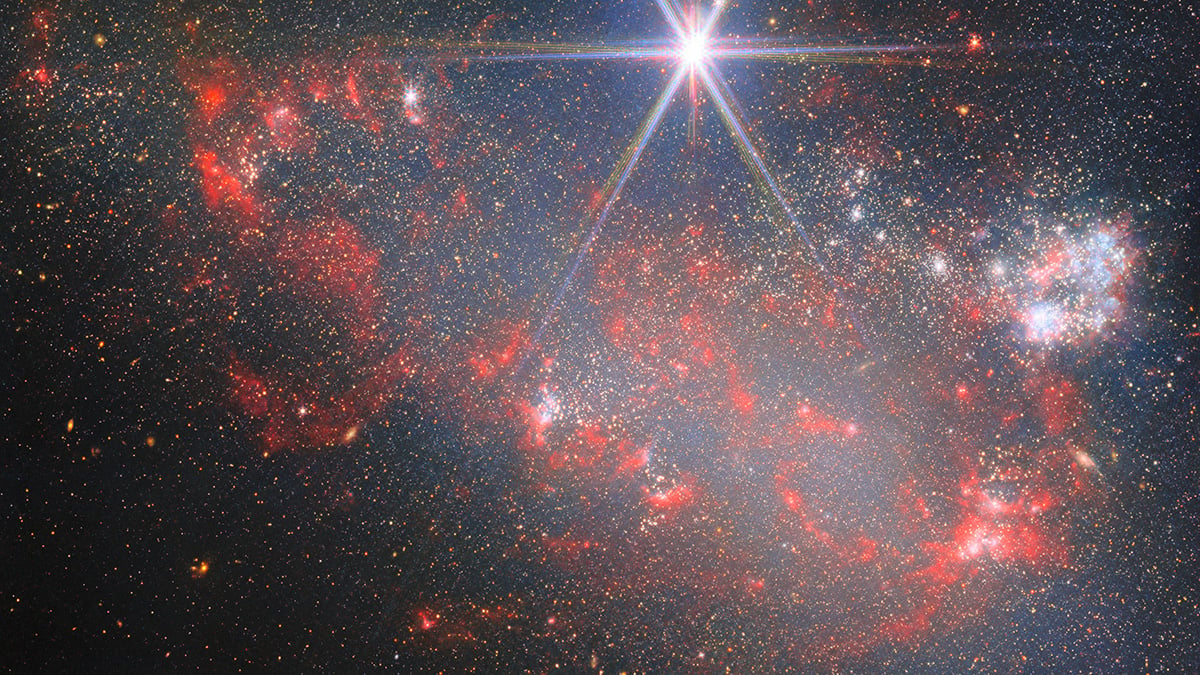
Galaxy mergers can leave behind structures that survive long after the original encounter has ended. Arp 263 is one example. Located about 25 million light-years away in the constellation Leo, this irregular galaxy has a disturbed stellar distribution, unsettled hydrogen gas, and widespread star formation.
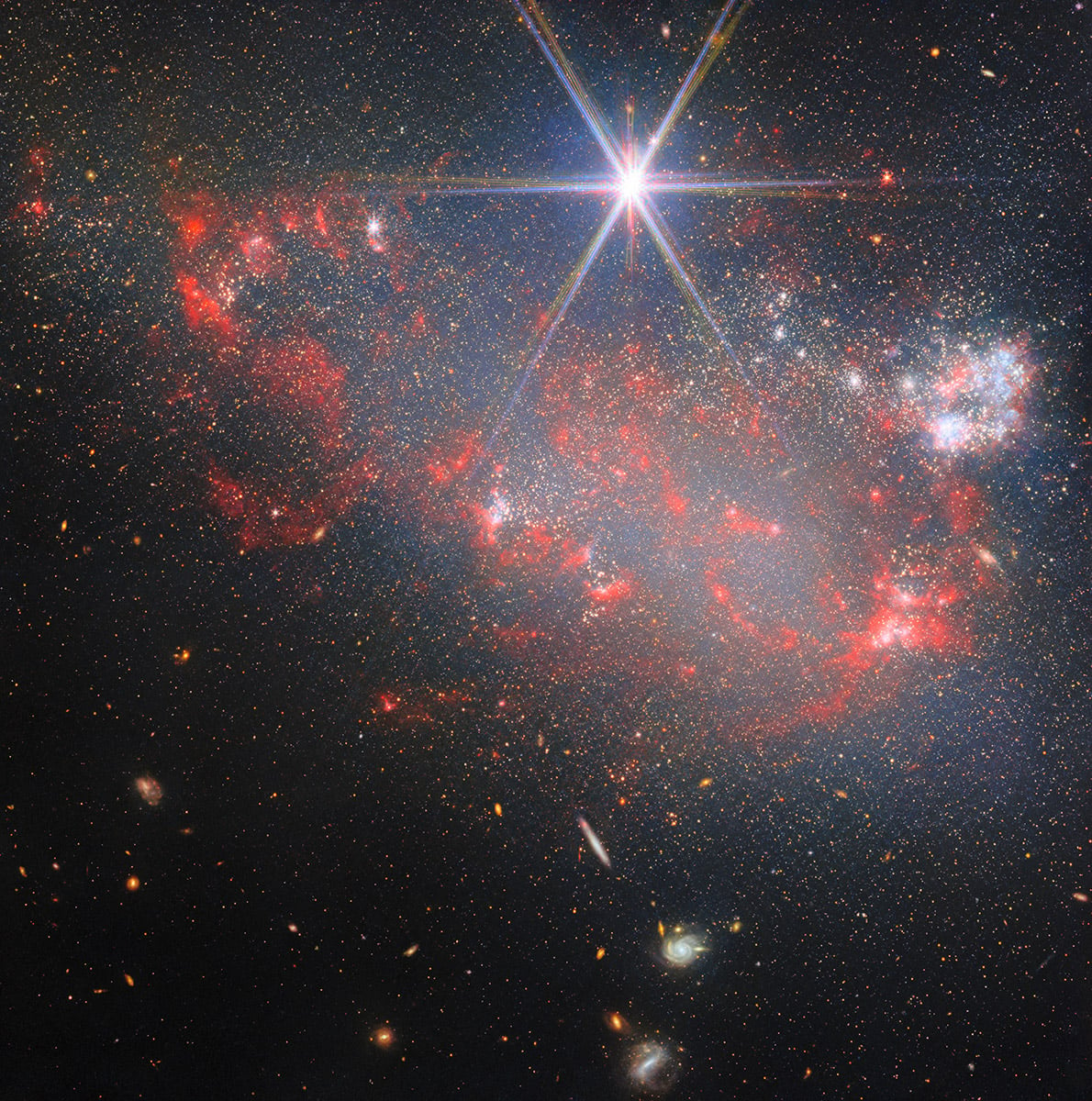
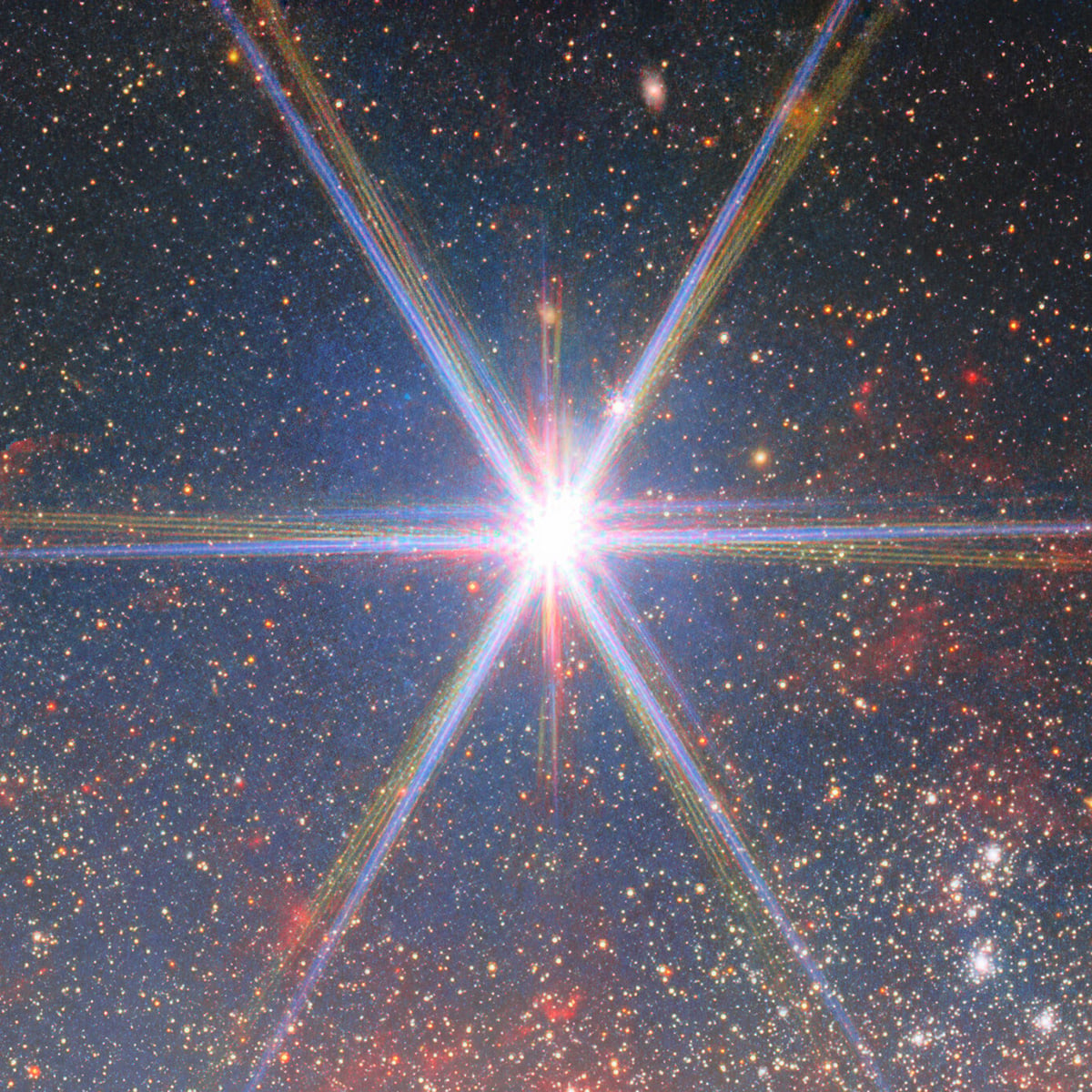
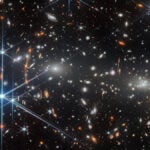
A new image from the James Webb Space Telescope offers a detailed look at what remains. Webb used its Near-Infrared Camera (NIRCam) to observe Arp 263 through four infrared filters. The resulting image separates old stars from young star clusters and shows glowing hydrogen around active regions of star formation. The image also reveals dust containing complex molecules across the galaxy.
Arp 263: Scars of an old collision
Arp 263 does not possess the organized shape of a typical spiral galaxy. Its stars form an irregular distribution with bright concentrations scattered across the system. That unusual structure first drew attention long before JWST or Hubble observed it. William Herschel discovered the galaxy in 1784, and astronomers later catalogued it as NGC 3239.
The evidence for a past merger comes from several parts of the galaxy. Two short, curved stellar tails extend beyond JWST’s field of view. Such structures can develop when gravitational forces pull stars out of their original orbits during an encounter between galaxies.
The gas provides another clue. The stars and hydrogen gas in Arp 263 do not share the same orientation. Astronomers also find regions where the hydrogen gas moves at different velocities. Those differences suggest that the galaxy’s gas has not reached a stable configuration.
The widespread star formation also fits the picture. A galaxy merger can disturb a large reservoir of gas and change its density and motion. Some regions can become compressed enough to collapse and form new stars. Arp 263 contains many such regions.
James Webb looks into the dusty regions of Arp 263
The new Webb image adds information that wasn’t possible to obtain from visible light images. NIRCam detects near-infrared radiation, allowing it to observe stars and structures behind some of the dust that obscures them at shorter wavelengths.
For this observation, astronomers combined four NIRCam bands centered at 1.5, 1.87, 3.0, and 3.35 micrometers. The 1.87-micrometer band traces Paschen-alpha emission from hydrogen. The 3.0-micrometre band probes emission associated with water ice, while the 3.35-micrometre band traces polycyclic aromatic hydrocarbons, or PAHs, which are complex carbon-based molecules found in interstellar dust.
The colors in the finished image translate those different infrared signals into a visible representation. Dust appears in red, reflecting emission from complex molecules within the material. Ionised hydrogen around active star-forming regions appears blue.
Hubble and Webb show two different sides of the galaxy
Arp 263 had already attracted attention from the Hubble Space Telescope. NASA and ESA released a Hubble image in July 2023 after combining observations from two separate investigations.
One programme used Hubble’s Wide Field Camera 3 to examine the site of supernova SN 2012A, which exploded in Arp 263 more than a decade earlier. A second investigation used Hubble’s Advanced Camera for Surveys to image previously unobserved galaxies from Halton Arp’s catalogue.
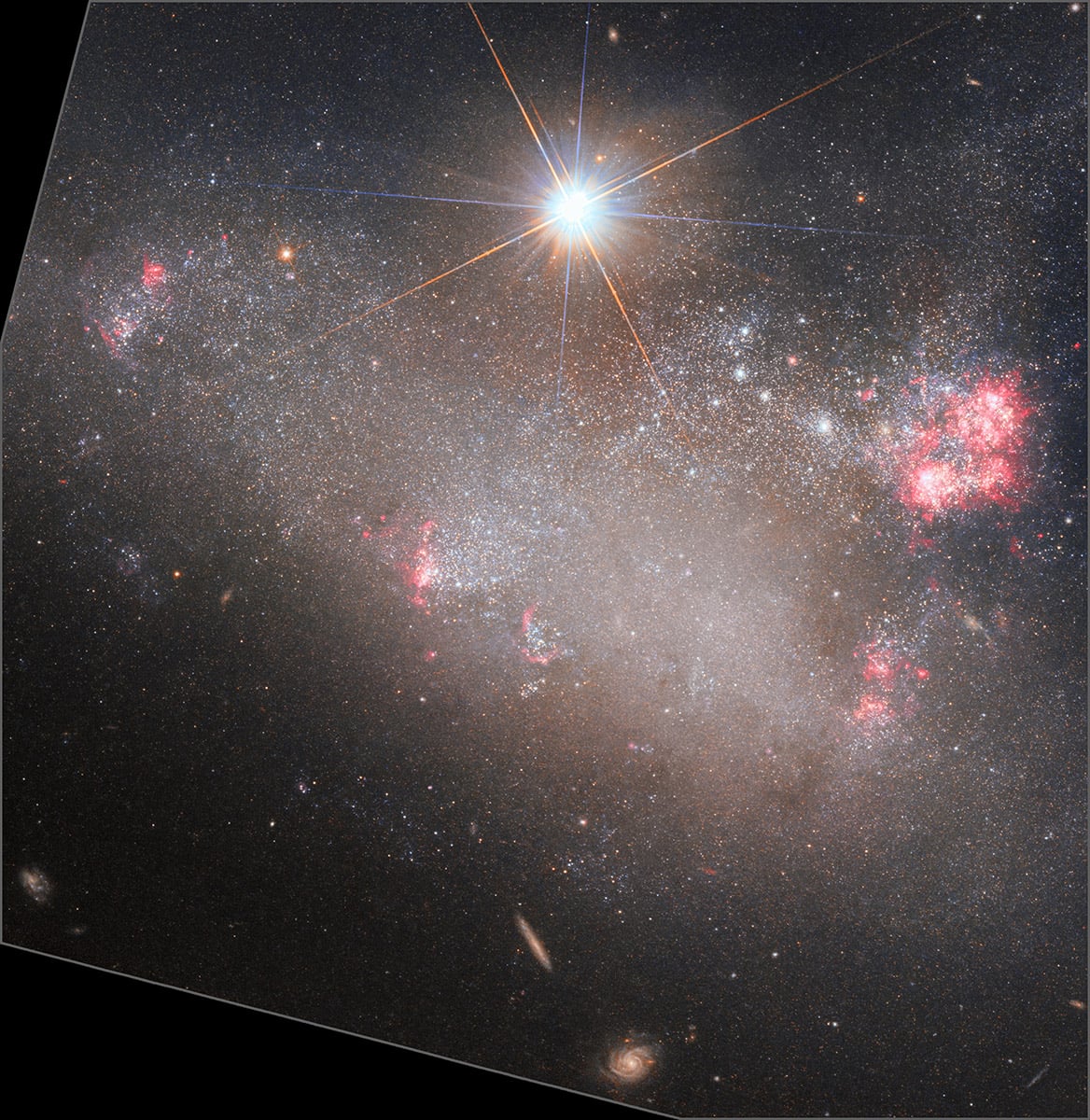
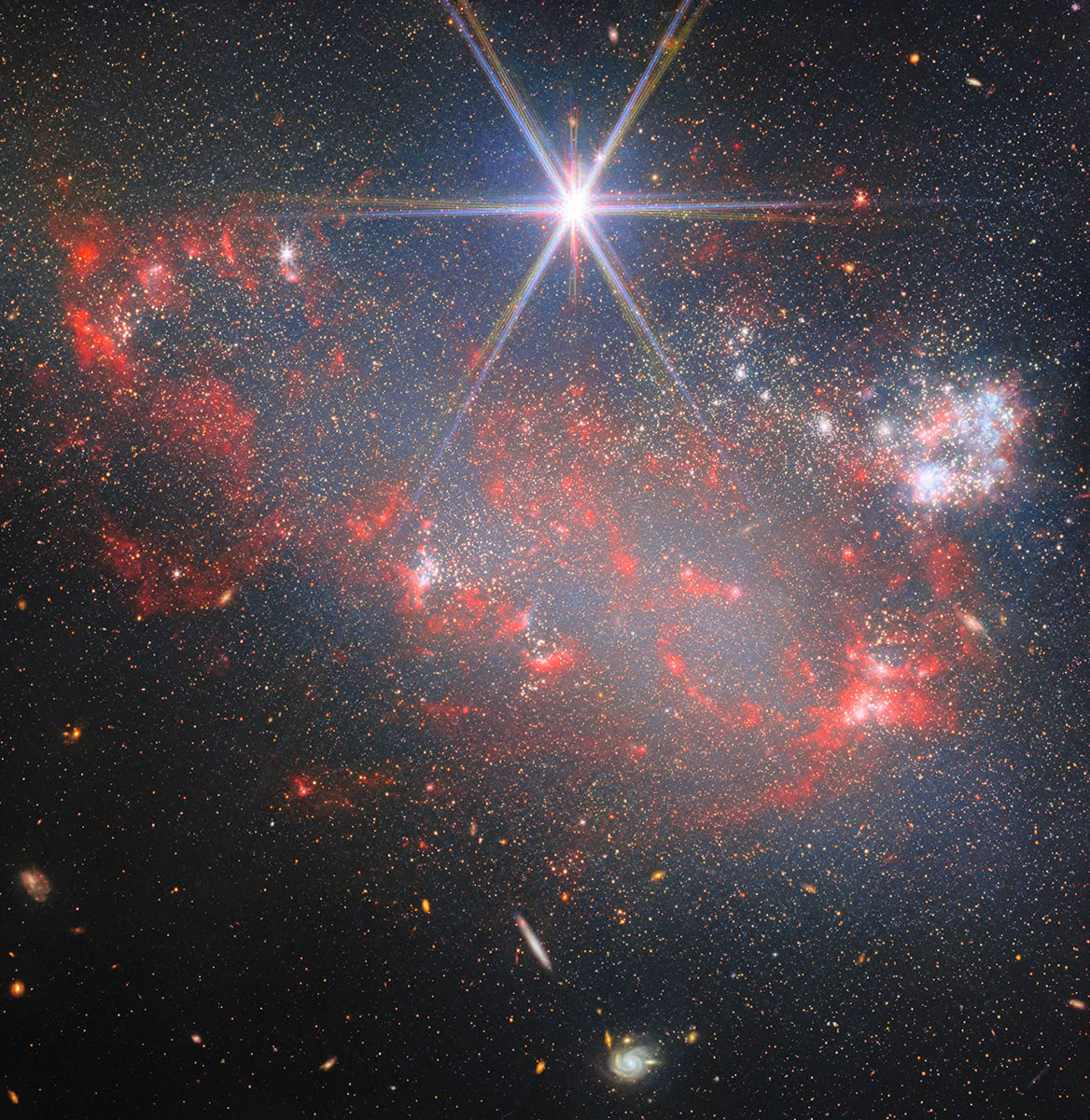
Hubble’s visible-light image shows Arp 263 as a patchy, irregular system. Several bright pink regions mark areas where stars are forming. The galaxy appears much less structured than a conventional spiral galaxy.
Webb sees the same system differently. Its infrared observations penetrate deeper into dusty parts of the galaxy and reveal stars and clusters that are harder to distinguish in the optical image.
ESA has released versions of the Hubble and Webb observations that can be compared.
There is a bright star in the image
One of the most obvious objects in the James Webb image is not part of Arp 263 at all. The bright star BD+17 2217 lies in the Milky Way and happens to sit in front of the distant galaxy from our viewpoint.
Its apparent brightness comes from its much smaller distance. The star’s light also produces long diffraction spikes. These spikes result from the way light interacts with the telescope’s optical structure and are a normal feature of JWST images.
Clear skies!
See more from DIYPhotography.net on Google
Add DIYPhotography.net as a trusted source. This makes
our stories more likely to appear in your Google Search results.
 Add as a preferred source on Google

Soumyadeep Mukherjee
Soumyadeep Mukherjee is an award-winning astrophotographer from India. He has a doctorate degree in Linguistics. His work extends to the sub-genres of nightscape, deep sky, solar, lunar and optical phenomenon photography. He is also a photography educator and has conducted numerous workshops. His works have appeared in over 40 books & magazines including Astronomy, BBC Sky at Night, Sky & Telescope among others, and in various websites including National Geographic, NASA, Forbes. He was the first Indian to win “Astronomy Photographer of the Year” award in a major category.

Join the Discussion
DIYP Comment Policy
Be nice, be on-topic, no personal information or flames.