


























Very Large Telescope Captures the Clearest Image Ever of Betelgeuse’s Companion
Jul 28, 2026
Soumyadeep Mukherjee
Soumyadeep Mukherjee is an award-winning astrophotographer from India. He has a doctorate degree in Linguistics. His work extends to the sub-genres of nightscape, deep sky, solar, lunar and optical phenomenon photography. He is also a photography educator and has conducted numerous workshops. His works have appeared in over 40 books & magazines including Astronomy, BBC Sky at Night, Sky & Telescope among others, and in various websites including National Geographic, NASA, Forbes. He was the first Indian to win “Astronomy Photographer of the Year” award in a major category.
Share:
For more than a century, Betelgeuse has occupied a unique place in stellar astronomy. As one of the nearest red supergiants to Earth, it offers an exceptional opportunity to study the final evolutionary stages of massive stars. Despite decades of increasingly sophisticated observations, one question remained unresolved. Was Betelgeuse truly a solitary star, or was an unseen companion quietly shaping its behavior?
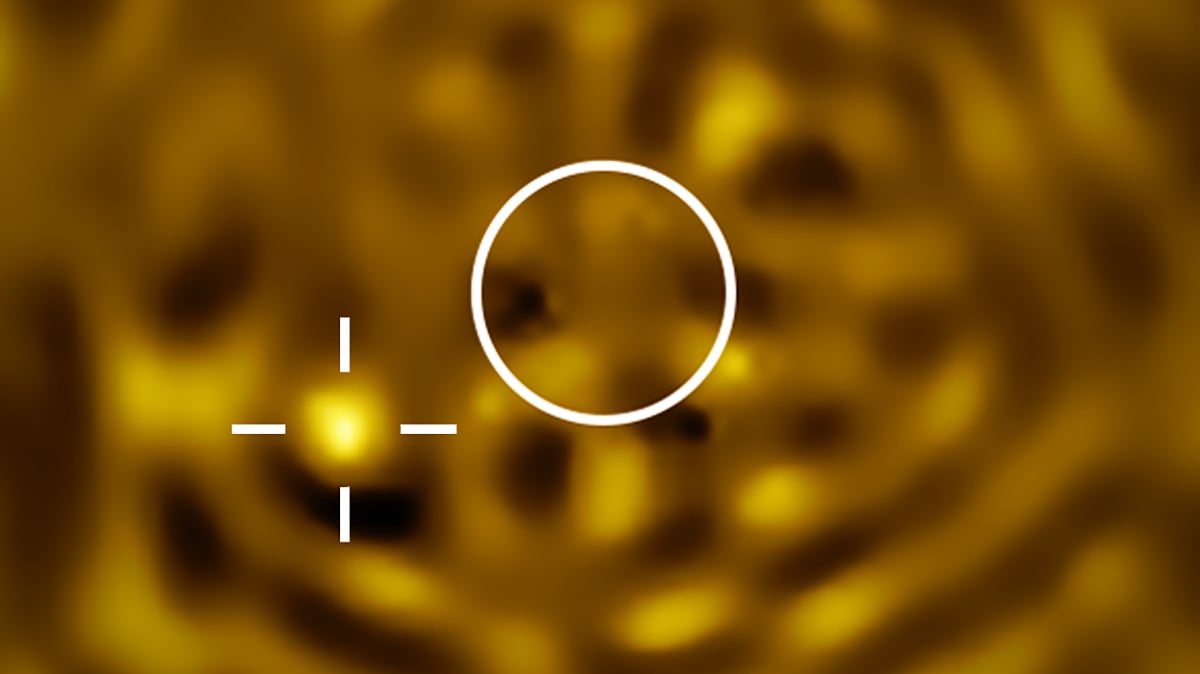
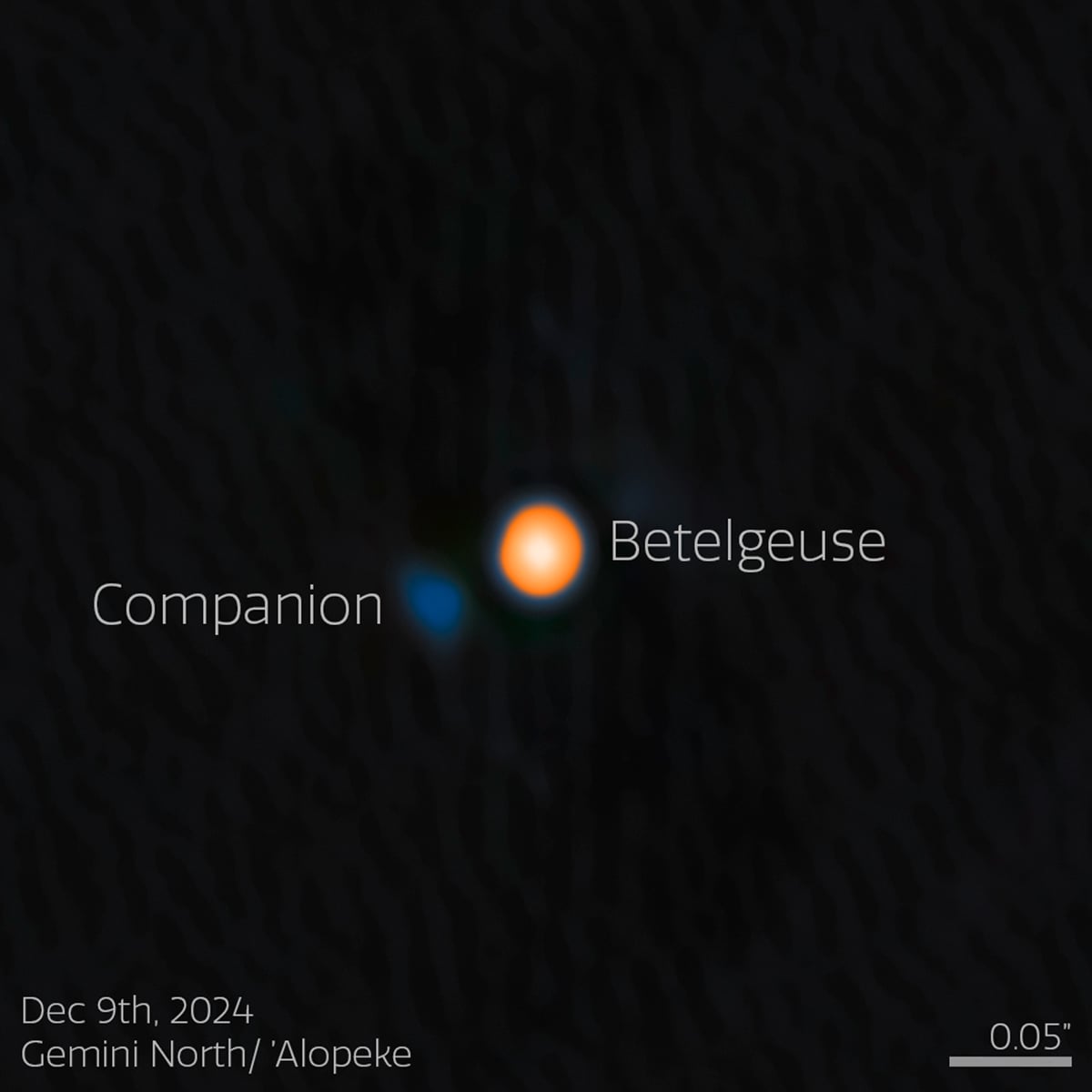
That question has lingered since the early twentieth century, when astronomers first noticed that Betelgeuse’s brightness varied in ways that stellar pulsations alone could not explain. After the findings of Gemini North in 2025, astronomers using the European Southern Observatory’s (ESO) Very Large Telescope (VLT) in Chile have uncovered the strongest evidence yet that the companion is real. Their observations reveal a faint star precisely where decades of orbital models predicted it should appear.
A century-old puzzle
Located roughly 550 to 650 light-years from Earth in the constellation Orion, the red supergiant has exhausted the hydrogen fuel at its core and expanded to extraordinary proportions. If it replaced the Sun at the center of our Solar System, its atmosphere would extend well beyond the orbit of Mars. Despite its immense size, Betelgeuse is far from stable. The star constantly changes.

Astronomers have monitored the changes for well over a hundred years. Early observations revealed that Betelgeuse brightens and fades on a cycle lasting about 400 days. That variation is well understood. Like many evolved giant stars, Betelgeuse pulsates. Its outer layers slowly expand and contract, causing predictable changes in brightness.
Alongside the 400-day rhythm, observers repeatedly measured another variation lasting about 2,100 days, or almost six years. The pattern appeared too regular to dismiss as random activity, yet it did not match any known pulsation model. The discrepancy became one of the biggest unanswered questions surrounding the famous star.
Finding a star hidden inside another star’s glare
Betelgeuse dominates everything around it. Its photosphere alone is enormous, while its extended atmosphere stretches even farther into space. Any nearby object must compete with the overwhelming light pouring from the giant star. Conventional imaging techniques simply could not separate the two.
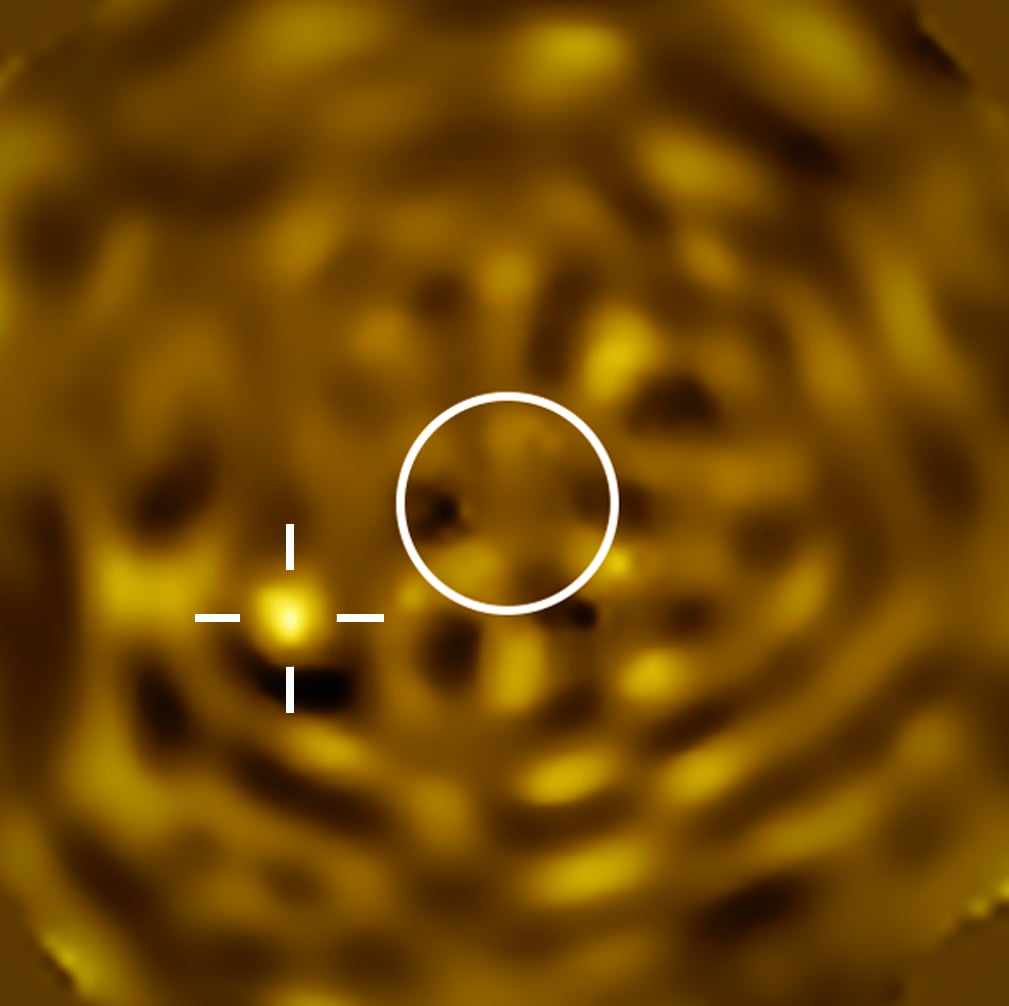
The research team turned to the SPHERE instrument on ESO‘s Very Large Telescope, one of the most sophisticated high-contrast imaging systems ever built. SPHERE combines extreme adaptive optics with coronagraphic techniques that suppress the glare of bright stars. The instrument continually corrects for atmospheric turbulence, allowing astronomers to recover details that would otherwise disappear beneath Earth’s constantly shifting air.
Years of theoretical work had produced increasingly refined orbital models for the suspected companion. Those calculations predicted where the object should appear and, more importantly, when it would be far enough from Betelgeuse to have the best chance of detection. Current estimates suggest the companion is a hot blue-white main-sequence star with a mass around one and a half times that of the Sun. It completes one orbit roughly every six years, closely matching the mysterious brightness cycle recorded for decades.
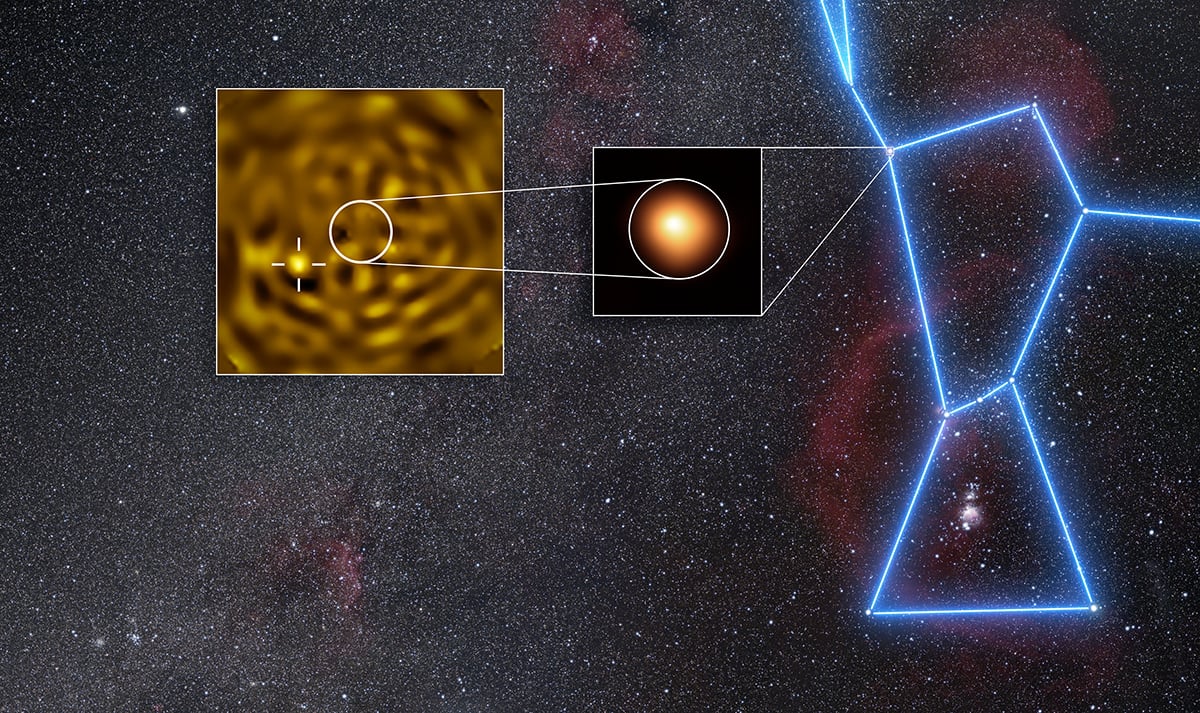
Solving the mystery of Betelgeuse’s six-year rhythm
The newly detected companion provides the missing piece that astronomers had searched for over many decades. The familiar 400-day brightness cycle still reflects the star’s natural pulsations. That explanation remains unchanged. The longer six-year variation now appears to have a far more straightforward origin.
As the companion travels around Betelgeuse, its gravity likely disturbs the giant’s extended atmosphere. These interactions may alter the distribution of gas and dust surrounding the star. They may also influence how material escapes into interstellar space. Together, those changes produce subtle variations in the amount of light reaching Earth.
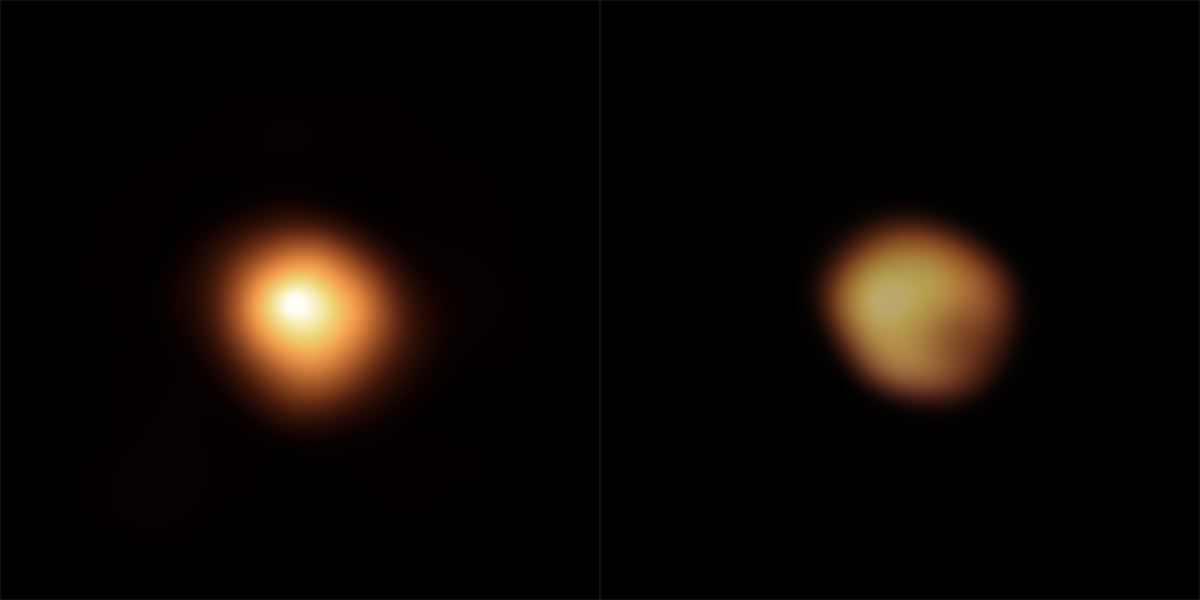
The observations also strengthen earlier measurements that hinted Betelgeuse was wobbling very slightly under the gravitational influence of another object. When Betelgeuse dramatically faded during 2019 and 2020, many wondered whether the star was about to explode as a supernova. Follow-up observations eventually showed that a massive cloud of dust, produced after a powerful surface eruption, temporarily obscured part of the star from Earth‘s view. The newly discovered companion may influence Betelgeuse over long periods, but the dramatic fading event remains best explained by dust created by the star itself.
Clear skies!
See more from DIYPhotography.net on Google
Add DIYPhotography.net as a trusted source. This makes
our stories more likely to appear in your Google Search results.
 Add as a preferred source on Google

Soumyadeep Mukherjee
Soumyadeep Mukherjee is an award-winning astrophotographer from India. He has a doctorate degree in Linguistics. His work extends to the sub-genres of nightscape, deep sky, solar, lunar and optical phenomenon photography. He is also a photography educator and has conducted numerous workshops. His works have appeared in over 40 books & magazines including Astronomy, BBC Sky at Night, Sky & Telescope among others, and in various websites including National Geographic, NASA, Forbes. He was the first Indian to win “Astronomy Photographer of the Year” award in a major category.



Join the Discussion
DIYP Comment Policy
Be nice, be on-topic, no personal information or flames.