























Join the Dots: Photographer Captures VLT’s Outline in the Sky
May 25, 2026
Soumyadeep Mukherjee
Soumyadeep Mukherjee is an award-winning astrophotographer from India. He has a doctorate degree in Linguistics. His work extends to the sub-genres of nightscape, deep sky, solar, lunar and optical phenomenon photography. He is also a photography educator and has conducted numerous workshops. His works have appeared in over 40 books & magazines including Astronomy, BBC Sky at Night, Sky & Telescope among others, and in various websites including National Geographic, NASA, Forbes. He was the first Indian to win “Astronomy Photographer of the Year” award in a major category.
Share:
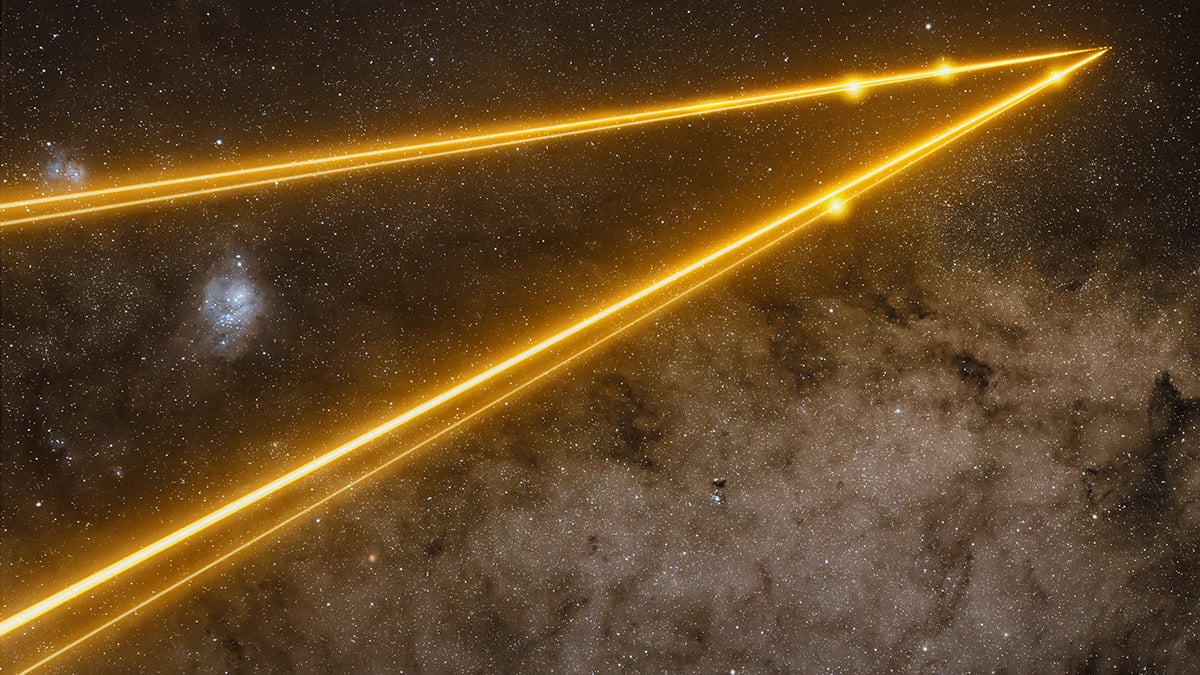
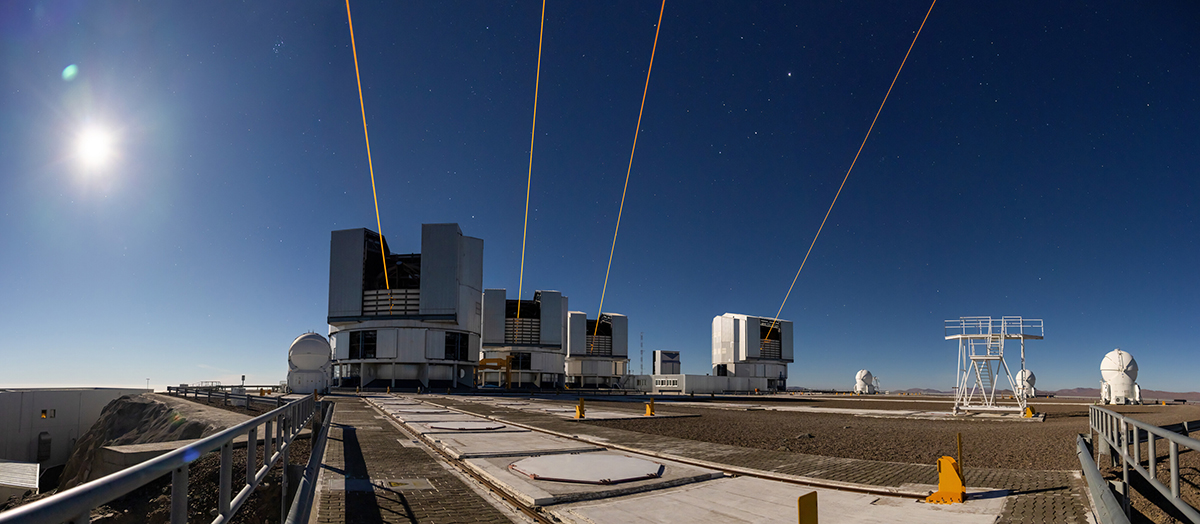
At the European Southern Observatory‘s Paranal Observatory in northern Chile, adaptive optics has become an essential part of daily operations. ESO has equipped all four Unit Telescopes of the Very Large Telescope Interferometer, or VLTI, with laser guide star systems as part of the GRAVITY+ upgrade programme. A recent image by photographer Anthony Berdeu has captured a captivating image of the laser beams creating a layout of the observatory in the sky.
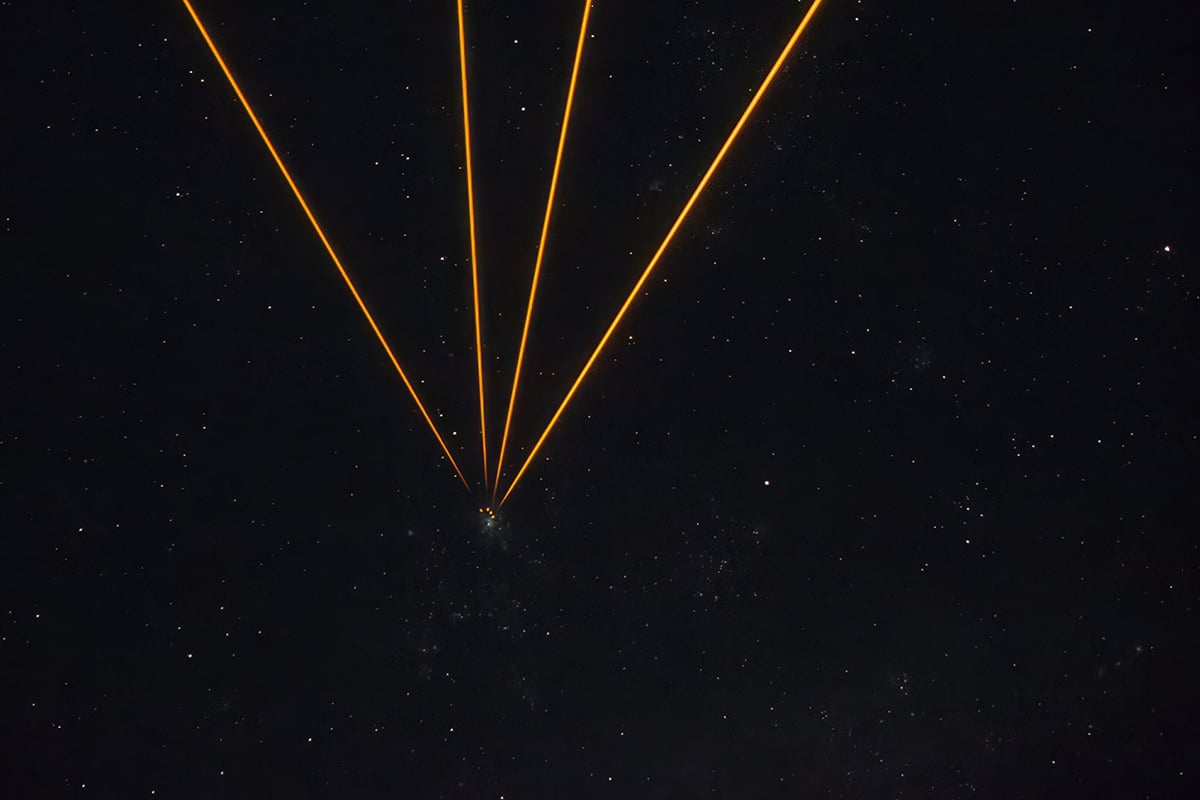
The image, titled Join the Dots, captured four laser beams projected from the Unit Telescopes of the Very Large Telescope. Along each beam appeared a bright, glowing point suspended in the sky. These luminous spots looked almost like artificial stars arranged in a geometric pattern above the observatory. However, the effect was not planned. A thin cloud layer drifted through the laser paths and scattered part of the light toward the camera.
A passing cloud became part of the experiment
Astronomers usually hope for cloud-free skies. Thin clouds reduce transparency and often interfere with observations. In this case, however, a small amount of cloud cover created an unexpected opportunity. As the four laser beams travelled upward through the atmosphere, they encountered a thin layer of clouds positioned well above the observatory. Tiny water droplets within the cloud scattered a fraction of the laser light in different directions. Some of that scattered light reached the camera and produced four bright points along the beams.
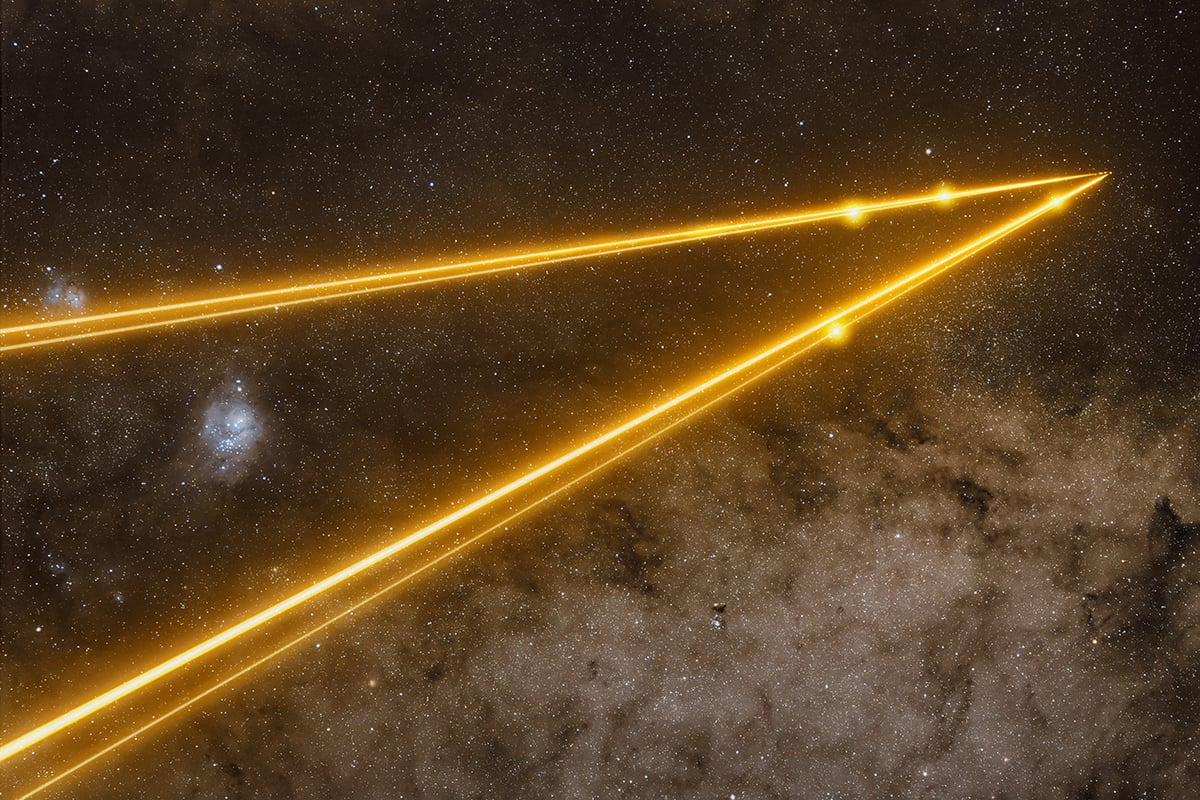
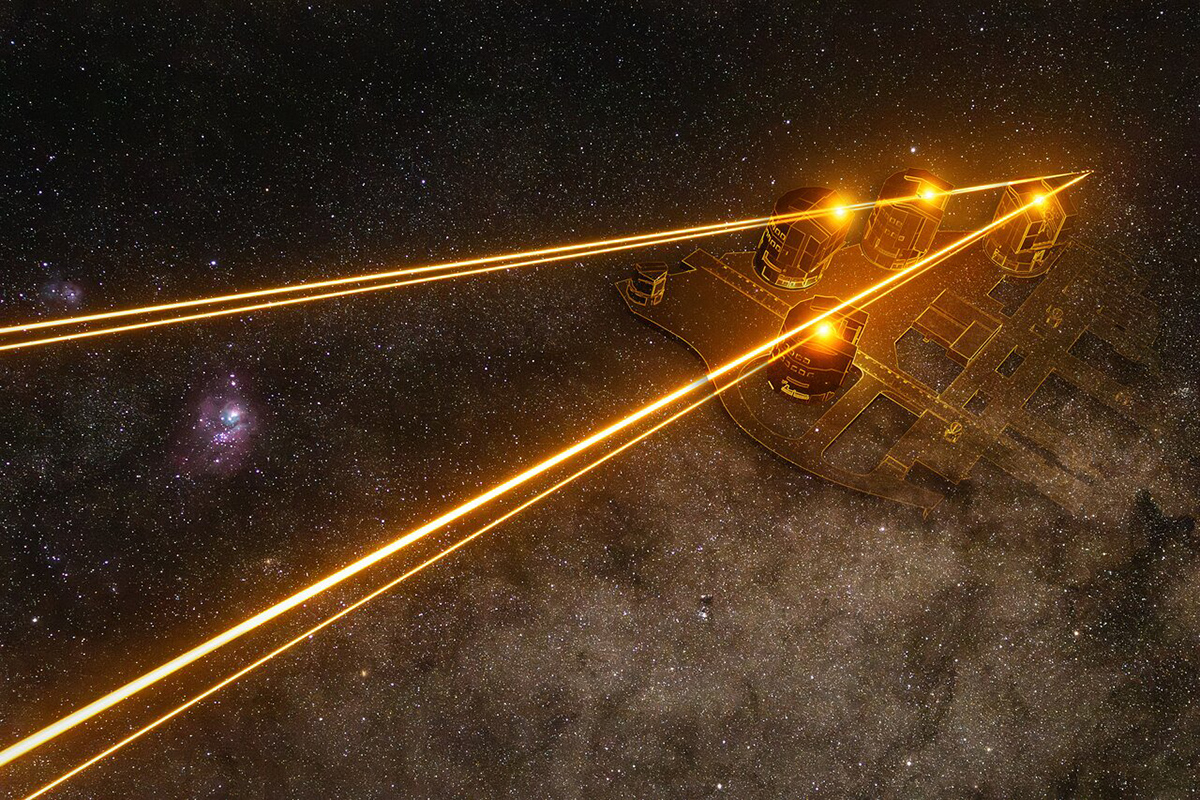
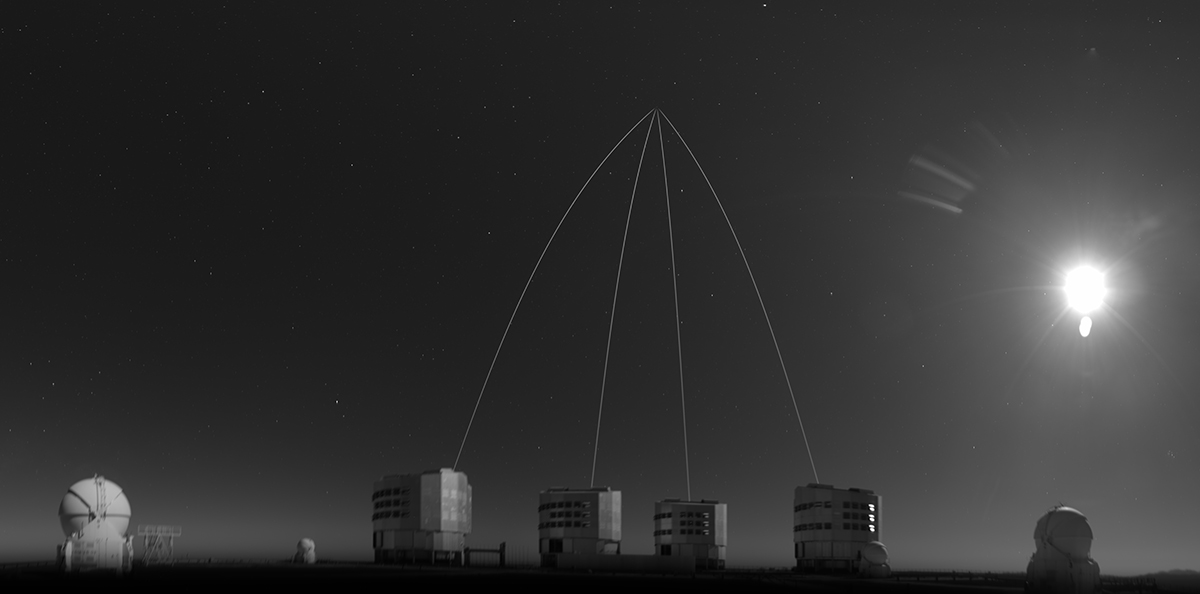
The positions of the glowing spots mirror the arrangement of the four 8.2-metre Unit Telescopes on the ground. In other words, the cloud layer projected the telescope layout into the sky. Anyone viewing the image can immediately recognise that the four lasers originate from separate telescopes operating simultaneously.
Normally, the geometry of an observatory remains hidden from view. Visitors see telescope enclosures scattered across the summit, while the optical systems connecting them remain concealed within infrastructure. With the image, however, for a brief moment, the relationship between the telescopes became visible against the night sky.
Why ESO fires lasers into the night sky
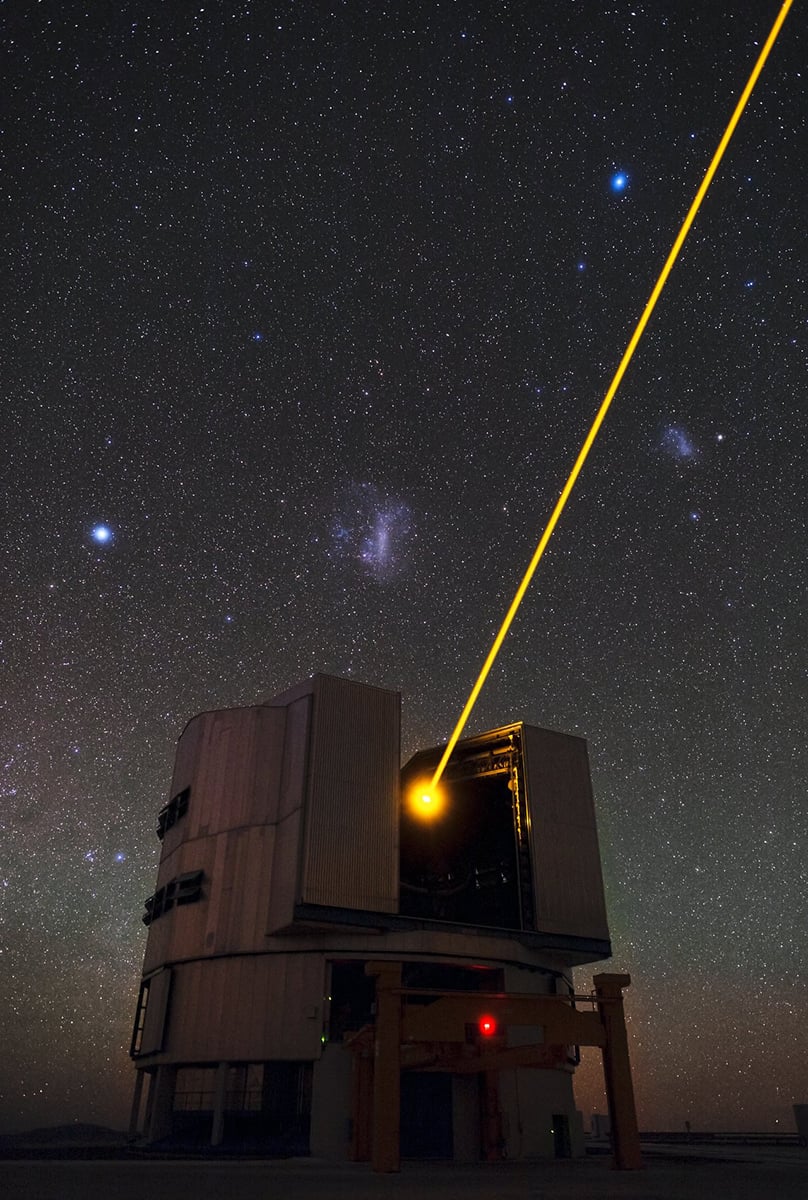
Each laser operates at a wavelength chosen to excite sodium atoms. When the atoms absorb this energy, they re-emit light and create an artificial star. These artificial stars appear at known locations and serve as reference points for adaptive optics systems.
The need for such reference stars arises from a fundamental challenge in observational astronomy. Atmospheric turbulence continuously bends and distorts incoming starlight. Even at exceptional observing sites such as Paranal, the atmosphere introduces blurring that limits image sharpness. Large telescope mirrors alone cannot solve this problem.
Adaptive optics systems measure these distortions and compensate for them in real time. Wavefront sensors analyse the appearance of the guide star and determine how atmospheric turbulence has altered the light. Control computers, then calculate corrective adjustments and send commands to deformable mirrors. As a result, the system removes much of the atmospheric distortion before the light reaches the scientific instrument.
The Very Large Telescope Interferometer: Combining four giants
The four lasers shown in the image support an extraordinary facility at Paranal: the Very Large Telescope Interferometer. The VLTI differs from a conventional telescope. Rather than relying on a single mirror, it combines light collected by multiple telescopes and processes that light as a single system. This technique, known as optical interferometry, allows astronomers to achieve much higher angular resolution than any individual telescope could provide alone.
Light arriving from a distant star reaches each telescope at slightly different times because the telescopes occupy different locations. Engineers compensate for those differences before combining the beams. Even tiny mismatches can destroy the interference pattern needed for scientific measurements.
To solve this problem, the VLTI uses an intricate network of tunnels, mirrors, beam-combination systems, and optical delay lines. These delay lines adjust the path length of incoming light with astonishing accuracy. Once the beams are aligned, instruments can combine them and extract information that would otherwise remain inaccessible.
The effective resolution achieved through interferometry exceeds that of any single telescope at the observatory. Astronomers can examine structures surrounding young stars, investigate the surfaces of evolved stars, study planet-forming disks, and probe environments close to black holes.
Clear skies!
See more from DIYPhotography.net on Google
Add DIYPhotography.net as a trusted source. This makes
our stories more likely to appear in your Google Search results.
 Add as a preferred source on Google

Soumyadeep Mukherjee
Soumyadeep Mukherjee is an award-winning astrophotographer from India. He has a doctorate degree in Linguistics. His work extends to the sub-genres of nightscape, deep sky, solar, lunar and optical phenomenon photography. He is also a photography educator and has conducted numerous workshops. His works have appeared in over 40 books & magazines including Astronomy, BBC Sky at Night, Sky & Telescope among others, and in various websites including National Geographic, NASA, Forbes. He was the first Indian to win “Astronomy Photographer of the Year” award in a major category.



Join the Discussion
DIYP Comment Policy
Be nice, be on-topic, no personal information or flames.