























James Webb Exposes the Turbulent Core of M77 Galaxy in Infrared
May 7, 2026
Soumyadeep Mukherjee
Soumyadeep Mukherjee is an award-winning astrophotographer from India. He has a doctorate degree in Linguistics. His work extends to the sub-genres of nightscape, deep sky, solar, lunar and optical phenomenon photography. He is also a photography educator and has conducted numerous workshops. His works have appeared in over 40 books & magazines including Astronomy, BBC Sky at Night, Sky & Telescope among others, and in various websites including National Geographic, NASA, Forbes. He was the first Indian to win “Astronomy Photographer of the Year” award in a major category.
Share:
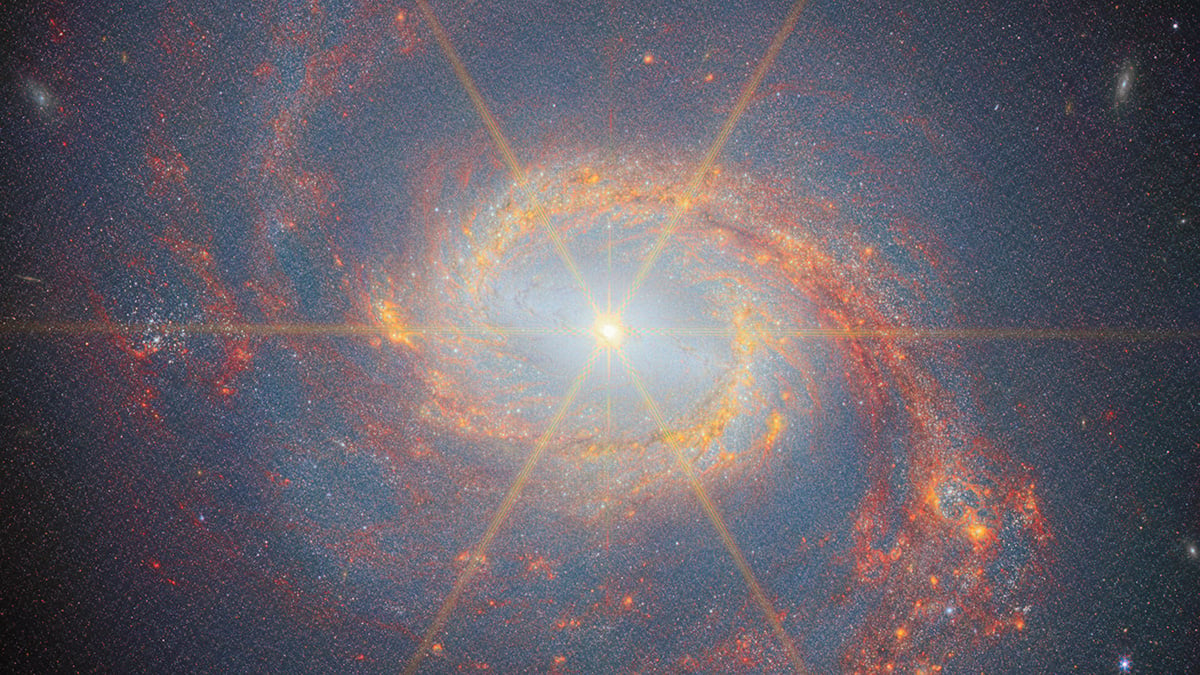
Astronomers have observed Messier 77 for more than two centuries, yet the galaxy continues to reveal new layers of complexity. The latest infrared observations from the James Webb Space Telescope provide one of the clearest views ever obtained of its active nucleus, dusty inner structure, and surrounding star-forming regions. Using JWST’s Near-Infrared Camera (NIRCam) and Mid-Infrared Instrument (MIRI), researchers captured a detailed portrait of the galaxy’s energetic core. They traced the distribution of warm dust across its spiral structure with remarkable precision.
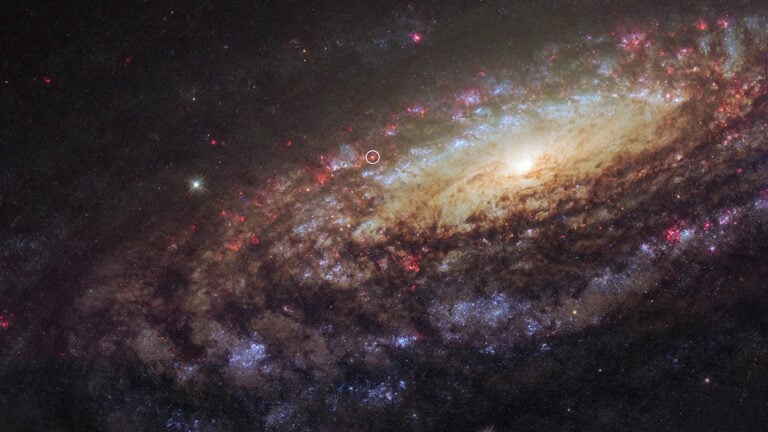
Messier 77, also known as NGC 1068, lies approximately 45 million light-years away in the constellation Cetus. Astronomers classify it as a Seyfert galaxy because of its luminous active galactic nucleus powered by a supermassive black hole. The galaxy has long served as one of the most important nearby laboratories for studying black hole activity and its interaction with galactic environments. Earlier observations from Hubble, radio observatories, and infrared missions already showed that M77 contains dense dust clouds, rapid star formation, and strong nuclear activity. JWST, however, pushes far deeper into the dusty central regions that visible-light telescopes struggle to penetrate.
The violent environment around the central black Hole
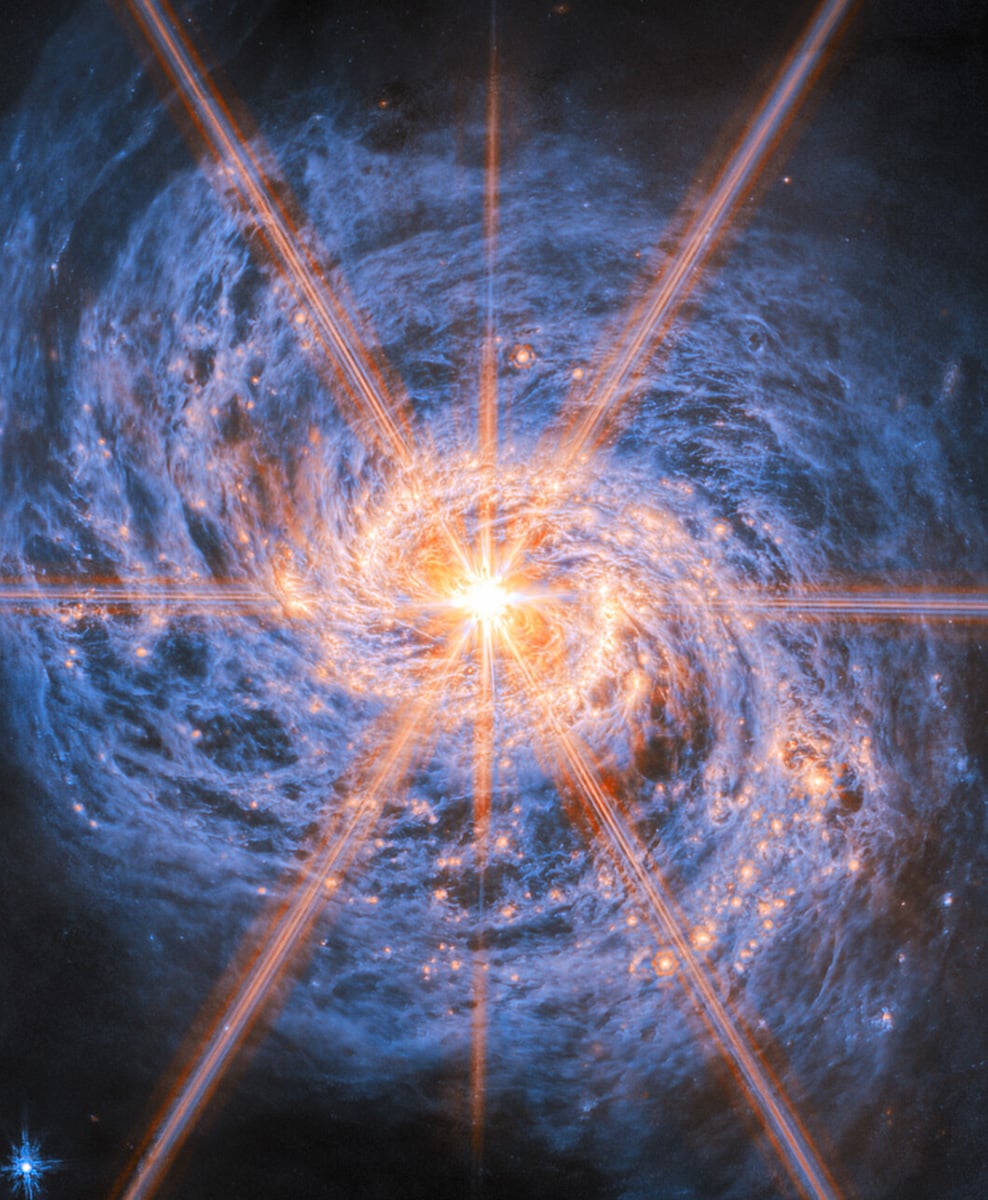
At the center of Messier 77 sits a supermassive black hole with a mass estimated at nearly eight million Suns. Unlike the relatively quiet black hole at the center of the Milky Way, the one inside M77 actively consumes surrounding gas and dust. As matter spirals inward, it forms a rapidly rotating accretion disk. Friction and gravitational forces heat this material to enormous temperatures, producing intense radiation across multiple wavelengths.
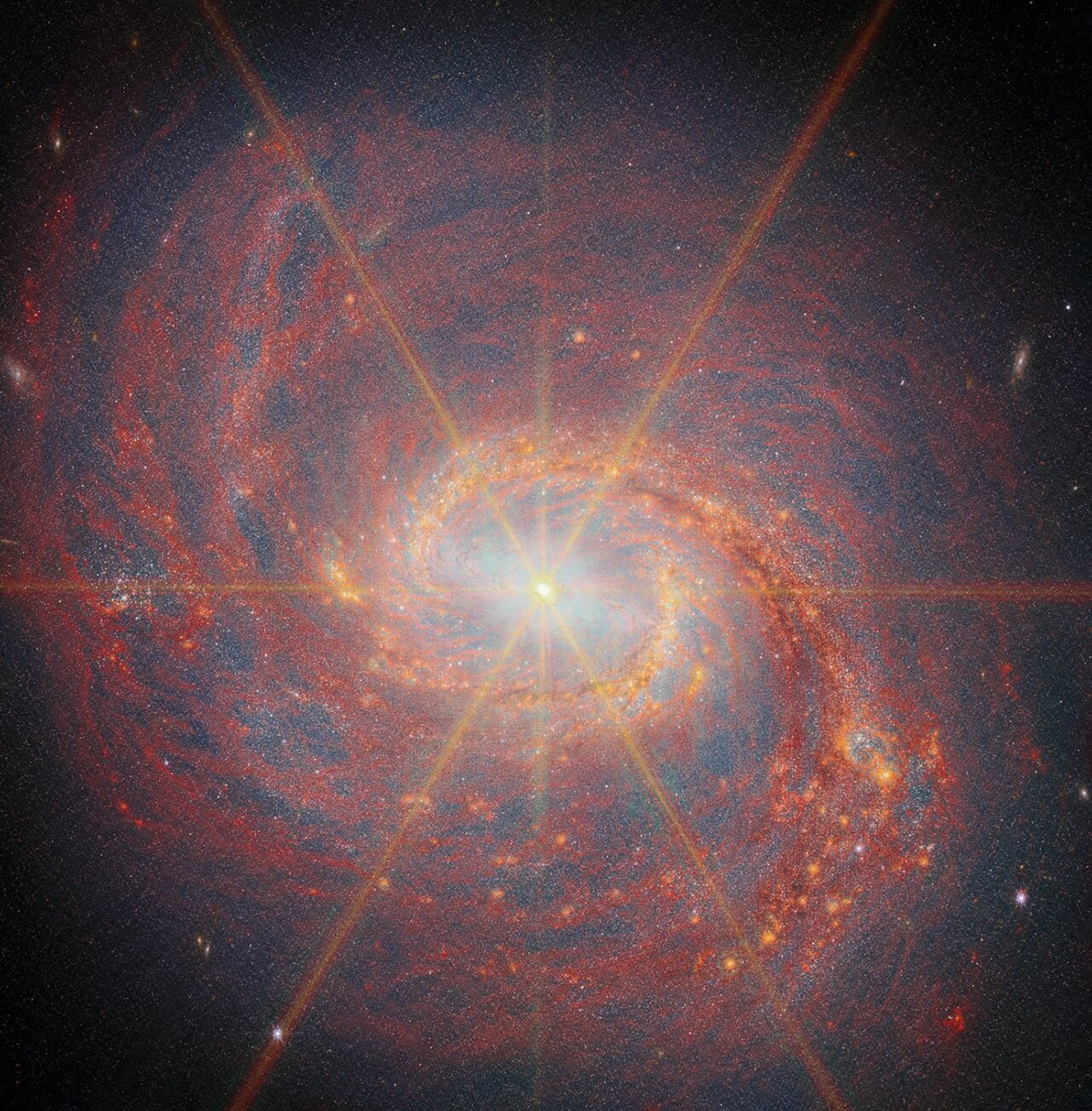
This active nucleus dominates the galaxy’s infrared emission. JWST’s observations show the central region glowing with exceptional brightness, while long diffraction spikes extend outward from the core. Those spikes originate from JWST’s mirror geometry and support structures rather than the galaxy itself. Similar patterns often appear when telescopes observe extremely compact and luminous sources.
The nucleus of M77 has attracted scientific attention for decades because it provides a nearby example of how active galactic nuclei behave. Seyfert galaxies, such as M77, emit large amounts of radiation from their cores while retaining the recognizable structure of spiral galaxies. This combination makes them particularly valuable for studying the relationship between black holes and galactic evolution.
Infrared observations reveal the hidden structure of the galaxy
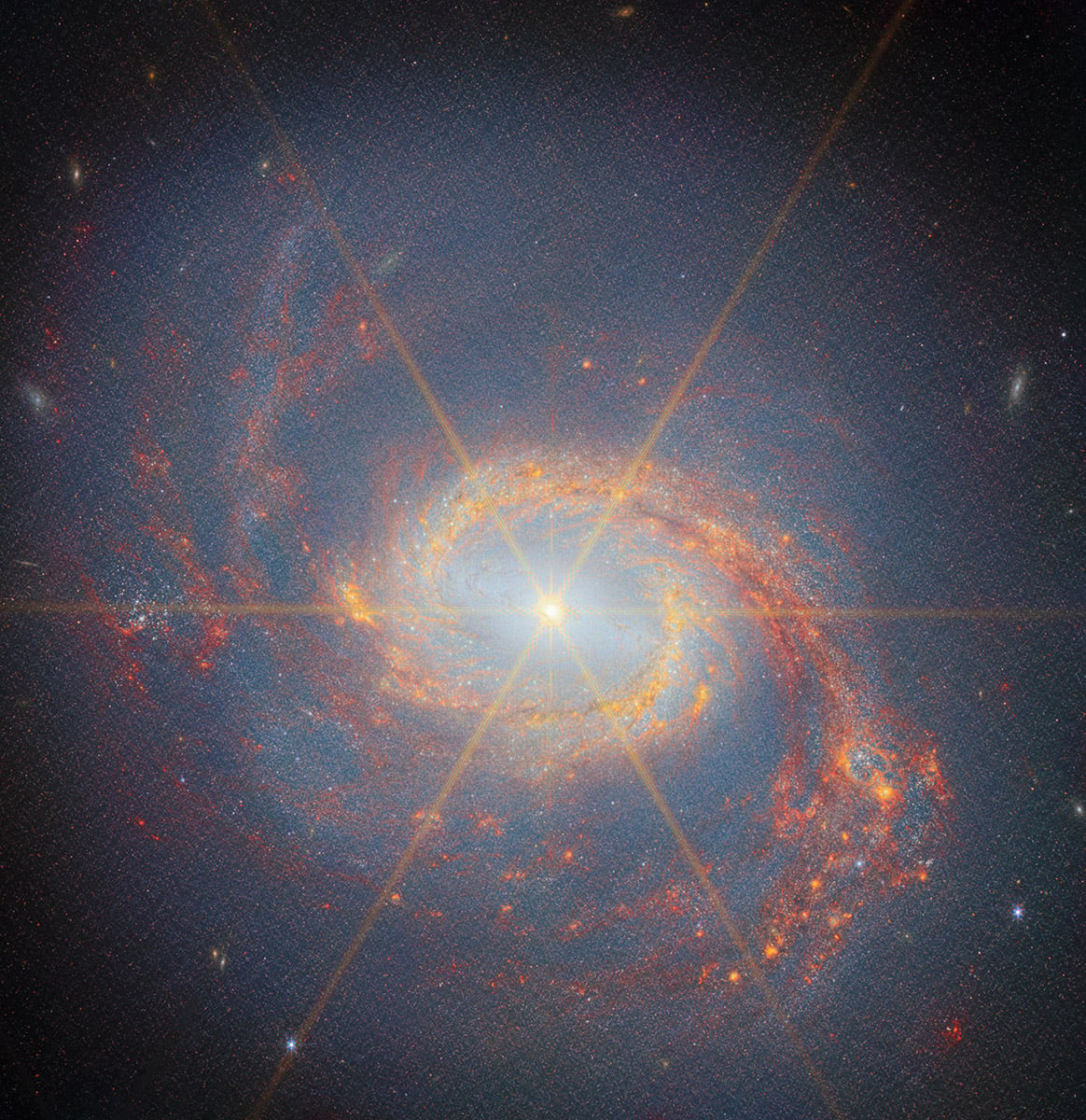
Visible-light observations portray Messier 77 as a bright spiral galaxy with broad arms and a luminous center. JWST’s infrared view reveals a much more complicated internal structure. Dust that appears dark and opaque in visible wavelengths begins to glow strongly in infrared light. Hidden stellar populations also emerge throughout the galaxy.
One of the most important features revealed in the new observations is the galaxy’s central bar structure. Earlier images hinted at its existence, but JWST traces the feature with greater clarity. The bar stretches across the inner region of the galaxy and appears connected to the dense star-forming ring surrounding the nucleus.
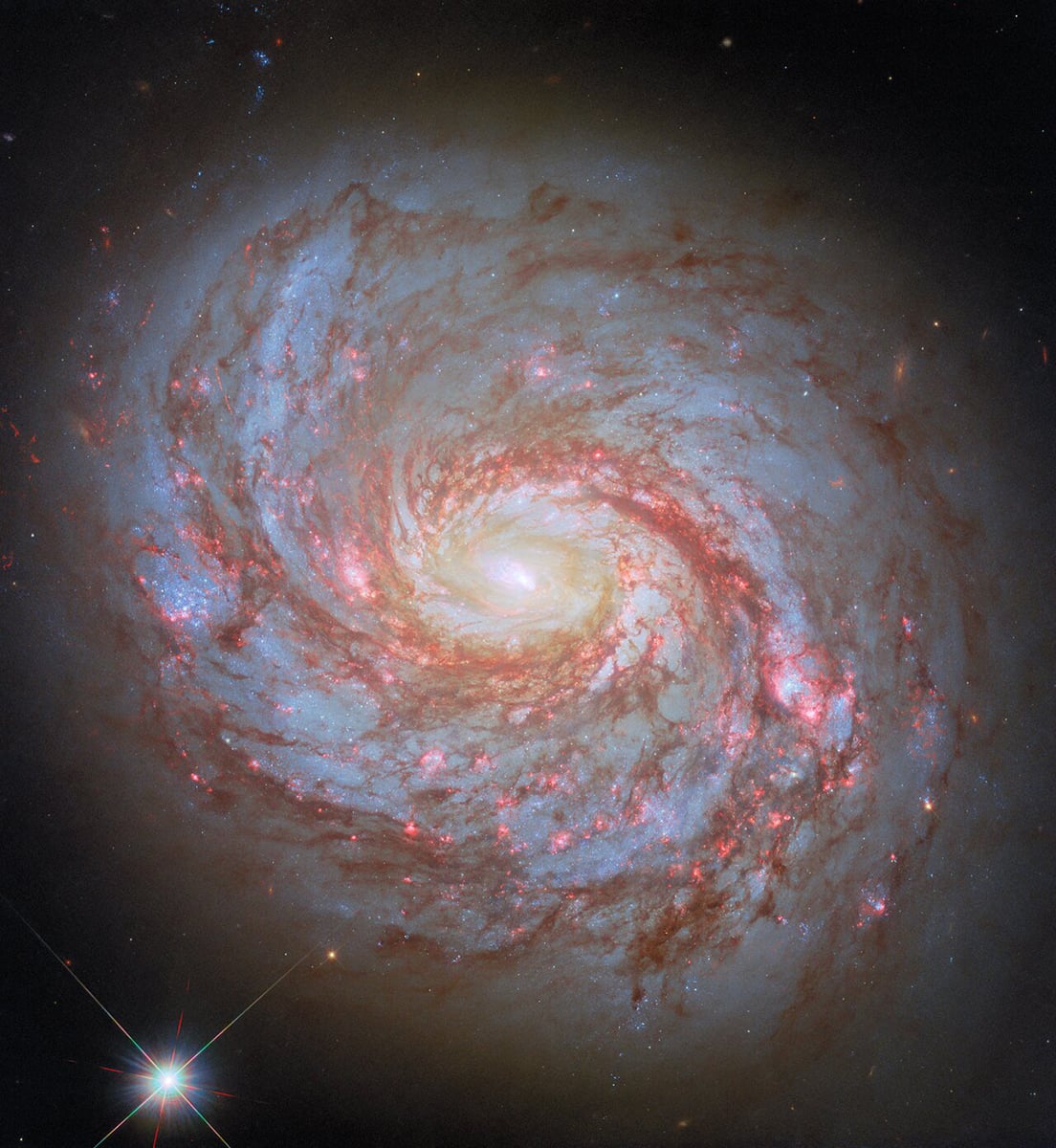
Bars play a major role in galactic evolution. They redistribute angular momentum and help move gas from outer regions toward galactic centers. This inward gas flow fuels star formation and may also feed the central black hole. In M77, JWST’s observations support the idea that the bar actively transports material toward the nucleus.
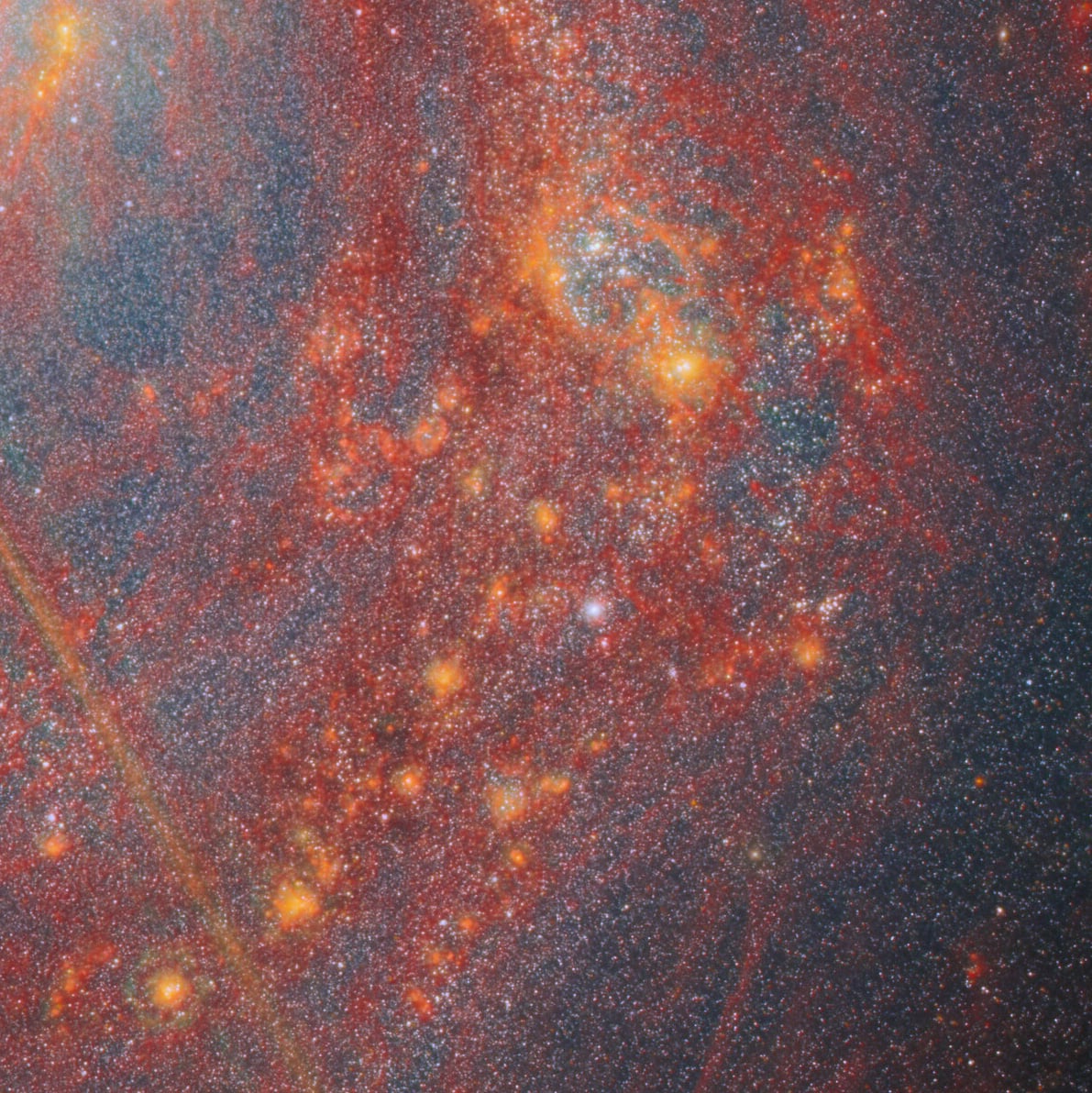
The starburst ring surrounding the core contains numerous compact regions of intense star formation. JWST detects these areas as bright infrared knots embedded within dusty clouds. Young massive stars heat the surrounding material, causing it to radiate strongly at infrared wavelengths.
The central role of dust
Dust often appears secondary in visible-light astronomy, but infrared observations show that it shapes nearly every major process inside galaxies. Messier 77 demonstrates this especially well. JWST’s observations place dust at the center of the galaxy’s structure and activity.
The Mid-Infrared Instrument detects warm dust spread throughout the spiral arms, inner disc, and central regions. These dusty environments contain dense molecular clouds where new stars form. Gravity slowly compresses gas and dust within these clouds until nuclear fusion begins inside newborn stars.
Young stars then transform their surroundings. Their ultraviolet radiation heats nearby dust, causing it to emit infrared light. Stellar winds and supernova explosions later disrupt the surrounding material and reshape the interstellar medium. JWST captures multiple stages of this cycle across M77.
Dust also influences how energy travels through the galaxy. Dense clouds absorb visible and ultraviolet radiation while reradiating that energy in infrared wavelengths. This process changes the appearance of galaxies, depending on the wavelength being observed.
Clear skies!
See more from DIYPhotography.net on Google
Add DIYPhotography.net as a trusted source. This makes
our stories more likely to appear in your Google Search results.
 Add as a preferred source on Google

Soumyadeep Mukherjee
Soumyadeep Mukherjee is an award-winning astrophotographer from India. He has a doctorate degree in Linguistics. His work extends to the sub-genres of nightscape, deep sky, solar, lunar and optical phenomenon photography. He is also a photography educator and has conducted numerous workshops. His works have appeared in over 40 books & magazines including Astronomy, BBC Sky at Night, Sky & Telescope among others, and in various websites including National Geographic, NASA, Forbes. He was the first Indian to win “Astronomy Photographer of the Year” award in a major category.
Join the Discussion
DIYP Comment Policy
Be nice, be on-topic, no personal information or flames.