






















Hubble Photographs a Galactic Illusion: Arp 4’s “Long-Distance Relationship”
Dec 23, 2025
Soumyadeep Mukherjee
Soumyadeep Mukherjee is an award-winning astrophotographer from India. He has a doctorate degree in Linguistics. His work extends to the sub-genres of nightscape, deep sky, solar, lunar and optical phenomenon photography. He is also a photography educator and has conducted numerous workshops. His works have appeared in over 40 books & magazines including Astronomy, BBC Sky at Night, Sky & Telescope among others, and in various websites including National Geographic, NASA, Forbes. He was the first Indian to win “Astronomy Photographer of the Year” award in a major category.
Share:

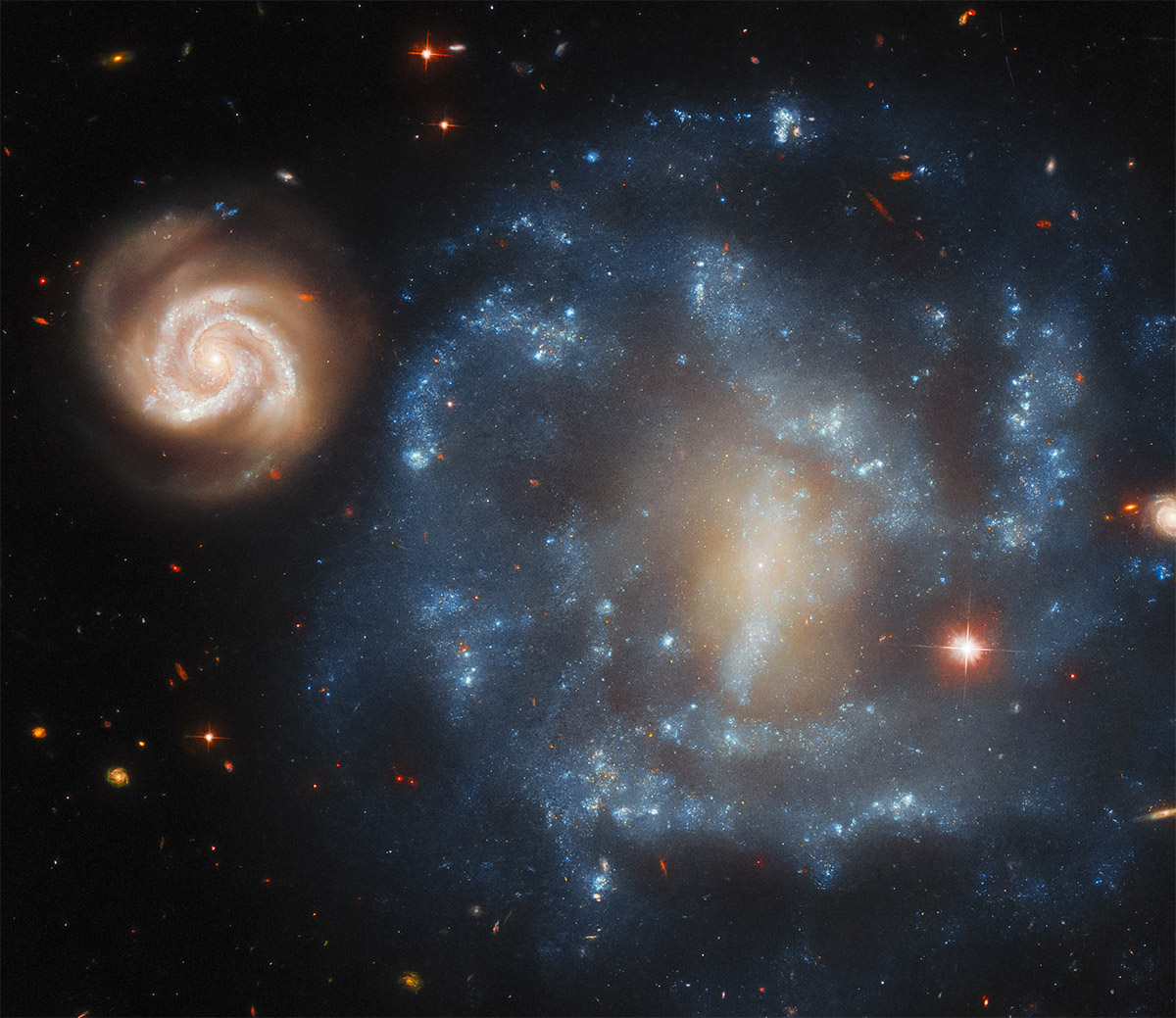
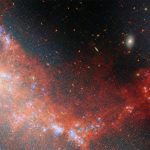
Modern astronomy relies on precision. Distance measurements, spectral analysis, and high-resolution imaging define how scientists interpret the universe. Visual appearance alone rarely tells the full story. The Hubble Space Telescope’s latest Picture of the Week, titled “Long-Distance Relationship,” demonstrates this principle with striking clarity. The image presents what looks like a close pair of spiral galaxies. Their alignment suggests interaction. Their proximity implies a shared history. Careful observation proves otherwise.
This image shows Arp 4, an object long catalogued for its unusual appearance. Hubble’s data reveal that the two galaxies occupy vastly different distances in space. One lies relatively nearby. The other sits hundreds of millions of light-years farther away. They are not interacting, nor bound by gravity. They only share our line of sight. The image captures a rare and instructive cosmic coincidence.
A galaxy pair that isn’t a pair
The image shows two spiral galaxies aligned almost perfectly along our line of sight. The larger galaxy spreads across the frame with a faint glow. Its arms look broken and uneven. The smaller galaxy sits nearby. It shines brighter. Its spiral structure looks sharper and more defined. This arrangement suggests interaction. In many Hubble images, close galaxy pairs distort each other through gravity. Their arms stretch. Gas clouds collide. Star formation increases. None of that is happening here.
These two galaxies only appear close from Earth. The larger, diffuse galaxy lies about 65 million light-years away. The smaller, brighter galaxy lies far behind it, at a distance of roughly 675 million light-years. They do not orbit each other or interact. They simply align by chance. ESA and NASA scientists describe this as a line-of-sight coincidence. Such alignments are rare, and Arp 4 is a textbook example.
Understanding the Arp 4 classification
The name Arp 4 comes from the Atlas of Peculiar Galaxies. Astronomer Halton Arp published this catalogue in 1966. His goal was to document galaxies with unusual shapes. He believed these objects could reveal how galaxies evolve. Arp’s atlas includes interacting systems, distorted spirals, and low surface brightness galaxies. Arp 4 falls into that last category.
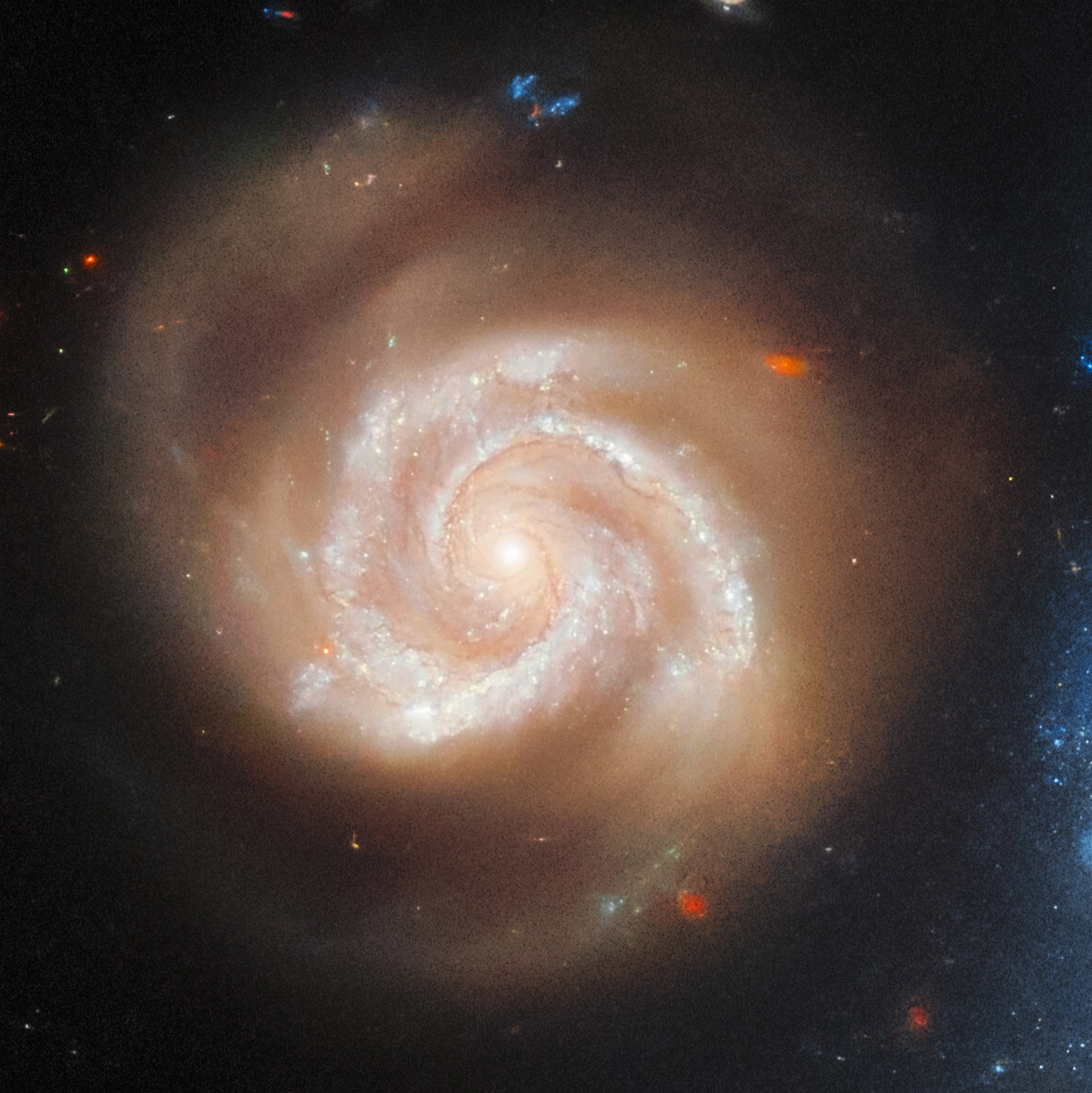
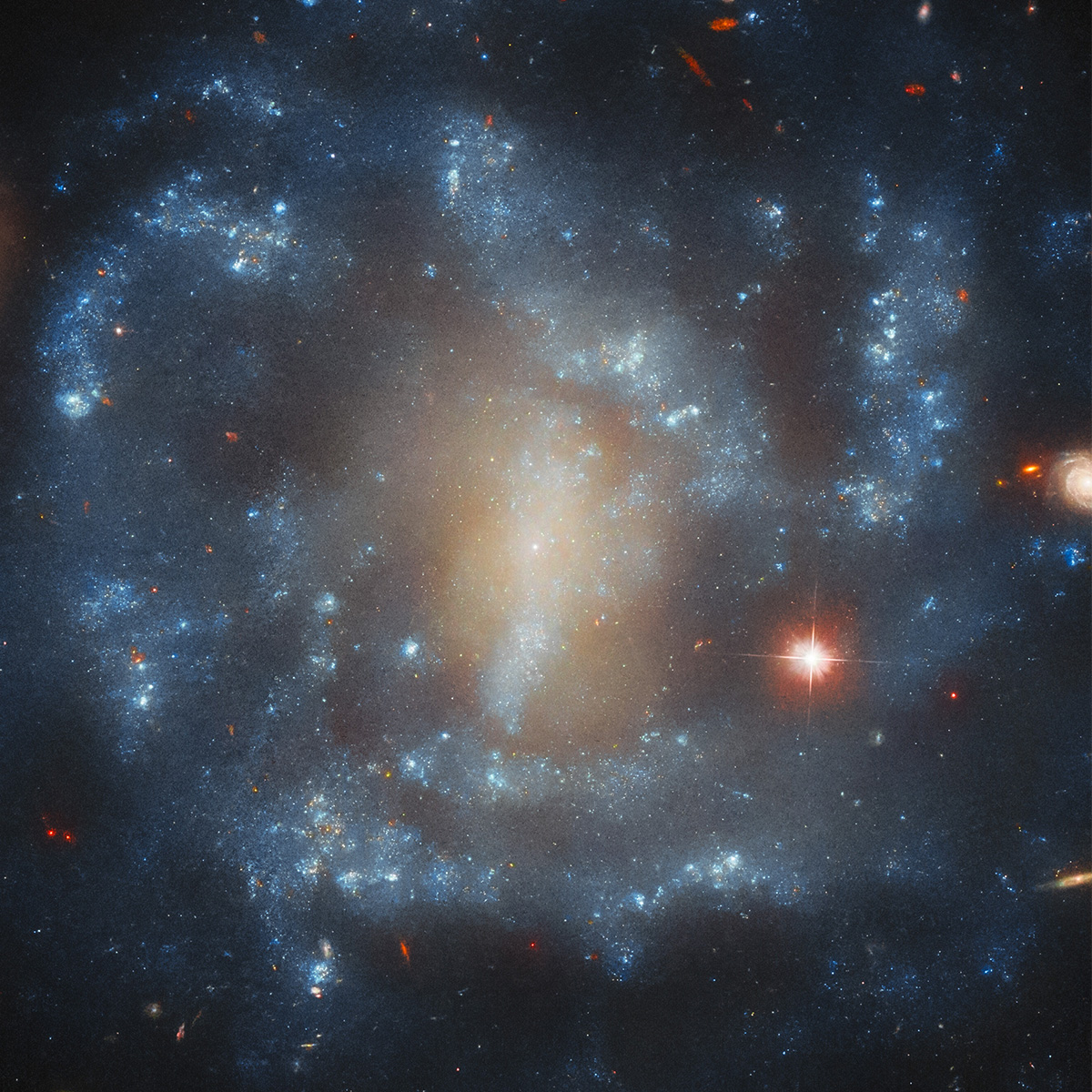
The foreground galaxy in this image is known as MCG-02-05-050. It has very low surface brightness. That means its light spreads thinly across a large area. These galaxies contain stars. They also contain gas and dark matter. But they emit little visible light. Low surface brightness galaxies challenge traditional galaxy formation models. They often evolve slowly. They form fewer stars. Their spiral arms appear weak or fragmented. Hubble’s image shows these traits clearly.
The background galaxy carries the designation MCG-02-05-050a. It looks brighter and more compact. That brightness comes from dense star populations and active star-forming regions. Its distance makes it appear smaller, even though it may be physically larger than the foreground galaxy.
Distance and brightness: Hubble’s contribution
In astronomy, brightness does not equal proximity. A distant galaxy with intense star formation can outshine a closer, quieter system. Arp 4 demonstrates this principle clearly. The background galaxy sits more than ten times farther away than the foreground galaxy. Yet it still appears prominent. That tells astronomers something important. It likely hosts a large number of young, hot stars. These stars emit strong visible and ultraviolet light.
The foreground galaxy, by contrast, contains older stellar populations. Its stars emit less energetic light. Its gas content supports little ongoing star formation. As a result, it looks faint and diffuse. Hubble’s sharp resolution allows scientists to study both galaxies at once. It separates foreground structure from background detail. Ground-based telescopes struggle with this task. Atmospheric distortion blurs faint features. Hubble avoids that limitation entirely.
Hubble’s role in this image goes beyond aesthetics. The telescope’s instruments capture subtle differences in structure, color, and brightness. These details help astronomers classify galaxies correctly. The image uses data from Hubble’s Advanced Camera for Surveys. This instrument excels at deep-field imaging. It records faint light over long exposures. That capability makes low surface brightness galaxies visible.
In the Arp 4 image, Hubble reveals the foreground galaxy’s uneven spiral arms. It shows patches of faint star clusters. It also highlights dust lanes in the background galaxy’s arms. These features allow scientists to distinguish coincidence from interaction. They confirm that the galaxies show no tidal distortions. Their shapes remain intact. Their gas shows no signs of compression or shock.
Visual coincidences
Images like Arp 4 play an important role in modern astronomy. They remind scientists to question assumptions. Proximity in the sky does not guarantee physical association. Large galaxy surveys rely on accurate distance measurements. Redshift data provides those distances. When galaxies align by chance, astronomers must identify that alignment correctly. Failure to do so can skew statistical studies of galaxy environments.
Low surface brightness galaxies like MCG-02-05-050 remain an active research topic. Astronomers still debate how they form. Some theories suggest they evolve in isolation. Others propose that they form in dark matter-rich environments. Hubble’s image adds observational data to that debate. It shows a low surface brightness galaxy without signs of recent interaction. That supports the idea of slow, isolated evolution.
Meanwhile, the background galaxy shows classic spiral structure. Its star formation appears organized and sustained. Comparing these two systems helps astronomers understand how the environment influences galaxy growth.
Clear skies!
See more from DIYPhotography.net on Google
Add DIYPhotography.net as a trusted source. This makes
our stories more likely to appear in your Google Search results.
 Add as a preferred source on Google

Soumyadeep Mukherjee
Soumyadeep Mukherjee is an award-winning astrophotographer from India. He has a doctorate degree in Linguistics. His work extends to the sub-genres of nightscape, deep sky, solar, lunar and optical phenomenon photography. He is also a photography educator and has conducted numerous workshops. His works have appeared in over 40 books & magazines including Astronomy, BBC Sky at Night, Sky & Telescope among others, and in various websites including National Geographic, NASA, Forbes. He was the first Indian to win “Astronomy Photographer of the Year” award in a major category.



Join the Discussion
DIYP Comment Policy
Be nice, be on-topic, no personal information or flames.