

























James Webb Reveals a Giant Protostellar Jet on the Edge of the Milky Way
Sep 11, 2025
Soumyadeep Mukherjee
Soumyadeep Mukherjee is an award-winning astrophotographer from India. He has a doctorate degree in Linguistics. His work extends to the sub-genres of nightscape, deep sky, solar, lunar and optical phenomenon photography. He is also a photography educator and has conducted numerous workshops. His works have appeared in over 40 books & magazines including Astronomy, BBC Sky at Night, Sky & Telescope among others, and in various websites including National Geographic, NASA, Forbes. He was the first Indian to win “Astronomy Photographer of the Year” award in a major category.
Share:

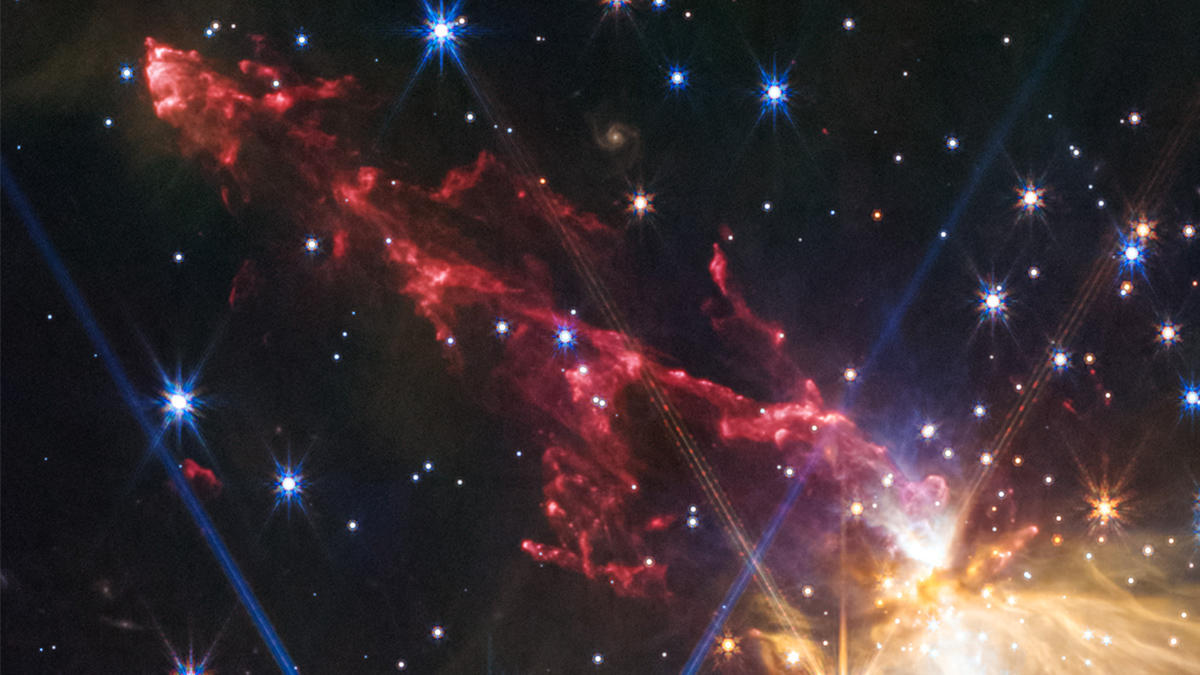
The James Webb Space Telescope has once again opened a new window into star formation. Its latest images reveal an enormous protostellar jet, launched by a massive young star in the star-forming region Sh2-284. This jet stretches across eight light-years. This makes it one of the largest and most striking examples ever observed inside our galaxy.
The discovery provides direct clues about how massive stars form, and how different environments influence the earliest stages of stellar life. The observation is particularly valuable because Sh2-284 lies far out on the edge of the Milky Way, in a region with fewer heavy elements than the solar neighborhood.
A young star with an enormous outflow
At the center of this cosmic scene is a protostar about ten times the mass of our Sun. Unlike mature stars, protostars are still forming, gathering material from surrounding clouds of gas and dust. As this happens, they often release part of that material in the form of jets, twin beams of plasma launched along the star’s rotation axis.
In Sh2-284, the protostar’s jet is unusually large. From one end to the other, it measures around eight light-years. It is about twice the distance from the Sun to Alpha Centauri, the nearest star system beyond our own. JWST’s infrared cameras reveal the jet cutting through its environment with striking symmetry, producing bright knots and bow-shaped shocks along its path.
Seeing what was hidden before
Protostellar jets are not new to science, but most examples studied in detail come from stars much smaller than this one. Observing jets from massive protostars has been a challenge because these stars usually form in dense, dusty regions where visible-light telescopes cannot see.
This is where the James Webb Space Telescope has a unique advantage. Operating in infrared light, JWST can pierce through thick layers of dust that hide star-forming regions from view. Its Near-Infrared Camera (NIRCam) detects the glow of warm dust and shocked gas, making jets like the one in Sh2-284 visible in their entirety.

Star formation at the edge of the galaxy
Sh2-284 lies about 15,000 light-years away, on the far edge of the Milky Way’s disk. That location adds another layer of significance. The gas in this region contains fewer heavy elements than the gas closer to the galactic center. Astronomers call this lower “metallicity.”
Metallicity plays a critical role in star formation. Heavy elements help gas clouds cool, allow dust grains to form, and influence the strength of stellar winds. In regions with fewer heavy elements, stars may behave differently as they form. By studying a massive jet in such a low-metallicity environment, astronomers gain insights into how stars may have formed earlier in cosmic history, when the universe itself contained fewer heavy elements. In many ways, Sh2-284 provides a local laboratory that mimics the conditions under which the first generations of stars were born.

While the Sh2-284 jet is fascinating in its own right, its greatest value may lie in its role as an analogue for the early universe. The first stars formed when the cosmos contained very few heavy elements. By studying a massive protostar in a low-metallicity environment today, astronomers can test whether those ancient stars might have formed and evolved in similar ways. As researchers follow up with spectroscopy and complementary observations, this system will become a benchmark for understanding the formation of massive stars. More broadly, it offers a glimpse of how the earliest stars in the universe may have behaved.
Clear skies!
See more from DIYPhotography.net on Google
Add DIYPhotography.net as a trusted source. This makes
our stories more likely to appear in your Google Search results.
 Add as a preferred source on Google

Soumyadeep Mukherjee
Soumyadeep Mukherjee is an award-winning astrophotographer from India. He has a doctorate degree in Linguistics. His work extends to the sub-genres of nightscape, deep sky, solar, lunar and optical phenomenon photography. He is also a photography educator and has conducted numerous workshops. His works have appeared in over 40 books & magazines including Astronomy, BBC Sky at Night, Sky & Telescope among others, and in various websites including National Geographic, NASA, Forbes. He was the first Indian to win “Astronomy Photographer of the Year” award in a major category.
Related Posts
 James Webb Captures the Clearest-Ever View of M87’s Supermassive Black Hole Jet
 James Webb telescope captures Horsehead Nebula’s edge in unprecedented detail
 You think James Webb is powerful? $1 billion Giant Magellan Telescope will have 4x higher resolution
 James Webb telescope captures a distant galaxy just like the Milky Way
Join the Discussion
DIYP Comment Policy
Be nice, be on-topic, no personal information or flames.