

















I Photographed Flowing Lava Just Meters Away, But Don’t Try This At Home
Aug 18, 2025
Alex Baker
Alex Baker is a portrait and lifestyle driven photographer based in Valencia, Spain. She works on a range of projects from commercial to fine art and has had work featured in publications such as The Daily Mail, Conde Nast Traveller and El Mundo, and has exhibited work across Europe
Share:
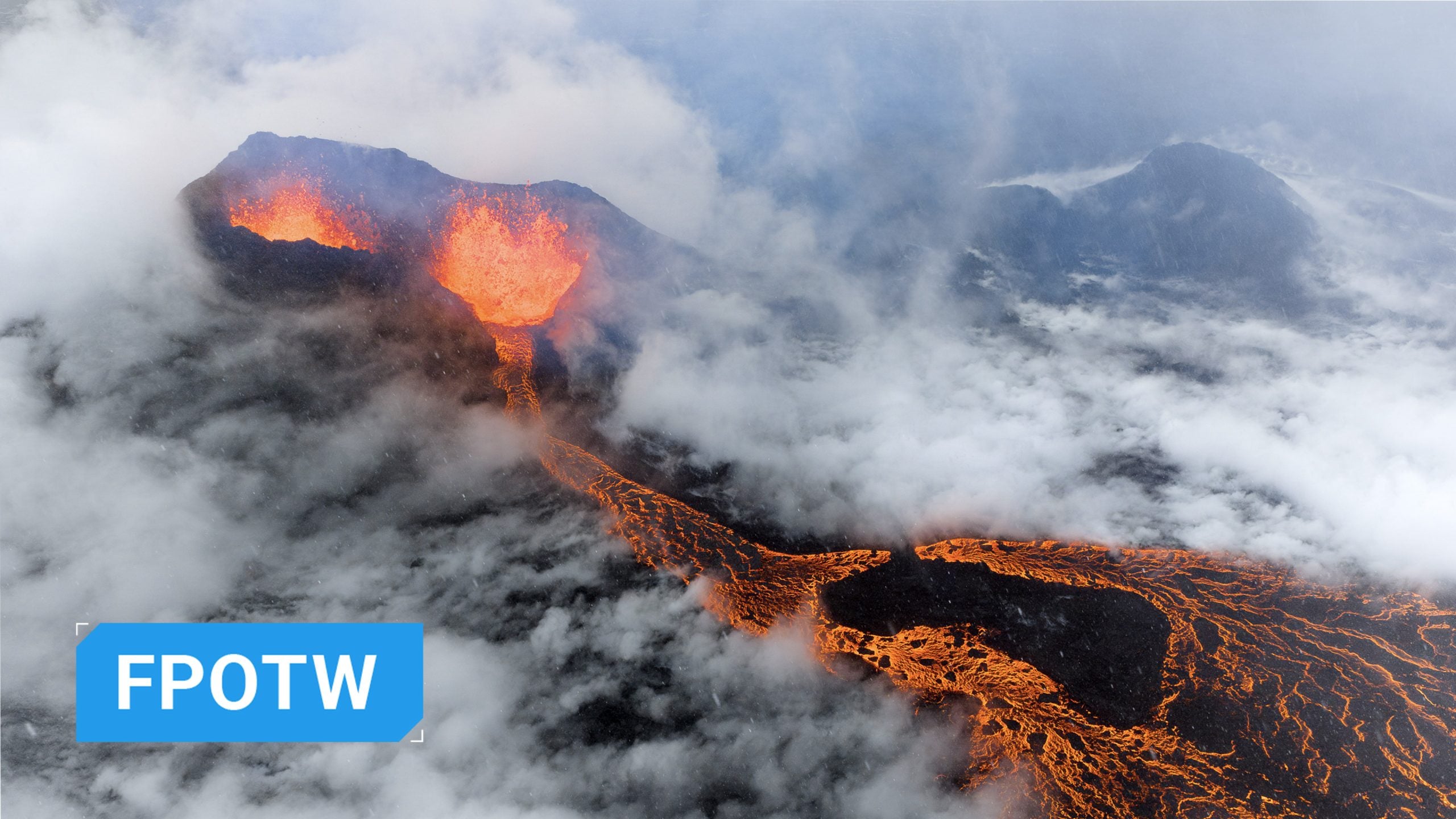
There are a few places in the world that draw photographers like a honeypot, and for good reason. Iceland is definitely one of those places, and Belgian landscape and nature photographer Jeroen Van Nieuwenhove was not immune to Iceland’s call. His work has gained international acclaim, particularly his awe-inspiring shots of Iceland’s recent volcanic eruptions, which showcase both the power and artistry of nature.
Jeroen’s work is nothing short of spectacular, and DIYP was excited to talk to Jeroen more about flying a drone over an active volcano (and living to tell the tale!). Here, he shares his creative process, the challenges of shooting in extreme conditions, and his tips for capturing dynamic landscapes, whether from the ground or the sky.

DIYP: Can you tell me a little about your photographic background and how you got started?
Jeroen: I found my passion for photography very early on when I discovered an analogue Canon SLR (the Canon AV-1) in my parents’ attic at the age of 10. Learning how to use it caused me to be fascinated by photography. Complementing that fascination, I was fortunate enough to travel with my parents to unspoiled, and sometimes distant, countries such as South Africa, Canada and Norway during my childhood. Those travels, together with the many National Geographic and BBC Earth documentaries I loved watching, developed my respect and admiration for nature tremendously. However, I didn’t really turn photography into my main focus until much later, when I stepped into the digital era with a Canon 550D.

DIYP: What prompted you to relocate to Iceland? Can you describe a particular moment when you knew that was the next step?
Jeroen: In 2012, after discovering the beauty of Icelandic nature through the Sígur Rós music DVD ‘Heima’, I travelled to Iceland for the first time with my local scouts group. After arriving in the country, our group stepped on a special 4×4 highland bus and started our journey by hiking the now-famous Laugavegur trail. This 4-day experience in the Highlands of Iceland deeply changed something in me. For me, this “change” has always been very difficult to describe to other people. It was as if I no longer felt at home in my country, Belgium. It felt as if I was not where I was supposed to be. It took me a few years to truly understand this new feeling.
In search of an “explanation”, I kept travelling to Iceland again and again, hoping it would help me find my place. After about a dozen trips, I decided I’d had enough of travelling back and forth several times per year and wondered what it would be like to build a life there. In early 2015, I decided I had to give it a shot. This change in thinking came after I realised I would probably only regret what I hadn’t tried. In my mind, the worst that could happen was that I would have had to return to Belgium. I didn’t want to end up being that person who had to keep wondering “what if” at a later stage in life. In early 2016, I sold all my belongings and resigned from my job in Belgium. Shortly after, I bought a one-way ticket to Reykjavík. I quite literally stepped onto the plane with a few suitcases and began my new life in Iceland.


DIYP: Having spent so much time photographing Iceland, what is it about this country that continues to inspire and challenge you as a photographer?
Jeroen: I think Iceland is just a really special place. In a relatively small surface area, you have such a wild variety in landscapes. And some of these landscapes just look as if they belong in a fantasy story. Because of its volcanic nature, the landscapes here give you the feeling as if you are looking back in time as well (especially true with eruptions). On top of that, summer and winter are so different that it feels as if you are photographing two different countries in one.

DIYP: Your images of volcanic eruptions (like Fagradalsfjall and Litli-Hrútur) are nothing short of mesmerising. What goes into planning a shoot near an active volcano?
Jeroen: I honestly don’t “plan” a lot in these kinds of situations and the primary reason for that is that eruptions aren’t a static kind of thing. The landscape is literally growing in front of your eyes, which means that there’s very little you can plan for. Instead, I visit as often as I can because there is always something special happening, it’s just up to me to find what that is. Of course, sometimes I do plan to be there during special weather conditions or in special lighting situations.


DIYP: Can you share a particularly intense or unforgettable moment while photographing an eruption? Any close calls or unexpected challenges?
Jeroen: During the first eruption in 2021, the area was closed for a few days after a new fissure opened unexpectedly. When the area was reopened, I headed out there as soon as I could. I hiked into the area, but once I arrived on the scene, the wind shifted, which pushed all the gas from the eruption my way. I put on my gas mask and escaped the area. But because I went all the way after several days of closure, I decided not to give up quite yet and hike around the other side of the lava field, upwind.
Once I arrived close to one of the erupting craters, the most amazing thing happened. The lava erupting from the crater, which was originally flowing eastwards, suddenly changed direction and began flowing westwards, straight to my position. Within minutes, the lava field began expanding towards us, moving a meter forward every couple of seconds. It was absolutely incredible. The thrill of being so close to fast-moving lava is something I will never forget. And no, there was no danger in being there. We stayed uphill from the lava and upwind from the gas.
DIYP: How do you balance safety with getting the perfect shot in such extreme conditions?
Jeroen: I always prioritise safety. There is no shot I would want to take if it means I would be truly endangering myself. I am sure I have sometimes left a shot “on the table” because it felt too tricky or dangerous to get. For me, the best story is the one you can still share afterwards.

DIYP: What’s in your essential kit when shooting Iceland’s extreme landscapes? Any gear that’s indispensable for volcanic or drone photography?
Jeroen: It’s a tricky question. In terms of essential gear, I would say that more than ever, having a drone is super important, especially with eruptions. There is just no way I could get the photographs and videos I have been able to produce without it. In terms of essential accessories, I absolutely swear by thick microfiber dish towels that I can use to keep my gear totally dry and clean in even the harshest situations.

DIYP: How has drone tech influenced your creative process and your ability to tell stories from the air?
Jeroen: It has definitely become more and more important in the last few years as drones have become more capable and the image quality you get from them has become more potent. The big appeal to me is that you can literally be anywhere in a 3D space. It allows you to find compositions and perspectives that have never been seen before, allowing you to capture places in completely new ways. This “revelation” has definitely opened my creative mind a lot and allowed me to reinvent my work time and time again.
DIYP: Do you have a single favourite photograph from your portfolio? What’s the story behind it, and why does it stand out to you?
Jeroen: There are so many images I am proud of and are among my favourites. If I had to pick just one, I would probably pick this one (including the story). It was such a great moment for me.

DIYP: How do you approach post-processing for your images, particularly those with challenging lighting (like lava at night or the aurora)?
Jeroen: I really like being outside and shooting far more than editing. And because of that, I try to spend my time finding the best light and best conditions so the editing part of the images becomes minimal. My whole “style”, if you can call it that, is to edit naturally. Stick to what I saw and captured, and amplify certain elements I want you to look at more.
Photographing something unique like the eruption with the northern lights above it was something I really wanted to capture in a single exposure. Sure, bracketing the scene may have worked better, but it would have felt less real to me. It would have felt like less of a memory if that makes sense. Bracketing a scene like that would have required far too much manipulation for me because of the many moving parts in the images. The lava, the gas, the northern lights, … it all moves, which makes bracketing all of that very hard.


DIYP: Are there any upcoming projects or locations in Iceland (or beyond) that you’re excited to explore next?
Jeroen: I am always working on a lot of things, and I have a ton in the pipeline, like my second book. I am also working on new photography workshop concepts I really want to realise next year but nothing quite ready yet to share I’m afraid.

DIYP: Lastly, what advice would you give to aspiring landscape photographers who dream of capturing scenes as powerful as yours?
Jeroen: Focus on being outside, being in the right moment at the right place, but also by putting the experience of being there front and centre. For me, photography is about capturing memories. And once you put the effort into making those memories special, when those memories turn into inspiration, that’s when you will produce your best work.
You can see more of Jeroen’s work and find out about his upcoming book and photo workshops on his website, or follow him on Instagram.
See more from DIYPhotography.net on Google
Add DIYPhotography.net as a trusted source. This makes
our stories more likely to appear in your Google Search results.
 Add as a preferred source on Google
Filed Under:
Tagged With:
Alex Baker
Alex Baker is a portrait and lifestyle driven photographer based in Valencia, Spain. She works on a range of projects from commercial to fine art and has had work featured in publications such as The Daily Mail, Conde Nast Traveller and El Mundo, and has exhibited work across Europe


Join the Discussion
DIYP Comment Policy
Be nice, be on-topic, no personal information or flames.