


















This Hubble Image Will Prepare Roman Telescope for a Dark Matter Hunt
Oct 25, 2026
Soumyadeep Mukherjee
Soumyadeep Mukherjee is an award-winning astrophotographer from India. He has a doctorate degree in Linguistics. His work extends to the sub-genres of nightscape, deep sky, solar, lunar and optical phenomenon photography. He is also a photography educator and has conducted numerous workshops. His works have appeared in over 40 books & magazines including Astronomy, BBC Sky at Night, Sky & Telescope among others, and in various websites including National Geographic, NASA, Forbes. He was the first Indian to win “Astronomy Photographer of the Year” award in a major category.
Share:
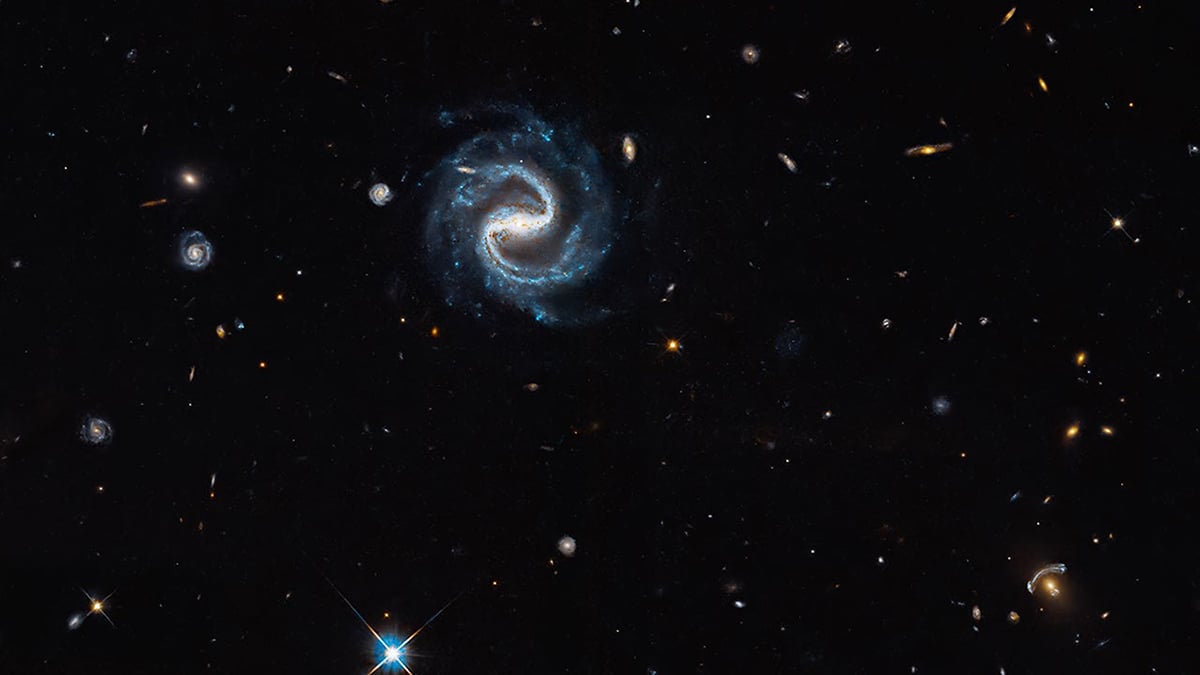
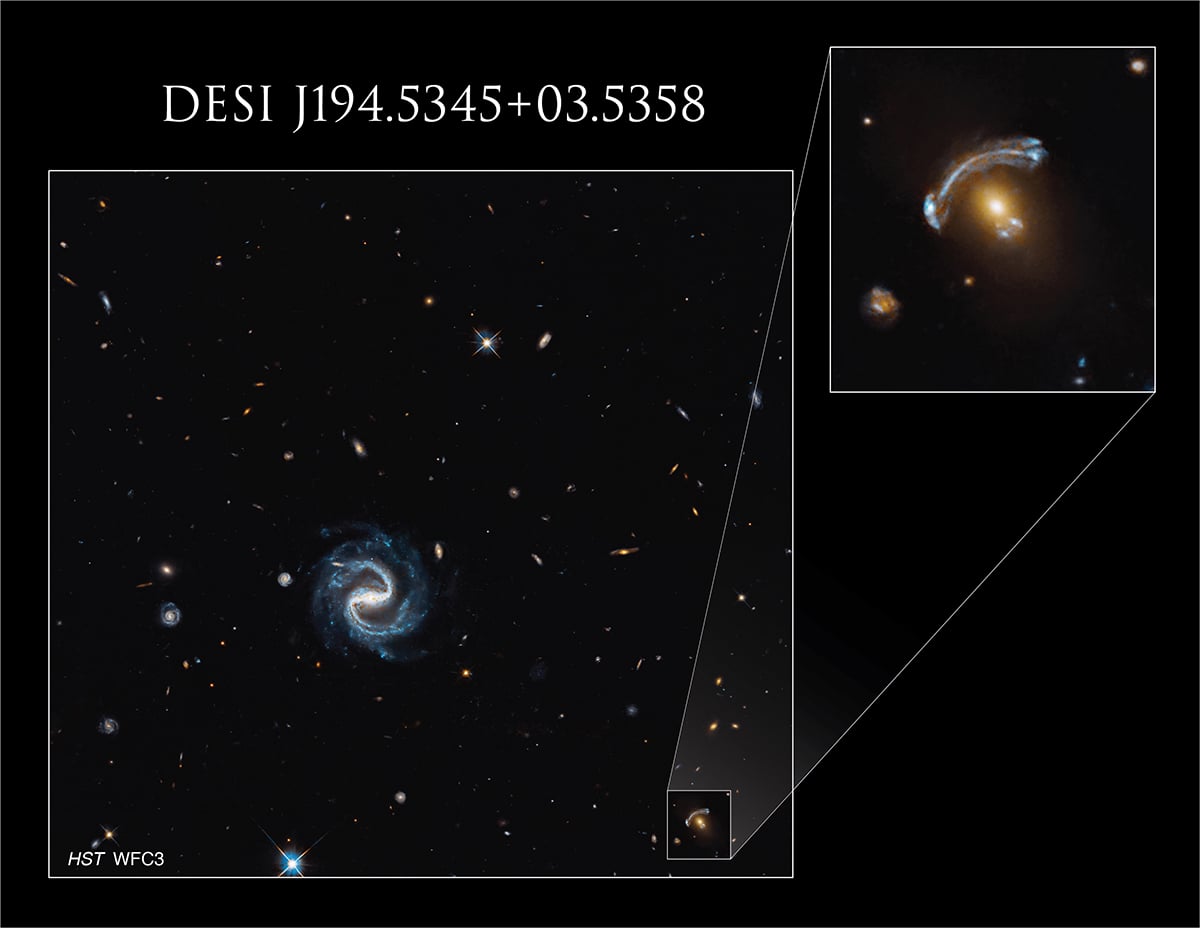
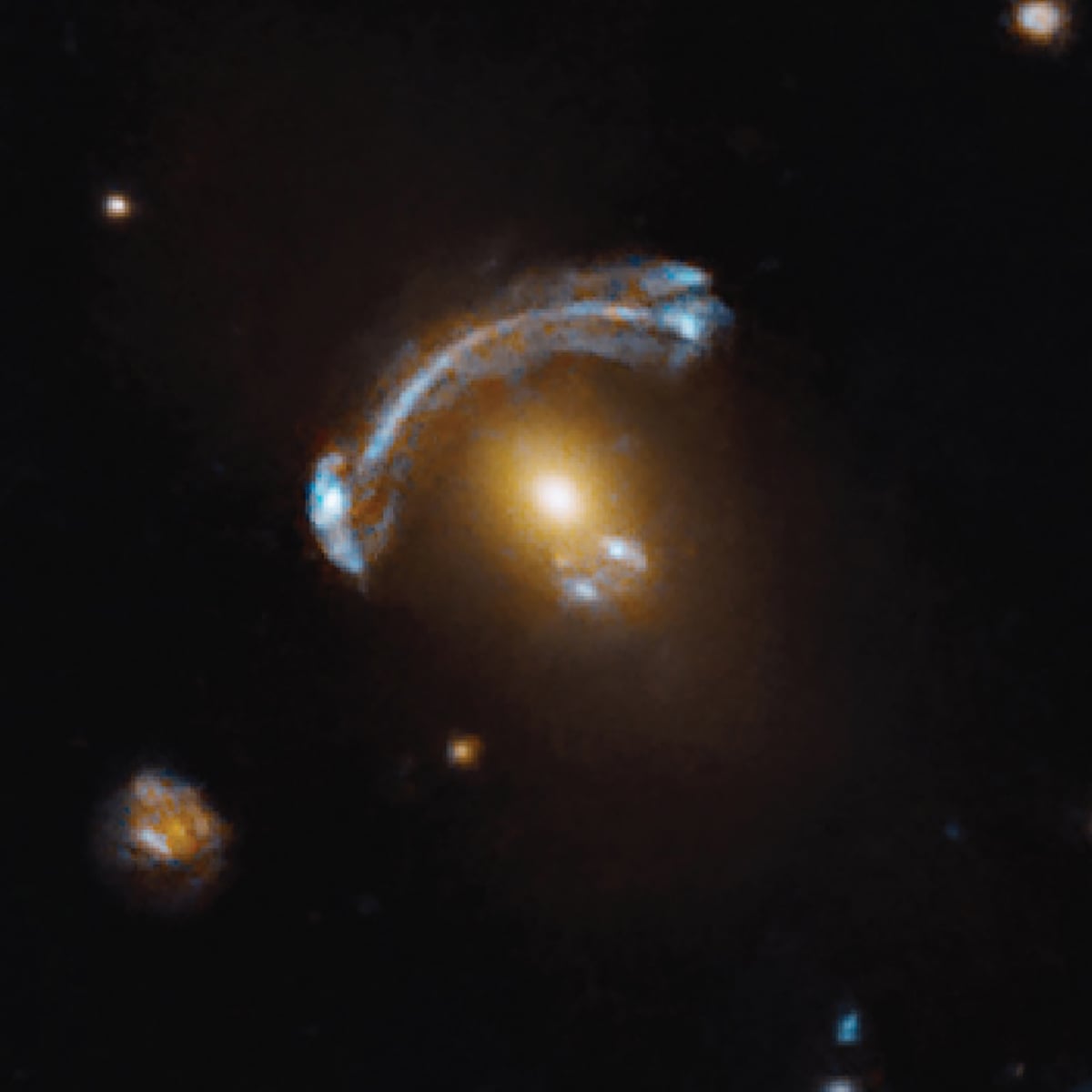
A reddish elliptical galaxy in a new Hubble image appears to have split a distant galaxy into two blue arcs. The arcs sit on opposite sides of the foreground galaxy, with one much larger than the other. Both show the same background object. Its light has taken different paths around the foreground galaxy before reaching Earth.
NASA released the image as part of a wider effort to prepare for the Nancy Grace Roman Space Telescope. Astronomers are using Hubble’s detailed observations to develop methods for studying gravitational lenses. Roman will search much larger areas of the sky, giving researchers a far bigger sample of these unusual systems.
A distant galaxy appears twice in Hubble’s image
The image shows a barred spiral galaxy near the center, with its arms extending from a bright central bar. The structure resembles the Milky Way, which astronomers also classify as a barred spiral galaxy. A smaller spiral appears to its left. The gravitational lens sits in the lower-right corner, away from the main galaxy’s prominent arms.
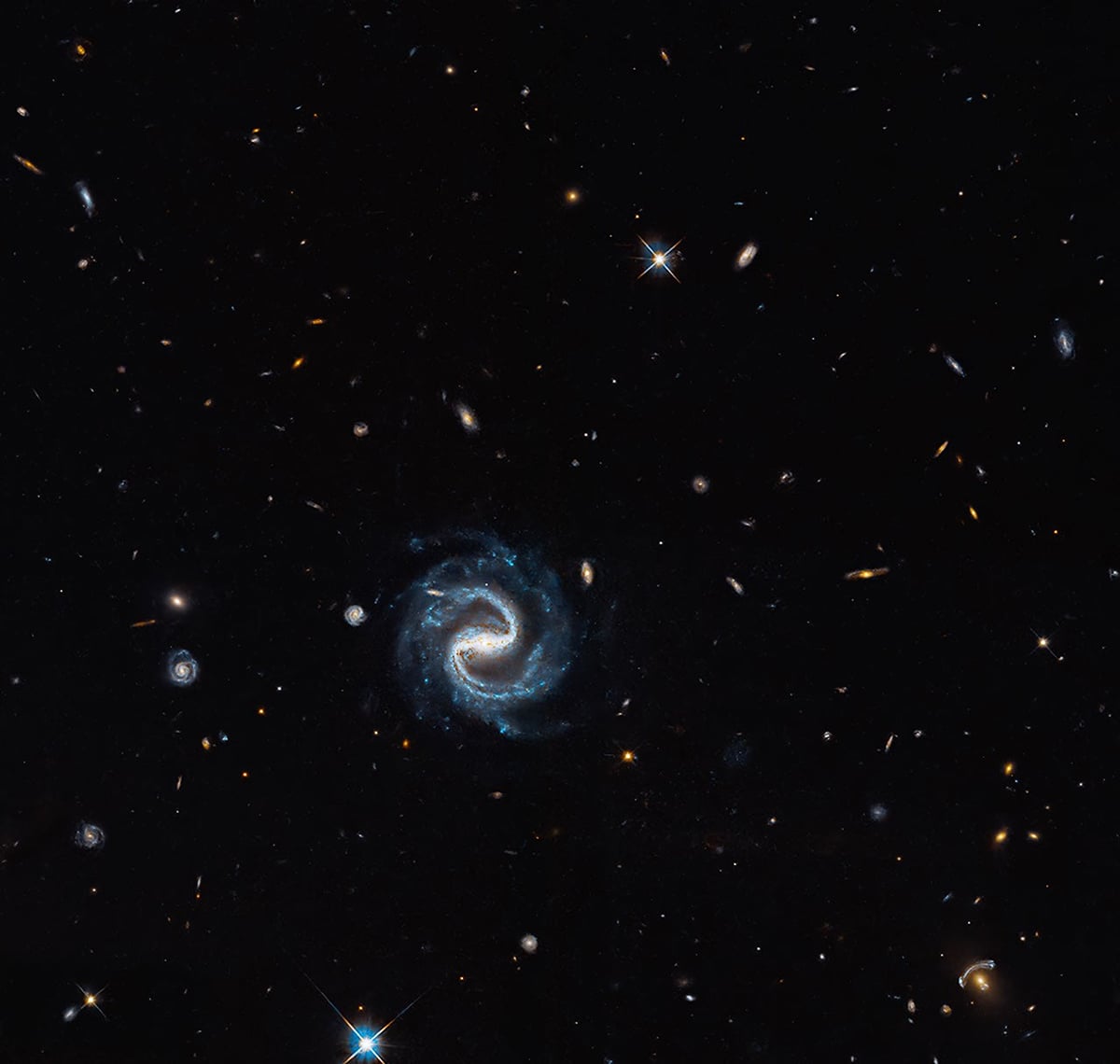
The lens consists of a reddish elliptical galaxy about 4.5 billion light-years away and a background galaxy roughly eight billion light-years away. Light from the foreground galaxy began its journey towards us when the Solar System was still forming. The background galaxy lies almost twice as far away.
The foreground galaxy’s gravity bends the light from the more distant object. Instead of producing one image, the lens creates two distorted views. One appears as a large arc above and to the left of the elliptical galaxy. The other is a smaller, flipped image on the opposite side. Astronomers call this arrangement an arc-counterarc pair.
Gravitational lensing and dark matter
Einstein’s general theory of relativity explains why gravity can bend light. Massive objects curve spacetime, and light follows the resulting paths. A galaxy with enough mass can redirect light from an object behind it, producing stretched arcs, multiple images, or other distortions.
Astronomers use these distortions to estimate the foreground galaxy’s mass. They measure the shapes and positions of the lensed images, then compare them with computer models of the galaxy’s gravitational field. The stronger the distortion, the greater the gravitational influence along the light’s path.
Stars, gas, and dust contribute to a galaxy’s mass, but visible material alone often cannot explain the observed lensing. Astronomers infer the presence of dark matter from the additional gravity required by their measurements. Dark matter does not emit, reflect, or absorb light in the usual way, so researchers study its effects rather than observing it directly.
Why Roman needs Hubble’s detailed views
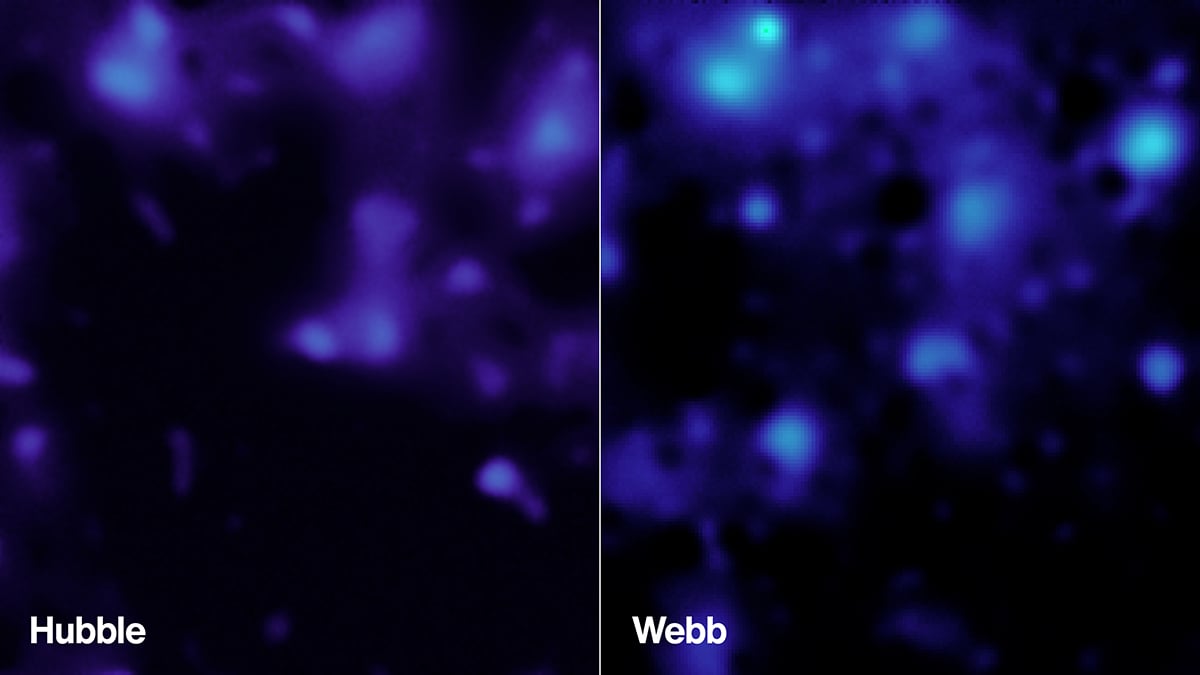
Hubble has captured gravitational lenses for years, but finding them takes time. The required alignment between foreground and background galaxies is uncommon, and Hubble sees a relatively small area of the sky in each observation. Astronomers have studied only a limited number of lenses in the detail needed for dark matter research.
NASA’s Nancy Grace Roman Space Telescope will change the scale of the search. Roman’s primary mirror measures 2.4 meters across, matching Hubble’s diameter. Its field of view, however, will cover at least 100 times more sky in a single observation.
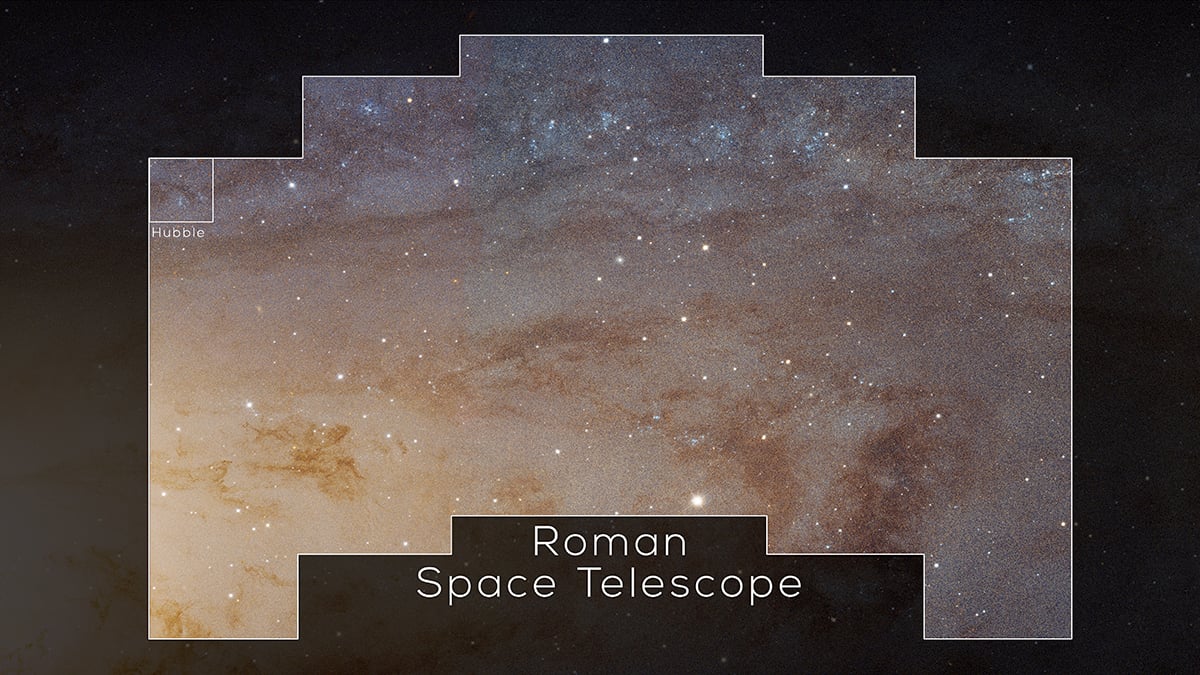
That wider view will allow Roman to survey huge areas and find lenses that smaller surveys might miss. A NASA-supported study published in 2025 estimated that Roman could discover more than 160,000 gravitational lenses. Researchers expect only a fraction of those systems to meet the requirements for detailed studies of dark matter.
Hubble and Roman will approach the task from different directions. Hubble can capture sharp views of individual lenses, while Roman will find promising targets across a much wider area. Researchers are using Hubble’s images to develop and test computer models before applying them to Roman’s survey data. Hubble can also follow up on particularly interesting lenses that Roman discovers.
Clear skies!
See more from DIYPhotography.net on Google
Add DIYPhotography.net as a trusted source. This makes
our stories more likely to appear in your Google Search results.
 Add as a preferred source on Google

Soumyadeep Mukherjee
Soumyadeep Mukherjee is an award-winning astrophotographer from India. He has a doctorate degree in Linguistics. His work extends to the sub-genres of nightscape, deep sky, solar, lunar and optical phenomenon photography. He is also a photography educator and has conducted numerous workshops. His works have appeared in over 40 books & magazines including Astronomy, BBC Sky at Night, Sky & Telescope among others, and in various websites including National Geographic, NASA, Forbes. He was the first Indian to win “Astronomy Photographer of the Year” award in a major category.

Join the Discussion
DIYP Comment Policy
Be nice, be on-topic, no personal information or flames.