










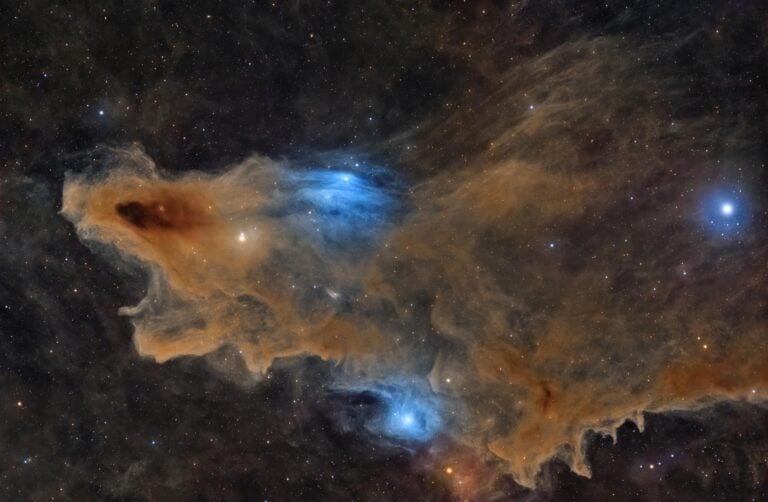













JWST’s New Image Reveals Two Edge-On Planet-Forming Discs
Apr 4, 2026
Soumyadeep Mukherjee
Soumyadeep Mukherjee is an award-winning astrophotographer from India. He has a doctorate degree in Linguistics. His work extends to the sub-genres of nightscape, deep sky, solar, lunar and optical phenomenon photography. He is also a photography educator and has conducted numerous workshops. His works have appeared in over 40 books & magazines including Astronomy, BBC Sky at Night, Sky & Telescope among others, and in various websites including National Geographic, NASA, Forbes. He was the first Indian to win “Astronomy Photographer of the Year” award in a major category.
Share:
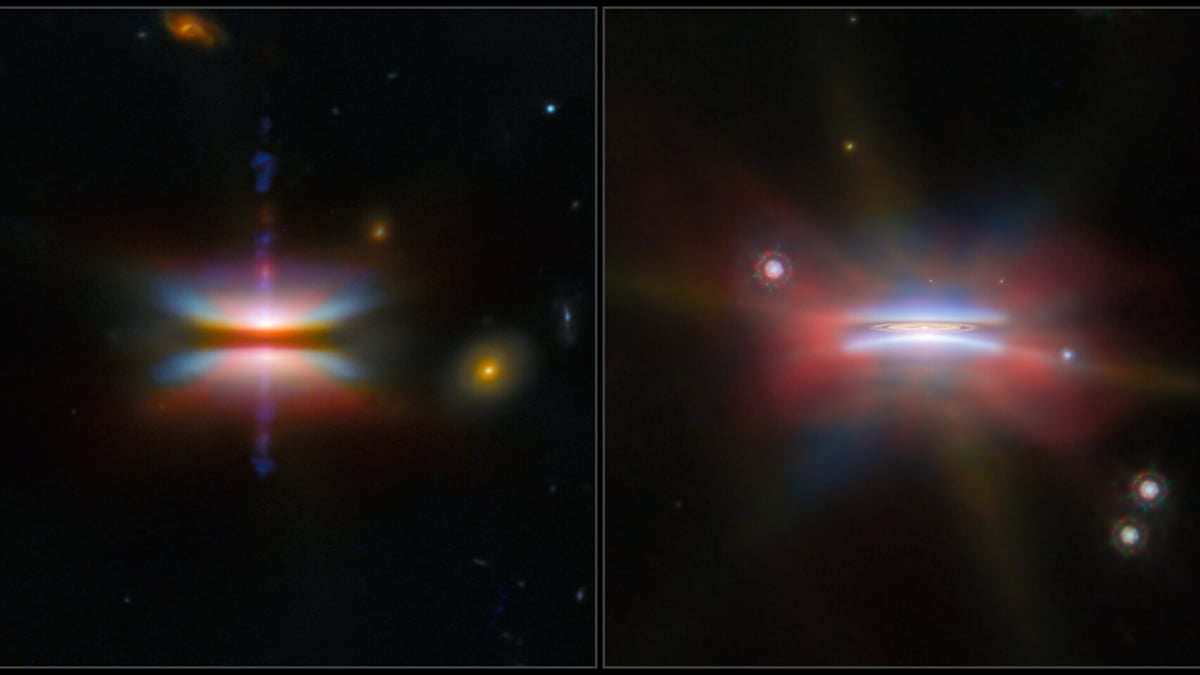
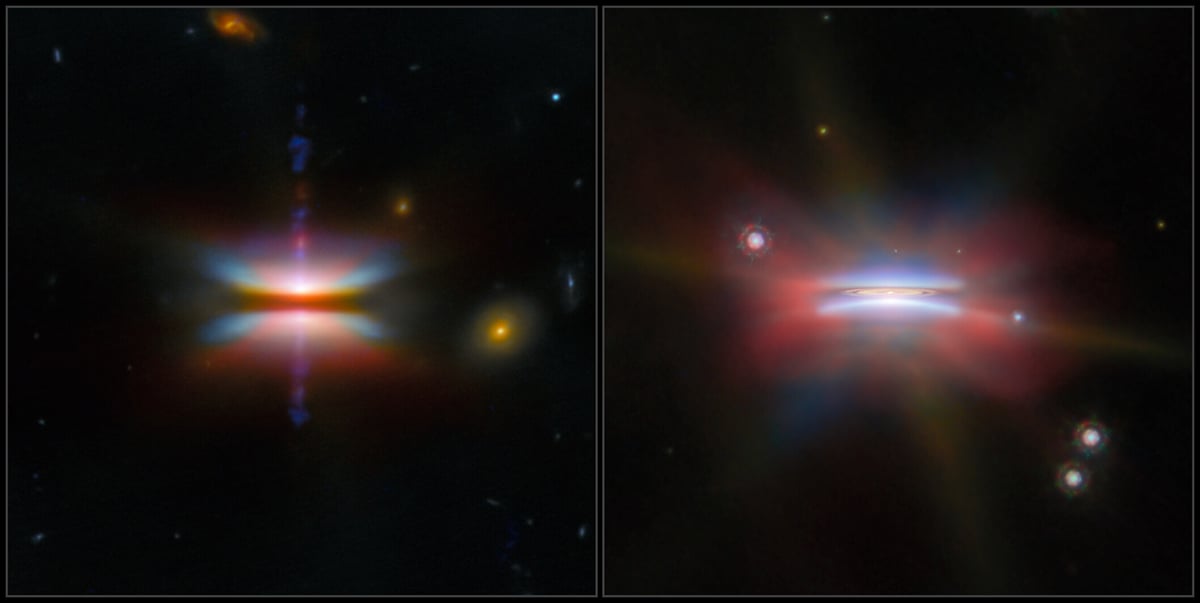
Earlier this week, the European Space Agency released a composite observation showing two nearby edge-on discs surrounding young stars, Tau 042021 and Oph 163131. Because both systems appear almost perfectly side-on, the observations expose the stratified structure of dust grains across the disc atmosphere and mid-plane.
These observations combine infrared data from JWST with optical imaging from the Hubble Space Telescope and millimetre-wavelength measurements from the Atacama Large Millimeter/submillimeter Array (ALMA). The datasets trace multiple grain populations across both discs.
Protoplanetary discs: Birthplaces of planetary systems
Planetary systems form inside rotating discs of gas and dust that surround young stars during their earliest evolutionary stages. These protoplanetary discs originate naturally as collapsing molecular clouds conserve angular momentum. Material that cannot fall directly into the central star settles into orbit around it and forms a flattened structure.
Inside these discs, dust grains collide continuously. At the beginning, the grains remain microscopic. However, repeated collisions allow them to grow into larger aggregates. Over time, these aggregates become pebbles and later kilometre-scale bodies called planetesimals. These objects act as the seeds of planets.
This sequence unfolds over millions of years. Astronomers cannot observe the entire process in a single system. Instead, they examine many discs at different stages of development. Each observation contributes one step toward reconstructing the overall timeline of planetary growth.
Tau 042021 and Oph 163131 represent systems that still retain substantial reservoirs of dust and gas. Their discs therefore preserve early structural conditions that favour planet formation. Because both stars lie only a few hundred light-years away, telescopes can measure their disc geometry with high precision. These characteristics make them ideal laboratories for studying how dust evolves during the earliest phases of planetary assembly.
Edge-on orientation reveals the vertical architecture of discs
Most protoplanetary discs appear either face-on or moderately inclined relative to Earth. In those cases, astronomers often detect rings and gaps that trace orbital structure. However, such viewing angles hide the vertical distribution of dust inside the disc.
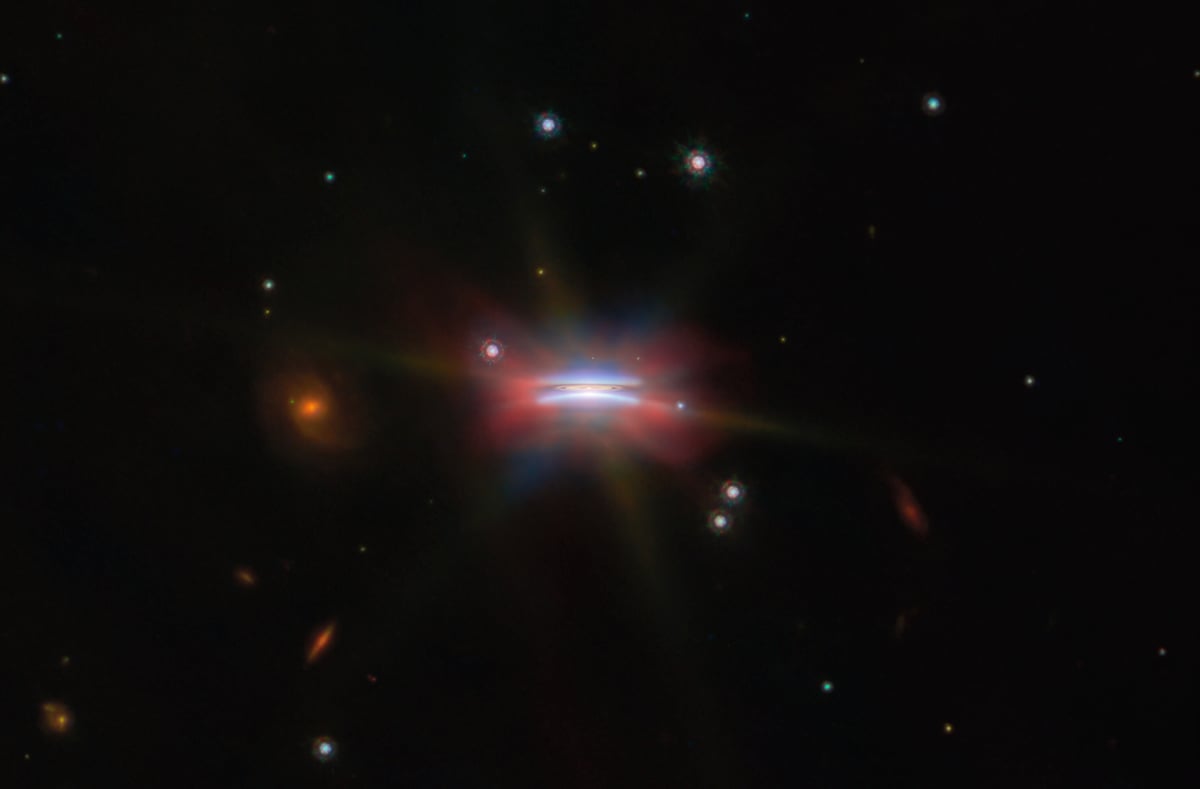
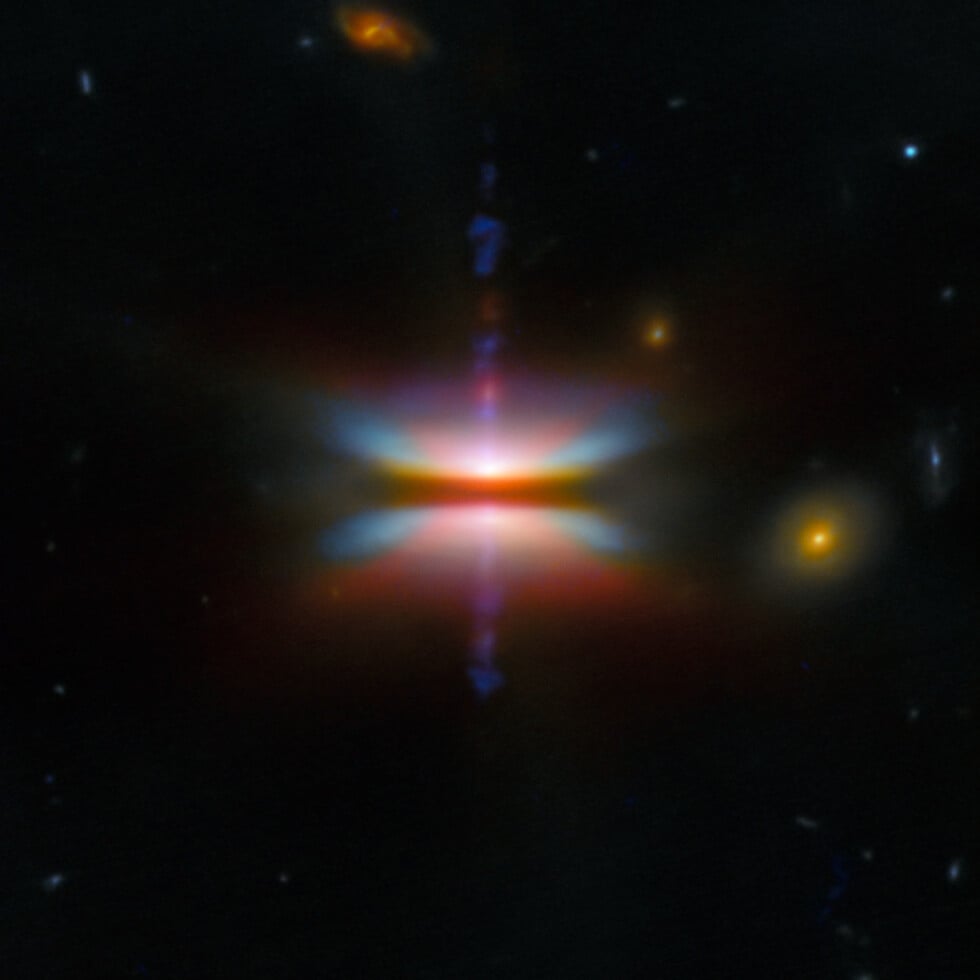
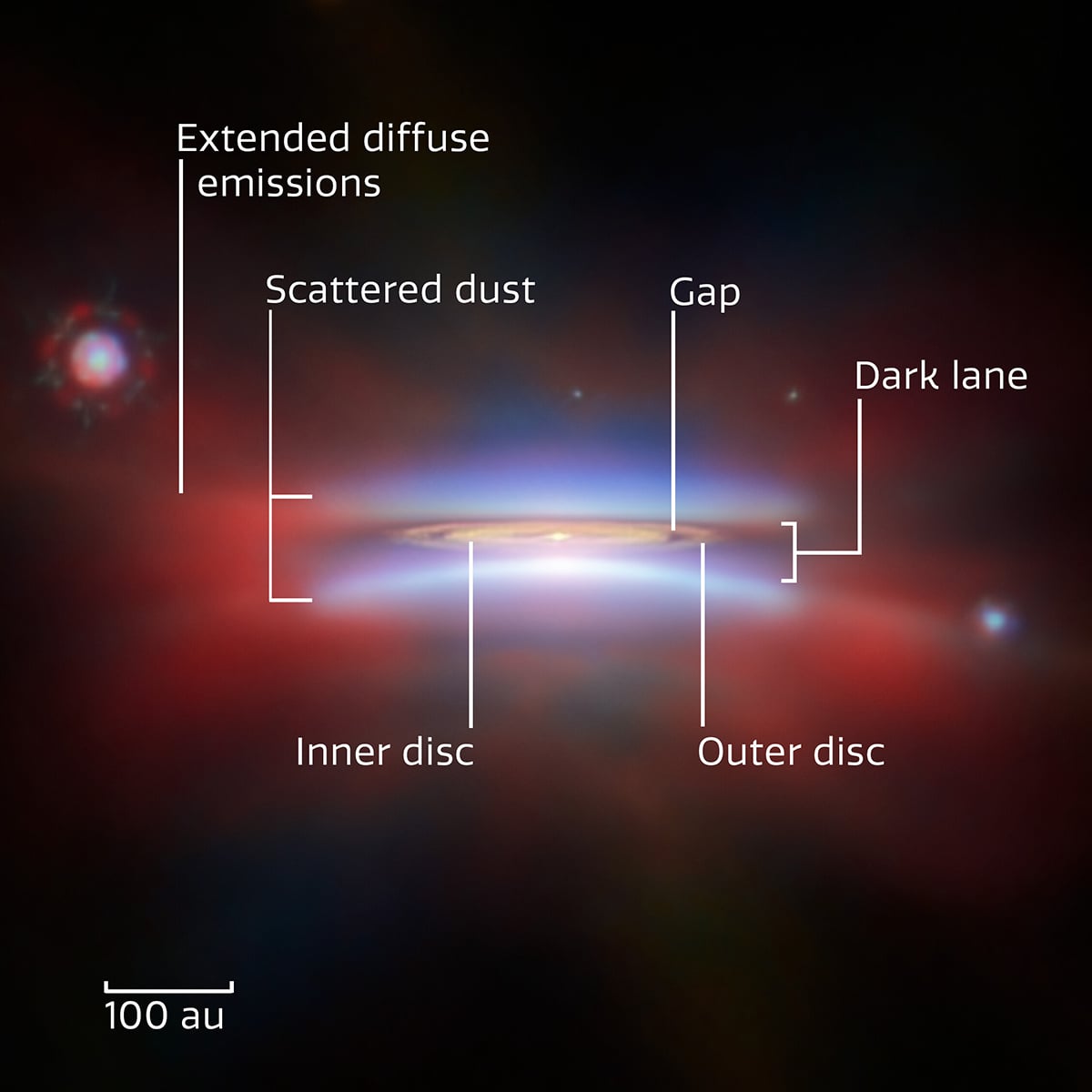
Tau 042021 and Oph 163131 appear almost perfectly edge-on. Consequently, their discs obscure direct starlight, producing a dark horizontal lane across each system. Above and below that lane, faint scattered light outlines the upper layers of the disc atmosphere. This geometry reveals the vertical structure that is normally hidden.
Dust does not remain uniformly mixed within a disc. Larger particles gradually settle toward the dense mid-plane, while smaller grains remain suspended at higher altitudes. This separation strongly influences how efficiently planets form. Dense mid-plane layers promote frequent collisions between particles and accelerate growth toward planetesimals.
The Taurus and Ophiuchus star-forming environments
Tau 042021 lies within the nearby Taurus molecular cloud, one of the closest active star-forming regions to Earth. Astronomers have studied Taurus for decades because it contains many young stars surrounded by discs at different evolutionary stages. This diversity allows researchers to compare systems that formed under similar conditions but evolved along different paths.
Oph 163131 lies within the Ophiuchus molecular cloud complex. Like Taurus, this region hosts numerous young stellar systems embedded within cold gas and dust. Many of these stars still retain massive circumstellar discs. As a result, Ophiuchus provides another important environment for studying early planetary development.
Both regions formed from large reservoirs of interstellar gas that continue to produce new stars today. However, discs inside such environments do not survive indefinitely. Stellar radiation, winds, and gravitational interactions gradually disperse the surrounding material. Planet formation must therefore occur within a limited time window.
Observations of Tau 042021 and Oph 163131 capture discs that remain active during this early evolutionary interval. Their structure reflects conditions that existed shortly after star formation began. Consequently, they provide valuable insight into how planetary systems emerge before disc dispersal progresses too far.
Multi-wavelength observations trace dust grain growth
The composite image released by ESA integrates observations from JWST, Hubble, and ALMA. Each observatory probes a different physical component of the discs. Together, they create a layered view of dust grain evolution across multiple size scales.
JWST observed both systems using near-infrared and mid-infrared wavelengths. These bands trace warm dust and molecular emission within the upper disc layers. They also reveal faint scattered light that outlines the vertical structure of the disc atmosphere.
Hubble contributed optical observations that highlight extremely small dust grains suspended above the mid-plane. These grains scatter visible light efficiently and therefore mark the outermost regions of the disc surface layers.
ALMA provided millimetre-wavelength measurements that detect larger particles concentrated closer to the mid-plane. These grains represent an advanced stage of dust growth and therefore play a direct role in planetesimal formation.
A combination of the datasets can map how particle size varies with height inside each disc. Small grains dominate the upper layers. Larger grains settle closer to the central plane. This distribution agrees closely with theoretical expectations for early planet-forming environments.
Clear skies!
See more from DIYPhotography.net on Google
Add DIYPhotography.net as a trusted source. This makes
our stories more likely to appear in your Google Search results.
 Add as a preferred source on Google

Soumyadeep Mukherjee
Soumyadeep Mukherjee is an award-winning astrophotographer from India. He has a doctorate degree in Linguistics. His work extends to the sub-genres of nightscape, deep sky, solar, lunar and optical phenomenon photography. He is also a photography educator and has conducted numerous workshops. His works have appeared in over 40 books & magazines including Astronomy, BBC Sky at Night, Sky & Telescope among others, and in various websites including National Geographic, NASA, Forbes. He was the first Indian to win “Astronomy Photographer of the Year” award in a major category.


Join the Discussion
DIYP Comment Policy
Be nice, be on-topic, no personal information or flames.