
























NASA captures a “Spooky Face” on the Sun: An image for Halloween
Nov 2, 2025
Soumyadeep Mukherjee
Soumyadeep Mukherjee is an award-winning astrophotographer from India. He has a doctorate degree in Linguistics. His work extends to the sub-genres of nightscape, deep sky, solar, lunar and optical phenomenon photography. He is also a photography educator and has conducted numerous workshops. His works have appeared in over 40 books & magazines including Astronomy, BBC Sky at Night, Sky & Telescope among others, and in various websites including National Geographic, NASA, Forbes. He was the first Indian to win “Astronomy Photographer of the Year” award in a major category.
Share:
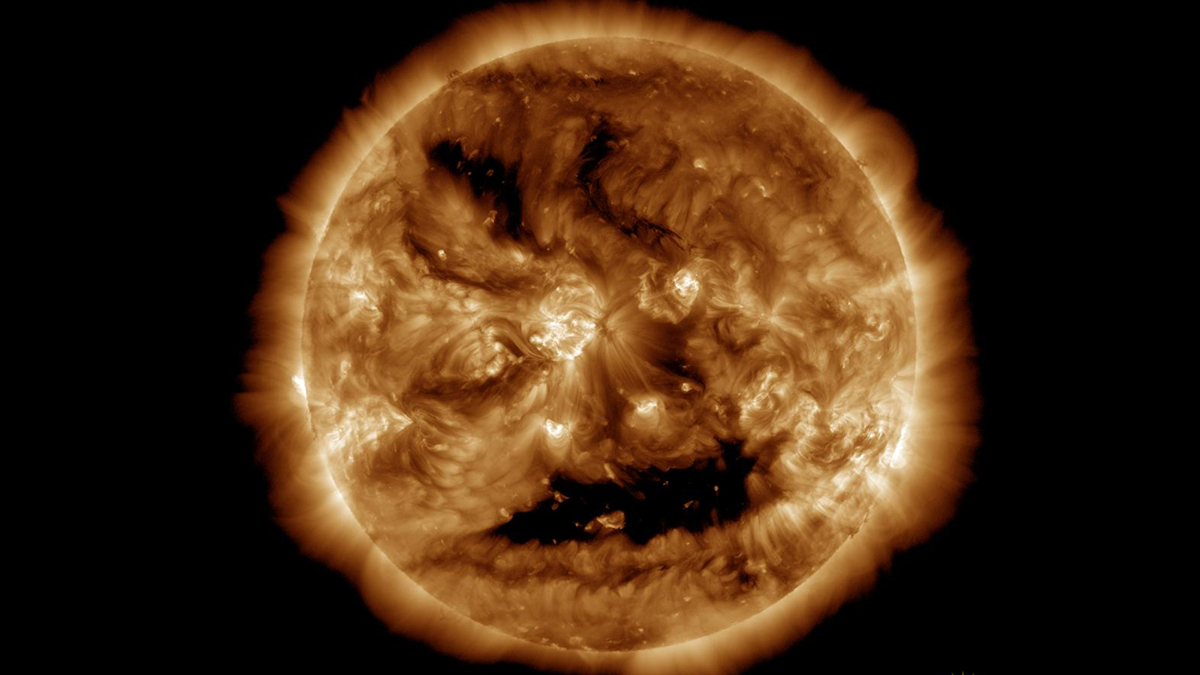
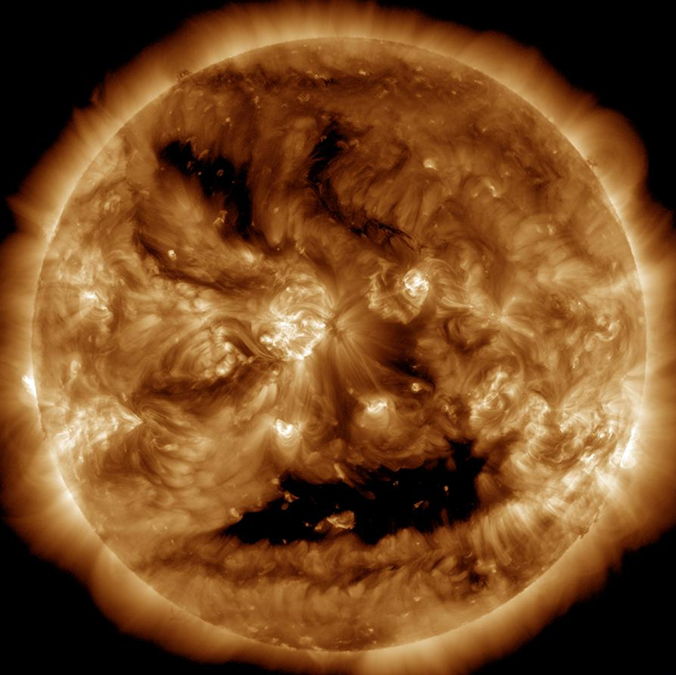
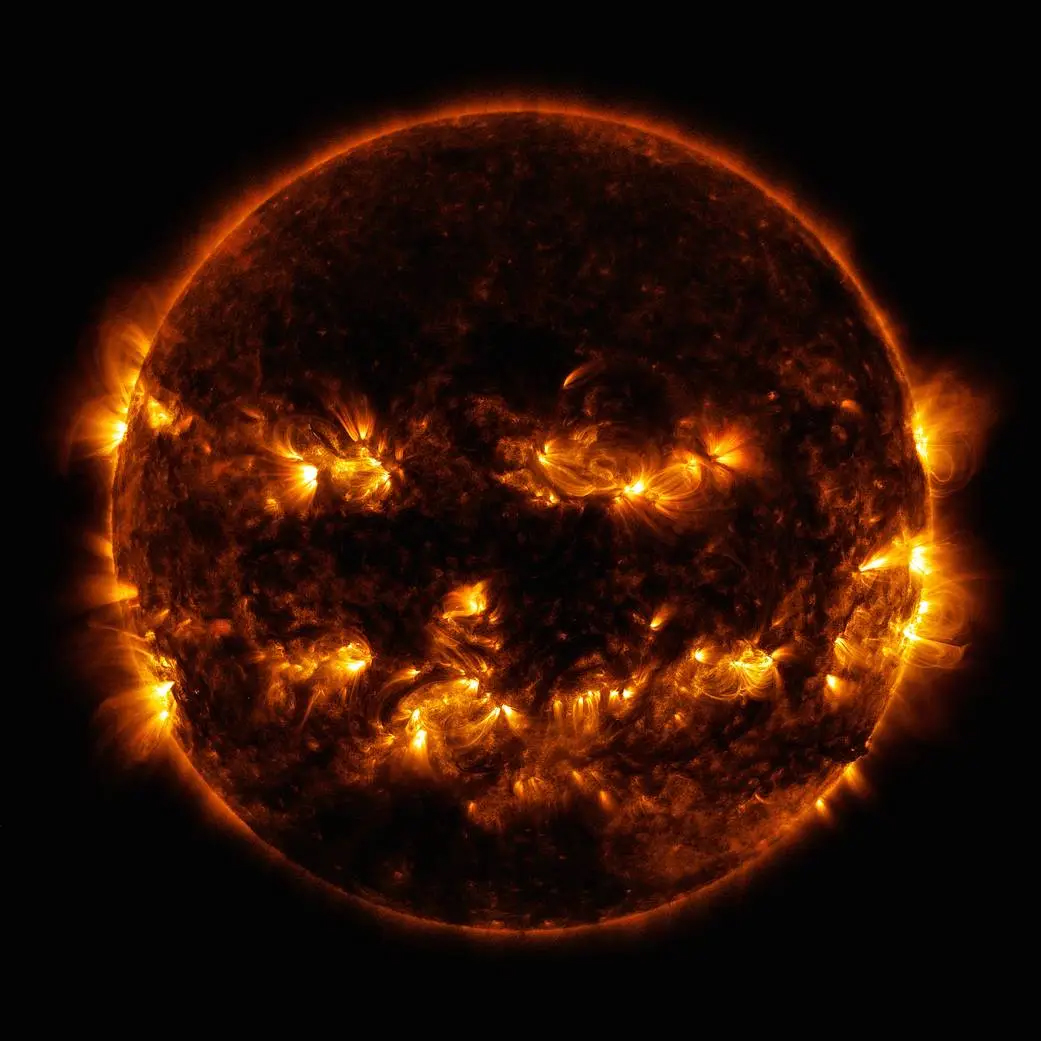
Just before Halloween 2025, NASA’s Solar Dynamics Observatory (SDO) captured something remarkable: the Sun appeared to grin like a jack-o’-lantern. In ultraviolet light, bright patches formed two glowing eyes and a nose, while a dark, wide arc curved into a smile. The timing was perfect for the season, but behind the humor lay a fascinating glimpse into the complex structure of our star.
How NASA’s Solar Dynamics Observatory saw it
The Solar Dynamics Observatory has been continuously monitoring the Sun since its launch in 2010. It records solar activity in multiple wavelengths, including extreme ultraviolet, to reveal fine details invisible to the naked eye. The image that created the Halloween buzz was taken in the 193-angstrom wavelength, which highlights plasma heated to about 1.25 million Kelvin.
In this light, the Sun’s corona, its outer atmosphere, appears in striking detail. Bright regions indicate areas of intense magnetic activity, while darker patches denote coronal holes, where magnetic field lines extend outward into space. On October 28, 2025, these features accidentally arranged themselves into a face-like pattern.
The SDO documented a natural combination of solar structures, one that human imagination instantly turned into a face. Scientists refer to this effect as pareidolia: the tendency to perceive familiar shapes, such as faces, in random patterns. It’s the same reason we see animals in clouds or figures on the Moon’s surface.
The science behind the “eyes” and “smile”
The glowing “eyes” in NASA’s image were active regions, places where the Sun’s magnetic field is especially strong and tangled. These regions often release bursts of energy in the form of solar flares or coronal mass ejections. The “smile,” on the other hand, was a large coronal hole stretching across the lower part of the solar disk.
Coronal holes are not dangerous in themselves. They are simply areas where the Sun’s magnetic field lines extend far into space, allowing high-speed solar wind to escape more freely. The solar wind is a continuous stream of charged particles flowing outward from the Sun. When that wind interacts with Earth’s magnetic field, it can cause minor geomagnetic disturbances and sometimes auroras near the poles.
In this case, scientists at NASA and NOAA noted that the coronal hole was sending a fast stream toward Earth. It was expected to cause only minor effects, nothing unusual or harmful. But it did remind researchers how dynamic and ever-changing the Sun remains, even as it follows predictable cycles of activity.
Understanding coronal holes and their effects
Coronal holes are among the most studied features in solar physics. They appear darker because they are cooler and less dense than the surrounding areas. The open magnetic field lines act as escape routes for particles that form the solar wind.
When the high-speed solar wind reaches Earth, it compresses the magnetosphere, the region dominated by Earth’s magnetic field. The interaction can create mild geomagnetic storms, which may interfere with radio signals, satellites, and power systems. But for most people, the visible result is beautiful: enhanced auroras in high-latitude skies.
Scientists use spacecraft like SDO, the Parker Solar Probe, and ESA’s Solar Orbiter to track these solar outflows. By studying how coronal holes evolve, they learn how energy moves from the Sun’s surface into interplanetary space. These observations help space agencies predict space-weather conditions that could affect astronauts and satellites.
A closer look at SDO’s role in solar science
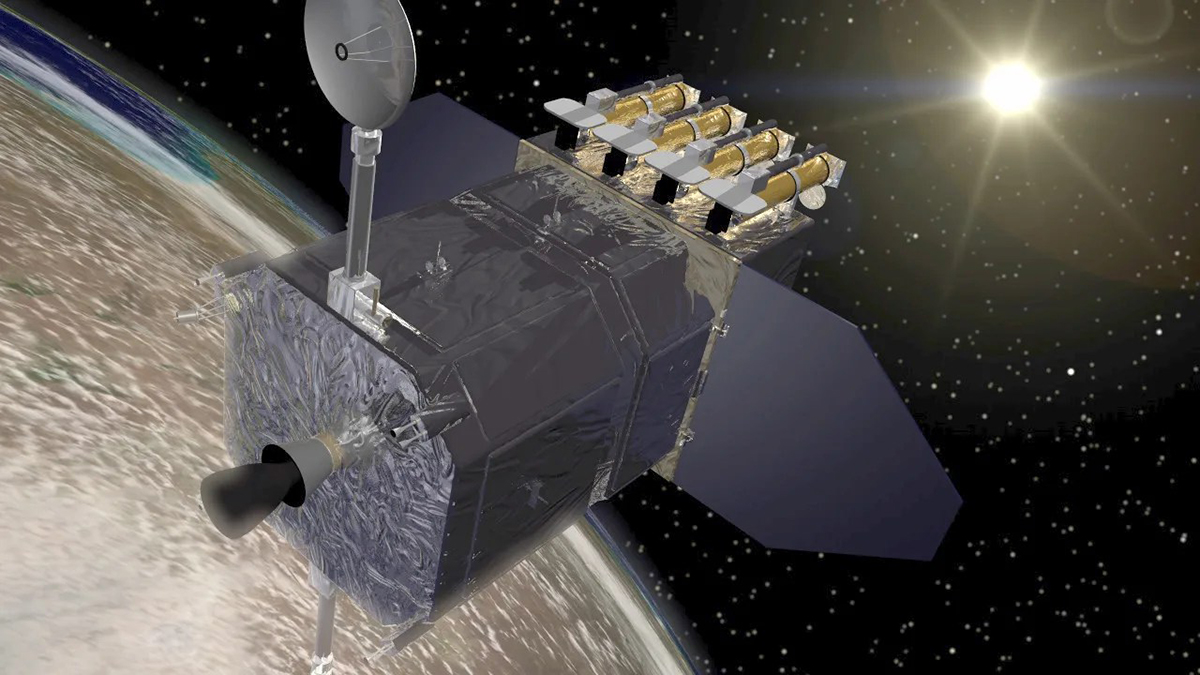
The Solar Dynamics Observatory is one of NASA’s most important solar missions. It was launched on February 11, 2010, as part of the agency’s Living With a Star program. The goal was to understand how solar variability influences Earth and near-Earth space.
SDO carries three main instruments:
- Atmospheric Imaging Assembly (AIA) captures high-resolution images of the Sun in multiple wavelengths, revealing details from the photosphere to the corona.
- Helioseismic and Magnetic Imager (HMI) studies magnetic fields and motions on the solar surface to understand how magnetic energy builds up.
- Extreme Ultraviolet Variability Experiment (EVE) measures changes in the Sun’s ultraviolet output that affect Earth’s atmosphere.
Together, these instruments provide a continuous, detailed picture of solar behavior. SDO sends back about 1.5 terabytes of data every day, more than any other NASA mission before it. Its images allow scientists to study how solar flares erupt, how magnetic loops twist and reconnect, and how large-scale events affect space weather.
The Halloween image came from AIA’s ultraviolet channel, which is particularly good at showing the structure of the corona. By examining such images over time, scientists can track how active regions grow and fade, how coronal holes shift, and how the solar magnetic cycle progresses.
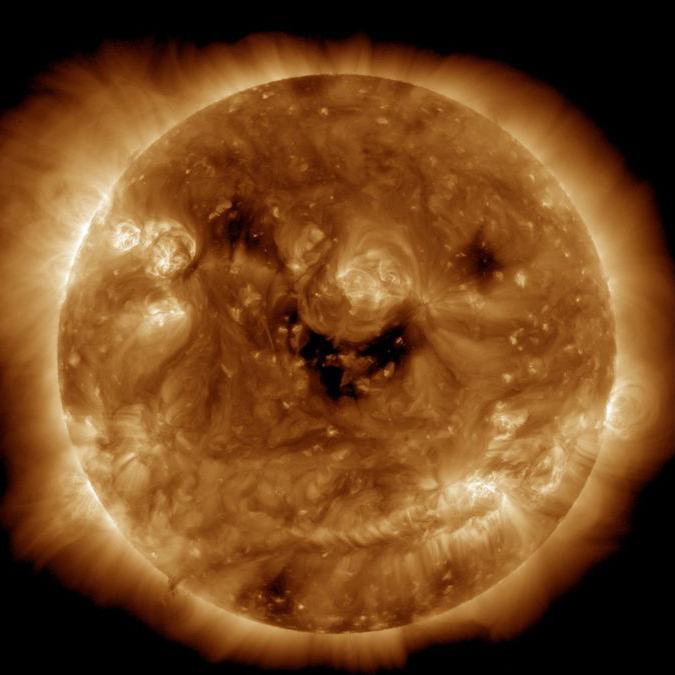
This wasn’t the first time the Sun appeared to smile. A similar image went viral in 2014, also captured by the SDO. Back then, NASA described it as a “pumpkin-like face” formed by active regions glowing brighter than their surroundings.
Clear skies!
See more from DIYPhotography.net on Google
Add DIYPhotography.net as a trusted source. This makes
our stories more likely to appear in your Google Search results.
 Add as a preferred source on Google

Soumyadeep Mukherjee
Soumyadeep Mukherjee is an award-winning astrophotographer from India. He has a doctorate degree in Linguistics. His work extends to the sub-genres of nightscape, deep sky, solar, lunar and optical phenomenon photography. He is also a photography educator and has conducted numerous workshops. His works have appeared in over 40 books & magazines including Astronomy, BBC Sky at Night, Sky & Telescope among others, and in various websites including National Geographic, NASA, Forbes. He was the first Indian to win “Astronomy Photographer of the Year” award in a major category.



Join the Discussion
DIYP Comment Policy
Be nice, be on-topic, no personal information or flames.