





















Collision in Centaurus: Dark Energy Camera’s View of Abell 3754
Oct 24, 2025
Soumyadeep Mukherjee
Soumyadeep Mukherjee is an award-winning astrophotographer from India. He has a doctorate degree in Linguistics. His work extends to the sub-genres of nightscape, deep sky, solar, lunar and optical phenomenon photography. He is also a photography educator and has conducted numerous workshops. His works have appeared in over 40 books & magazines including Astronomy, BBC Sky at Night, Sky & Telescope among others, and in various websites including National Geographic, NASA, Forbes. He was the first Indian to win “Astronomy Photographer of the Year” award in a major category.
Share:

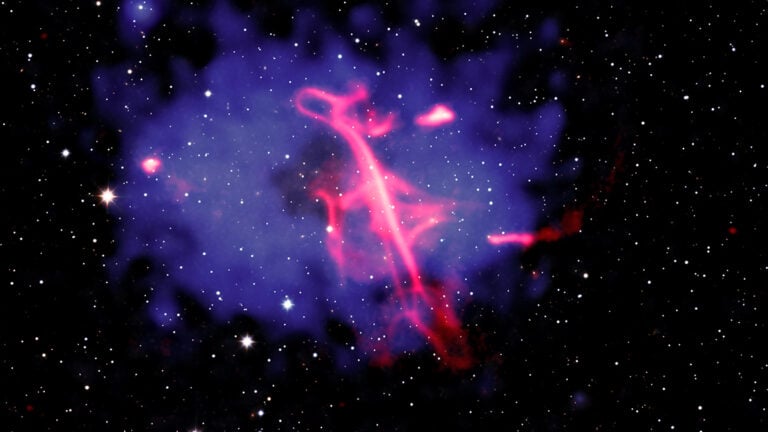
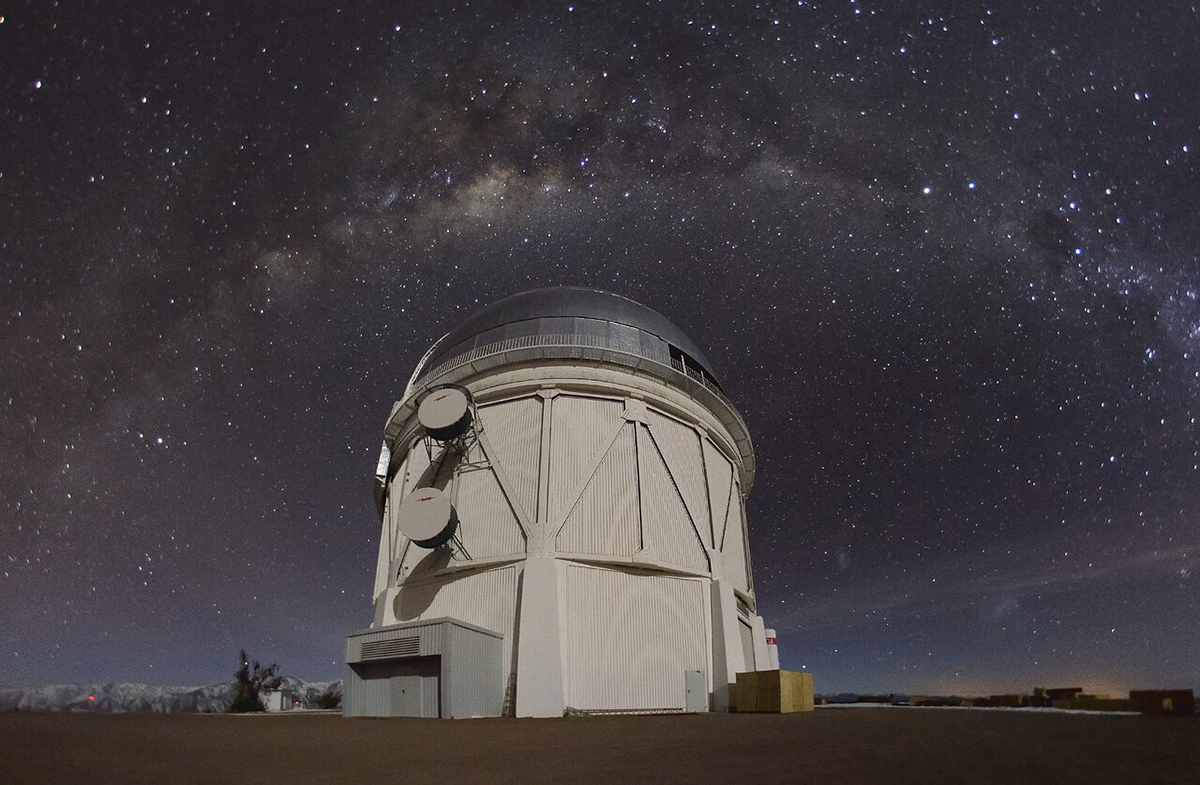
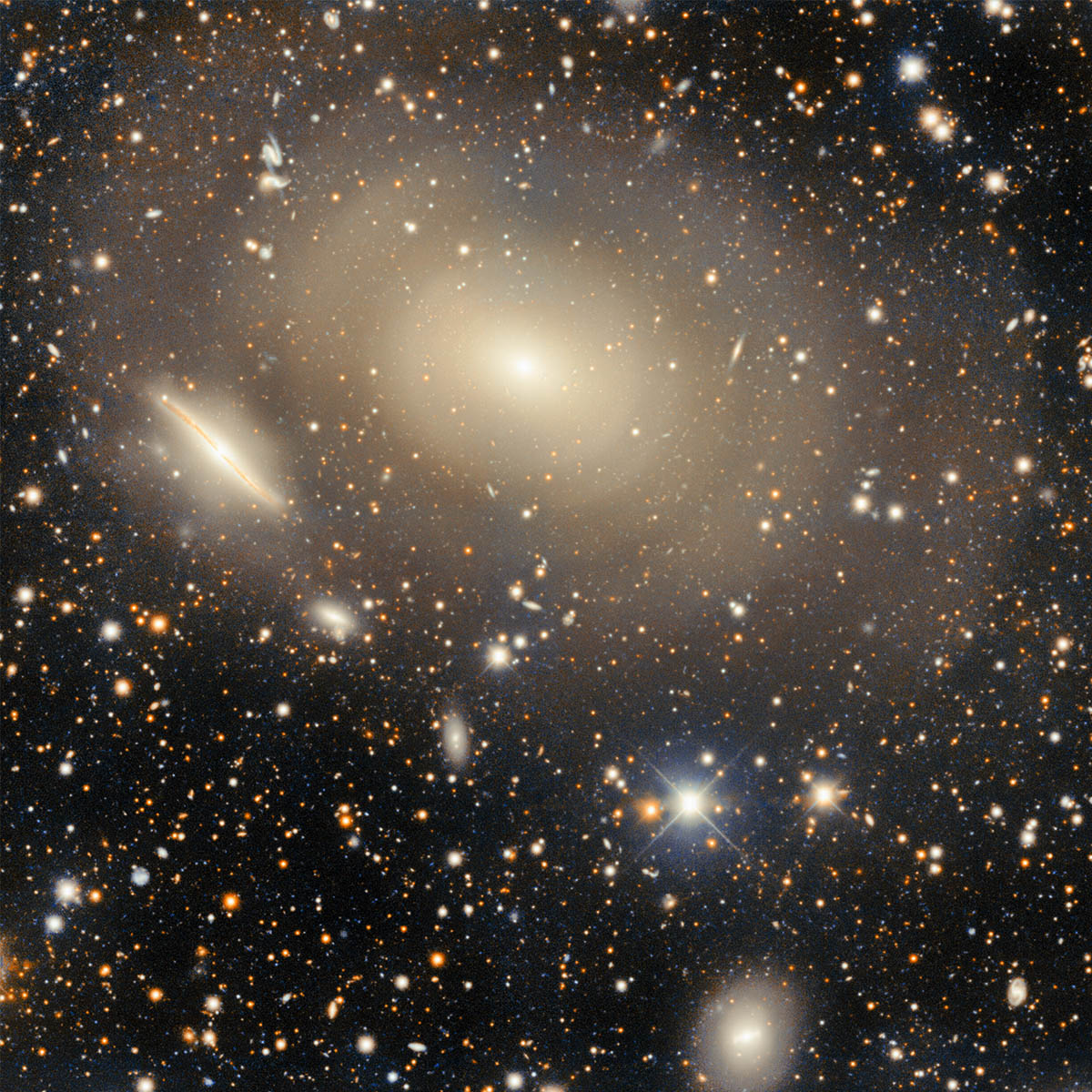
In the southern sky, a quiet storm unfolds. Galaxies collide, stretch, and reshape one another, leaving delicate trails of starlight behind. This dramatic scene is captured in NOIRLab’s latest “Image of the Week”, showing the galaxy cluster Abell 3754 in breathtaking detail. The image was taken with the Dark Energy Camera (DECam), mounted on the Víctor M. Blanco 4-meter Telescope at Cerro Tololo Inter-American Observatory in Chile. What it reveals is a glimpse into the restless life of galaxies bound together by gravity.
A busy cosmic neighborhood
Abell 3754 lies around 800 million light-years away, deep in the constellation Centaurus. The cluster contains hundreds of galaxies, most visible as soft glows against the dark sky. Some lie closer or farther along the line of sight, giving the image remarkable depth. At the upper left shines IC 4329, a massive, luminous galaxy dominating the field. Its extended halo and faint outer ring hint at a complex past. Around it, smaller galaxies look distorted, stretched into arcs and spirals by invisible forces. These are the fingerprints of tidal interactions, where gravity from one galaxy pulls on another, dragging out stars and gas in long filaments.
Clusters like Abell 3754 are crowded environments. Galaxies rarely move in isolation here. They pass near each other frequently, exchanging matter or even merging entirely. Every close encounter changes them, spirals lose their structure, gas is stripped away, and star formation slows. Over time, the once-blue galaxies filled with young stars fade into red, elliptical systems. What DECam shows here is that process frozen in motion: an entire population of galaxies caught mid-transformation.

The power behind the image: Dark Energy Camera
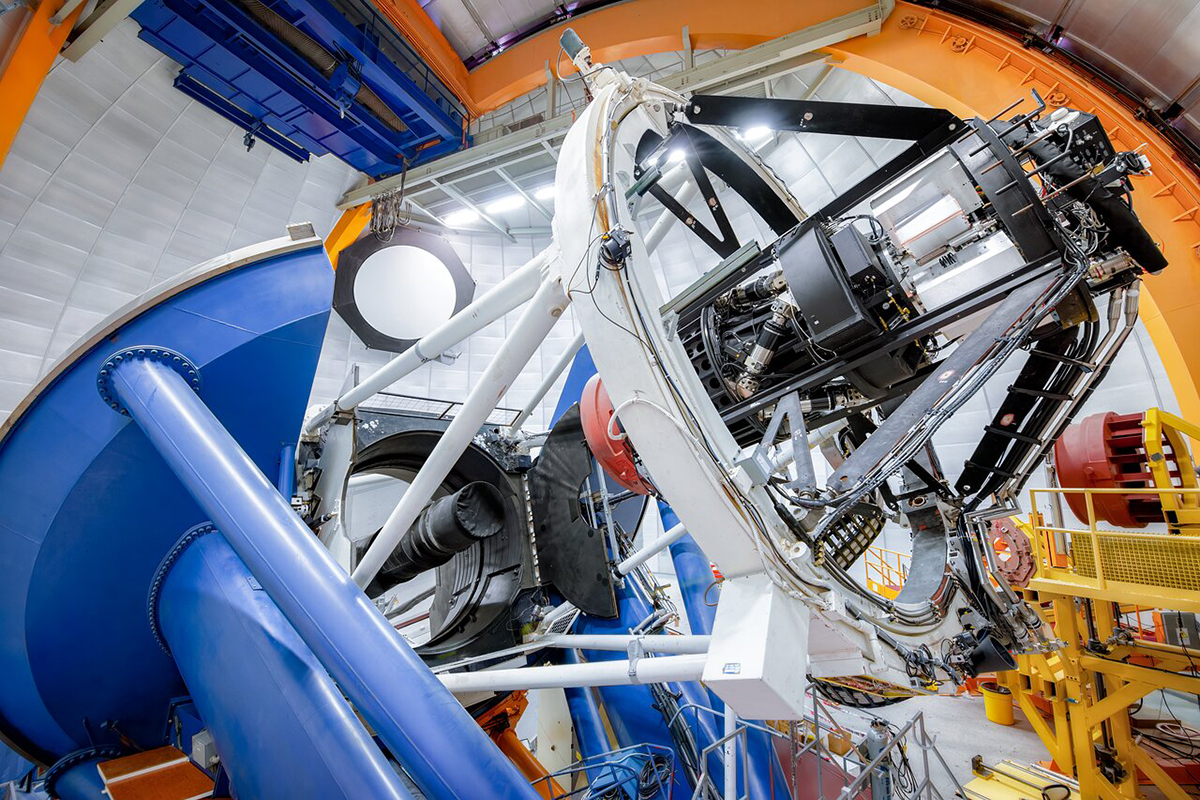
The Dark Energy Camera is one of the most advanced astronomical imagers ever built. It was designed for the Dark Energy Survey, a massive international effort to map hundreds of millions of galaxies and measure the expansion of the universe. DECam sits high on the Víctor M. Blanco 4-meter Telescope in Chile’s Atacama Desert, one of the clearest skies on Earth. Its 570-megapixel sensor and two-degree-wide field of view let astronomers capture entire galaxy clusters in a single shot.
That capability is what makes images like this possible. DECam records both the bright, obvious galaxies and the faint, ghostly structures that surround them. In Abell 3754, you can see delicate tidal streams and extended halos, the faint remains of past collisions that would be invisible to smaller telescopes.
Although built for cosmology, DECam now serves as a community instrument under NSF’s NOIRLab. Scientists use it for everything from galaxy evolution studies to supernova searches. The Abell 3754 image showcases its versatility, a single frame that is packed with information about structure, color, and form.
Collisions and consequences
At its core, this is an image about interaction. Each galaxy’s shape tells a story of motion, pressure, and change. The standout feature, IC 4329, sits like a beacon in the upper left. It is a Seyfert galaxy, meaning it hosts an active galactic nucleus, a supermassive black hole consuming nearby gas. As matter spirals inward, it emits intense radiation across the electromagnetic spectrum. Observations from Chandra and XMM-Newton have studied this activity in detail, showing how the black hole powers the galaxy’s central brightness.
The DECam image also reveals faint ripples and a wide, diffuse ring surrounding IC 4329. These are signatures of a past collision. When a smaller galaxy plunges through a larger one, it sends waves through the stars and gas. The result is a ring-like structure that can persist for hundreds of millions of years. Around it, other galaxies appear misshapen and streaked. Some display thin arcs of stars, known as tidal tails, created when galaxies pass close enough to pull material from one another. Eventually, these galaxies will merge, and the tails will fade, leaving behind a smoother, more rounded remnant.
A window into cosmic evolution
Every point of light in this image is a galaxy, and every galaxy carries history. Some are forming stars right now. Others have long gone quiet. Some are colliding, while others drift silently through the gravitational field of the cluster. The NOIRLab image of Abell 3754 captures these interactions in a single glance. It shows how galaxies evolve not in isolation but as part of a living ecosystem. Gravity binds them together and reshapes them endlessly.
Abell 3754 may be hundreds of millions of light-years away, but its image brings us close to the mechanics of cosmic evolution. The universe, even in its stillness, is never truly at rest. Galaxies grow, merge, and transform, a constant cycle that defines the structure of the cosmos.

Clear skies!
See more from DIYPhotography.net on Google
Add DIYPhotography.net as a trusted source. This makes
our stories more likely to appear in your Google Search results.
 Add as a preferred source on Google

Soumyadeep Mukherjee
Soumyadeep Mukherjee is an award-winning astrophotographer from India. He has a doctorate degree in Linguistics. His work extends to the sub-genres of nightscape, deep sky, solar, lunar and optical phenomenon photography. He is also a photography educator and has conducted numerous workshops. His works have appeared in over 40 books & magazines including Astronomy, BBC Sky at Night, Sky & Telescope among others, and in various websites including National Geographic, NASA, Forbes. He was the first Indian to win “Astronomy Photographer of the Year” award in a major category.

Join the Discussion
DIYP Comment Policy
Be nice, be on-topic, no personal information or flames.