


























Malin 2 Revealed: Deep Imaging Uncovers the Hidden Past of a Giant Spiral Galaxy
Oct 15, 2025
Soumyadeep Mukherjee
Soumyadeep Mukherjee is an award-winning astrophotographer from India. He has a doctorate degree in Linguistics. His work extends to the sub-genres of nightscape, deep sky, solar, lunar and optical phenomenon photography. He is also a photography educator and has conducted numerous workshops. His works have appeared in over 40 books & magazines including Astronomy, BBC Sky at Night, Sky & Telescope among others, and in various websites including National Geographic, NASA, Forbes. He was the first Indian to win “Astronomy Photographer of the Year” award in a major category.
Share:

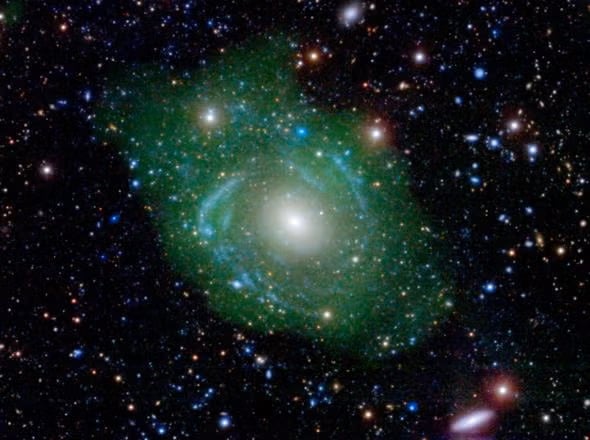
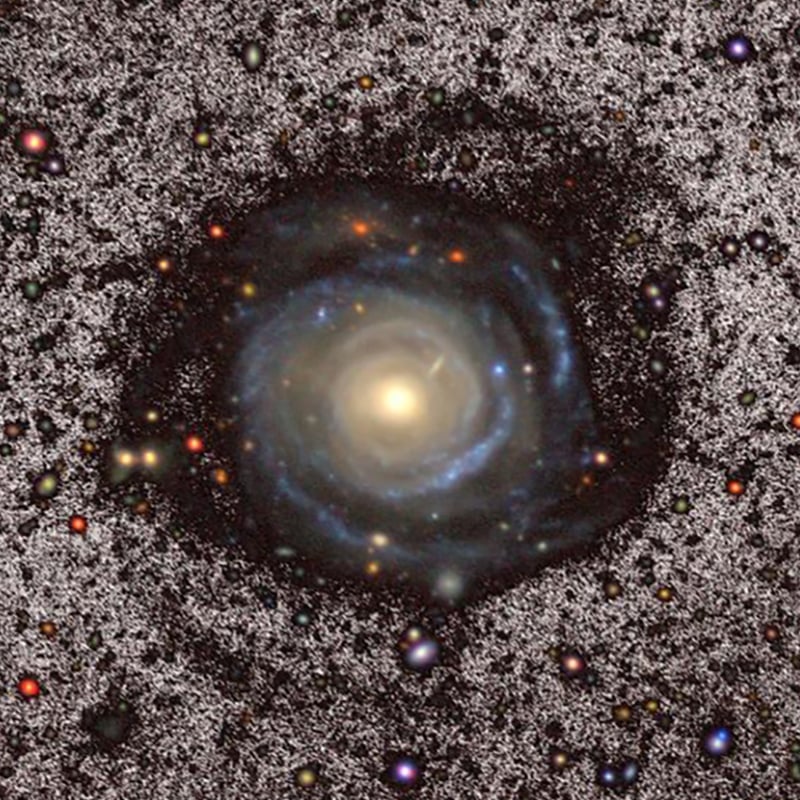
Astronomers have taken a fresh, unblinking look at one of the most mysterious galaxies in the nearby universe: Malin 2. Using ultra-deep images from the Two-meter Twin Telescope (TTT) at the Teide Observatory in Spain’s Canary Islands, researchers from the Instituto de Astrofísica de Canarias (IAC) have uncovered faint structures that were invisible until now. These delicate features, sprawling arms, diffuse light, and even a potential satellite dwarf galaxy, paint a far more dynamic picture of this ghostly spiral.
For decades, Malin 2 has stood as an enigma. It is enormous, extending several times farther than the Milky Way, yet its stars are so spread out that the galaxy barely glows. In many surveys, it appears only as a dim smudge. Astronomers classify it as a giant low-surface-brightness galaxy, or GLSB, an elusive class of galaxies that defy simple formation models. Because they are so faint, their outer regions have remained largely uncharted.
A galaxy that hides in plain sight
Malin 2 was discovered in the 1980s and quickly earned attention for its sheer size and faintness. Its disk spans nearly half a million light-years, roughly five times the Milky Way’s diameter. But despite its scale, its stars emit very little light per unit area. The galaxy’s surface brightness is so low that even long-exposure photographs struggle to capture it. It’s like trying to photograph smoke in moonlight.
That invisibility has long frustrated astronomers. Was Malin 2 a quiet, isolated system that evolved without disturbance? Or was it a survivor of past collisions, its stars dispersed by gravitational encounters? Until recently, the data weren’t deep enough to tell. Ordinary imaging didn’t go far enough down the brightness scale to reveal the galaxy’s faint outskirts.
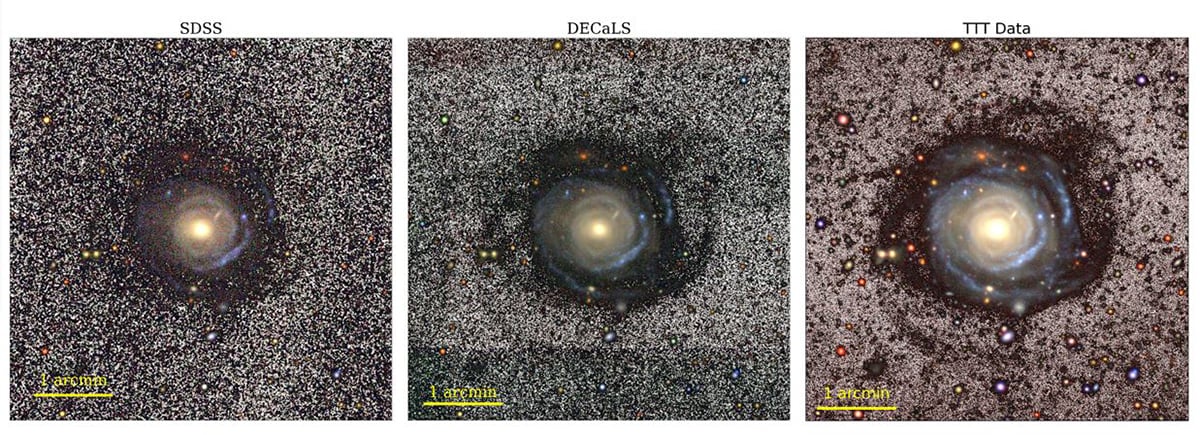
The IAC team decided to change that. Using the new TTT telescope, they conducted a dedicated deep-field campaign to trace Malin 2’s light as far out as possible. The result is the most detailed optical view ever obtained of this galaxy.
Unveiling the faintest structures
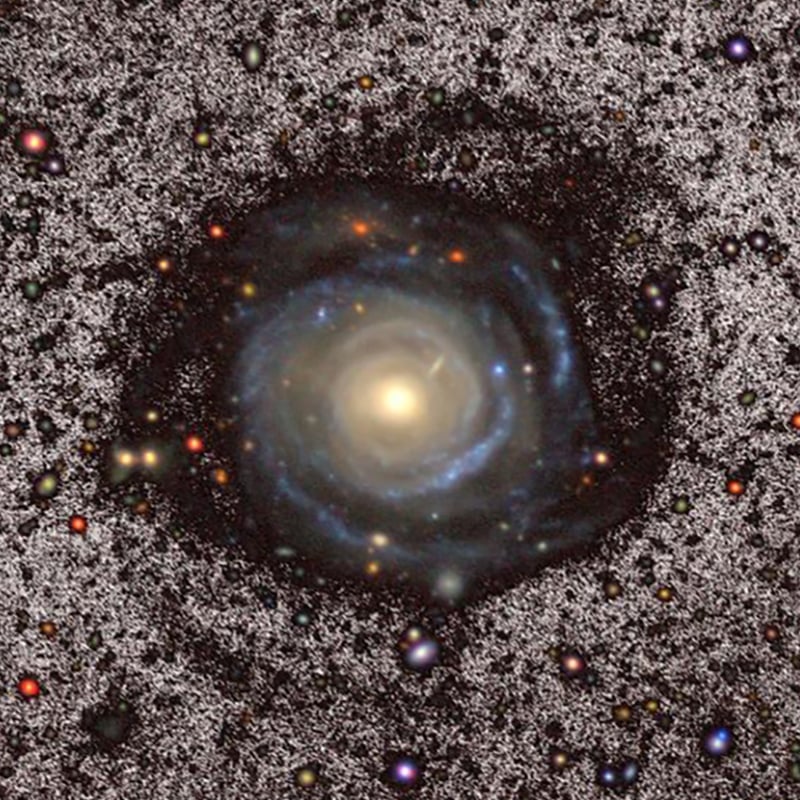
When the images came in, the researchers immediately noticed features that had never appeared before. They detected diffuse stellar emissions stretching far beyond the main disk. One elongated structure curved gracefully outward, a ghostly spiral arm or tidal extension, faint but unmistakable. Another region displayed asymmetric light that didn’t fit the expected smooth pattern of a calm, undisturbed spiral.
Digging deeper into the data, they identified a tiny, ultra-diffuse object about 400,000 light-years from Malin 2. It might be a dwarf satellite galaxy, possibly the first one linked to this system. The team named it TTT-d1, after the telescope that captured it. If confirmed, this companion could hold crucial clues about Malin 2’s past. Dwarfs often leave subtle signatures on the larger galaxies they orbit, distorting outer disks and triggering waves of star formation.
The researchers also compared the faint optical structures with previous hydrogen gas maps of Malin 2. The alignment was striking. Regions rich in neutral hydrogen corresponded closely with the newly discovered stellar features. That overlap strongly suggests a shared history, one shaped by gravitational interaction and gas dynamics, not quiet isolation.
A window into galaxy evolution
Why do these faint outer structures matter so much? Because they are time capsules. The outskirts of a galaxy preserve the scars of its past. When galaxies collide or interact, tidal forces pull out streams of stars and gas. These remnants can persist for billions of years, long after the main bodies have settled. Spotting them requires extraordinarily deep imaging, precisely what the TTT provided.
In Malin 2, those scars show that its history has been more turbulent than astronomers once believed. For years, giant low-surface-brightness galaxies were thought to evolve slowly and peacefully, gathering gas from their surroundings without much interference. But these new results point to something else. The faint arm-like structures and asymmetric light patterns tell a story of past encounters and tidal disruptions.
It’s possible that Malin 2 once merged with a smaller galaxy or pulled in several gas-rich companions. Such interactions could explain its broad, diffuse disk and its unusual gas dynamics. Instead of being a relic of gentle evolution, Malin 2 might be the product of cosmic reshaping, stretched and stirred by past collisions, yet still remarkably intact.
The telescope that made it possible
The breakthrough came thanks to the Two-meter Twin Telescope, or TTT, a relatively new facility at the Teide Observatory on Tenerife. Operated by the IAC, the TTT is designed specifically for deep, wide-field optical imaging. It features twin 2-meter Ritchey-Chrétien telescopes working in parallel, equipped with high-sensitivity scientific CMOS detectors.
Located at 2,390 meters above sea level, Teide offers stable atmospheric conditions, minimal light pollution, and more than 300 clear nights a year. The observatory’s dry, dark skies are ideal for faint-object work. The TTT’s wide field and robotic operation allow astronomers to take long, stable exposures across multiple filters without interruption.
For Malin 2, the team used this setup to push the limits of optical detection. They reached surface-brightness levels near 30 magnitudes per square arcsecond in the g-band, among the deepest ever achieved for such a large galaxy. At that depth, even the faintest extensions became visible. Without this instrument and site, the delicate stellar glow around Malin 2 would have remained invisible.

Rethinking a quiet giant
The findings carry big implications for how astronomers understand diffuse spiral galaxies. If Malin 2, one of the archetypes of its class, shows clear evidence of past disturbance, others may too. The idea that giant low-surface-brightness galaxies form in perfect isolation may no longer hold.
Instead, they might grow through gradual accretion and occasional tidal events, accumulating gas and stars over long periods. That process could explain their immense size and low density. It also aligns with theoretical models where galaxies build up extended disks through minor mergers and cold gas inflow. Malin 2 may represent one step along that evolutionary path, a system stretched by interactions but still massive enough to remain stable.
Clear skies!
See more from DIYPhotography.net on Google
Add DIYPhotography.net as a trusted source. This makes
our stories more likely to appear in your Google Search results.
 Add as a preferred source on Google

Soumyadeep Mukherjee
Soumyadeep Mukherjee is an award-winning astrophotographer from India. He has a doctorate degree in Linguistics. His work extends to the sub-genres of nightscape, deep sky, solar, lunar and optical phenomenon photography. He is also a photography educator and has conducted numerous workshops. His works have appeared in over 40 books & magazines including Astronomy, BBC Sky at Night, Sky & Telescope among others, and in various websites including National Geographic, NASA, Forbes. He was the first Indian to win “Astronomy Photographer of the Year” award in a major category.


Join the Discussion
DIYP Comment Policy
Be nice, be on-topic, no personal information or flames.