






















James Webb Captures Stunning View of Pismis 24 in the Lobster Nebula
Sep 4, 2025
Soumyadeep Mukherjee
Soumyadeep Mukherjee is an award-winning astrophotographer from India. He has a doctorate degree in Linguistics. His work extends to the sub-genres of nightscape, deep sky, solar, lunar and optical phenomenon photography. He is also a photography educator and has conducted numerous workshops. His works have appeared in over 40 books & magazines including Astronomy, BBC Sky at Night, Sky & Telescope among others, and in various websites including National Geographic, NASA, Forbes. He was the first Indian to win “Astronomy Photographer of the Year” award in a major category.
Share:

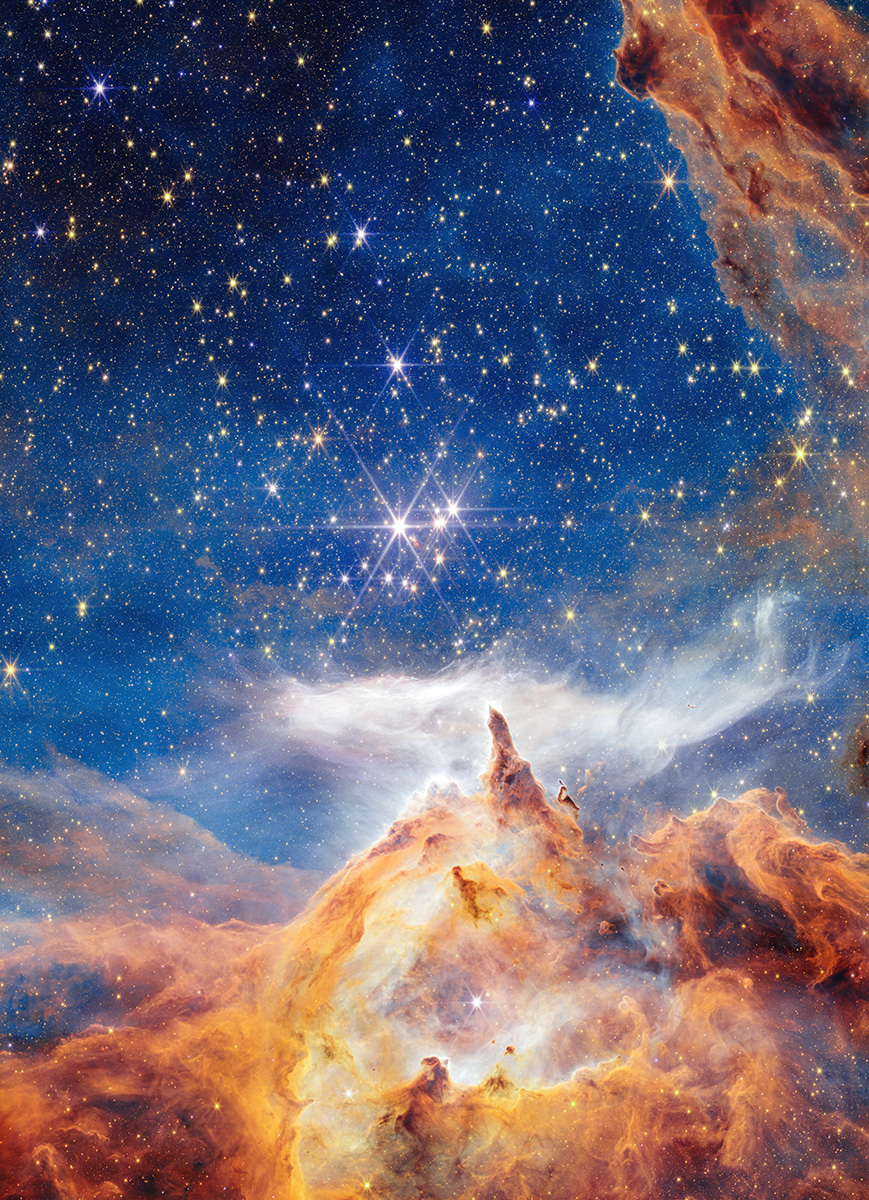
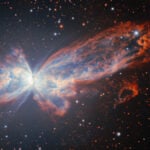
NASA and ESA have unveiled a breathtaking image taken by the James Webb Space Telescope. The release, called “Glittering glimpse of starbirth,” shows the young star cluster Pismis 24 in the heart of the Lobster Nebula, located about 5,500 light-years away in the constellation Scorpius. The picture was captured with JWST’s Near-Infrared Camera (NIRCam) and offers an extraordinary view of a stellar nursery where massive stars are being born. The image provides valuable insight into the powerful processes that shape star-forming regions.
Pismis 24: A cluster of giants
At the center of the scene lies Pismis 24, a cluster known for containing some of the largest stars ever identified. The most famous among them is Pismis 24-1, once believed to be a single giant star. Later studies revealed that it is at least two stars, with estimated masses of 74 and 66 times the Sun’s mass. These are still among the heaviest and most luminous stars in the Milky Way.
Massive stars like these live short but violent lives. They radiate enormous amounts of energy and unleash powerful stellar winds that blow away surrounding gas and dust. The JWST image shows this process in action. Huge spires of dust rise within the nebula, carved by the intense radiation of newborn stars. The tallest structures reach about 5.4 light-years, a length large enough to enclose more than 200 solar systems the size of ours.
Sculpted by light and wind
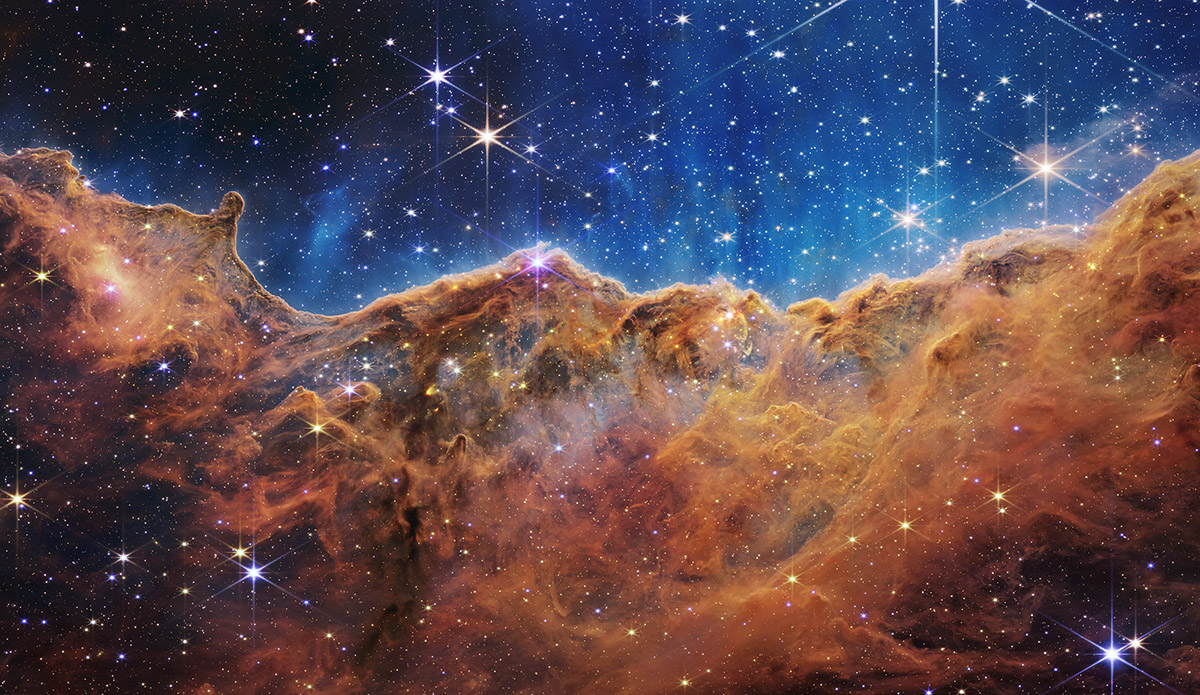
The Lobster Nebula, also cataloged as NGC 6357, is one of the most active star-forming regions in our galaxy. The new JWST image highlights the dramatic ways in which massive stars reshape their surroundings. What appears to be a mountain range in the picture is actually towering walls of gas and dust being eroded by intense radiation.
This balance of creation and destruction is a hallmark of stellar nurseries. While stars form from the densest clumps of gas, the very radiation they emit can strip away material and halt further star formation. JWST’s detailed view enables the study of both sides of this process in the same image.
Thousands of stars are scattered across the frame, some shining white or yellow, while others glow red due to intervening dust. Beyond the nebula itself, tens of thousands of stars from the Milky Way form a dense background. The result is a vivid snapshot of a busy stellar landscape.
JWST’s infrared vision
The James Webb Space Telescope was built to peer into dusty regions of the universe that optical telescopes cannot penetrate. Its infrared instruments can cut through the gas and dust that obscure young stars, revealing structures that were previously hidden.
In this image, JWST’s NIRCam brings out both the glowing gas and the stars embedded within the nebula. The sharp resolution allows astronomers to pick out individual stars in the crowded cluster. The instrument’s sensitivity also makes it possible to map temperature differences and chemical compositions across the scene.
For scientists, the ability to see through the dust and into the core of Pismis 24 is transformative. They can now track how newborn stars interact with their surroundings, measure the impact of stellar winds, and study the early conditions that eventually lead to supernova explosions. JWST’s unique capabilities are giving researchers a level of detail that was not possible before.

Star formation in a larger context
The JWST image of the Lobster Nebula joins other famous views of stellar nurseries, such as the Carina Nebula, the Tarantula Nebula, and the Pillars of Creation in the Eagle Nebula. Each region provides a different perspective on the same underlying processes. By comparing these observations, astronomers can build a more complete picture of how stars form across the Milky Way and beyond. JWST’s ability to study stellar nurseries in other galaxies means the lessons from Pismis 24 will serve as a reference point for interpreting more distant and less detailed observations.
Ultimately, studies like this connect back to the origins of life. The heavy elements forged in massive stars and spread through nebulae are essential for building planets and living organisms. JWST’s observations show us the very places where these ingredients are created and dispersed.
Clear skies!
See more from DIYPhotography.net on Google
Add DIYPhotography.net as a trusted source. This makes
our stories more likely to appear in your Google Search results.
 Add as a preferred source on Google

Soumyadeep Mukherjee
Soumyadeep Mukherjee is an award-winning astrophotographer from India. He has a doctorate degree in Linguistics. His work extends to the sub-genres of nightscape, deep sky, solar, lunar and optical phenomenon photography. He is also a photography educator and has conducted numerous workshops. His works have appeared in over 40 books & magazines including Astronomy, BBC Sky at Night, Sky & Telescope among others, and in various websites including National Geographic, NASA, Forbes. He was the first Indian to win “Astronomy Photographer of the Year” award in a major category.


Join the Discussion
DIYP Comment Policy
Be nice, be on-topic, no personal information or flames.