


























VLBA Photographs “Eye of Sauron”: A rare, head-on look into a blazar’s jet
Aug 19, 2025
Soumyadeep Mukherjee
Soumyadeep Mukherjee is an award-winning astrophotographer from India. He has a doctorate degree in Linguistics. His work extends to the sub-genres of nightscape, deep sky, solar, lunar and optical phenomenon photography. He is also a photography educator and has conducted numerous workshops. His works have appeared in over 40 books & magazines including Astronomy, BBC Sky at Night, Sky & Telescope among others, and in various websites including National Geographic, NASA, Forbes. He was the first Indian to win “Astronomy Photographer of the Year” award in a major category.
Share:
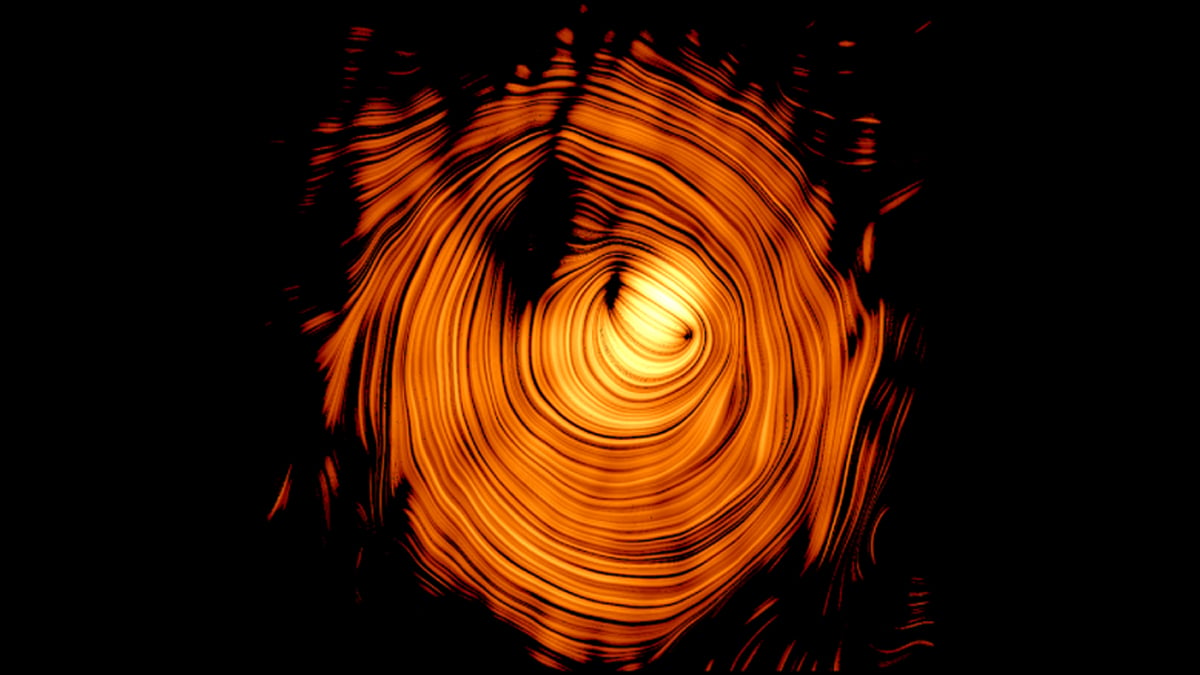
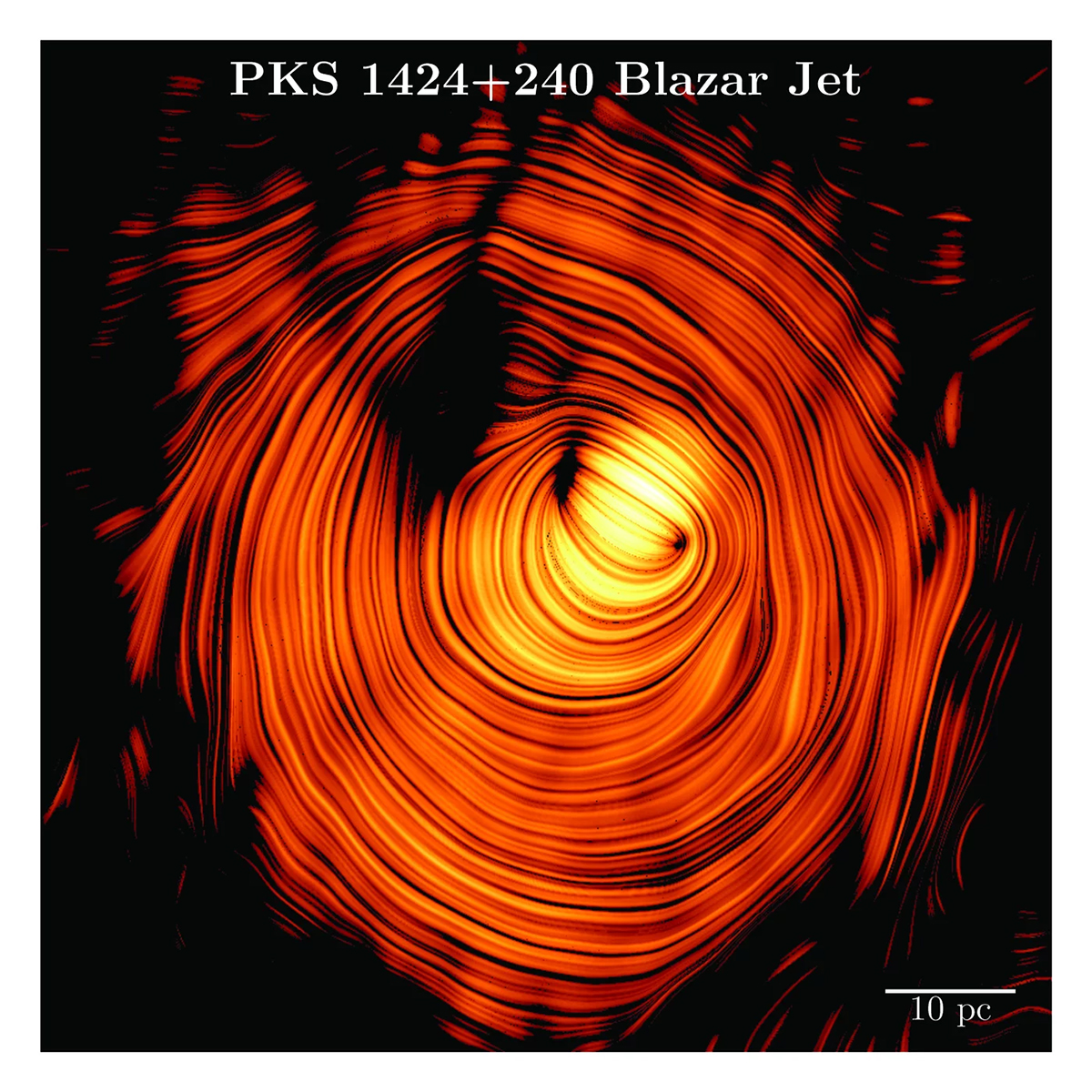
Astronomers have captured a remarkable radio image of the blazar PKS 1424+240. For the first time, we see its plasma jet almost perfectly head-on. In the image, the magnetic field forms a clean ring around the flow. This structure offers a direct clue to how the blazar produces its powerful gamma rays and neutrinos. The work is the result of 15 years of observations with the Very Long Baseline Array (VLBA). By combining polarization-sensitive images, researchers assembled a detailed view of the jet’s magnetic field.
What is a blazar?
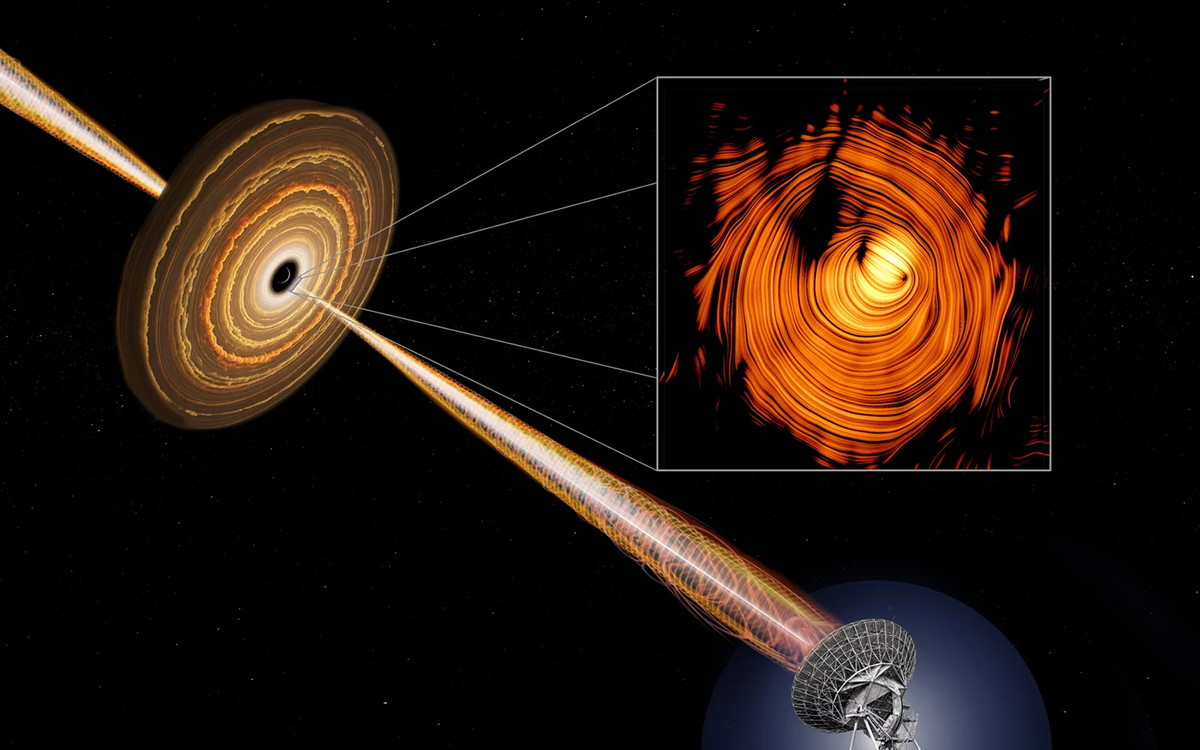
A blazar is a type of active galactic nucleus, or AGN. At the center of a distant galaxy, a supermassive black hole, millions to billions of times the Sun’s mass, draws in surrounding gas and dust. This matter forms a hot accretion disk. Magnetic fields and rotation drive twin jets of plasma that shoot out from the poles at nearly the speed of light. AGNs come in different classes depending on their orientation relative to Earth. If we look from the side, we see a radio galaxy or a quasar. But if one of the jets points almost directly at us, we see a blazar. That orientation matters. Because the jet points our way, relativity boosts its apparent brightness. Radiation across the electromagnetic spectrum is amplified, making blazars appear far brighter than they would from other angles. This effect, known as Doppler boosting, explains why blazars dominate high-energy sky maps.
The “Eye of Sauron”
In the new study, the team stitched together 42 VLBA images taken between 2009 and 2025. These images measured both intensity and polarization, which traces magnetic field geometry. By stacking the data, the researchers revealed faint but persistent structures hidden in individual epochs. The composite image shows a toroidal magnetic field, ring-shaped and ordered, around the jet. A toroidal or helical field confines and accelerates charged particles within the plasma. It provides the conditions needed to produce both very-high-energy photons and neutrinos. This is the clearest observational evidence yet that PKS 1424+240’s jet has the right internal structure to serve as a particle accelerator on cosmic scales.
PKS 1424+240 is not just any blazar. It stands out in IceCube’s neutrino sky maps. Analyses show that it contributes to the diffuse flux of astrophysical neutrinos, alongside other famous sources such as TXS 0506+056 and NGC 1068. Unlike single-event associations, this evidence is statistical: the blazar’s position aligns with a slight but persistent excess of detected neutrinos. At the same time, PKS 1424+240 is one of the brightest blazars at very high energies. Ground-based Cherenkov telescopes have observed it shining in the TeV gamma-ray range. Such emission requires extreme particle acceleration, yet the radio jet had appeared too slow to support the process. The new magnetic-field map shows why. With the jet pointing within 0.6 degrees of our line of sight, relativistic boosting explains the apparent contradiction.
How the image was made
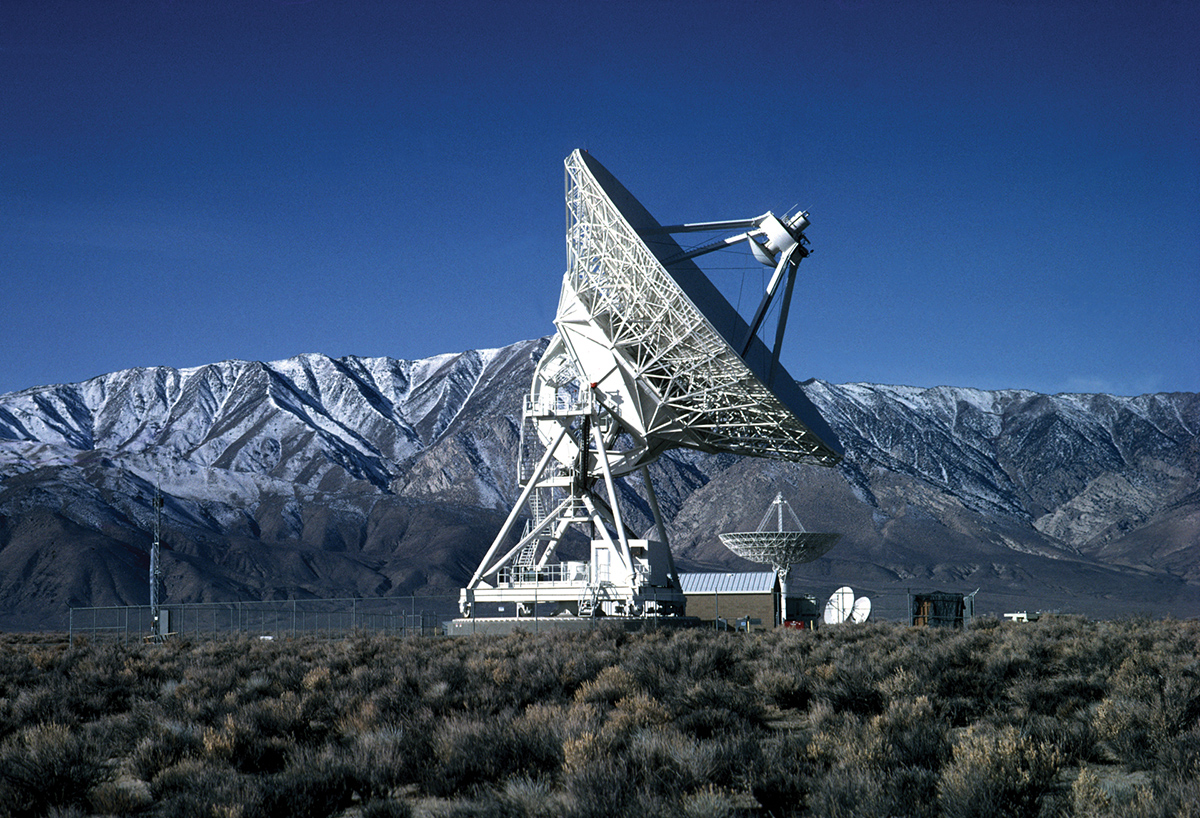
The Very Long Baseline Array is a continent-wide radio interferometer made up of ten 25-meter antennas. Stations stretch from Hawaii to St. Croix, giving a maximum baseline of 8,600 kilometers. Signals from each antenna are combined using very long baseline interferometry (VLBI). This technique achieves resolution at the tens-of-microarcsecond level, fine enough to probe parsec-scale jet structures in distant galaxies. For this project, researchers used 15-gigahertz observations from the MOJAVE program, a long-running survey that monitors radio-bright AGN across the northern sky. MOJAVE provides uniform calibration and cadence, which made it possible to align and stack more than a decade of images into a deep composite. The final result is a high-resolution map of the jet, viewed nearly head-on.
PKS 1424+240 is one of the brightest neutrino-associated blazars. The new magnetic-field structure shows exactly how the jet can accelerate protons to such energies. At the same time, the relativistic boosting explains the intense gamma-ray output observed by Cherenkov telescopes. Together, the multi-wavelength and multi-messenger evidence paints a consistent picture of the blazar’s engine.
Clear skies!
See more from DIYPhotography.net on Google
Add DIYPhotography.net as a trusted source. This makes
our stories more likely to appear in your Google Search results.
 Add as a preferred source on Google

Soumyadeep Mukherjee
Soumyadeep Mukherjee is an award-winning astrophotographer from India. He has a doctorate degree in Linguistics. His work extends to the sub-genres of nightscape, deep sky, solar, lunar and optical phenomenon photography. He is also a photography educator and has conducted numerous workshops. His works have appeared in over 40 books & magazines including Astronomy, BBC Sky at Night, Sky & Telescope among others, and in various websites including National Geographic, NASA, Forbes. He was the first Indian to win “Astronomy Photographer of the Year” award in a major category.
Related Posts
 Awakening of a Sleeping Giant: VLA and VLBA Photographs a Supermassive Black Hole
 BLAZAR has announced new Full-Frame anamorphic lenses for EF and PL mounts
 Blazar just dropped “the world’s lightest” affordable full-frame 2x anamorphic cine lenses
 One Cosmic Eye with Two Observatories: Hubble and Euclid Capture Cat’s Eye Nebula
Join the Discussion
DIYP Comment Policy
Be nice, be on-topic, no personal information or flames.