





















Ten breathtaking astrophotography images you should see (July 2025)
Aug 31, 2025
Soumyadeep Mukherjee
Soumyadeep Mukherjee is an award-winning astrophotographer from India. He has a doctorate degree in Linguistics. His work extends to the sub-genres of nightscape, deep sky, solar, lunar and optical phenomenon photography. He is also a photography educator and has conducted numerous workshops. His works have appeared in over 40 books & magazines including Astronomy, BBC Sky at Night, Sky & Telescope among others, and in various websites including National Geographic, NASA, Forbes. He was the first Indian to win “Astronomy Photographer of the Year” award in a major category.
Share:

NASA Astronomy Picture of the Day is a huge collection of astronomical images, both amateur and professional. It celebrates our amazing universe every day.
Since its inception in 1995, NASA APOD has been selecting and publishing some of the best images of space. Its two editors, Robert Nemiroff and Jerry Bonnell, are the people behind it. Here, you can view images captured by space telescopes such as Hubble and JWST. But it also includes amateur images taken with regular DSLR cameras.
Here are some of the best images from July 2025.
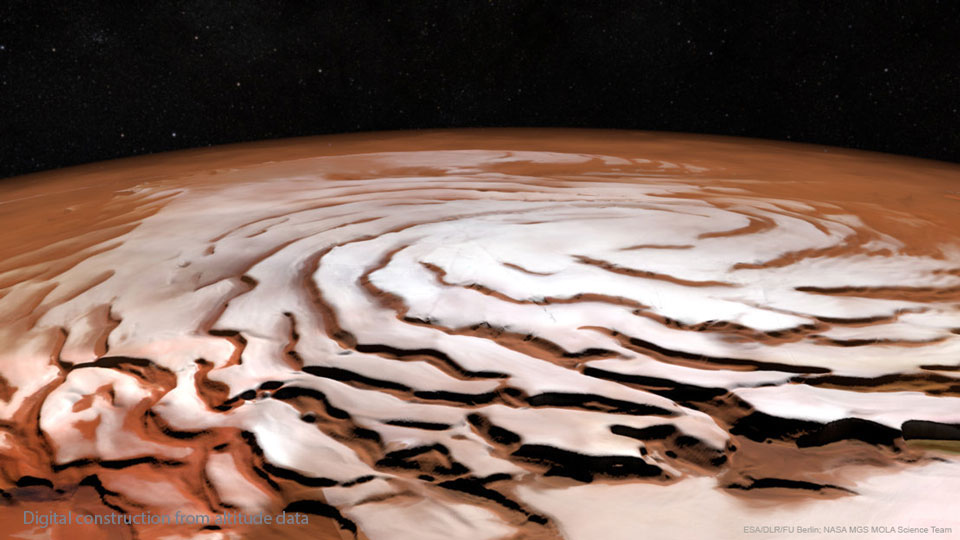
The Spiral North Pole of Mars
Why does the North Pole of Mars have a spiral? This pole forms a fresh outer layer every winter that is around one metre thick and is made of carbon dioxide that has been frozen out of the thin Martian atmosphere. This new layer is placed on top of an ever-present water-ice layer. The red planet’s rotation causes strong winds to whirl from above the cap’s centre, adding to Planum Boreum’s spiral shape. The highlighted picture is a perspective mosaic created in 2017 using heights from the laser altimeter on NASA’s Mars Global Surveyor mission and many photos captured by ESA’s Mars Express.
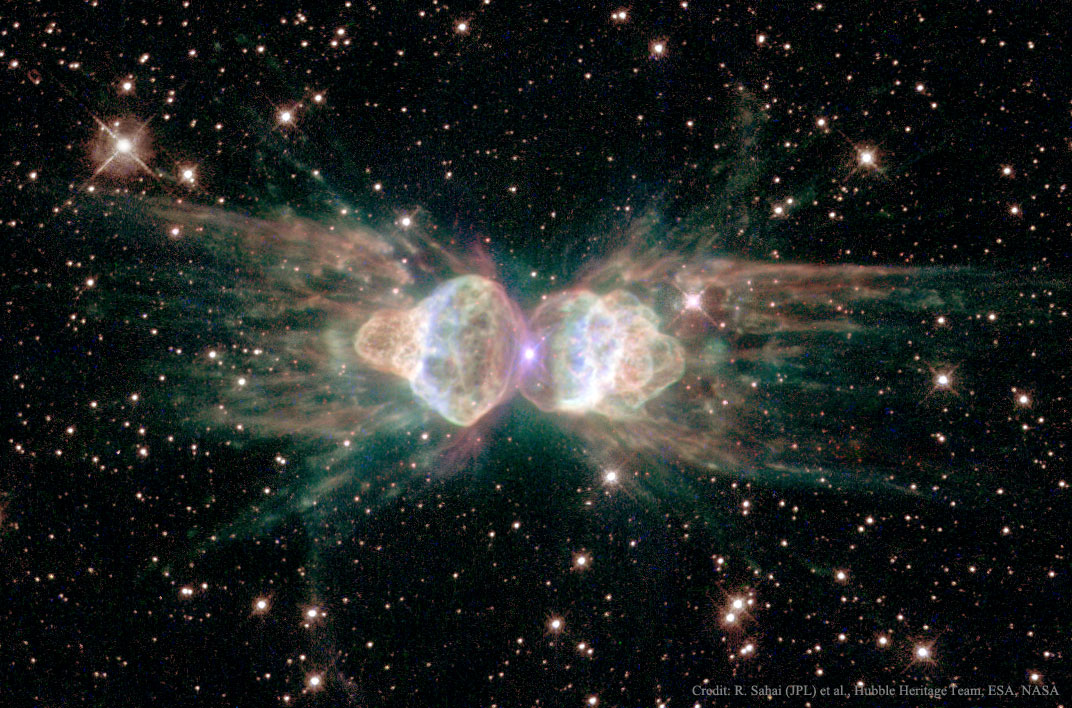
Planetary Nebula Mz3: The Ant Nebula
Why does this ant not resemble a large sphere? The planetary nebula Mz3 is being ejected by a star that is undoubtedly spherical and resembles our Sun. So why would the escaping gas form a nebula that is ant-shaped and clearly not round? The structure’s light-year length, the magnetic field of the star shown here in the centre of the nebula, and the high velocity of the blasted gas—1000 kilometres per second—could all be clues. One explanation could be that Mz3 is concealing a second, fainter star that circles the brilliant star. Another theory is that the gas is being channelled by the core star’s own magnetic field and spin.
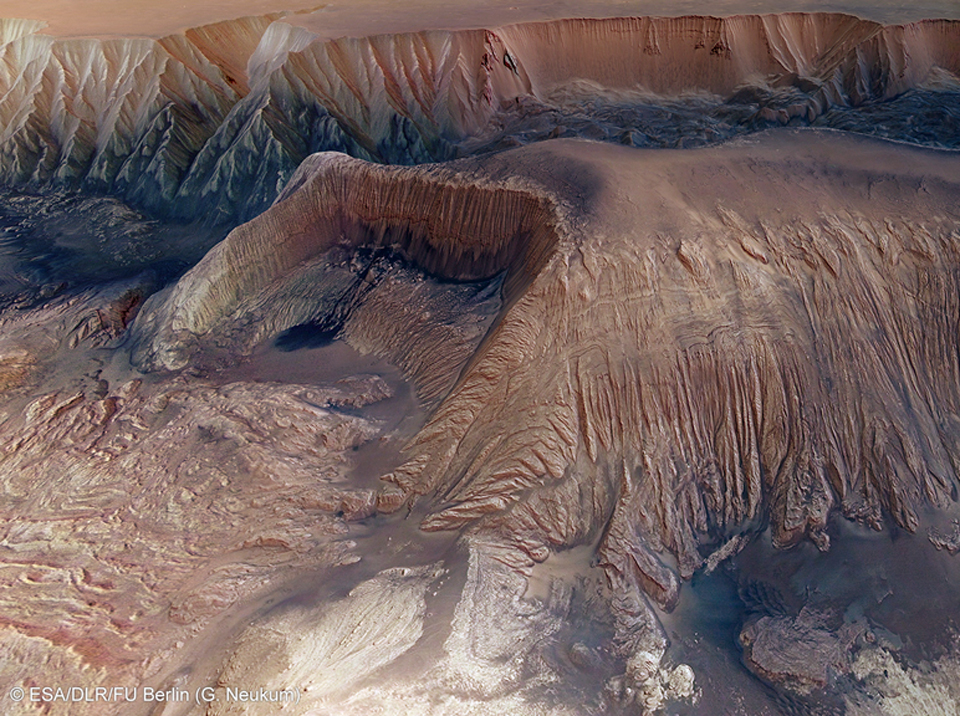
Collapse in Hebes Chasma on Mars
Just to the north of the massive Valles Marineris canyon lies a depression known as Hebes Chasma. It’s unknown where the interior material went because the depression isn’t connected to any other surface features. Hebes Mensa, a five-kilometer-high mesa inside Hebes Chasma, looks to have had an unexpected partial collapse; this collapse may be offering hints. Great details of the chasm and the peculiar horseshoe-shaped indentation in the central mesa are visible in the featured image, which was captured by ESA’s robotic Mars Express probe, which is presently orbiting Mars. A potential black layer seems to have gathered like ink on a downslope landing, while material from the mesa seems to have spilled onto the chasm bottom.
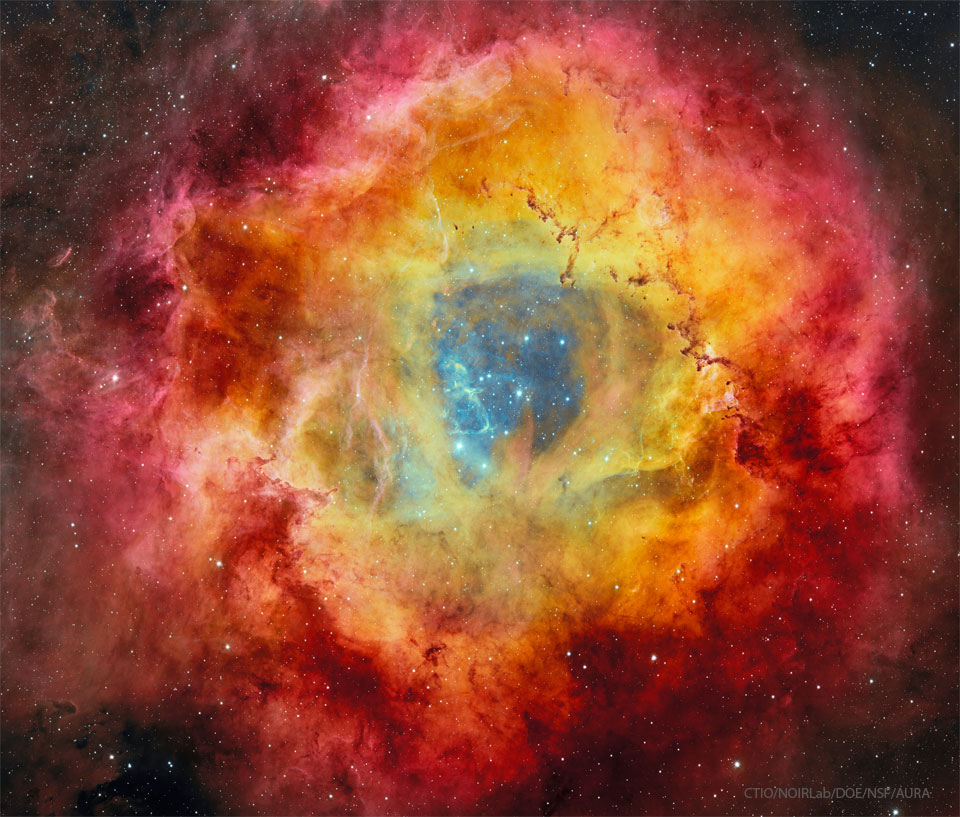
The Rosette Nebula from DECam
This flowery emission nebula, photographed by the Dark Energy Camera (DECam) on the Blanco 4-meter telescope at the NSF’s Cerro Tololo Inter-American Observatory in Chile, appears to be unaffected by its unimpressive New General Catalogue classification of NGC 2237. NGC 2244 is an open cluster of young, brilliant stars located inside the nebula. These stars, which are shielded by a layer of dust and hot gas, originated from the nebular material some four million years ago. Their stellar winds are currently removing a hole from the centre of the nebula. The surrounding nebula glows due to the hot cluster stars’ ultraviolet radiation. With a modest telescope, one may view the Rosette Nebula, which is roughly 100 light-years across and 5000 light-years away.
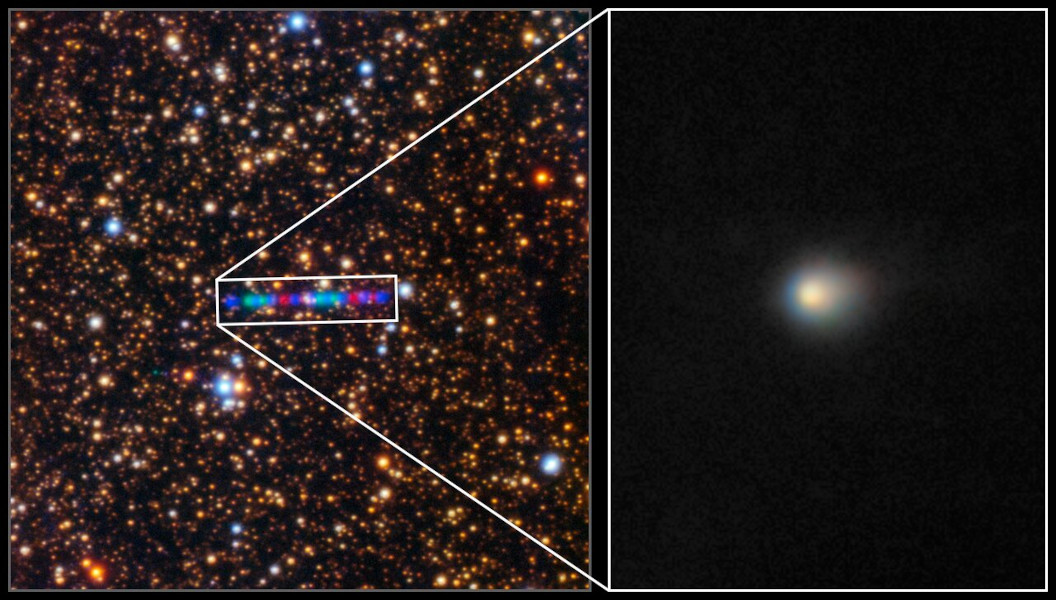
3I/ATLAS
3I/ATLAS is the third known interstellar object to travel through our Solar System. It was discovered on July 1 at Rio Hurtado, Chile, using the NASA-funded ATLAS (Asteroid Terrestrial-impact Last Alert System) survey telescope. It comes after the comet 2I/Borisov in 2019 and 1I/ʻOumuamua in 2017. 3I/ATLAS, also known as C/2025 N1, is unmistakably a comet. These pictures, taken with the massive Gemini North telescope on Maunakea, Hawai‘i, vividly show its widespread cometary coma, which is a cloud of gas and dust encircling an icy core.
ISS Meets Saturn
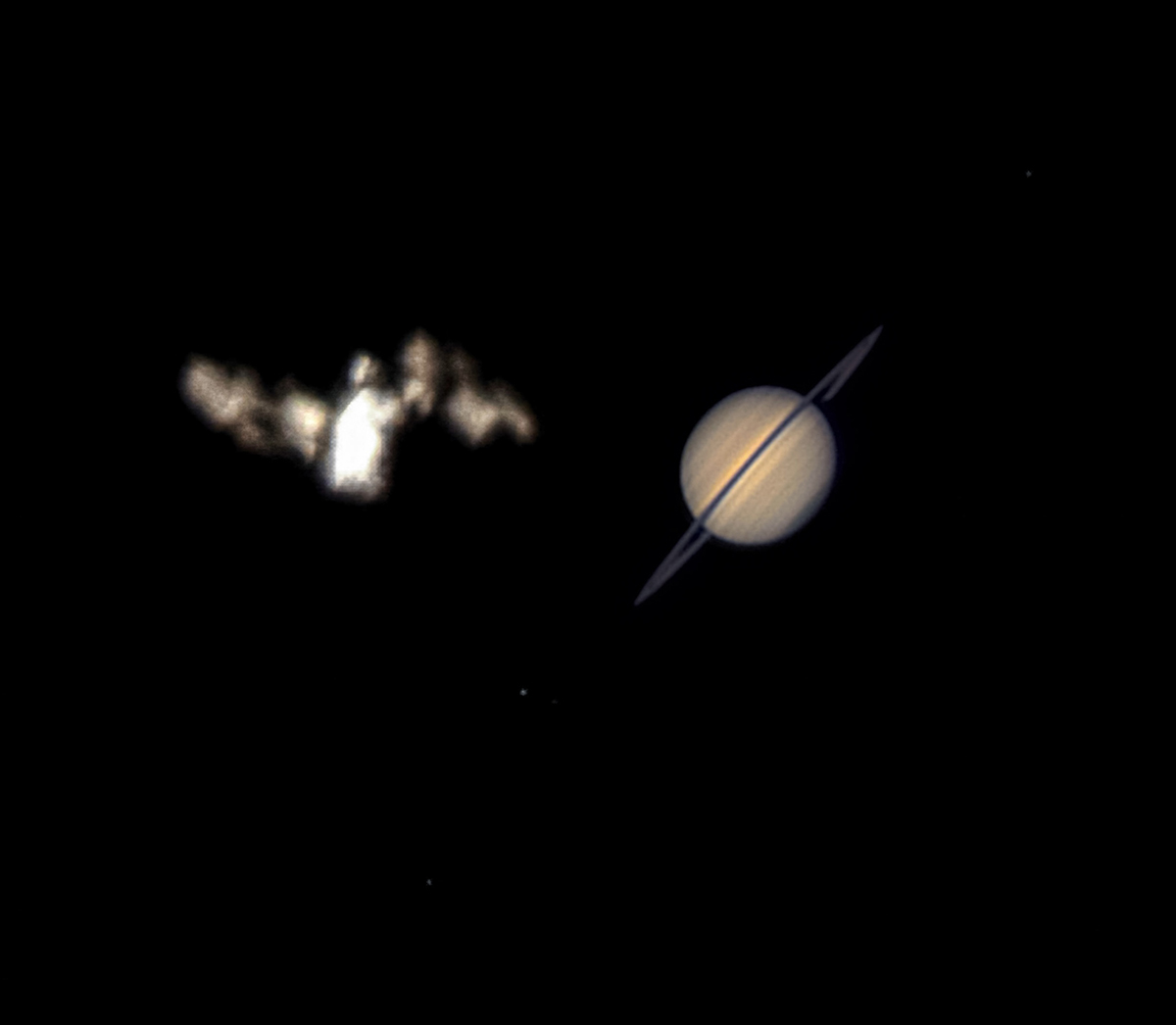
Viewed from a point in Federal Way, Washington, USA, Saturn briefly posed with the International Space Station in the early morning hours of July 6. Their brief conjunction in the same telescopic field of vision is captured in this carefully thought-out image, which is a stack of video frames. The distance between the space station and the gas giant planet was about 1.4 billion kilometres while the ISS was in low Earth orbit. Although they appear to be about the same size, the ringed planet’s brightness has been enhanced for visibility in the stacked image, and the ISS was significantly brighter than Saturn. Precise timing and an accurate position were needed to photograph the ISS/Saturn conjunction.
Lunar Nearside
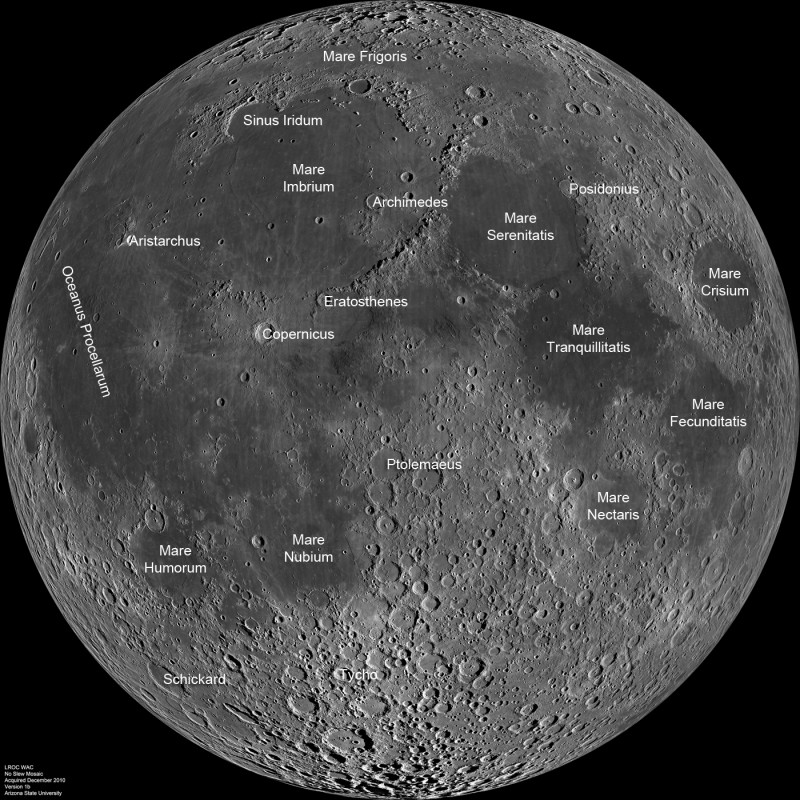
This breathtaking vision of a familiar face, the lunar nearside, was created from over 1,300 photos taken with the wide-angle camera on board the Lunar Reconnaissance Orbiter mission. About once every 28 days, the Moon circles the Earth and rotates on its axis at the same speed. One side, the nearside, is constantly facing Earth due to the synchronous rotation in this tidally locked configuration. As a result, earthbound skygazers are familiar with the smooth, dark, lunar maria (really lava-flooded impact basins) and rocky highlands, which are portrayed in astonishing detail in the full-resolution mosaic. Simply click this link or move your mouse over the image to locate your preferred mare or huge crater. Over the course of two weeks in December 2010, the LRO pictures that were used to create the mosaic were captured.
Cat’s Paw Nebula from Webb Space Telescope
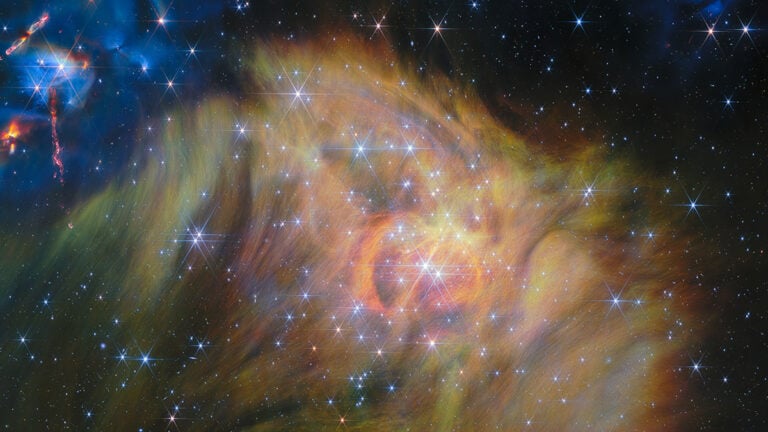
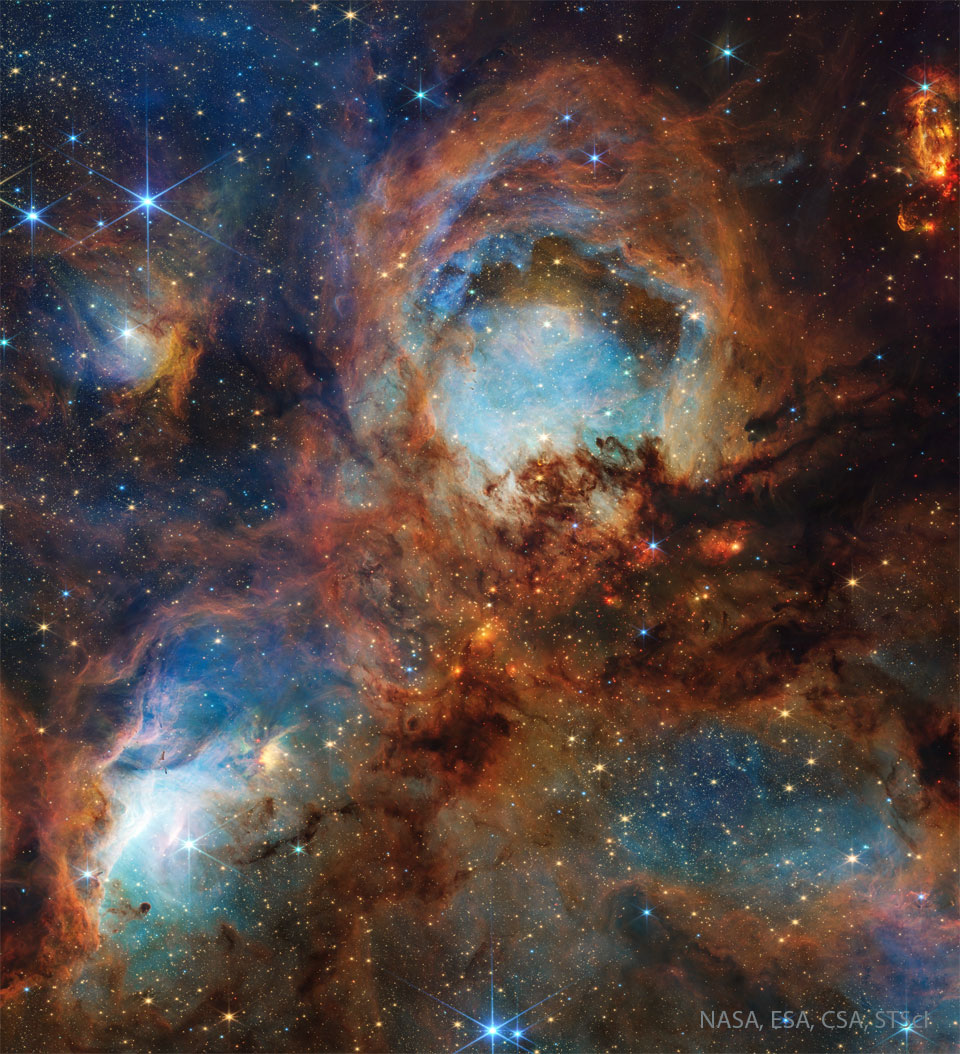
Cat’s Paw is an emission nebula located 5,700 light-years away in a bigger molecular cloud. In just the last few million years, stars over ten times the mass of our Sun have been created in the Bear Claw Nebula, also known as NGC 6334. Here is a newly published photograph of the Cat’s Paw captured by the James Webb Space Telescope using infrared light. This new, in-depth look at the nebula sheds light on how gas is converted to stars by turbulent molecular clouds.
A Double Detonation Supernova
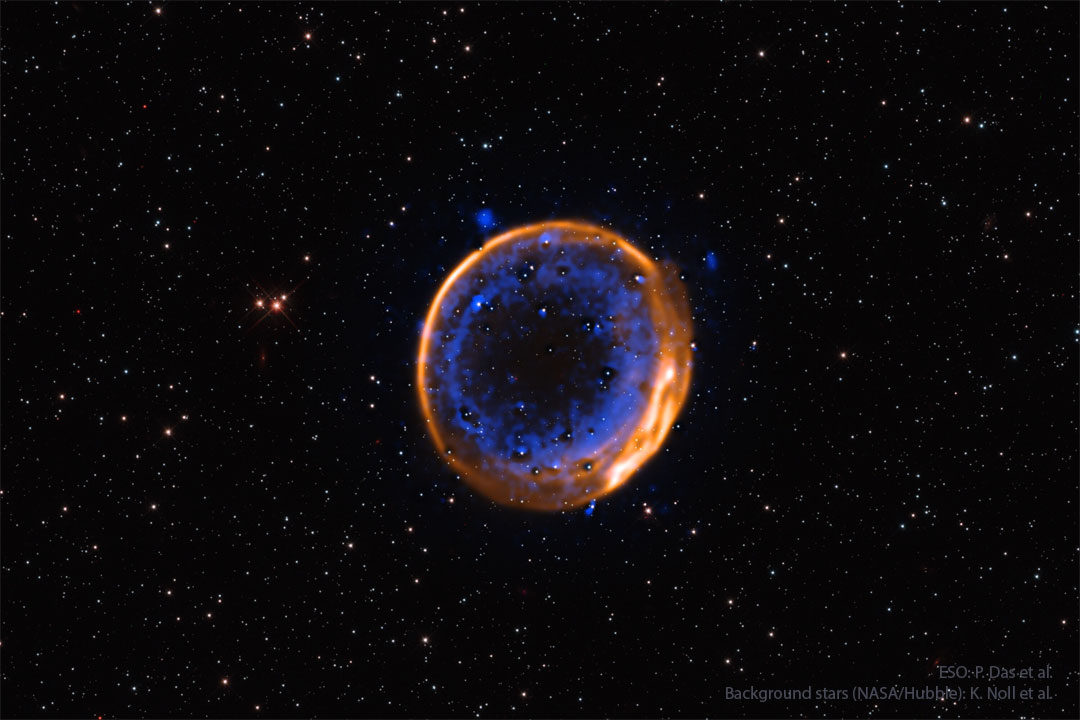
Are some supernovas capable of exploding twice? Yes, when the initial explosion serves as a catalyst for the subsequent one. One of the most plausible explanations for the origin of supernova remnant (SNR) 0509-67.5 is this. The larger, fluffier star in this two-star system loses mass to a smaller, denser white dwarf companion due to gravity. A complete Type Ia supernova is triggered close to the centre when the white dwarf’s near-surface temperature eventually reaches such a high point that it bursts, sending out a shock wave that also goes in. The featured image from the Very Large Telescope in Chile and other recent views of the SNR 0509-67.5 system reveal two shells with compositions and radii that support the twin explosion theory.
Twelve Years of Kappa Cygnids
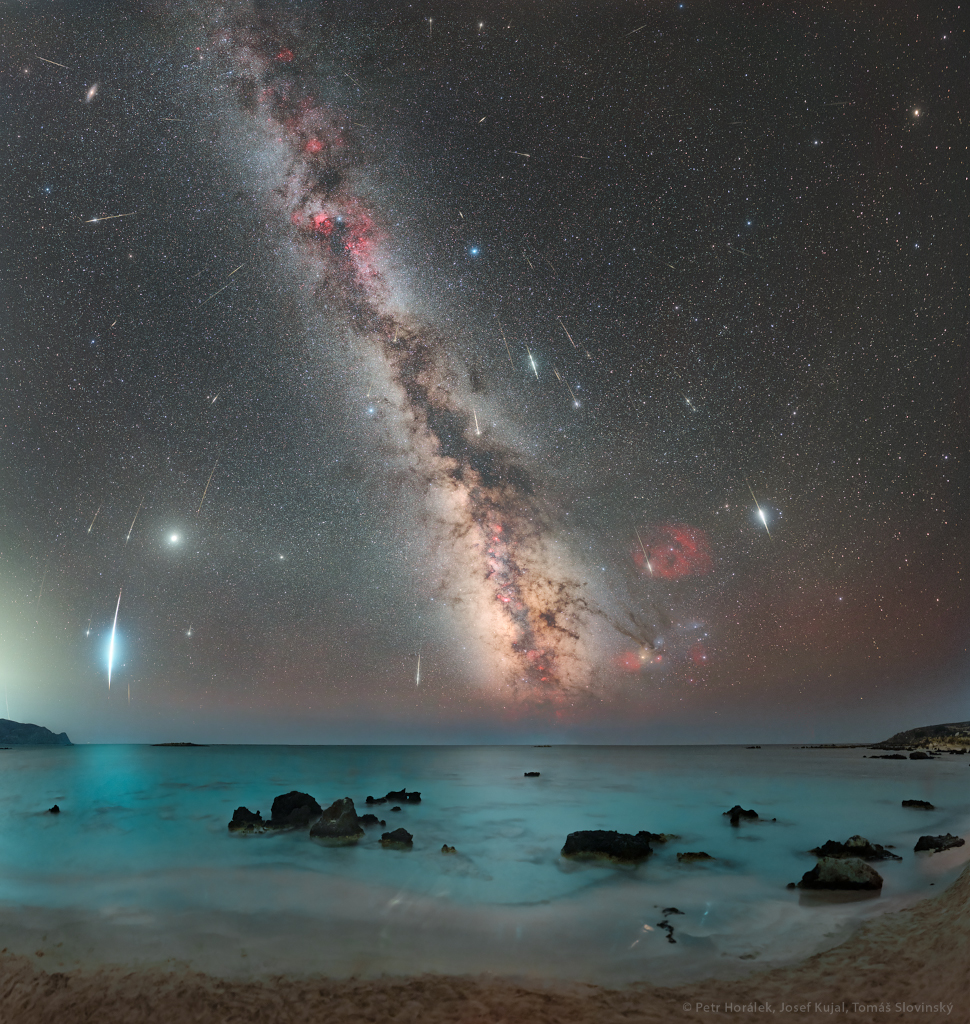
This time-lapse composite skyscape shows meteors from the Kappa Cygnid meteor shower. The minor meteor shower peaks in mid-August, nearly simultaneously with the much more well-known and better-observed Perseid meteor shower. It has a radiant not far from its titular star, Kappa Cygni. However, the more well-known and frequent meteor showers from the heroic constellation Perseus far outnumber the Kappa Cygnids, which are observed to have a peak rate of just roughly three meteors per hour. This long-term astro-imaging experiment collected meteors in exposures chosen from more than 51 August nights between 2012 and 2024 to record dozens of Kappa Cygnids. A base sea and night skyscape of the Milky Way above Elafonisi Beach in Crete, Greece, is used to register the twelve years’ worth of Kappa Cygnids.
If you have a space image, you can submit it to NASA APOD, too.
For more incredible astrophotography photos, check our previous Breathtaking Astronomy Photos articles:
- Breathtaking astrophotography images – June 2025
- Breathtaking astrophotography Images – May 2025
- Breathtaking Astrophotography Images – April 2025
- Breathtaking Astrophotography Images – March 2025
- Breathtaking Astrophotography Images – February 2025
- Breathtaking Astrophotography Images – January 2025
- Breathtaking Astrophotography Images – December 2024
- Breathtaking Astrophotography Images – November 2024
- Breathtaking Astrophotography Images – October 2024
- Breathtaking Astrophotography Images – September 2024
- Breathtaking Astrophotography Images – August 2024
Clear skies!
See more from DIYPhotography.net on Google
Add DIYPhotography.net as a trusted source. This makes
our stories more likely to appear in your Google Search results.
 Add as a preferred source on Google

Soumyadeep Mukherjee
Soumyadeep Mukherjee is an award-winning astrophotographer from India. He has a doctorate degree in Linguistics. His work extends to the sub-genres of nightscape, deep sky, solar, lunar and optical phenomenon photography. He is also a photography educator and has conducted numerous workshops. His works have appeared in over 40 books & magazines including Astronomy, BBC Sky at Night, Sky & Telescope among others, and in various websites including National Geographic, NASA, Forbes. He was the first Indian to win “Astronomy Photographer of the Year” award in a major category.

Join the Discussion
DIYP Comment Policy
Be nice, be on-topic, no personal information or flames.