



















Top ten breathtaking Astrophotography images from August 2024 you should see
Sep 15, 2024
Soumyadeep Mukherjee
Soumyadeep Mukherjee is an award-winning astrophotographer from India. He has a doctorate degree in Linguistics. His work extends to the sub-genres of nightscape, deep sky, solar, lunar and optical phenomenon photography. He is also a photography educator and has conducted numerous workshops. His works have appeared in over 40 books & magazines including Astronomy, BBC Sky at Night, Sky & Telescope among others, and in various websites including National Geographic, NASA, Forbes. He was the first Indian to win “Astronomy Photographer of the Year” award in a major category.
Share:
NASA Astronomy Picture of the Day is a huge collection of astronomical images, both amateur and professional. It celebrates our amazing universe, every day.
Since its inception in 1995, NASA APOD has been selecting and publishing some of the best images of the space. Its two editors Robert Nemiroff and Jerry Bonnell are the people behind it. Here, you can come across images taken with space telescopes like Hubble, JWST etc. But it also includes amateur images taken with regular DSLR cameras.
Here are some of the best images from August 2024.
Comet Olbers over Kunetice Castle
Comet 13P/Olbers visits the inner solar system around every 70 years. It had its closest position to the sun on June 30. But it is currently making its way back to the far-off Oort Cloud. Here, you can see the comet here over old Kunetice Castle, Czech Republic. On July 28, a composite of fixed exposures for the foreground landscape and tracked exposures for the comet and sky were captured. This image shows the comet’s ion tail, brighter coma, and broad dust tail buffeted by storms and winds from the Sun. You can see the comet against a dim starry background beneath the northern constellation Ursa Major, around 16 light-minutes beyond the castle. The hilltop fortress was built in the 15th century.

Periodic Comet Swift-Tuttle
Comet 109P/Swift-Tuttle is a Halley-type comet. It means that the comet orbits the sun between the orbits of Jupiter and Pluto. It has an orbital period of around 133 years. It is also regarded as the origin of the annual Perseid Meteor Shower. In 1992, the comet entered the inner solar system. You could not see it with your naked eye at first. But soon it became bright enough to be seen from most areas with binoculars and small telescopes. The photographer captured this image on November 24, 1992 on film. The image shows the beautiful colour image of Swift-Tuttle’s greenish coma, long ion tail, and dust tail. Scientists predict that it will make another appearance in 2126.

The Light, Dark, and Dusty Trifid
Trifid Nebula is located 5,000 light-years away in the constellation Sagittarius. It is a star-forming region in our galaxy’s plane. Trifid contains three types of astronomical nebulae. The red emission nebulae dominated by light from hydrogen atoms. The blue reflection nebulae produced by dust reflecting starlight. And the dark nebulae with dense dust clouds visible in silhouette. The Trifid’s famous name comes from its reddish zone. This zone is roughly divided into three parts by obscuring dust lanes. The cosmic cloud complex spans more than 40 light-years across. It is equivalent to the area of a full moon in the sky. But the nebula is too dim to be seen with the naked eye.

Perseid Meteors over Stonehenge
After the sky darkened, the photographer took multiple photographs of meteors from this year’s Perseids. The images were captured separately and combined into a single frame. Although the meteors travelled in straight lines, the wide-angle lens of the capturing camera caused them to appear bent. The meteor streaks may all be tracked back to a single point in the sky. It is located just off the top of the frame in the constellation Perseus. The same camera captured a deep view of the backdrop sky. It reveals the central band of our Milky Way galaxy running nearly vertically through the image centre. This photograph was taken in Wiltshire, England. It includes the famous monument Stonehenge at the bottom.

Meteors and Aurora over Germany
The night sky on 11th and 12th August was approaching the peak of the annual Perseid meteor shower. One could see Meteors flashing across the black night sky. The night sky in central Germany turned purple. The solar storm was so violent that it was visible as far south as Texas and Italy in the northern hemisphere. The image was created from seven exposures shot over 26 minutes at Ense, Germany.

Meteor Borealis
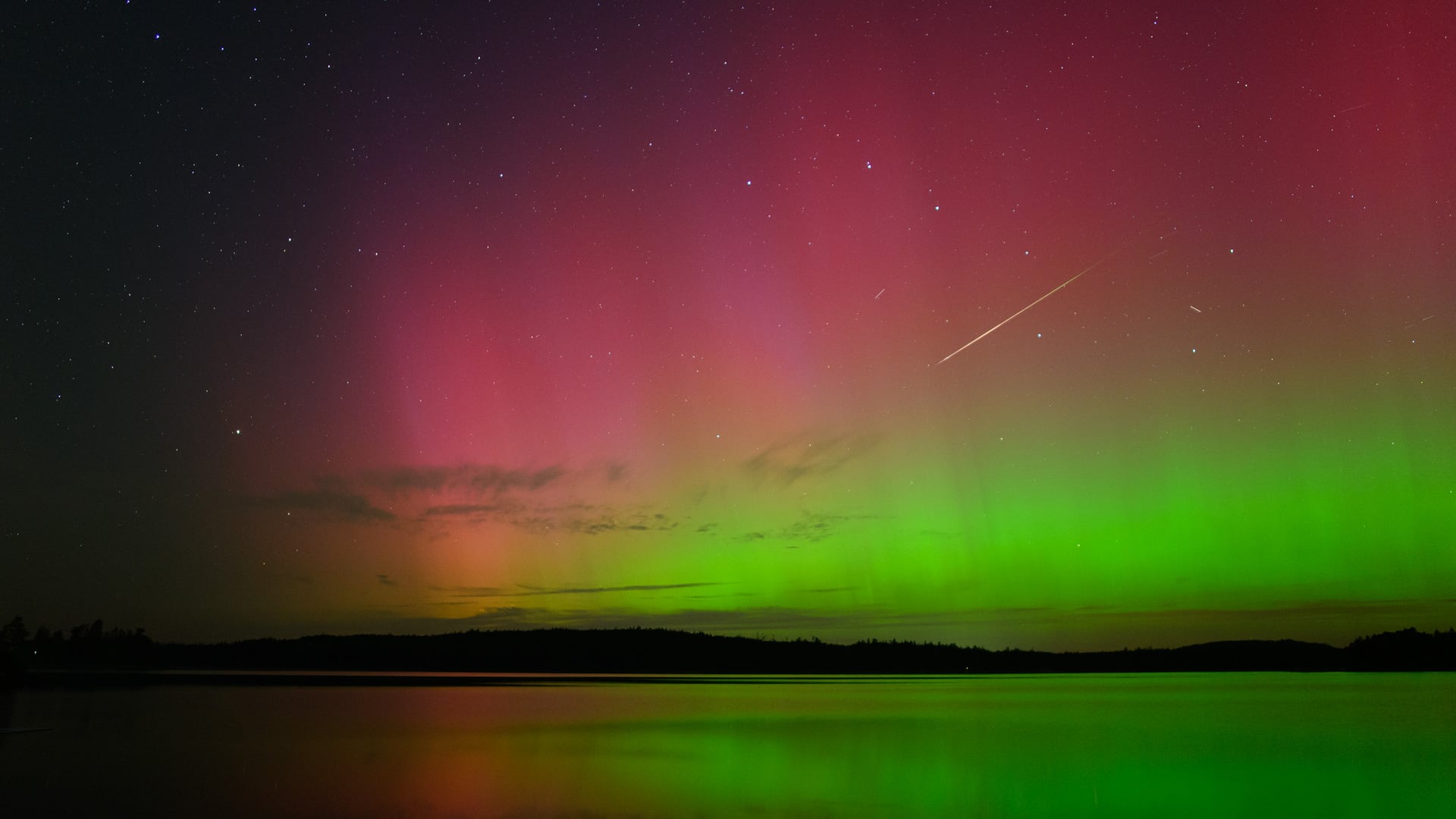
On August 12, a bright Perseid meteor was seen in the night sky west of Halifax, Nova Scotia, Canada. The picture was taken with a camera pointed almost straight north. The meteor’s bright trail is short-lived. It seems to cross the famous northern hemisphere asterism, the Big Dipper. The sky is illuminated with the colourful northern lights, also known as aurora borealis. Near the peak of this year’s Perseid meteor shower, geomagnetic storms made the aurora action on Earth even more amazing for people. The extreme space weather was caused by flares from an active Sun.
Sky Full of Arcs
On August 11, a Rocket Lab Electron rocket lifted off from Earth. It was launched from New Zealand’s north island and flew into low Earth orbit. This photo captures the southern sea and sky. It is a composite of 50 frames recorded over 2.5 hours. It shows the blazing trace of the beautiful launch arc to the east. The camera was mounted on a tripod and pointed directly at the South Celestial Pole. However, no bright star identifies that location in the southern hemisphere’s night sky.

Supermoon Beyond the Temple of Poseidon
Supermoons seem slightly larger and brighter than other full moons. It is because they reach closer to Earth — closer than 90% of all full moons. This supermoon was also a blue moon. A seasonal blue moon is defined as the third of four full moons in a single season. Another definition states that a blue moon is the second full moon in a given month. Blue moons do not appear blue. The above photograph captured the blue supermoon as it rose above the Temple of Poseidon in Greece.

Moon Eclipses Saturn
In the month of August, a Saturnian eclipse, also known as an occultation, was visible across a large portion of the Earth. This image is a composite of two separate images. One image captures Saturn. The other image was for the moon. With you naked eyes, you can see moon appears brighter than saturn. The images were all obtained in Breda, Catalonia, Spain, before occultation. Saturn-Moon eclipses will occur every month for the rest of the year. Each time, the occurrence will only be seen to those with clear skies and the right place on Earth.

Southern Moonscape
The south pole of the Moon is located at the top left of this exquisite moonscape. The photographer captured it on August 23. He framed his telescope towards the southern highlands of the moon. The view’s perspective heightens the impression of a dense field of craters. It also makes the craters appear more oval-shaped near the edge.

If you have a space image, you can submit it to NASA APOD too.
For more incredible astrophotography photos, check our previous Breathtaking Astronomy Photos articles:
See more from DIYPhotography.net on Google
Add DIYPhotography.net as a trusted source. This makes
our stories more likely to appear in your Google Search results.
 Add as a preferred source on Google

Soumyadeep Mukherjee
Soumyadeep Mukherjee is an award-winning astrophotographer from India. He has a doctorate degree in Linguistics. His work extends to the sub-genres of nightscape, deep sky, solar, lunar and optical phenomenon photography. He is also a photography educator and has conducted numerous workshops. His works have appeared in over 40 books & magazines including Astronomy, BBC Sky at Night, Sky & Telescope among others, and in various websites including National Geographic, NASA, Forbes. He was the first Indian to win “Astronomy Photographer of the Year” award in a major category.
Related Posts
 Ten breathtaking astrophotography images you should see (August 2025)
 Ten breathtaking Astrophotography images you should see right now (October 2024)
 Ten breathtaking astrophotography images you should see right now (December 2024)
 Ten breathtaking Astrophotography photos you should see right now (September 2024)
Join the Discussion
DIYP Comment Policy
Be nice, be on-topic, no personal information or flames.