




















Ten breathtaking astrophotography images you should see (August 2025)
Sep 30, 2025
Soumyadeep Mukherjee
Soumyadeep Mukherjee is an award-winning astrophotographer from India. He has a doctorate degree in Linguistics. His work extends to the sub-genres of nightscape, deep sky, solar, lunar and optical phenomenon photography. He is also a photography educator and has conducted numerous workshops. His works have appeared in over 40 books & magazines including Astronomy, BBC Sky at Night, Sky & Telescope among others, and in various websites including National Geographic, NASA, Forbes. He was the first Indian to win “Astronomy Photographer of the Year” award in a major category.
Share:
NASA Astronomy Picture of the Day is a huge collection of astronomical images, both amateur and professional. It celebrates our amazing universe every day.
Since its inception in 1995, NASA APOD has been selecting and publishing some of the best images of space. Its two editors, Robert Nemiroff and Jerry Bonnell, are the people behind it. Here, you can view images captured by space telescopes such as Hubble and JWST. But it also includes amateur images taken with regular DSLR cameras.
Here are some of the best images from August 2025.
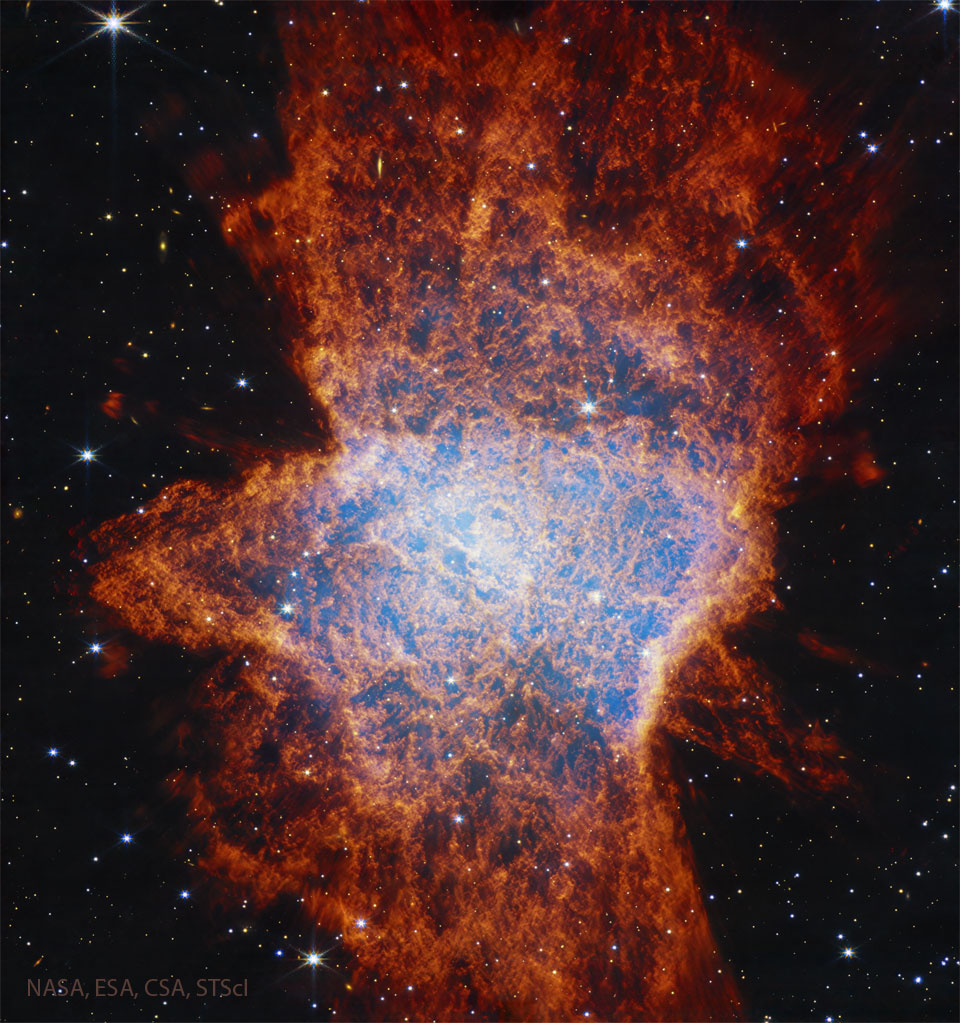
NGC 6072: A Complex Planetary Nebula from Webb
What makes this nebula so intricate? It has been determined that NGC 6072 is one of the more peculiar and intricate planetary nebulae. The highlighted image shows chilled hydrogen gas in infrared light with a red tint. The new Webb image reveals new details, including one disk’s edge projecting on the central left. Analysis of earlier photographs of NGC 6072 revealed two discs and multiple probable outflows inside the jumbled gas. According to a leading origin hypothesis, several eruptions from a star in a multi-star system close to the centre are what produce or increase the nebula’s complexity.
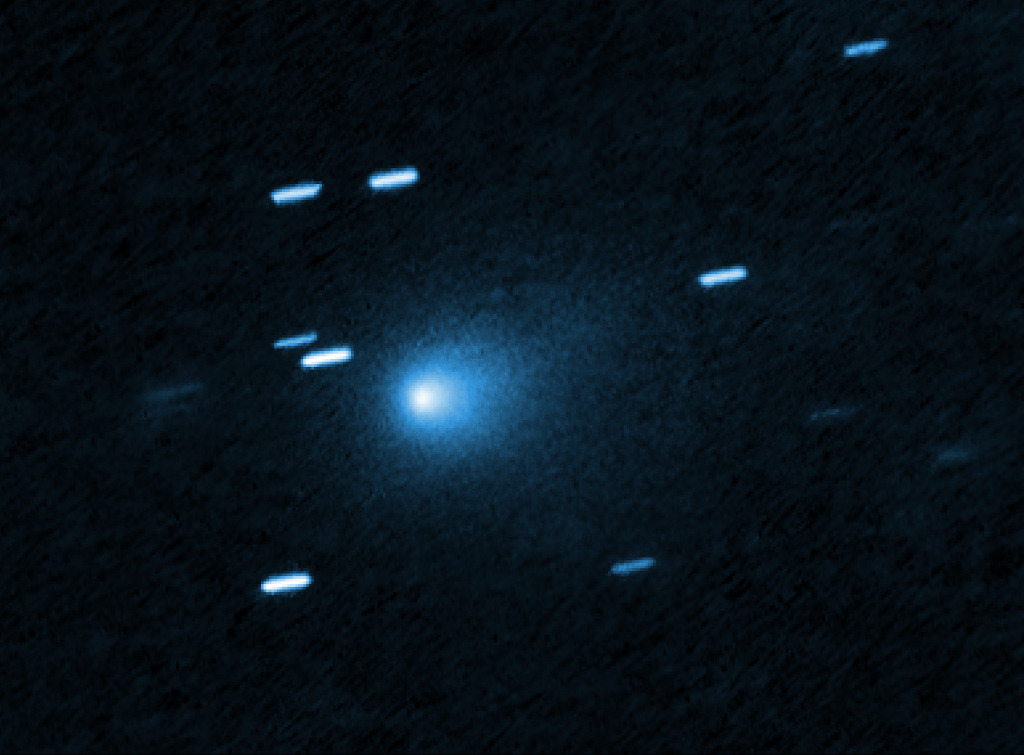
Interstellar Interloper 3I/ATLAS from Hubble
3I/ATLAS is the third known interstellar object to travel through our Solar System. It was discovered on July 1 at Rio Hurtado, Chile, using the NASA-funded ATLAS survey telescope. It comes after the comet 2I/Borisov in 2019 and 1I/ʻOumuamua in 2017. 3I/ATLAS, sometimes called C/2025 N1, is a comet. This clear view from the Hubble Space Telescope on July 21 shows a teardrop-shaped cloud of dust, released from its frozen centre, warmed by increasing sunlight. The exposure shows streaks of background stars as Hubble followed the fastest comet ever observed as it moved towards the inner solar system.
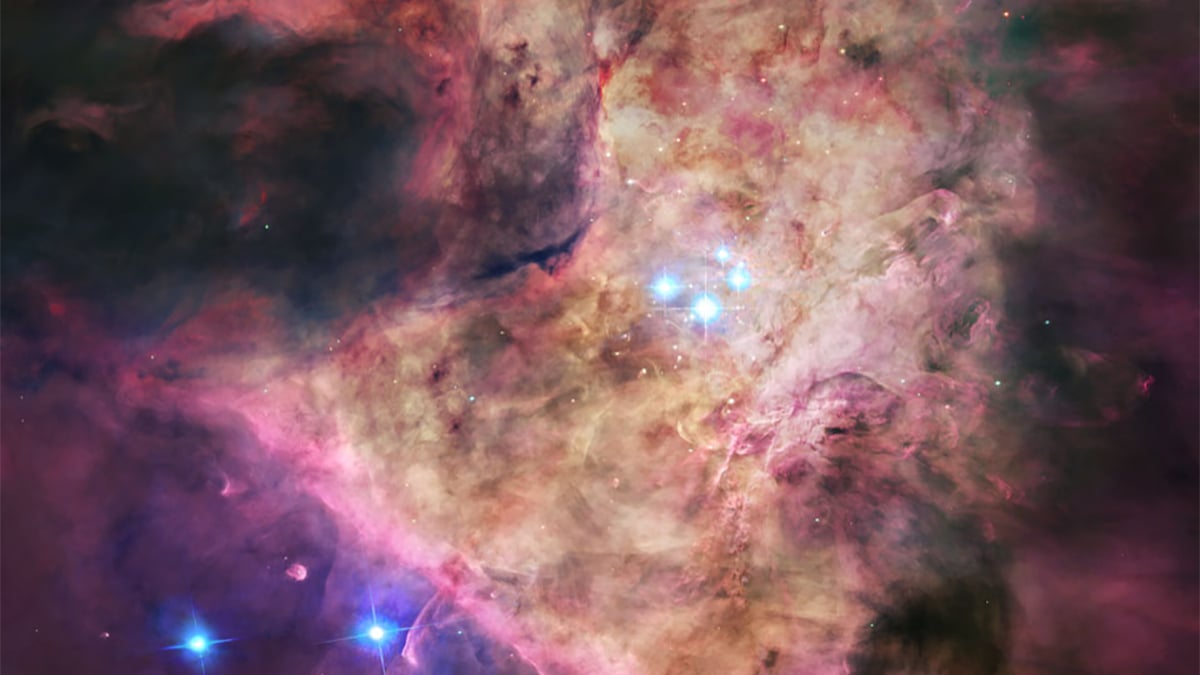
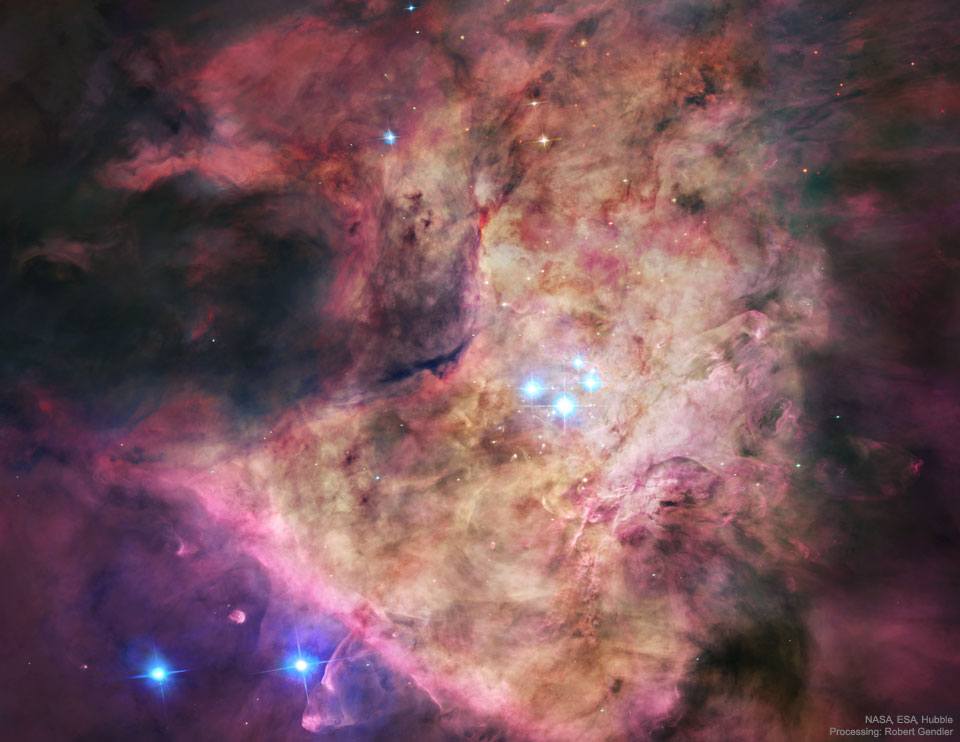
Trapezium: In the Heart of Orion
What’s within Orion’s heart? Four brilliant stars, known as Trapezium, are located close to the centre of this angular cosmic image. It is located in the centre of the dense Orion Nebula Star Cluster. These stars are concentrated in an area that is roughly 1.5 light-years in radius. The entire visible brilliance of the complicated star-forming region is powered by ultraviolet ionising radiation from the Trapezium stars, primarily from the brightest star Theta-1 Orionis C. Dynamical research suggests that runaway star collisions at an earlier age may have created a black hole with more than 100 times the mass of the Sun. The Orion Nebula Cluster is about three million years old and was even more compact in its younger years.
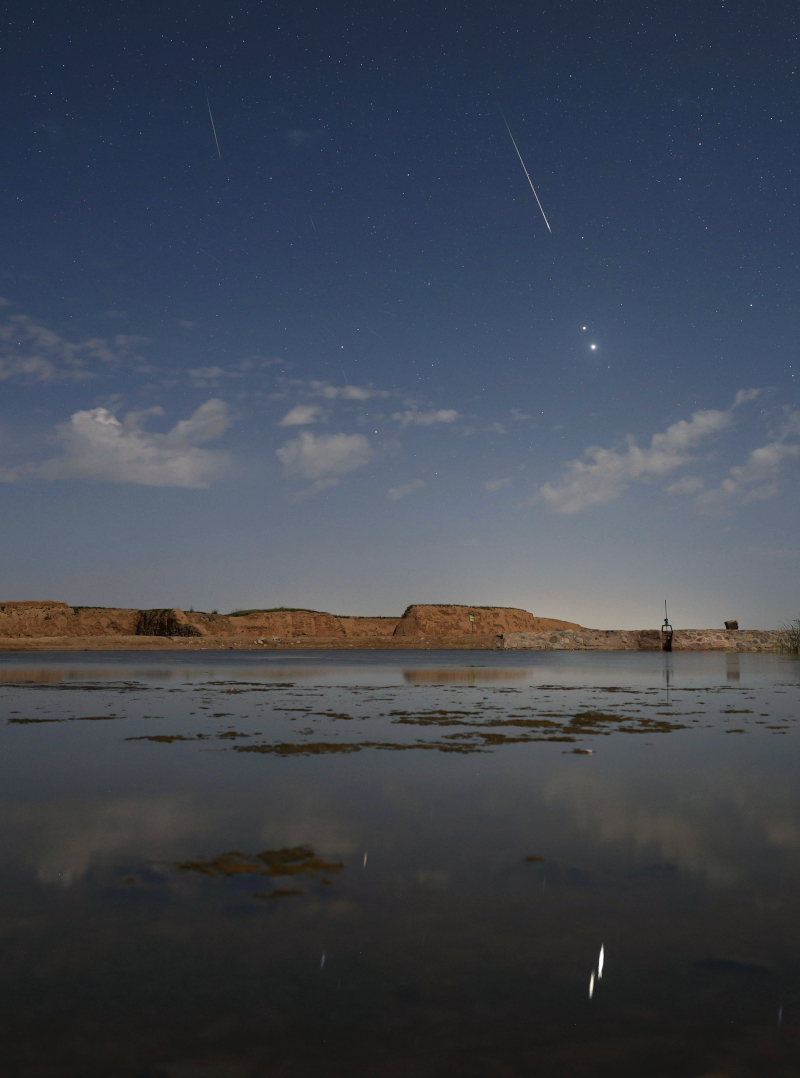
Moonlight, Planets, and Perseids
On August 13, two planets were near each other in the predawn sky. And it was difficult to miss the dazzling Jupiter and even brighter Venus despite the glare of a waning gibbous Moon. This early morning skyscape shows their bright close conjunction above the eastern horizon. Light from both planets was reflected in the quiet waters of a nearby pond in this single exposure photograph taken from a location close to Gansu, China. Flashes from the yearly Perseid Meteor Shower, which is renowned for its bright, swift meteors, were also visible against the moonlight. Even in a starry sky, the shower meteors briefly joined the two planets for a spectacular display near the much-anticipated peak of activity.
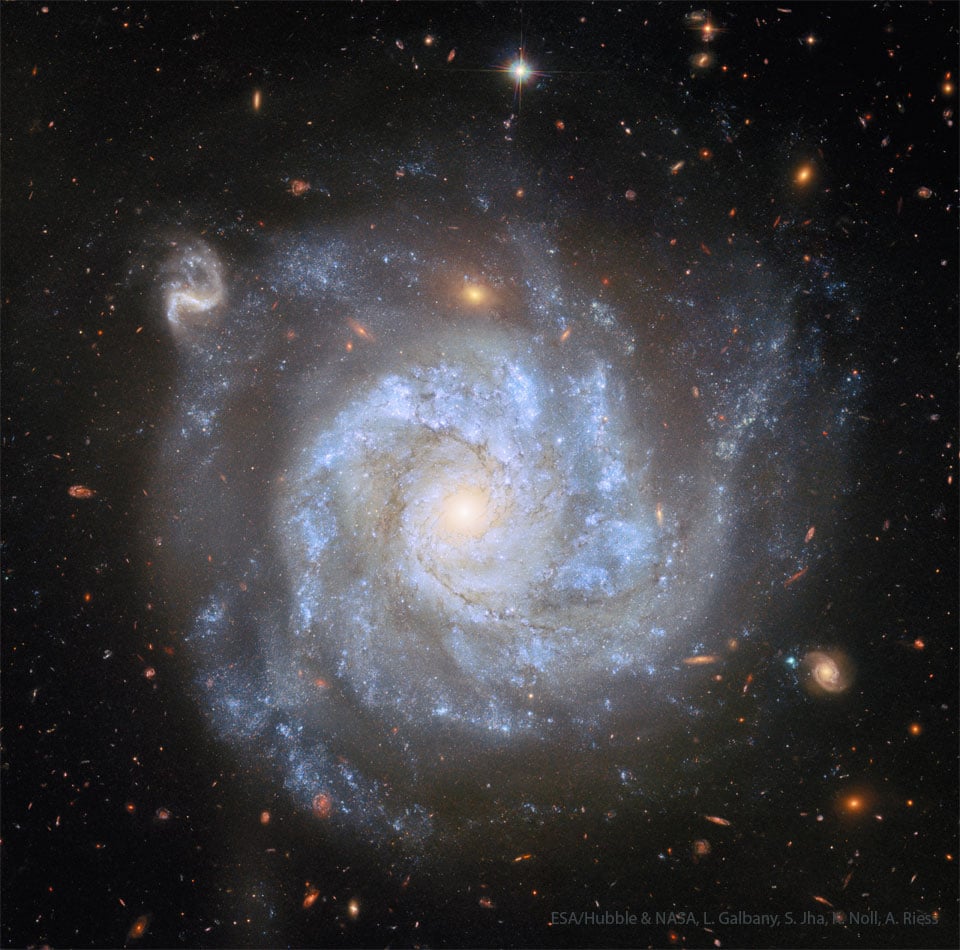
NGC 1309: A Useful Spiral Galaxy
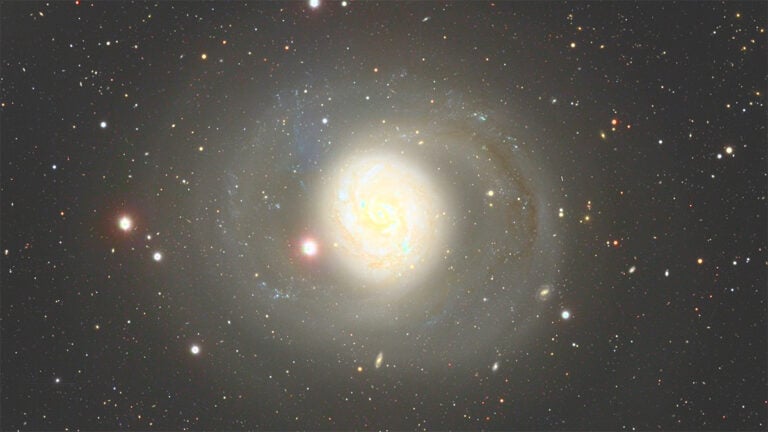
NGC 1309 is a stunning spiral located on the banks of the River (Eridanus) constellation, about 100 million light-years away. The galaxy is almost two-thirds the size of our larger Milky Way galaxy, spanning over 60,000 light-years. The spiral arms of NGC 1309 wind around an older yellowish star population at its core, and are traced out by bluish clusters of young stars and dust lanes. The two recent supernovae and several Cepheid variable stars observed in NGC 1309 help to calibrate the Universe’s expansion. However, once you’ve moved past the magnificent design of this lovely galaxy, take a look at the collection of farther-off background galaxies seen in this crisp Hubble Space Telescope photograph.
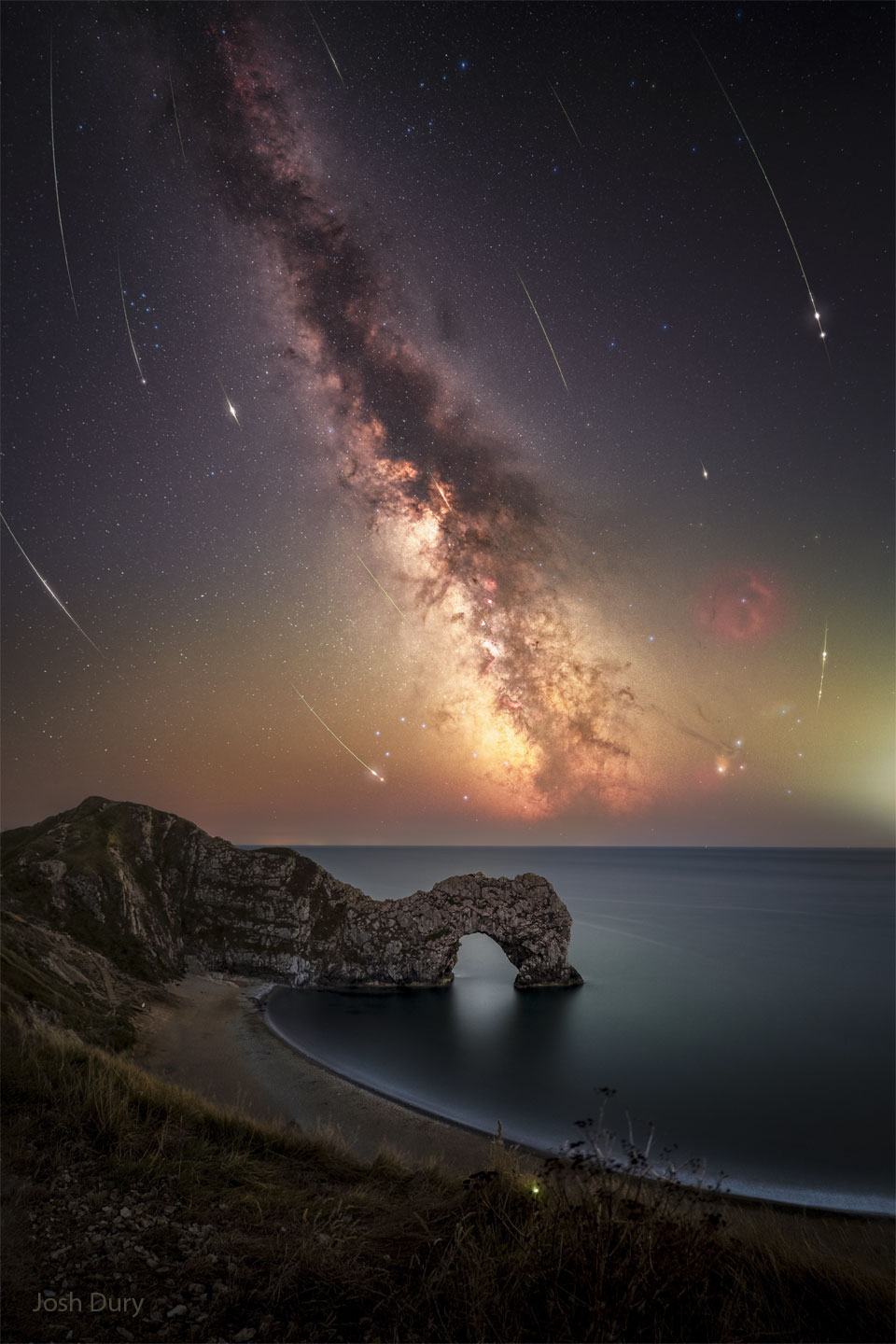
Perseid Meteors from Durdle Door
What are the sky’s curving arcs? Meteors, more especially meteors from the Perseid meteor shower this year. The wide-angle lens of the capturing camera gave the impression that the meteors’ straight courses were somewhat bent. The radiant is located in the constellation of Perseus just off the top of the frame. A deep image of the background sky captured by the same camera revealed the Milky Way galaxy’s core band. This band runs almost vertically across the centre of the featured image. The name Durdle Door, which is believed to have survived from a thousand years ago, refers to the limestone arch in the foreground in Dorset, England.
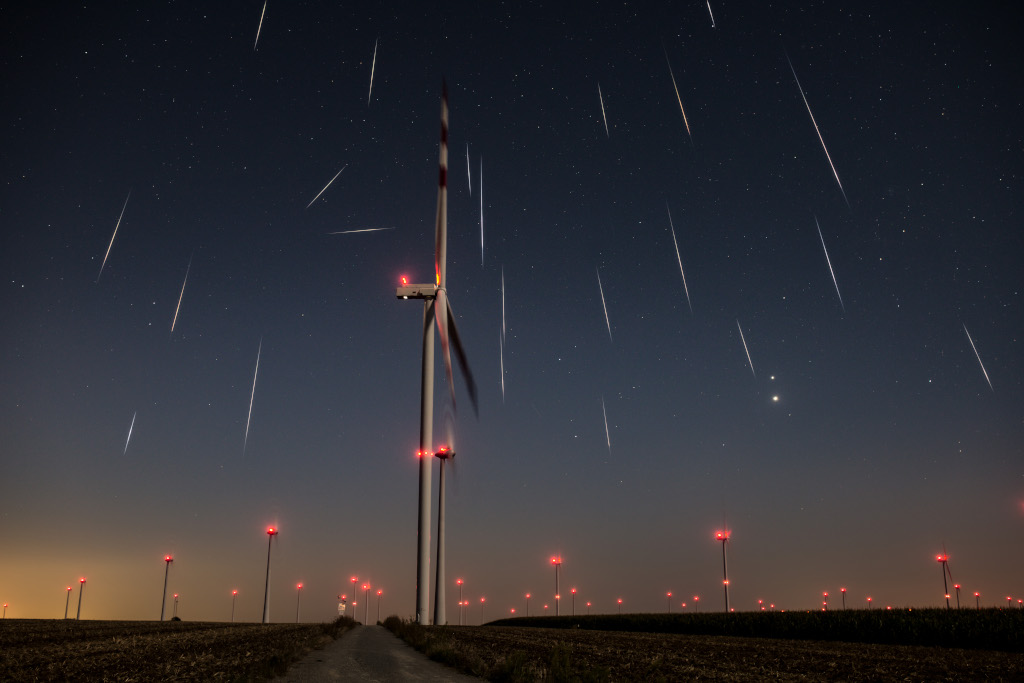
Mostly Perseids
The majority of the Perseid meteors that are falling on Earth are seen in this predawn skyscape that was taken early on August 13. The Perseid meteor streaks are easy to spot. They are the ones whose paths appear to converge on the radiant of the yearly meteor shower, which is situated off the top of the frame in the heroic constellation Perseus. The scene is a composite, which combines roughly 500 digital exposures. However, all exposures were obtained from a wind farm close to Mönchhof in Burgenland, Austria. The data collection spans a period of around two and a half hours. Bright planets Jupiter and Venus are poised above the eastern horizon in a magnificent near conjunction.
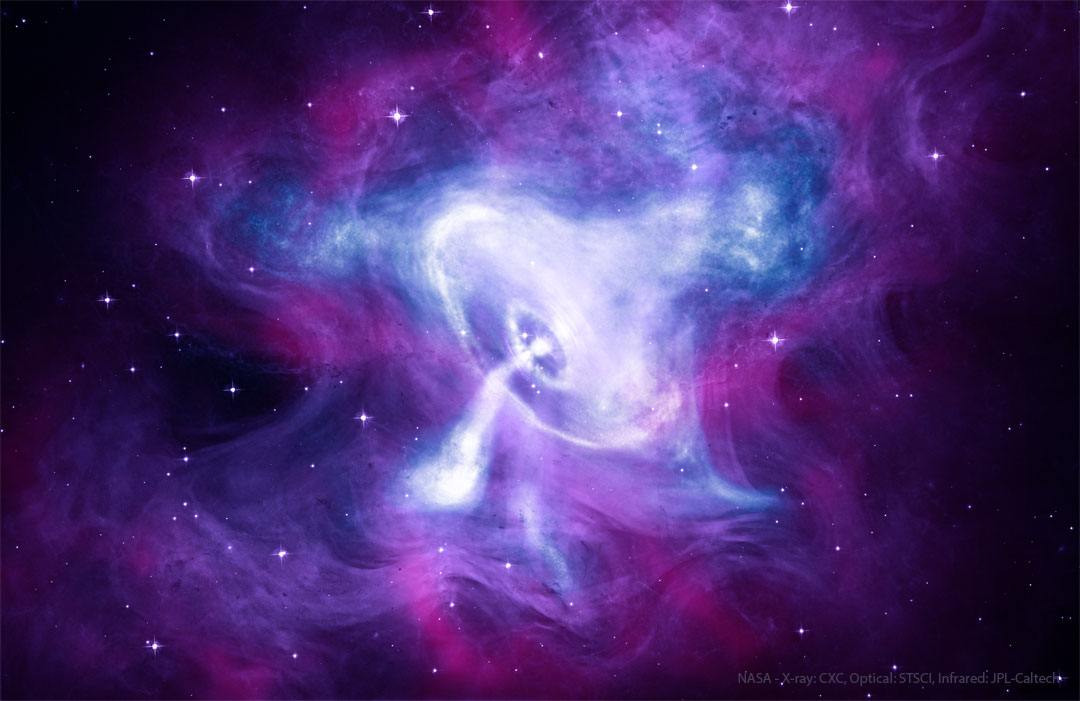
The Spinning Pulsar of the Crab Nebula
A city-sized, magnetised neutron star that rotates thirty times per second is located at the centre of the Crab Nebula. The brilliant spot at the centre of the gaseous swirl at the core of the nebula is called the Crab Pulsar. The stunning image frames the luminous gas, holes, and swirling filaments close to the centre of the Crab Nebula, which is about twelve light-years across. X-ray radiation from the Chandra X-ray Observatory is blue, infrared light from the Spitzer Space Telescope is red, and visible light from the Hubble Space Telescope is purple in the featured image. The expanding remnants of the star’s constituent gases make up the Crab Nebula’s outer regions. In the year 1054, a supernova explosion was observed on Earth.
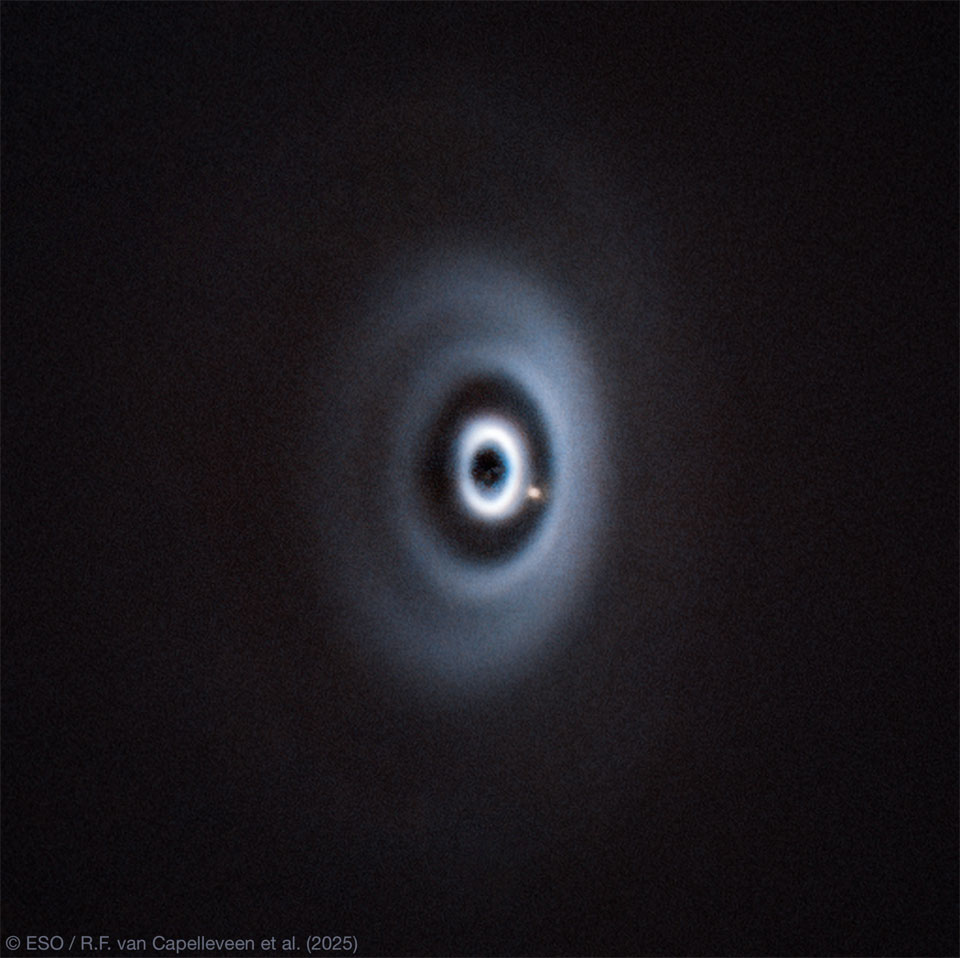
WISPIT 2b: Exoplanet Carves Gap in Birth Disk
A newborn planet outside of our Solar System is that yellow speck. Surprisingly, the featured image from Chile’s Very Large Telescope depicts a far-off scenario that is similar to the formation of our own Solar System some 4.5 billion years ago. A newborn star that resembles the Sun is at the centre of this image. It is shielded from its intense brightness by a coronagraph. A brilliant, dusty protoplanetary disc, the building block of planets, envelops the star. A newborn globe is accumulating gas and dust under its gravitational pull, clearing the path as it revolves around the star, as indicated by gaps and concentric rings. This is the first time an exoplanet has been seen actively creating a hole in a disc.
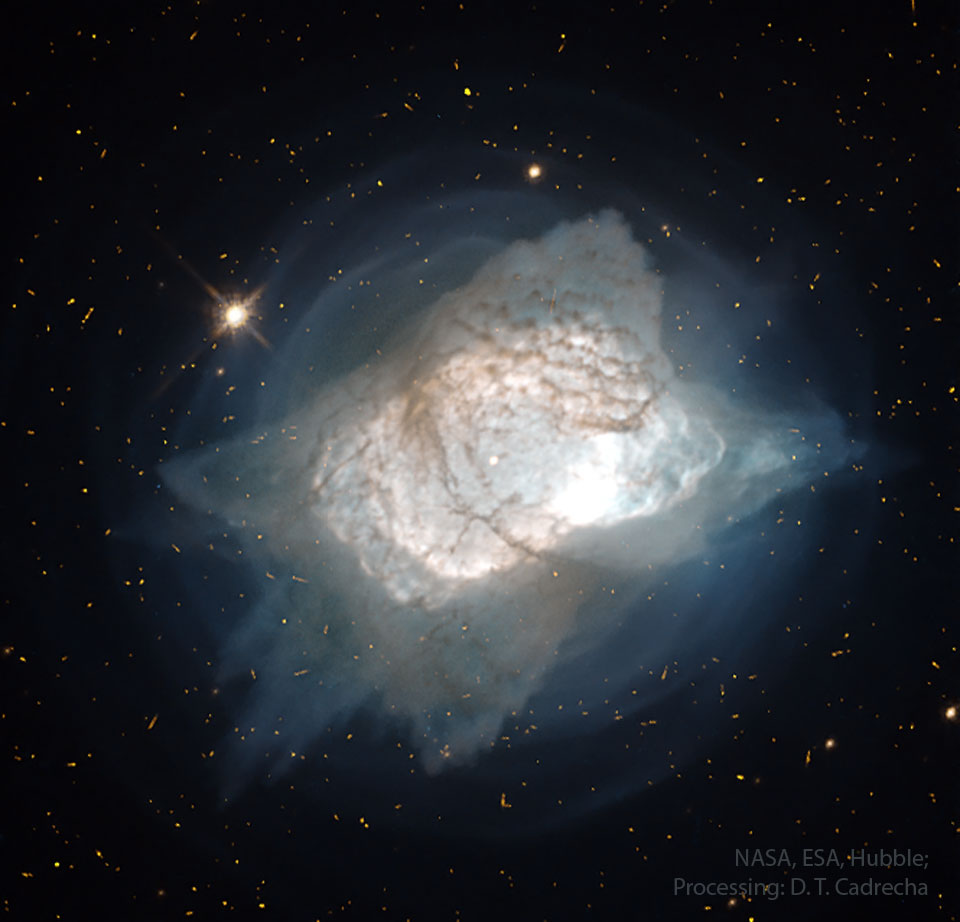
NGC 7027: The Pillow Planetary Nebula
One of the smallest, brightest, and most oddly shaped planetary nebulae known is NGC 7027, often known as the Pillow Nebula and the Flying Carpet Nebula. Based on its rate of expansion, NGC 7027 began to expand approximately 600 years ago, as seen from Earth. As visible in blue in the Hubble Space Telescope featured image, the planetary nebula has been releasing shells for a significant portion of its history. However, for unexplained reasons, it started ejecting gas and dust (seen in brown) in particular directions in the modern era, forming a new pattern that appears to have four corners. First identified in 1878, NGC 7027 is located approximately 3,000 light-years away and is visible toward the Swan (Cygnus) constellation with a normal backyard telescope.
If you have a space image, you can submit it to NASA APOD, too.
For more incredible astrophotography photos, check our previous Breathtaking Astronomy Photos articles:
- Breathtaking astrophotography Images – July 2025
- Breathtaking astrophotography images – June 2025
- Breathtaking astrophotography Images – May 2025
- Breathtaking Astrophotography Images – April 2025
- Breathtaking Astrophotography Images – March 2025
- Breathtaking Astrophotography Images – February 2025
- Breathtaking Astrophotography Images – January 2025
- Breathtaking Astrophotography Images – December 2024
- Breathtaking Astrophotography Images – November 2024
- Breathtaking Astrophotography Images – October 2024
- Breathtaking Astrophotography Images – September 2024
- Breathtaking Astrophotography Images – August 2024
Clear skies!
See more from DIYPhotography.net on Google
Add DIYPhotography.net as a trusted source. This makes
our stories more likely to appear in your Google Search results.
 Add as a preferred source on Google

Soumyadeep Mukherjee
Soumyadeep Mukherjee is an award-winning astrophotographer from India. He has a doctorate degree in Linguistics. His work extends to the sub-genres of nightscape, deep sky, solar, lunar and optical phenomenon photography. He is also a photography educator and has conducted numerous workshops. His works have appeared in over 40 books & magazines including Astronomy, BBC Sky at Night, Sky & Telescope among others, and in various websites including National Geographic, NASA, Forbes. He was the first Indian to win “Astronomy Photographer of the Year” award in a major category.
Join the Discussion
DIYP Comment Policy
Be nice, be on-topic, no personal information or flames.