

















NASA celebrates 10 years of Hubble’s outer planet tracking with stunning photos
Dec 11, 2024
Dunja Đuđić Kalinin
Dunja Djudjic is a multi-talented artist based in Novi Sad, Serbia. With 15 years of experience as a photographer, she specializes in capturing the beauty of nature, travel, concerts, and fine art. In addition to her photography, Dunja also expresses her creativity through writing, embroidery, and jewelry making.
Share:

NASA has unveiled a captivating series of images from the Hubble Space Telescope to mark the tenth anniversary of the Outer Planet Atmospheres Legacy (OPAL) program. This decade-long initiative, running from 2014 to 2024, has revolutionized our understanding of Jupiter, Saturn, Uranus, and Neptune by capturing their dynamic weather systems and atmospheric changes—all in stunning images.
NASA established the OPAL program to provide a consistent and long-term view of the outer planets. Hubble’s high spatial resolution and image stability make it the only telescope capable of capturing detailed global studies of these planets’ cloud formations, weather activity, and seasonal changes. The program’s aim is to unravel the atmospheric mechanics and evolution of these gas giants while offering insights into planetary weather patterns that may be mirrored on exoplanets orbiting other stars.
“Following the complex behavior is akin to understanding Earth’s dynamic weather as followed over many years, as well as the Sun’s influence on the solar system’s weather,” NASA explained.
Jupiter: A planet of perpetual storms
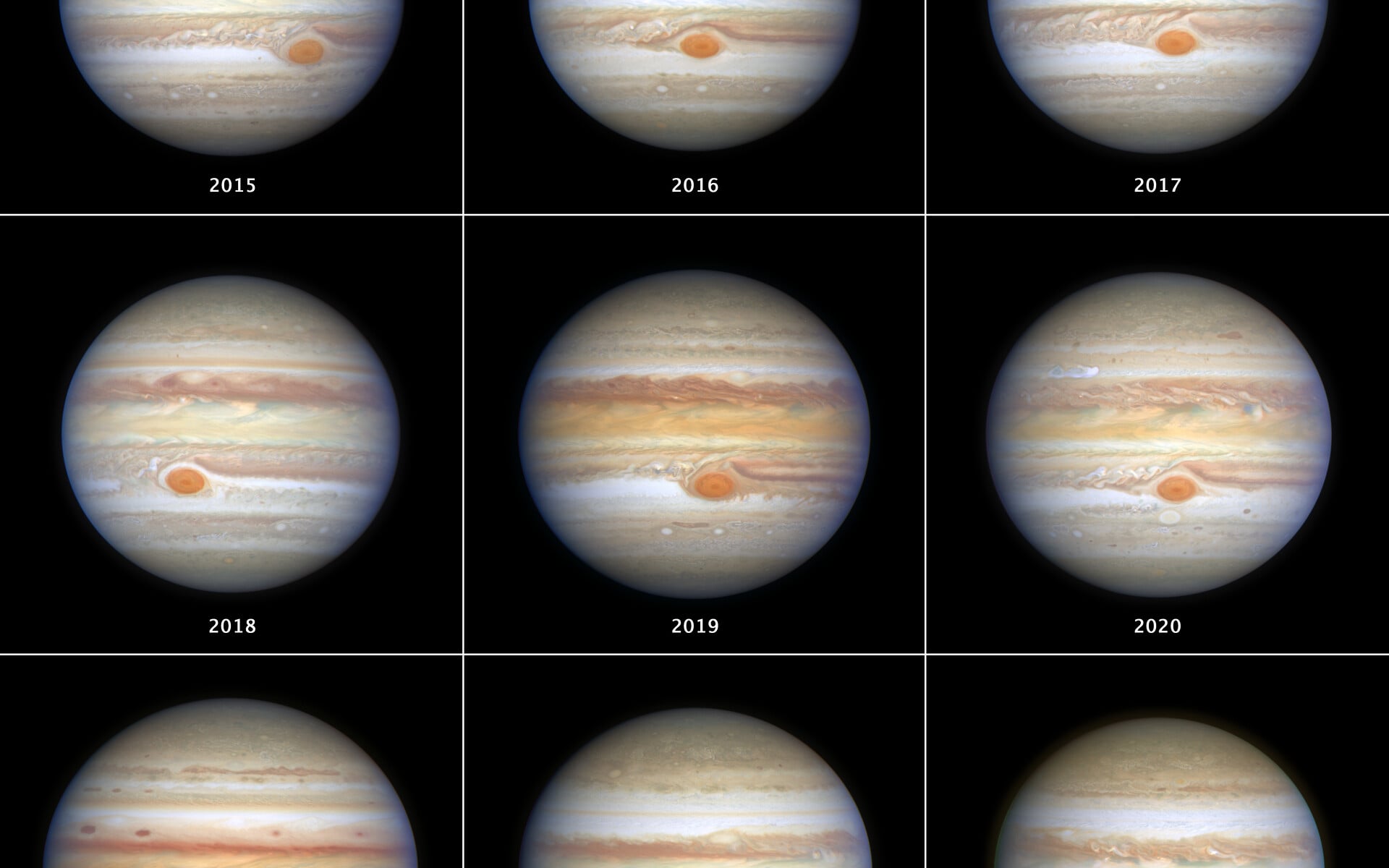
Jupiter’s iconic Great Red Spot (GRS) remains a focal point of Hubble’s observations, though the massive storm continues shrinking. The telescope has been instrumental in measuring wind patterns and tracking ultraviolet-dark ovals in the planet’s polar regions. This monitoring provides crucial data to complement ESA’s Jupiter Icy Moons Explorer (Juice) mission, launched in April 2023, which aims to explore Jupiter’s moons as potential habitats.

Saturn: Rings and subtle atmospheric changes
Hubble’s observations of Saturn have captured its gradual color changes, likely influenced by cloud height and wind variations. Seasonal shifts are particularly striking, with the planet’s iconic rings appearing edge-on periodically, as they will in 2025. OPAL also recorded the transient “ring spokes,” which appear seasonally and are influenced by the planet’s magnetic field.

Uranus: A planet of extremes
The tilted rotation of Uranus creates dramatic seasonal effects, with one hemisphere experiencing 42 years of continuous sunlight or darkness. Recent OPAL observations reveal that the planet’s north pole is brightening as it approaches its summer solstice in 2028. This change is accompanied by storms and methane ice-crystal clouds in the mid-northern latitudes.
Neptune: Dark storms and solar surprises
Hubble’s data has shed light on Neptune’s mysterious dark storms, demonstrating that they form and dissipate over several years. Intriguingly, the abundance of Neptune’s clouds correlates with the Sun’s 11-year solar cycle, despite the planet receiving minimal sunlight due to its distance. The findings raise questions about the interplay between solar activity and Neptune’s long seasons, each lasting about 40 years.
Over the past decade, the OPAL program has created a vast data archive, providing invaluable insights for planetary scientists worldwide. NASA’s commitment to tracking these celestial phenomena ensures that we continue to unlock the secrets of our solar system’s gas giants, with Hubble poised to remain an essential tool for exploration and discovery.
[via NASA]
See more from DIYPhotography.net on Google
Add DIYPhotography.net as a trusted source. This makes
our stories more likely to appear in your Google Search results.
 Add as a preferred source on Google

Dunja Đuđić Kalinin
Dunja Djudjic is a multi-talented artist based in Novi Sad, Serbia. With 15 years of experience as a photographer, she specializes in capturing the beauty of nature, travel, concerts, and fine art. In addition to her photography, Dunja also expresses her creativity through writing, embroidery, and jewelry making.


Join the Discussion
DIYP Comment Policy
Be nice, be on-topic, no personal information or flames.