


















Dust and Light: James Webb’s View of the Butterfly Star
Sep 1, 2025
Soumyadeep Mukherjee
Soumyadeep Mukherjee is an award-winning astrophotographer from India. He has a doctorate degree in Linguistics. His work extends to the sub-genres of nightscape, deep sky, solar, lunar and optical phenomenon photography. He is also a photography educator and has conducted numerous workshops. His works have appeared in over 40 books & magazines including Astronomy, BBC Sky at Night, Sky & Telescope among others, and in various websites including National Geographic, NASA, Forbes. He was the first Indian to win “Astronomy Photographer of the Year” award in a major category.
Share:

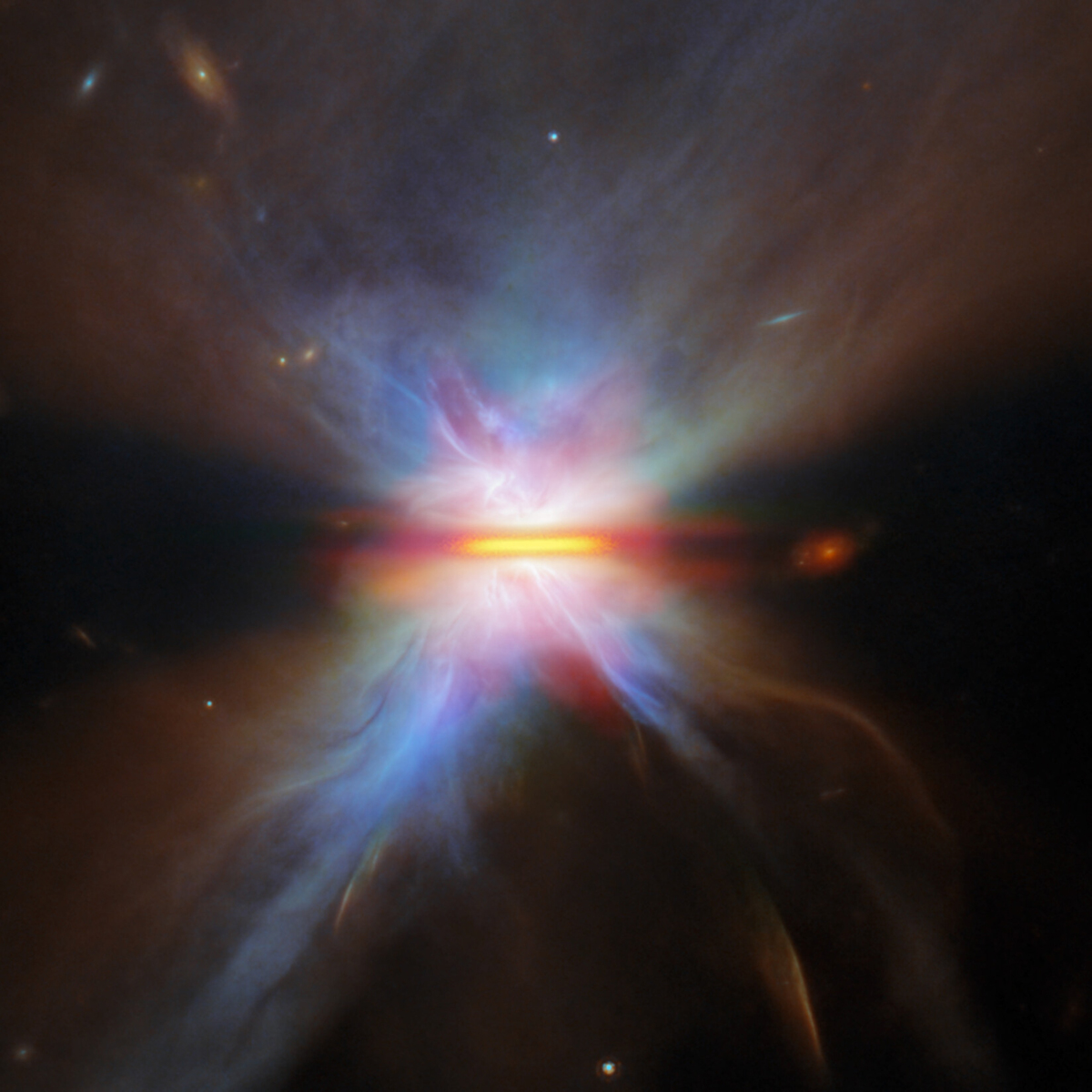
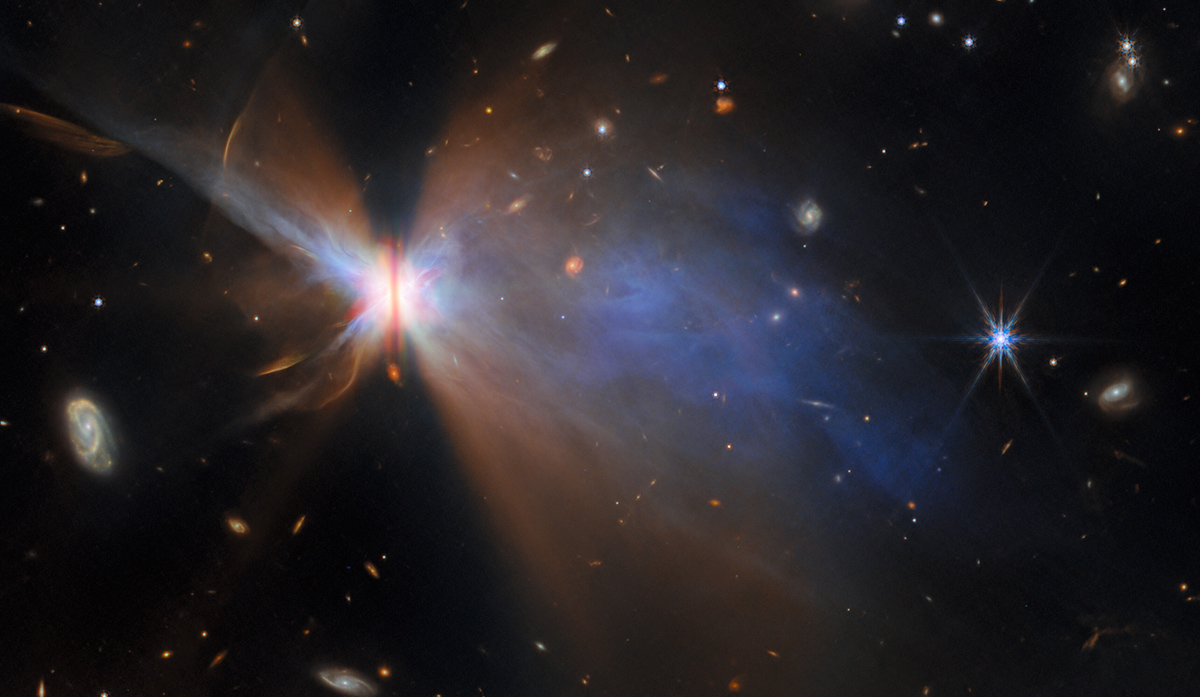
Astronomers have long searched for clear views of the earliest stages of planet formation. These stages are usually hidden by thick blankets of dust and gas. The James Webb Space Telescope has now provided one of its most detailed looks at such a process. The subject is a young protostar known as IRAS 04302+2247, located in the Taurus star-forming region about 525 light-years away. It is commonly called the “Butterfly Star” because of its distinctive appearance. The image combines data from JWST’s NIRCam (Near-Infrared Camera) and MIRI (Mid-Infrared Instrument). To provide context, optical data from the Hubble Space Telescope were also included.
A disc seen edge-on
Most protoplanetary discs are observed at an angle. That makes it difficult to separate their vertical structure from the glow of the central star. IRAS 04302 is different. Its disc lies exactly across our line of sight. The central protostar is hidden behind the thick midplane. Instead of being dazzled by the star’s glare, astronomers can study how dust is distributed within the disc itself.
This view is crucial for planet formation studies. Dust grains in such discs collide, stick together, and gradually grow into larger bodies. Over time, they may form planetesimals, the seeds of future planets. JWST’s data reveal how the density of dust changes with height above the midplane. The dark central band marks the zone where dust has settled most strongly. The illuminated lobes above and below glow because starlight escapes more easily through those less dense regions.
Light and dust in balance
The Butterfly Star’s appearance comes from the delicate balance between light and dust. The disc is opaque in visible light, which is why Hubble’s earlier observations showed mostly a dark silhouette. JWST extends the view into the infrared. These longer wavelengths can penetrate dusty regions and reveal structures invisible to the human eye.
In the JWST image, wisps of material stretch out from the disc into the surrounding space. These faint structures are part of the reflection nebula created when starlight bounces off dust grains. The symmetry of the lobes above and below the disc emphasises the star’s nickname. It looks like a butterfly with outstretched wings, although the scientific value lies not in the shape but in what it tells us about star and planet formation.
Such discs are transient. They exist for only a few million years before the material is either accreted onto the star, blown away, or incorporated into new planets. Observing them at the right moment is challenging. JWST’s sensitivity allows astronomers to catch these fleeting stages with unprecedented detail.
A multi-wavelength portrait
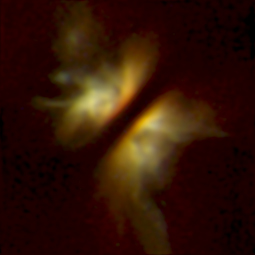
This release is notable because it combines observations from more than one telescope. The optical data from Hubble provide the familiar silhouette view. JWST’s NIRCam adds near-infrared detail, showing how light scatters through the dust. MIRI reaches further into the mid-infrared, mapping the glow of warm dust grains. Each wavelength tells a different story, but when combined, they create a full picture of the disc’s structure.
Such multi-wavelength imaging is essential for astrophysics. No single instrument can reveal everything. Shorter wavelengths show fine details and the effects of small particles. Longer wavelengths highlight colder and larger grains. Together, they explain how the environment changes with distance from the star and with height in the disc.
The science programme behind the image
The observations belong to a General Observer programme (GO #2562) led by principal investigator G. Wilson. The programme’s goal is to study edge-on protoplanetary discs in detail. This geometry provides the best opportunity to measure how dust settles within the discs. Such information is vital for models of planet formation, which depend on the growth and movement of grains.
Earlier telescopes could only provide limited data. Hubble showed the dark lane, but could not see through it. Ground-based observatories faced limits from Earth’s atmosphere. Webb now delivers both the resolution and sensitivity needed to go further. Its instruments can separate fine details across the disc and detect faint emissions from grains of different sizes.
By studying systems like the Butterfly Star, astronomers look back in time to the earliest chapter of our history. The orientation of IRAS 04302 provides a natural laboratory for these studies. Every detail captured by Webb adds to the broader story of how planetary systems emerge across the galaxy.
Clear skies!
See more from DIYPhotography.net on Google
Add DIYPhotography.net as a trusted source. This makes
our stories more likely to appear in your Google Search results.
 Add as a preferred source on Google

Soumyadeep Mukherjee
Soumyadeep Mukherjee is an award-winning astrophotographer from India. He has a doctorate degree in Linguistics. His work extends to the sub-genres of nightscape, deep sky, solar, lunar and optical phenomenon photography. He is also a photography educator and has conducted numerous workshops. His works have appeared in over 40 books & magazines including Astronomy, BBC Sky at Night, Sky & Telescope among others, and in various websites including National Geographic, NASA, Forbes. He was the first Indian to win “Astronomy Photographer of the Year” award in a major category.

Join the Discussion
DIYP Comment Policy
Be nice, be on-topic, no personal information or flames.