






















Cosmic Heartbeat of Mira A: ALMA and VLT Captures Heart-Shaped “Lighthouse”
Feb 16, 2026
Soumyadeep Mukherjee
Soumyadeep Mukherjee is an award-winning astrophotographer from India. He has a doctorate degree in Linguistics. His work extends to the sub-genres of nightscape, deep sky, solar, lunar and optical phenomenon photography. He is also a photography educator and has conducted numerous workshops. His works have appeared in over 40 books & magazines including Astronomy, BBC Sky at Night, Sky & Telescope among others, and in various websites including National Geographic, NASA, Forbes. He was the first Indian to win “Astronomy Photographer of the Year” award in a major category.
Share:

High-angular-resolution observations of evolved stars often reveal complex circumstellar structures. However, few systems have produced results as unexpected as the recent study of Mira A. This well-known asymptotic giant branch (AGB) star has expelled a large, asymmetric envelope of gas and dust that now appears distinctly heart-shaped. At the same time, the central star illuminates the surrounding material unevenly, producing a striking “lighthouse” effect.
Researchers led by Theo Khouri at Chalmers University of Technology reported these findings after analyzing multi-epoch data from major observatories in Chile. The observations indicate that Mira A recently underwent a powerful mass-loss episode that far exceeds standard expectations for Mira-type variables. As a result, the system now offers an unusually clear window into the late evolutionary stages of low- to intermediate-mass stars.
A well-studied variable star reveals new complexity
Mira A lies roughly 300 light-years away in the constellation Cetus. It serves as the prototype of Mira variables, a class of pulsating red giants characterized by large brightness changes and extended atmospheres. Astronomers have monitored its variability since the late sixteenth century. Because of this long observational record, the star has often been treated as a benchmark object for late-stage stellar evolution.
Yet the new observations reveal behavior that standard models did not predict. Like other AGB stars, Mira A loses mass through a dusty stellar wind driven by radiation pressure and pulsation. Under typical conditions, this process produces a relatively smooth and roughly spherical outflow. Over time, the lost material builds a circumstellar envelope that later contributes to planetary nebula formation.
In this case, however, the mass loss appears neither smooth nor symmetric. Instead, Mira A produced a concentrated and highly structured ejection. The resulting morphology immediately stood out when researchers examined the combined datasets.
Multi-wavelength data expose the heart-shaped envelope
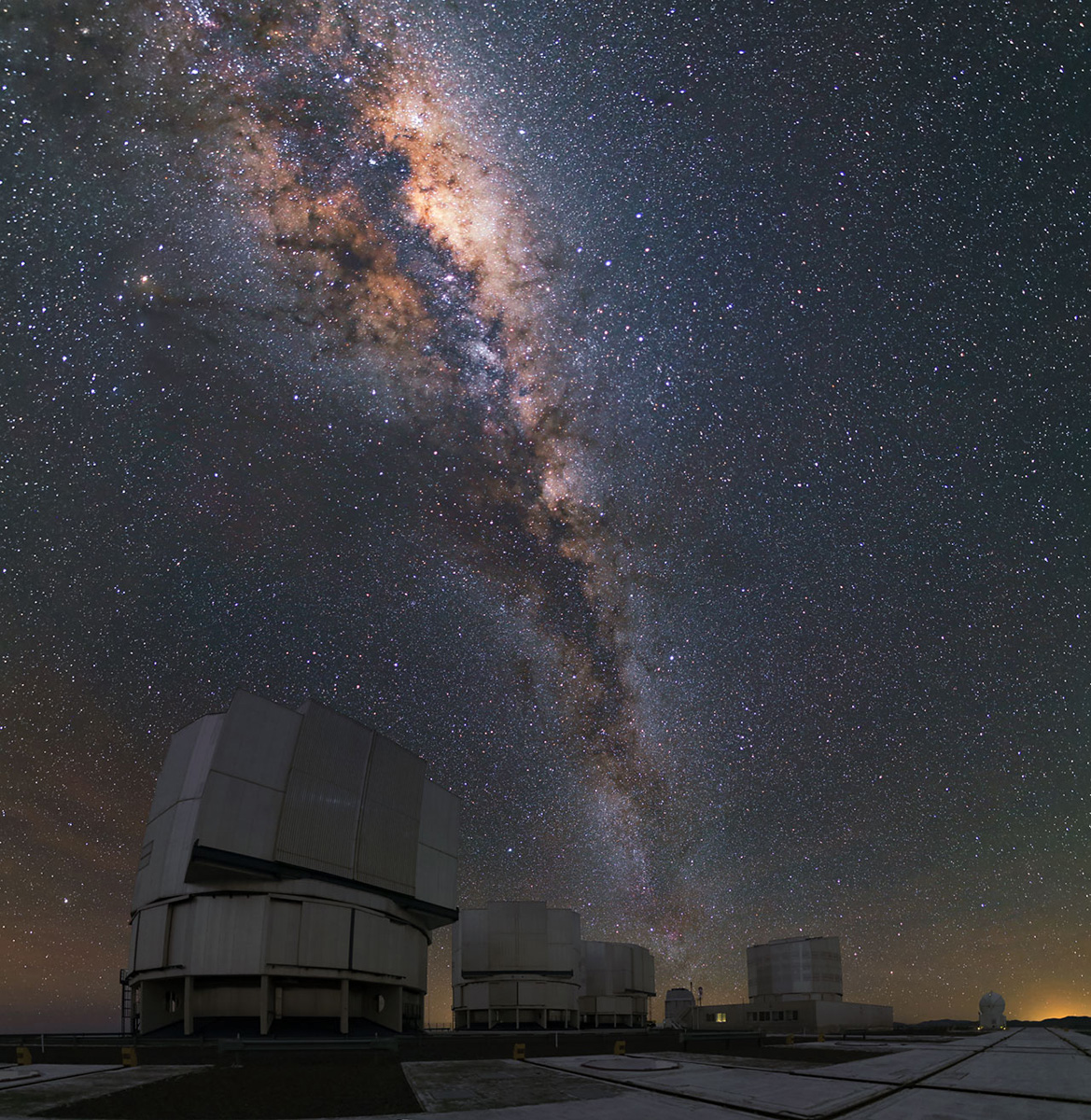
The research team assembled observations obtained between 2015 and 2023 using two premier facilities in Chile. The Atacama Large Millimeter/submillimeter Array traced molecular gas in the circumstellar environment. Meanwhile, the Very Large Telescope provided detailed optical views of dust and scattered starlight.
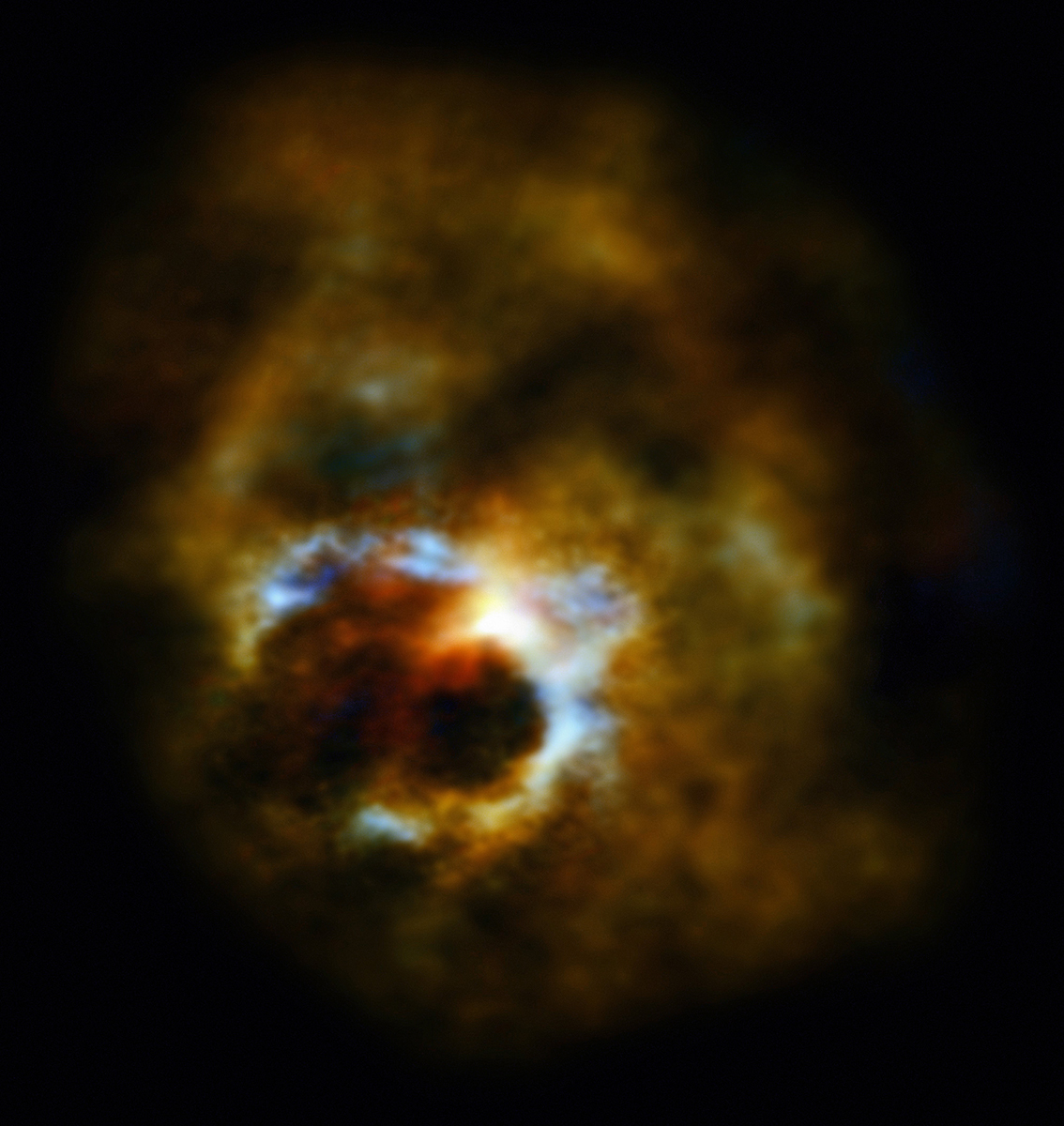
This multi-wavelength approach proved essential. Gas and dust respond differently to radiation and stellar winds, so observing both components allows a more complete reconstruction of the outflow geometry. When the datasets were combined, the team identified a clear two-lobed structure expanding away from Mira A.
Viewed together, the lobes form a shape that strongly resembles a heart. The morphology is not an imaging artifact. Instead, it reflects real asymmetry in the distribution of circumstellar material. The observations also reveal internal stratification. Gas dominates the interior of the lobes, while dust concentrates along the outer boundaries. This separation indicates that the ejection involved complex physical processes rather than a simple isotropic wind.
By measuring the expansion velocity, the researchers estimated that the mass-loss event occurred around 2010 to 2012. That timing makes the structure extremely young in astrophysical terms. Consequently, astronomers are observing the system during a relatively early phase of its evolution.

An unusually massive and asymmetric ejection
The scale of the outburst represents one of the most significant aspects of the discovery. The team estimates that Mira A expelled material equivalent to roughly seven Earth masses during this episode. For a single event in a Mira-type star, that figure is remarkably high.
Standard AGB models predict more gradual mass loss driven by pulsation-enhanced dust winds. Although episodic variations can occur, they typically remain modest in magnitude. Mira A appears to have deviated strongly from this pattern.
Equally important, the outflow is highly asymmetric. The heart-shaped morphology indicates that the ejection did not occur uniformly in all directions. Instead, the star released material preferentially along specific axes.
This behavior has direct implications for stellar evolution theory. The rate and geometry of mass loss determine how quickly an AGB star sheds its envelope and transitions toward the planetary nebula phase. If large, directional bursts occur more often than expected, existing evolutionary tracks may require revision.

The origin of the “Cosmic Lighthouse” effect
In addition to the unusual morphology, researchers identified strong spatial variations in the brightness of the surrounding dust. Certain regions appear significantly more illuminated than others, and the pattern changes with time. This behavior led the team to describe Mira A as acting like a cosmic lighthouse.
Several physical mechanisms may contribute to this effect. Mira variables possess enormous convective cells that can produce substantial surface inhomogeneities. These structures can alter the local radiation field emerging from the star. At the same time, the star’s pulsation cycle changes its temperature and luminosity on timescales of months.
Dust formation near the stellar photosphere adds further complexity. Newly formed dust clouds can absorb and scatter radiation unevenly, creating shifting illumination patterns across the circumstellar envelope.
Taken together, these processes likely produce the observed beacon-like behavior. Importantly, the lighthouse effect provides a rare diagnostic of the dynamic outer atmosphere of an AGB star. Continued monitoring may help disentangle the relative roles of convection, pulsation, and dust formation.
Binary Interaction with Mira B
The Mira system is not a single-star environment. Mira A has a companion, Mira B, which is a white dwarf located roughly seventy astronomical units away. Binary interaction often plays a key role in shaping circumstellar structures, and this system appears to be no exception.
Observations indicate that Mira B is already accreting some of the material expelled by the primary star. Even modest accretion can alter the geometry of the outflow by introducing gravitational focusing and tidal effects. Over longer timescales, such interactions can produce the complex morphologies commonly observed in planetary nebulae.
In the present case, the expanding heart-shaped envelope may represent an early stage of binary-driven shaping. As the material continues to move outward, the gravitational influence of Mira B could further distort the structure. Astronomers therefore plan continued monitoring to track any evolving interaction between the two stars.

Clear skies!
See more from DIYPhotography.net on Google
Add DIYPhotography.net as a trusted source. This makes
our stories more likely to appear in your Google Search results.
 Add as a preferred source on Google

Soumyadeep Mukherjee
Soumyadeep Mukherjee is an award-winning astrophotographer from India. He has a doctorate degree in Linguistics. His work extends to the sub-genres of nightscape, deep sky, solar, lunar and optical phenomenon photography. He is also a photography educator and has conducted numerous workshops. His works have appeared in over 40 books & magazines including Astronomy, BBC Sky at Night, Sky & Telescope among others, and in various websites including National Geographic, NASA, Forbes. He was the first Indian to win “Astronomy Photographer of the Year” award in a major category.


Join the Discussion
DIYP Comment Policy
Be nice, be on-topic, no personal information or flames.