









Hubble and JWST Find a Cat in Space: Capture Three Views of It
Nov 1, 2026
Soumyadeep Mukherjee
Soumyadeep Mukherjee is an award-winning astrophotographer from India. He has a doctorate degree in Linguistics. His work extends to the sub-genres of nightscape, deep sky, solar, lunar and optical phenomenon photography. He is also a photography educator and has conducted numerous workshops. His works have appeared in over 40 books & magazines including Astronomy, BBC Sky at Night, Sky & Telescope among others, and in various websites including National Geographic, NASA, Forbes. He was the first Indian to win “Astronomy Photographer of the Year” award in a major category.
Share:
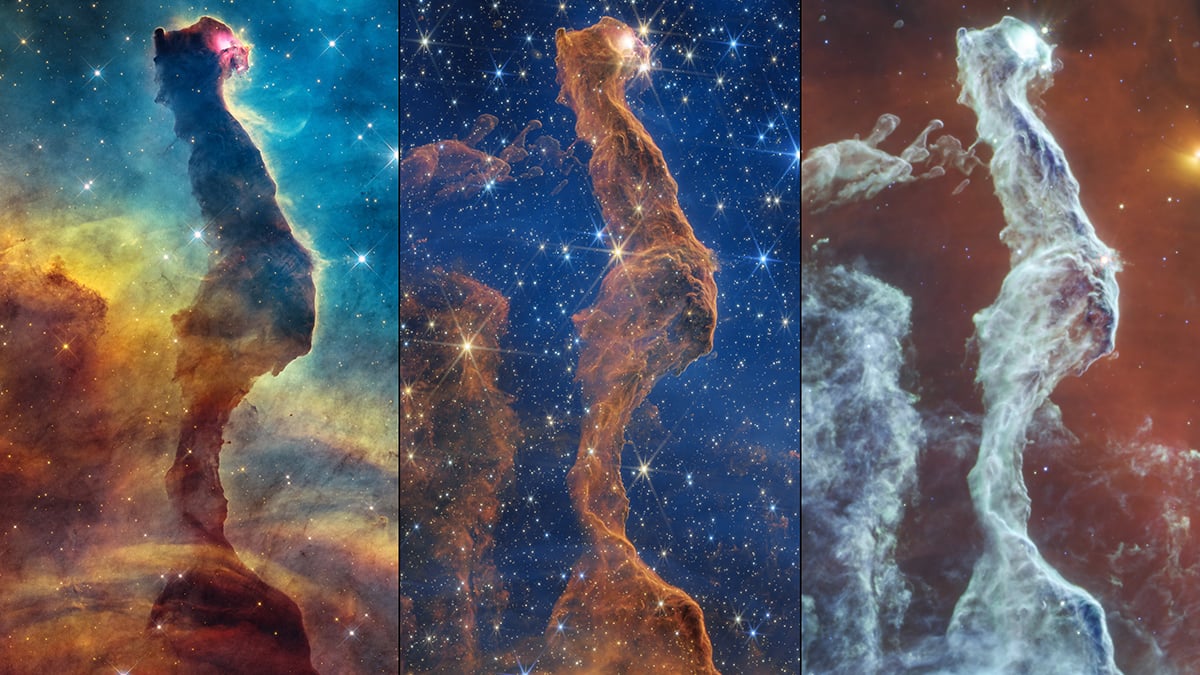
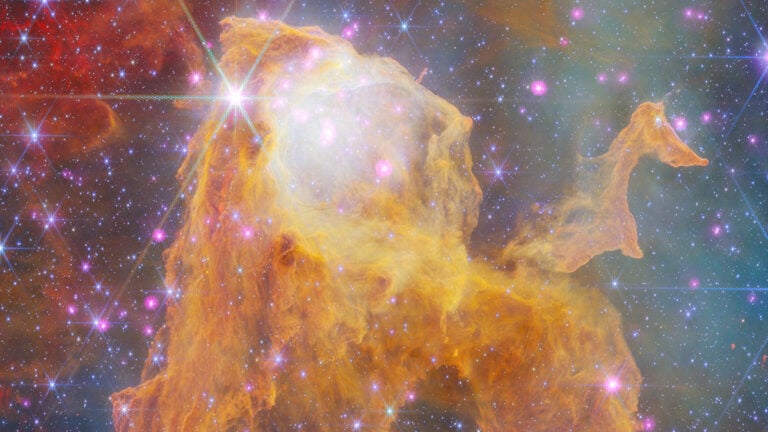
Cats are taking over the universe! A dark pillar of gas and dust sits at the center of a new Hubble Space Telescope image. Its unusual shape resembles a cat sitting with its back toward the viewer, its head turned to one side. A reddish feature near the head gives the impression of a glowing eye. But when the James Webb Space Telescope observes the same region, stars emerge from behind the dust, and fine structures appear across the surrounding clouds.
NASA and ESA have released three images of this region, known as the Cat’s Head Nebula. Hubble captured it in visible light, while Webb used its Near-Infrared Camera (NIRCam) and Mid-Infrared Instrument (MIRI). The Cat’s Head lies within the Carina Nebula, approximately 7,500 light-years from Earth.
A cat-shaped structure in the Carina Nebula
The Cat’s Head Nebula does not have a sharply defined boundary. Its outline comes from a dense filament of gas and dust that stands out against the surrounding material. The pillar stretches vertically through the image, with an irregular extension at its lower end. Its upper portion bends towards the right, creating the appearance of a cat looking over its shoulder.
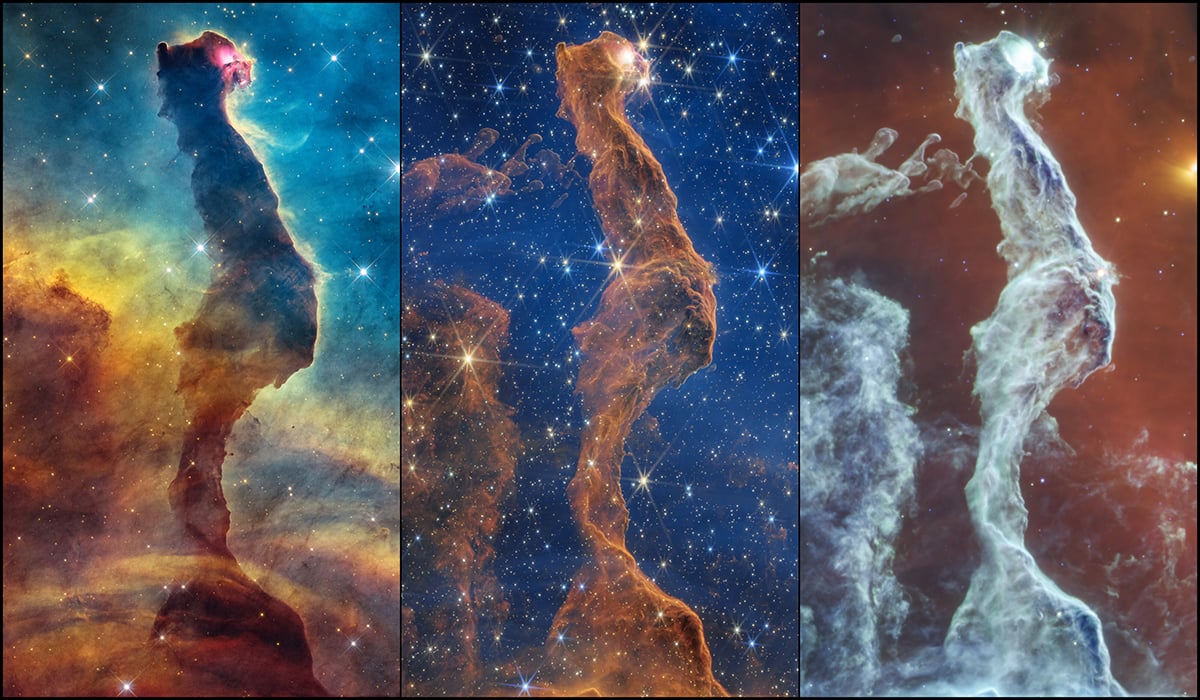
The structure sits within the Carina Nebula, a vast star-forming complex containing young stars and extensive clouds of gas. Massive stars in this region produce intense ultraviolet radiation and powerful stellar winds. Over time, these forces erode nearby clouds and reshape their surfaces. Denser patches of material can withstand this erosion for longer, leaving behind pillars and other irregular structures.
The Cat’s Head appears to have taken shape through this process. Ultraviolet radiation heats the exposed gas and causes it to escape into space. Astronomers call this process photoevaporation. Stellar winds also push surrounding material away, gradually changing the shape of the cloud.
Hubble captures the dark dust pillar
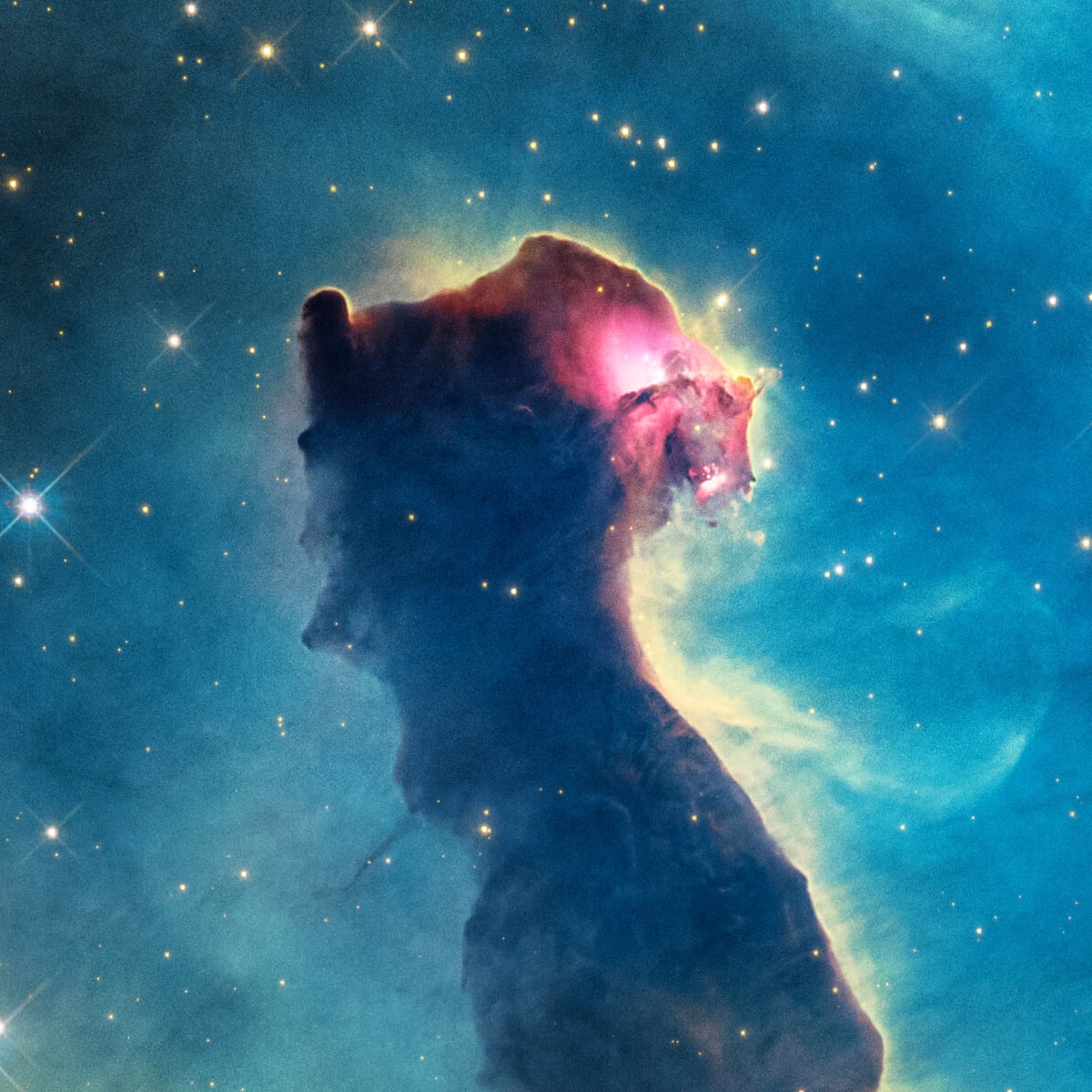
Hubble‘s Wide Field Camera 3 (WFC3) provides the visible-light view. The central pillar appears dark brown and almost opaque. It extends through much of the frame, blocking light from the material behind it. Its dense appearance makes the cat-like outline particularly easy to recognize.
A reddish patch near the head is one of the most noticeable features. Astronomers think it may mark a young star that remains partly embedded in the surrounding dust. The material around this feature makes it difficult to examine its immediate environment using visible light alone.
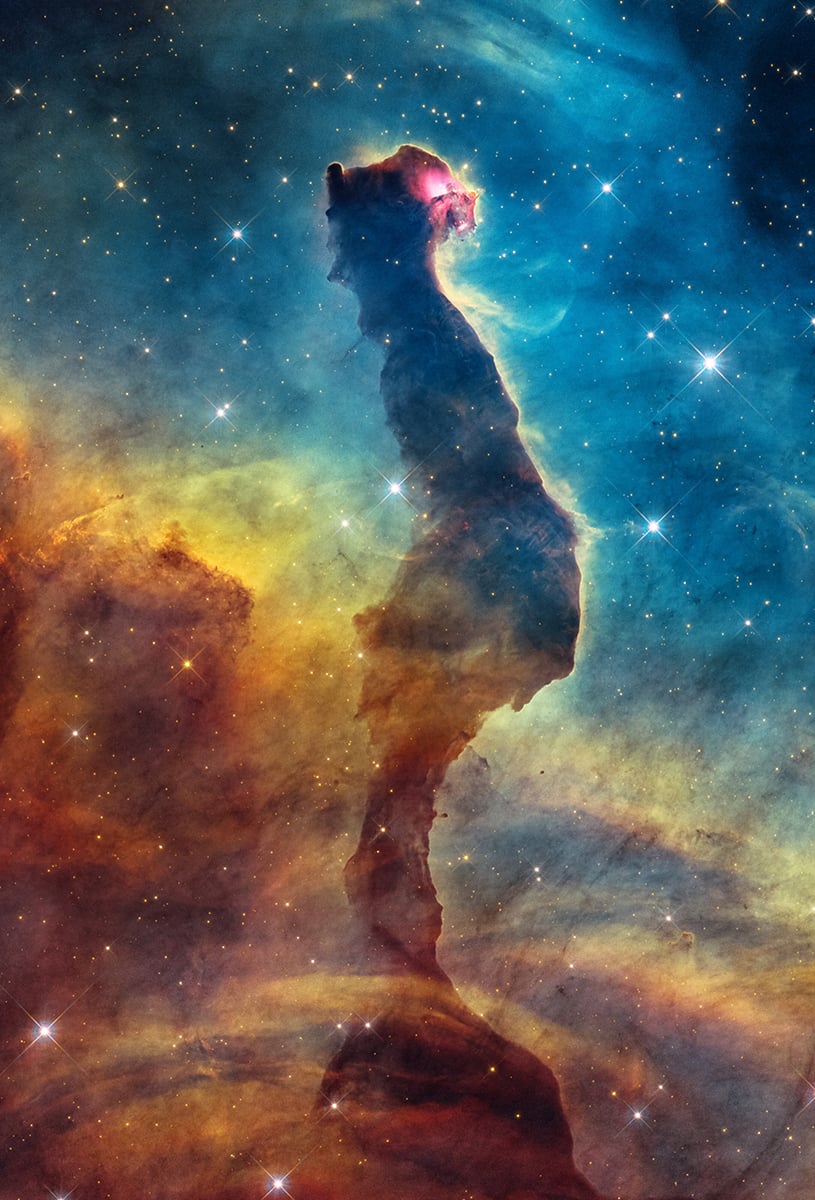
A hazy yellow ridge follows the right edge of the pillar. This boundary receives ultraviolet radiation from nearby massive stars. The radiation ionizes and heats the exposed gas, causing some of the material to evaporate. The bright rim offers a visible indication of this interaction.
NIRCam Reveals Stars and MIRI Finds Warm Dust
James Webb‘s Near-Infrared Camera (NIRCam) reveals a much busier scene. Near-infrared light can pass through some of the dust that blocks visible wavelengths. As a result, the central pillar appears less opaque, and its surface reveals a more complicated structure.
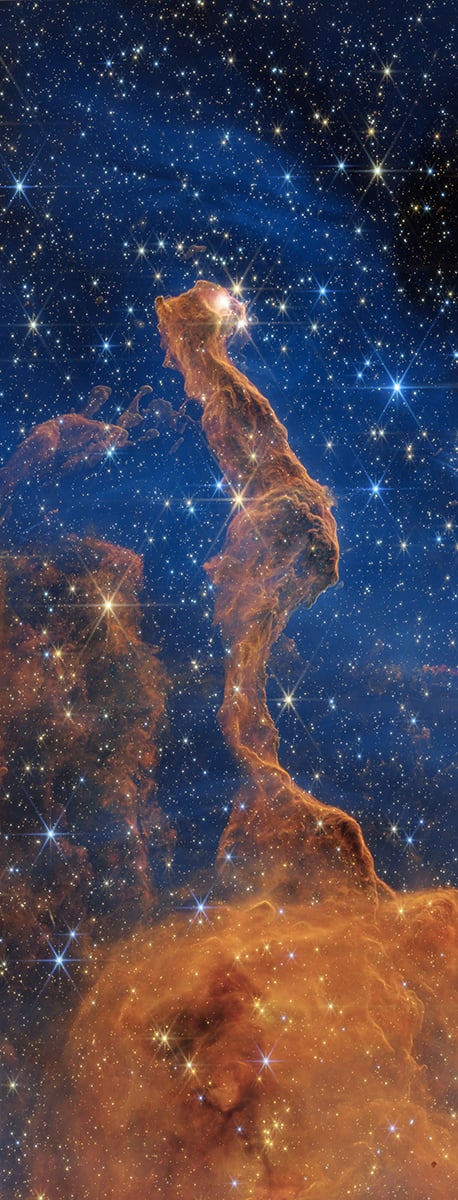
The difference becomes particularly noticeable around the edges. Fine variations in the dusty material are visible, while delicate wisps extend from the left side of the pillar. Nearby massive stars expose these structures to intense radiation, which gradually changes their appearance.
James Webb’s MIRI image captures yet another view. The instrument observes longer infrared wavelengths than NIRCam, allowing astronomers to study emission from warm dust and carbon-based molecules.
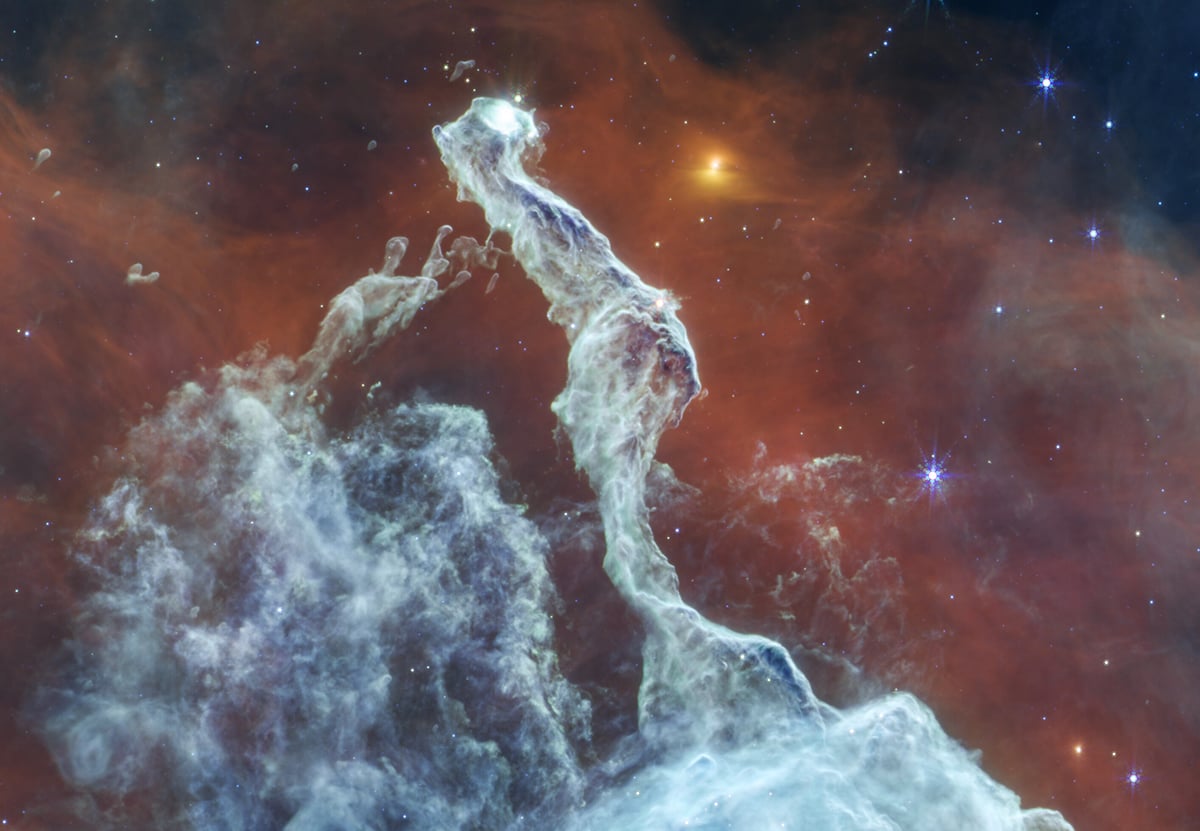
The central pillar appears bluish-gray in this image, while much of the surrounding region glows red. Its outline remains familiar, but the structures around it become particularly interesting. Small globules and thin strands of material stand out to the left of the pillar. They form an intricate arrangement that is much easier to distinguish in the mid-infrared view.
Clear skies!
See more from DIYPhotography.net on Google
Add DIYPhotography.net as a trusted source. This makes
our stories more likely to appear in your Google Search results.
 Add as a preferred source on Google

Soumyadeep Mukherjee
Soumyadeep Mukherjee is an award-winning astrophotographer from India. He has a doctorate degree in Linguistics. His work extends to the sub-genres of nightscape, deep sky, solar, lunar and optical phenomenon photography. He is also a photography educator and has conducted numerous workshops. His works have appeared in over 40 books & magazines including Astronomy, BBC Sky at Night, Sky & Telescope among others, and in various websites including National Geographic, NASA, Forbes. He was the first Indian to win “Astronomy Photographer of the Year” award in a major category.

Join the Discussion
DIYP Comment Policy
Be nice, be on-topic, no personal information or flames.