





















JWST Captures the Galaxy Behind the Most Distant Fast Radio Burst Yet
Oct 12, 2026
Soumyadeep Mukherjee
Soumyadeep Mukherjee is an award-winning astrophotographer from India. He has a doctorate degree in Linguistics. His work extends to the sub-genres of nightscape, deep sky, solar, lunar and optical phenomenon photography. He is also a photography educator and has conducted numerous workshops. His works have appeared in over 40 books & magazines including Astronomy, BBC Sky at Night, Sky & Telescope among others, and in various websites including National Geographic, NASA, Forbes. He was the first Indian to win “Astronomy Photographer of the Year” award in a major category.
Share:
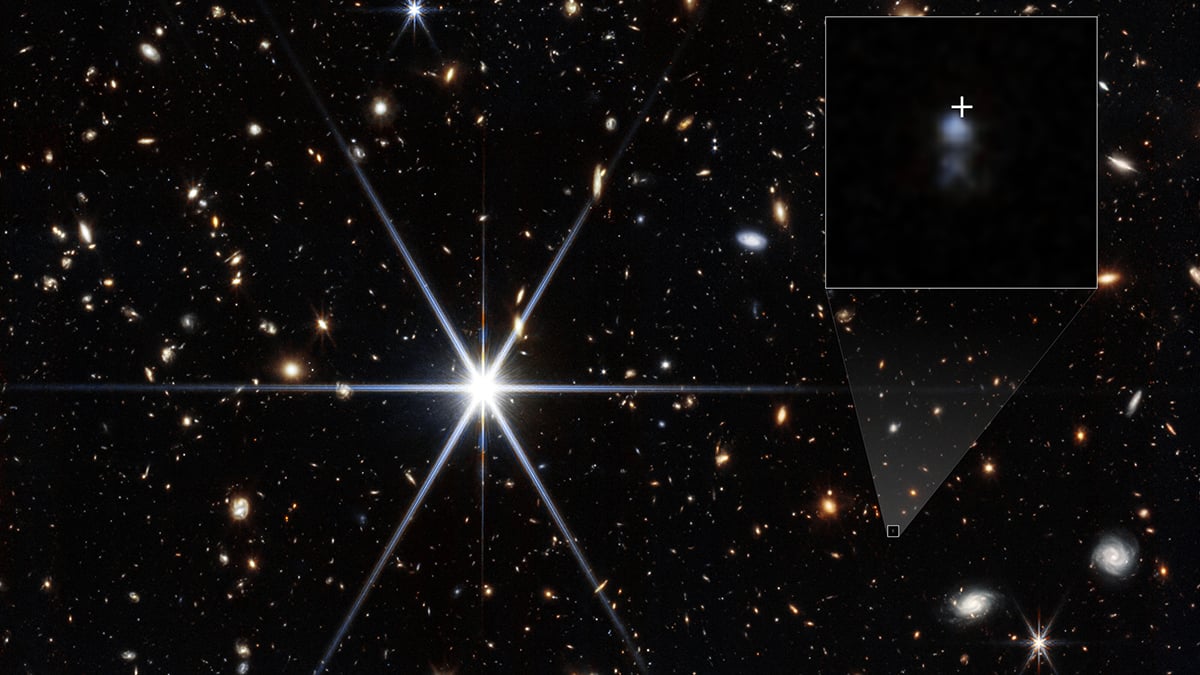
On 4 March 2024, the MeerKAT radio telescope in South Africa detected a brief flash of radio waves from deep space. The signal lasted milliseconds, but the source lay billions of light-years away. Astronomers could pinpoint the burst, yet they could not find the galaxy that produced it. Ground-based telescopes failed to reveal the faint object at its position.
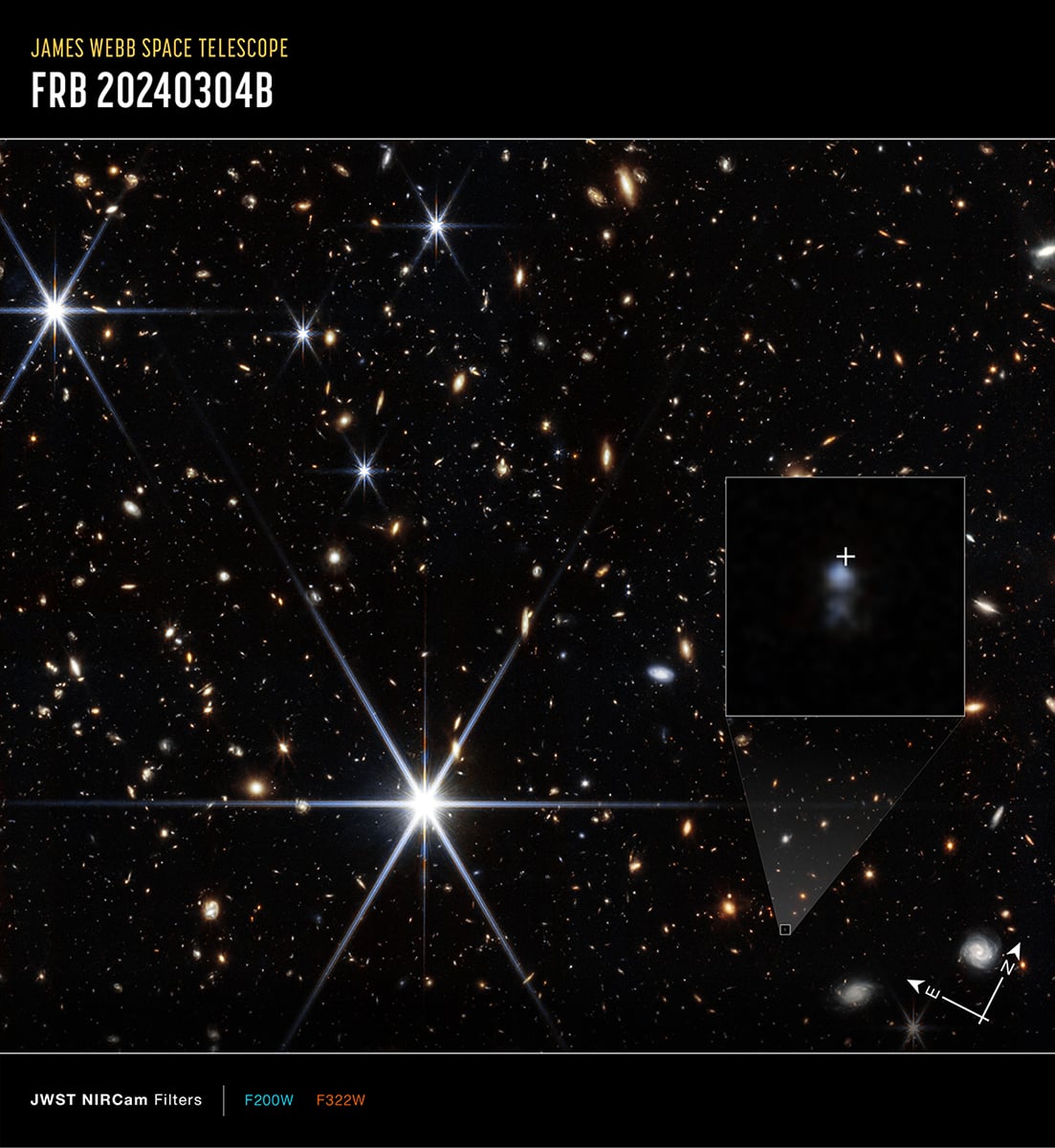
The team turned to the James Webb Space Telescope for a closer look. JWST found a small galaxy at the burst’s location and measured its distance. The event, named FRB 20240304B, is the most distant fast radio burst identified to date. Its light began travelling towards Earth when the Universe was about three billion years old.
A radio flash from the distant universe
Fast radio bursts, or FRBs, are intense flashes of radio emission that last only milliseconds. Astronomers discovered the first recognized example in 2007. Since then, radio telescopes have detected thousands of these events, but scientists still debate what produces them.
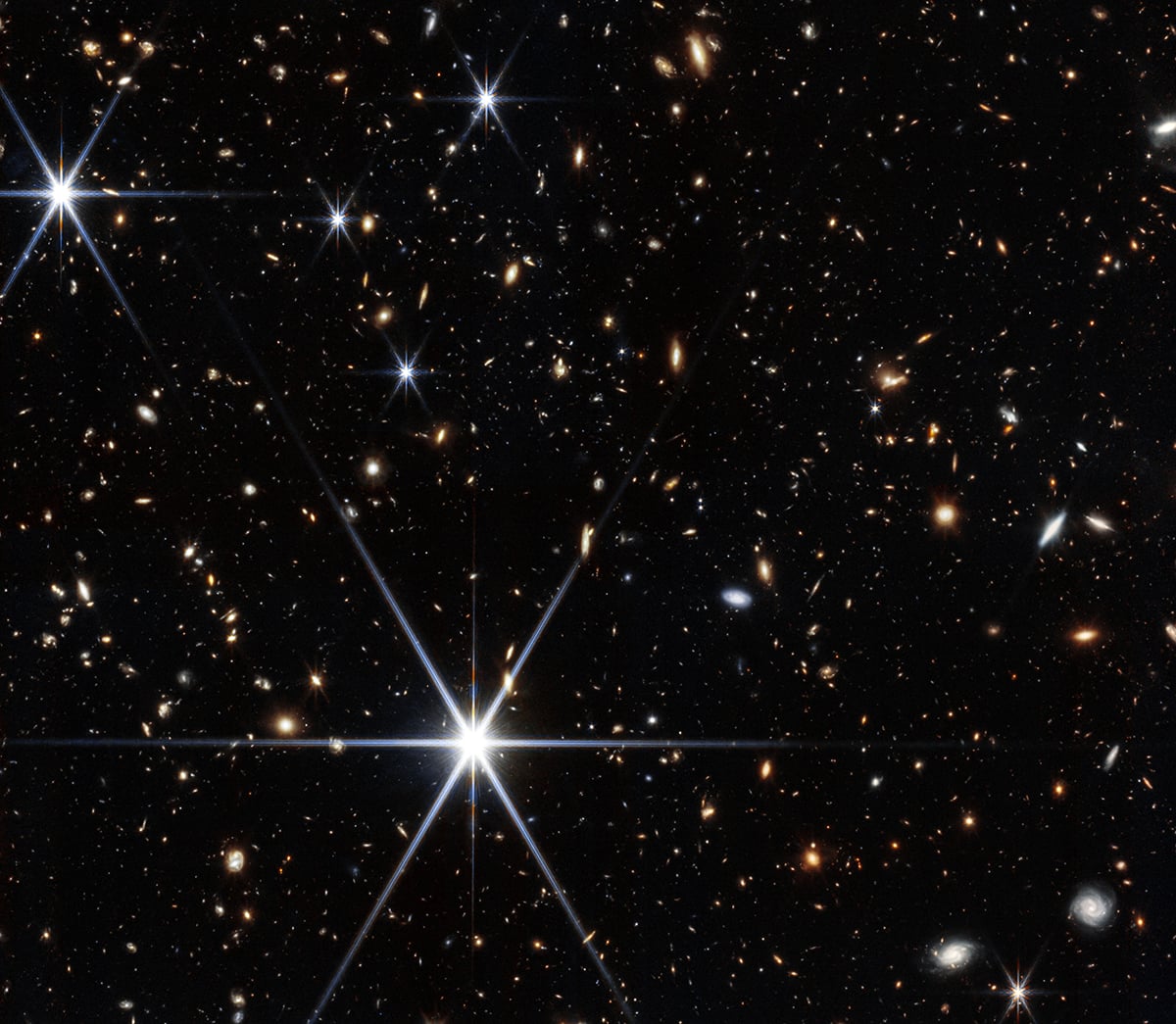
Some bursts repeat, giving researchers several opportunities to study the same source. Others appear once and never return. When a burst lasts only a fraction of a second, astronomers must establish its position accurately enough to search for the object responsible. Even then, the host galaxy may be too faint to detect.
Finding that galaxy can help narrow down the possible explanations. Its stellar population, mass, and rate of star formation provide clues about the objects inside it. A galaxy producing many young stars, for example, may contain recently formed neutron stars. An older galaxy presents a different set of possibilities.
How James Webb found the galaxy
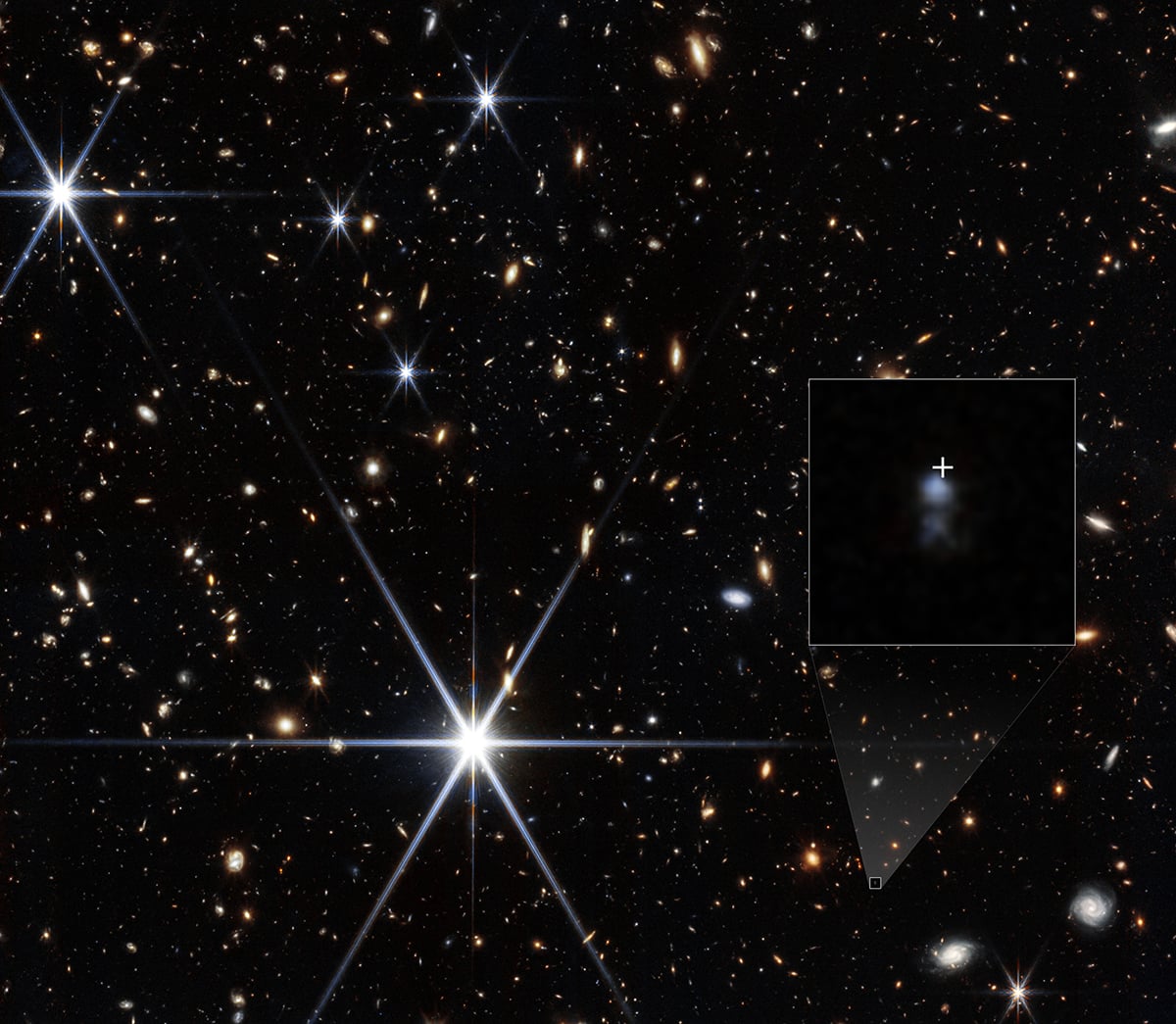
The MeerTRAP team detected FRB 20240304B with MeerKAT on 4 March 2024. MeerKAT’s radio measurements let researchers pinpoint the burst’s position. However, even the world’s largest ground-based telescopes could not detect the faint galaxy at that location.
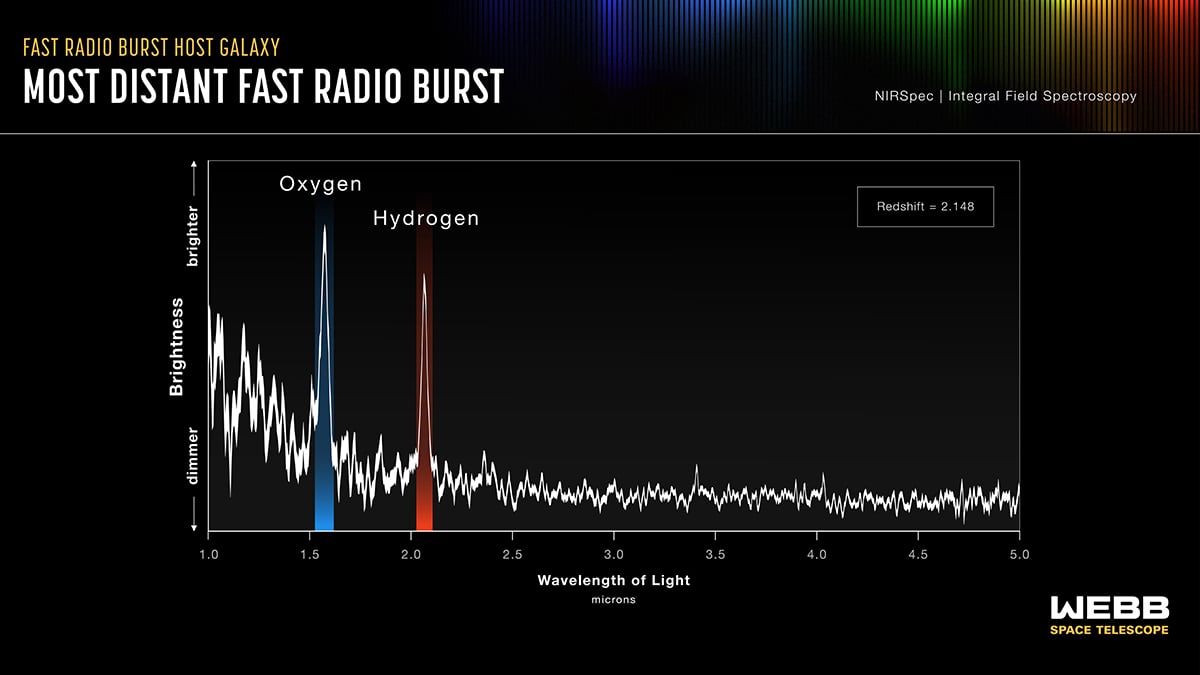
JWST‘s Near-Infrared Camera, known as NIRCam, detected the host galaxy. The team then used its Near-Infrared Spectrograph, or NIRSpec, to analyze the galaxy’s light. The spectrum revealed a redshift of 2.148, confirming that the galaxy existed when the Universe was roughly three billion years old.
Redshift measures how much an object’s light has stretched during its journey through the expanding Universe. Astronomers use it to estimate distances and establish when the light left its source. In this case, the measurement confirmed the extraordinary distance suggested by the radio data.
A dwarf galaxy that defied expectations
The host galaxy was much smaller than the researchers had anticipated. Many previously identified FRB host galaxies are massive systems with substantial populations of stars. The team expected to find a similarly large galaxy at the position of FRB 20240304B.
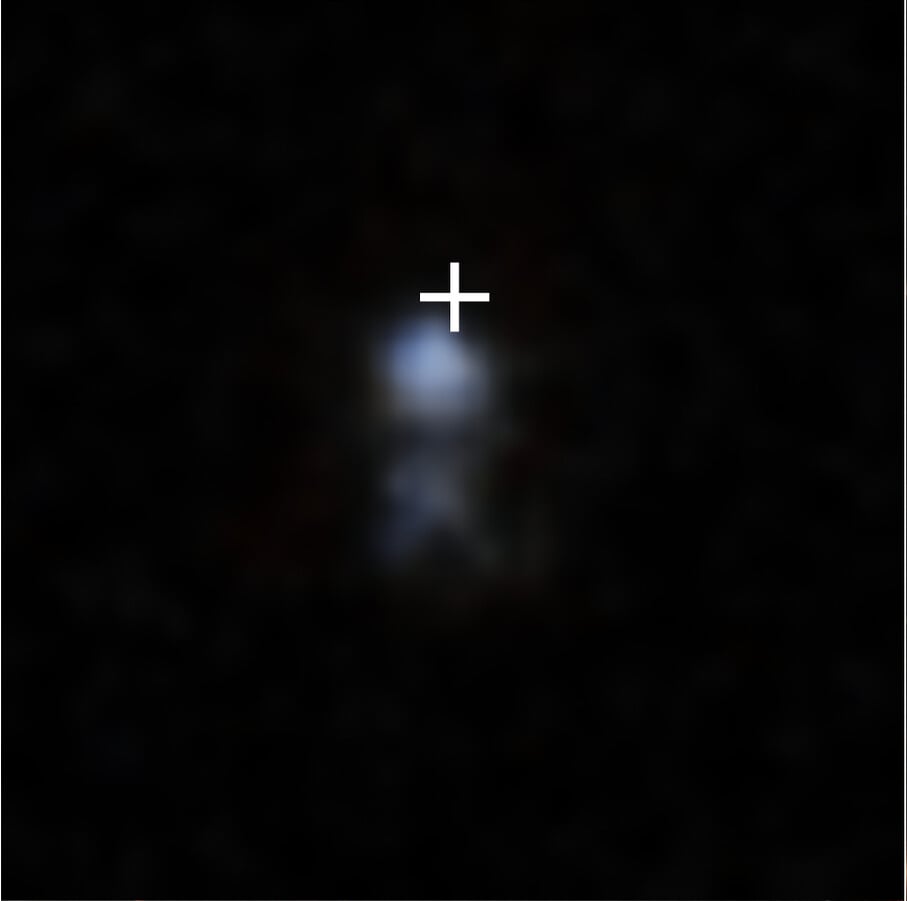
However, James Webb revealed a dwarf galaxy with roughly one-thousandth of the mass the researchers had expected. Despite its small size, the galaxy was actively forming stars. The team estimated that most of its stars may have formed within a period of just 30 million years.
The galaxy existed during a period known as cosmic noon. Roughly two to three billion years after the Big Bang, star formation across the Universe reached its peak. Many galaxies were building up their stellar populations, and massive stars were living and dying in large numbers.
Clear skies!
See more from DIYPhotography.net on Google
Add DIYPhotography.net as a trusted source. This makes
our stories more likely to appear in your Google Search results.
 Add as a preferred source on Google

Soumyadeep Mukherjee
Soumyadeep Mukherjee is an award-winning astrophotographer from India. He has a doctorate degree in Linguistics. His work extends to the sub-genres of nightscape, deep sky, solar, lunar and optical phenomenon photography. He is also a photography educator and has conducted numerous workshops. His works have appeared in over 40 books & magazines including Astronomy, BBC Sky at Night, Sky & Telescope among others, and in various websites including National Geographic, NASA, Forbes. He was the first Indian to win “Astronomy Photographer of the Year” award in a major category.
Join the Discussion
DIYP Comment Policy
Be nice, be on-topic, no personal information or flames.