






















NASA Astronaut’s Photos from ISS Reveal How Cities Have Changed at Night
Sep 14, 2026
Soumyadeep Mukherjee
Soumyadeep Mukherjee is an award-winning astrophotographer from India. He has a doctorate degree in Linguistics. His work extends to the sub-genres of nightscape, deep sky, solar, lunar and optical phenomenon photography. He is also a photography educator and has conducted numerous workshops. His works have appeared in over 40 books & magazines including Astronomy, BBC Sky at Night, Sky & Telescope among others, and in various websites including National Geographic, NASA, Forbes. He was the first Indian to win “Astronomy Photographer of the Year” award in a major category.
Share:
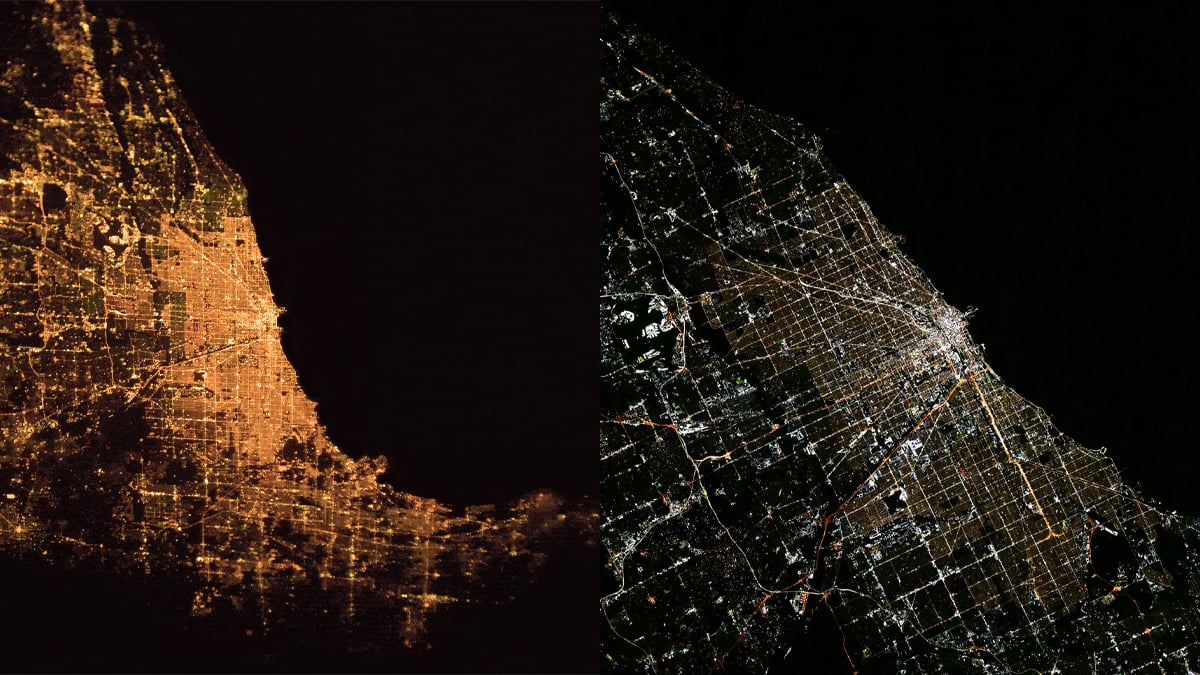
Cities look very different from space after dark. Over the past two decades, the view has kept changing. The orange glow that once covered many urban areas is giving way to brighter white and blue-white lights. NASA astronaut Don Pettit has captured this change in a series of photographs from the International Space Station. He recently shared several before-and-after comparisons on X. Each pair shows the same city photographed years apart.
The differences are easy to spot. Older photographs show broad areas of orange or yellow light, whereas the newer images contain more white light. Pettit’s photographs include Chicago, Mexico City, São Paulo, Seoul, Las Vegas, Monterrey, and Miami. He also showed the Hong Kong and Shenzhen area, where the two cities display very different lighting patterns.
Don Pettit has been watching the change from orbit
Pettit is one of NASA’s most experienced space photographers. He joined NASA’s astronaut corps in 1996 and has flown four space missions. His first long-duration stay aboard the ISS came during Expedition 6 in 2002 and 2003, and his latest mission ran from September 2024 to April 2025.
Pettit developed a tracking system to deal with the movement of the ISS. His setup allowed the camera to follow the ground during an exposure. It opened up the possibility of taking much sharper photographs of cities after dark.
Chicago, USA 2024 vs 2003
— Don Pettit (@astro_Pettit) September 7, 2026
The grid street layout of Chicago is immediately recognizable from orbit, and characteristic of many North American cities, and emphasize the change in color intensity. pic.twitter.com/JO1uRZBUyq
“I have spent 23 years documenting the global LED transition of city lighting from space. Across my 4 missions to the ISS, I have photographed every major city on Earth, building a data set of the gradual replacement of sodium vapor lighting with LEDs.”
Donald R. Pettit, NASA astronaut (on his X handle)
His photographs make the change pretty apparent. Older images carry a strong yellow-orange cast. Newer images contain much more white and blue-white illumination.
Mexico City, Mexico 2025 vs 2003
— Don Pettit (@astro_Pettit) September 7, 2026
A massive city with many streets, almost all transitioned to bright white LEDs. Nature preserves leave distinct dark spots that have remained unchanged. pic.twitter.com/aFDj3DT5ic
The orange glow is disappearing
For much of the last century, high-pressure sodium lamps provided street lighting in cities across the world. They produced a strong yellow-orange light. From several hundred kilometres above Earth, thousands or millions of those lamps merged into a broad orange glow.
Cities have adopted LEDs because they offer a few advantages. They use less electricity than many older lighting systems and generally last longer. They also allow much greater control over brightness and color.
A sodium lamp produces light within a relatively limited part of the spectrum. White LEDs, on the other hand, can produce a much broader range. Manufacturers can also make LEDs with different color temperatures, so two cities can use LED lighting and still look quite different from orbit.
Seoul, South Korea 2025 vs 2011
— Don Pettit (@astro_Pettit) September 7, 2026
City lights weave between mountain valleys and rivers, modernized to LEDs rapidly in the 2010s. pic.twitter.com/3LfHytx4of
Does whiter light mean more light pollution?
It is easy to look at Pettit’s newer photographs and assume that a brighter-looking city must have more light pollution. But the reality is a little more complicated.
Light pollution does not depend only on the color of a streetlight. The direction of the light is the key. A well-shielded fixture can keep most of its light on the road. A poorly aimed fixture can send light towards buildings, surrounding areas, and the sky.
NASA‘s global observation analysis of nighttime-light data from 2014 to 2022 found a 34 percent increase in global radiance. But the increase did not occur everywhere. Some parts of the world became darker during the same period. But in many major parts of the world, light pollution has grown steadily.
Miami, USA 2024 vs 2012
— Don Pettit (@astro_Pettit) September 7, 2026
Famous for its bright streets, it was only recently that Miami's many colors could be distinguished from orbit because the vast yellow glow of sodium vapor overwhelmed all others. pic.twitter.com/Kpnxkm7DVI
The difference in light pollution becomes very obvious when a photographer points a camera towards the night sky. The Milky Way provides the clearest example. Under a dark sky, its broad band stretches across the frame with visible dust lanes and dark patches. Near a large city, much of that structure disappears into the skyglow.
Las Vegas, USA 2025 vs 2012
— Don Pettit (@astro_Pettit) September 7, 2026
Perhaps the brightest city on Earth, Vegas has continued its spectacle with new LED sources such as the Vegas Sphere, seen as the large purple spot at center. pic.twitter.com/5Zflt2KOrn
Clear skies!
See more from DIYPhotography.net on Google
Add DIYPhotography.net as a trusted source. This makes
our stories more likely to appear in your Google Search results.
 Add as a preferred source on Google

Soumyadeep Mukherjee
Soumyadeep Mukherjee is an award-winning astrophotographer from India. He has a doctorate degree in Linguistics. His work extends to the sub-genres of nightscape, deep sky, solar, lunar and optical phenomenon photography. He is also a photography educator and has conducted numerous workshops. His works have appeared in over 40 books & magazines including Astronomy, BBC Sky at Night, Sky & Telescope among others, and in various websites including National Geographic, NASA, Forbes. He was the first Indian to win “Astronomy Photographer of the Year” award in a major category.
Related Posts
 How street photography changed my lifestreet photography changed my lifeHow street photography changed my life
 Photographer captures ISS astronauts’ spacewalk from his own backyard
 Designers reimagine big cities without billboards in a striking set of photos
 The Disposable Camera Astronauts Have Sent On A Suicide Mission To Capture Photos Of Burning Spacecraft
Join the Discussion
DIYP Comment Policy
Be nice, be on-topic, no personal information or flames.