





















JWST Image Reveals Cosmic “Buckyballs” Around a Dying Star
May 10, 2026
Soumyadeep Mukherjee
Soumyadeep Mukherjee is an award-winning astrophotographer from India. He has a doctorate degree in Linguistics. His work extends to the sub-genres of nightscape, deep sky, solar, lunar and optical phenomenon photography. He is also a photography educator and has conducted numerous workshops. His works have appeared in over 40 books & magazines including Astronomy, BBC Sky at Night, Sky & Telescope among others, and in various websites including National Geographic, NASA, Forbes. He was the first Indian to win “Astronomy Photographer of the Year” award in a major category.
Share:
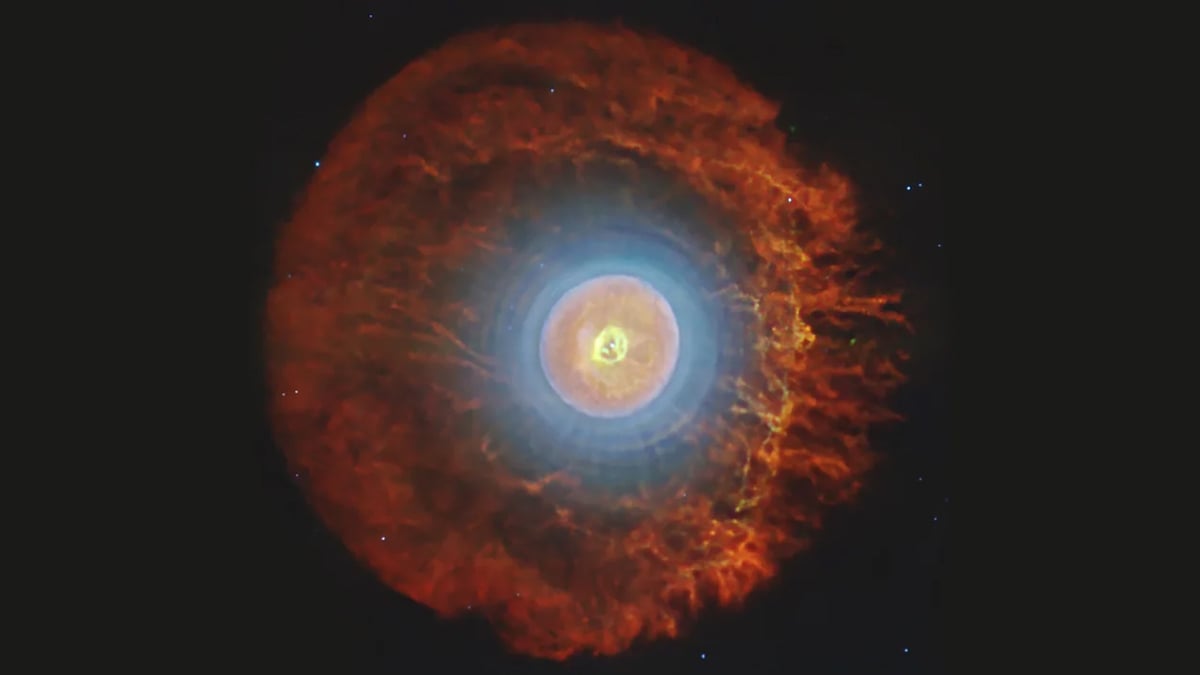
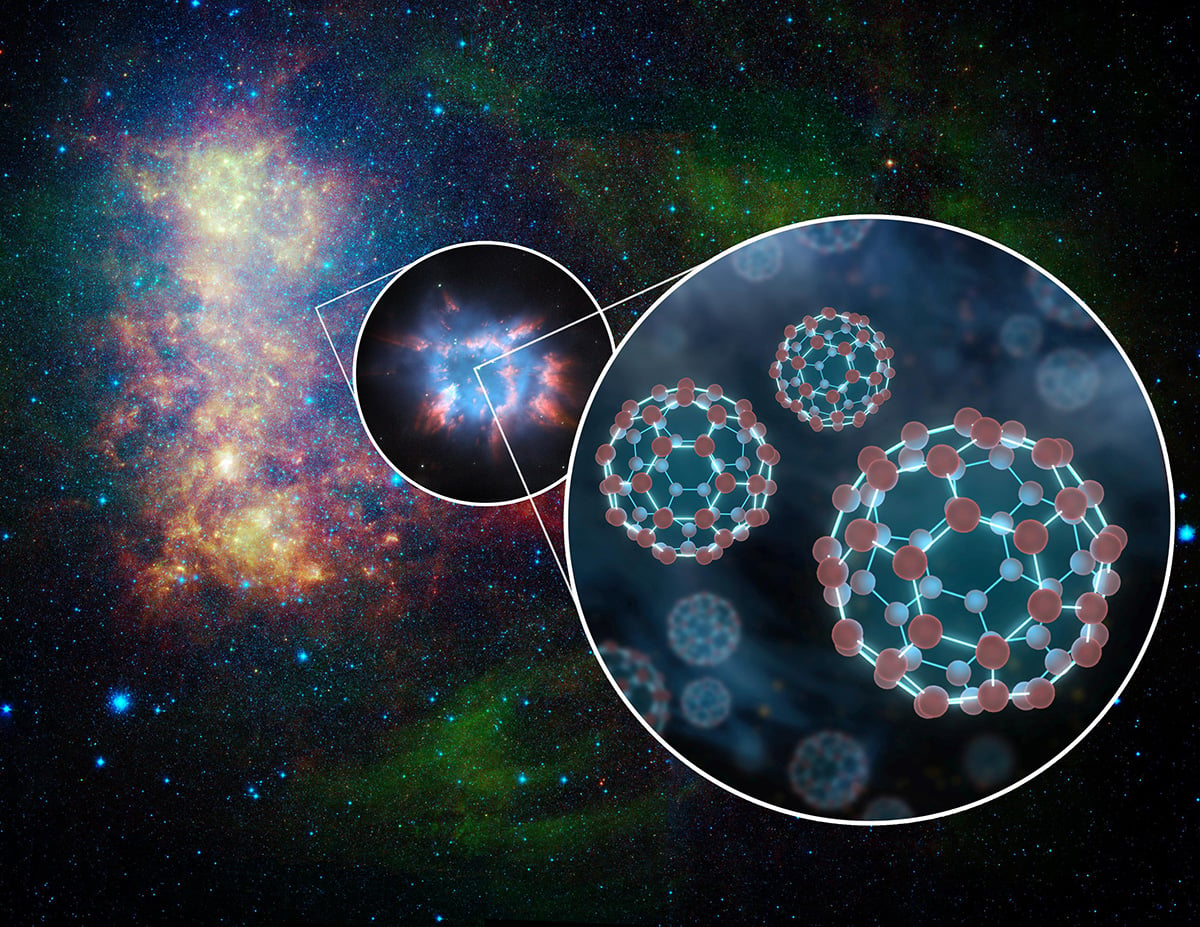
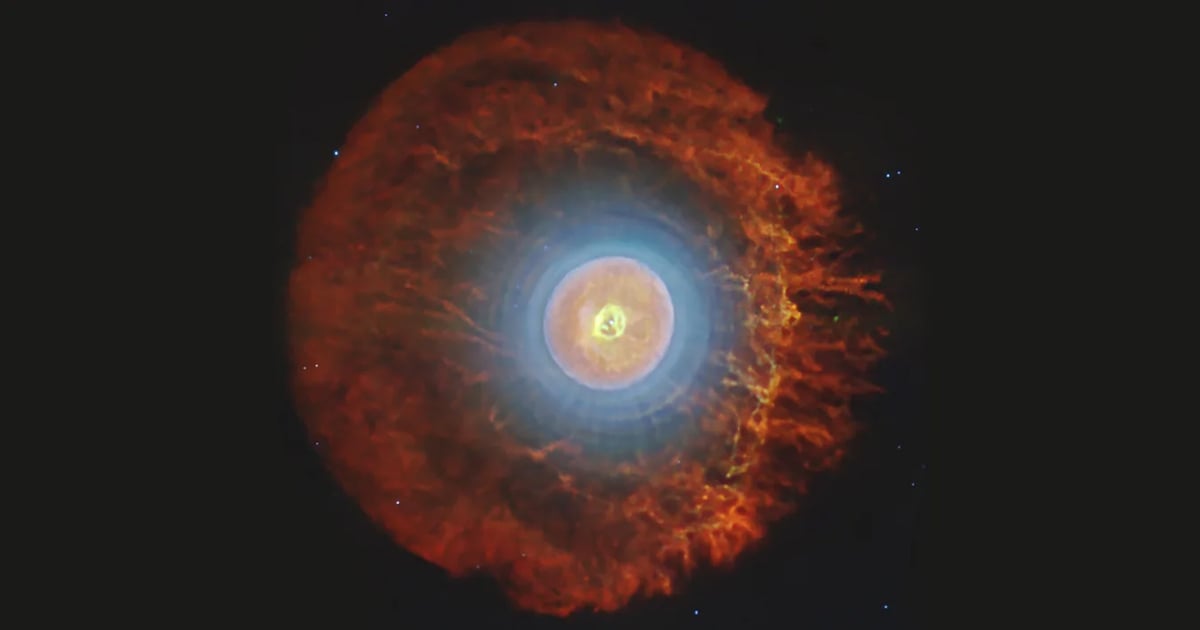
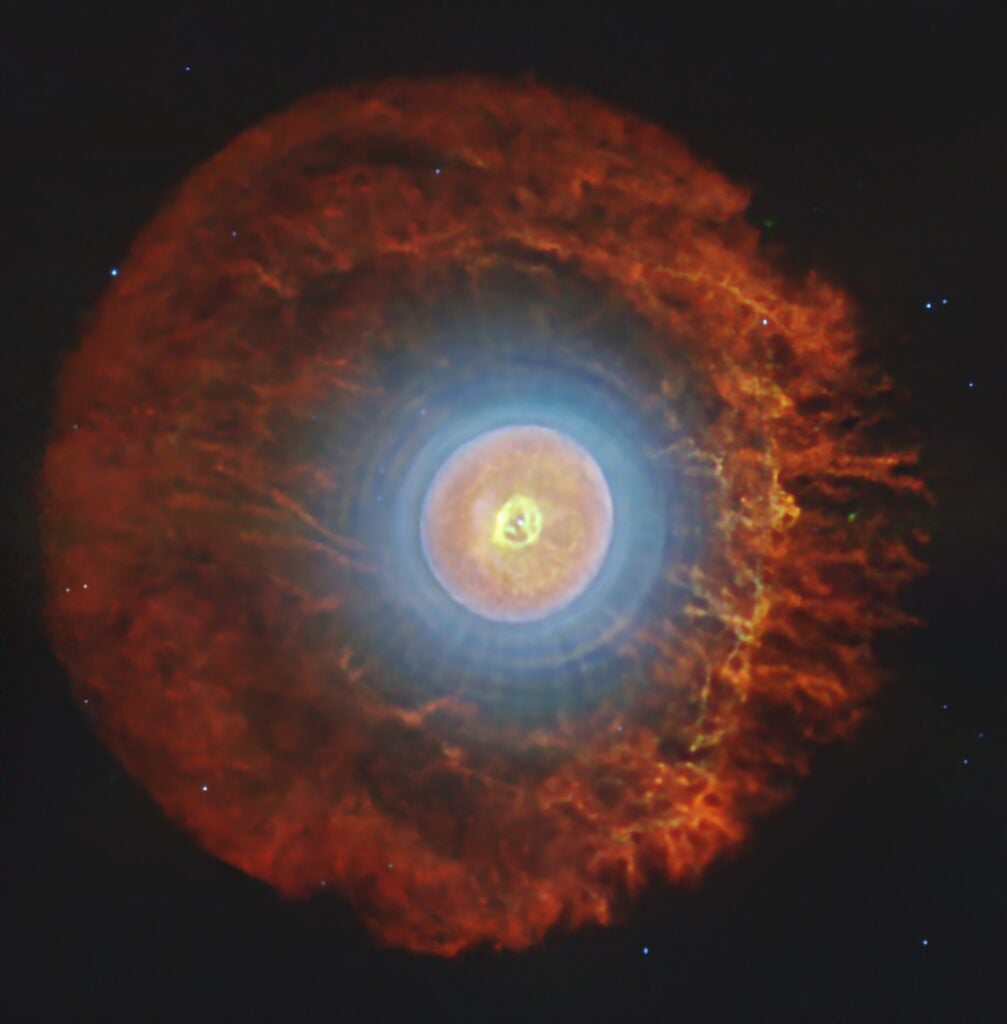
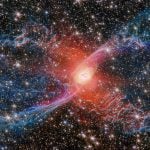
Planetary nebulae trace one of the final evolutionary stages of low- and intermediate-mass stars. The James Webb Space Telescope has captured one of the most detailed infrared views ever obtained of the planetary nebula Tc 1. The observations uncovered a highly structured molecular environment surrounding the dying star, including large concentrations of fullerene molecules, also known as buckyballs. JWST also revealed layered shells, arcs, filamentary structures, and an unusual feature shaped like an inverted question mark near the nebula’s center.
The observations build upon earlier discoveries made with the Spitzer Space Telescope, which first identified fullerene molecules inside Tc 1 in 2010. However, JWST’s higher sensitivity and spatial resolution now allow astronomers to study how these molecules are distributed throughout the nebula and how they interact with surrounding gas and dust.
Tc 1: An unusual planetary nebula
Tc 1 lies around 10,000 light-years away in the southern constellation Ara. It appears similar to many planetary nebulae observed across the Milky Way. A compact stellar remnant sits at the center while expanding layers of gas surround it in multiple shells. But infrared observations have shown for years that Tc 1 differs from most nebulae studied so far.
The system first attracted major scientific attention when astronomers using the Spitzer Space Telescope detected spectral signatures associated with fullerene molecules. That discovery represented the first confirmed detection of buckyballs in space. Scientists had predicted for decades that such molecules could form in carbon-rich stellar environments, but observational evidence remained uncertain before the Tc 1 detection.
Using the Mid-Infrared Instrument, or MIRI, JWST observed Tc 1 with far greater sensitivity than previous infrared telescopes. The resulting images revealed an exceptionally complex nebular structure. Instead of a smooth shell surrounding the central star, the nebula contains layered arcs, fragmented rings, molecular clumps, and diffuse filamentary structures extending across the system.
The observations also indicate that fullerene-rich material forms a large shell around the dying star. Researchers described the structure as resembling a “buckyball of buckyballs” because of its apparent large-scale organization around the nebular core.
JWST reveals an unexpectedly complex structure
The Tc 1 observations show why infrared astronomy has become essential for studying planetary nebulae. Visible-light observations capture ionized gas emission successfully, but they often miss colder dust structures and molecular material hidden inside the nebula. Infrared wavelengths penetrate those dusty regions much more effectively.
JWST’s MIRI instrument operates in the mid-infrared range, which makes it highly sensitive to warm dust and molecular emission. That capability allowed astronomers to reconstruct the internal structure of Tc 1 with unprecedented detail.
The new observations revealed that the nebula contains multiple shells and arcs distributed unevenly around the central white dwarf. Some regions appear dense and clumpy while others look diffuse and fragmented. Thin filamentary features also extend through several parts of the nebula, indicating that dynamic interactions continue shaping the expanding gas.
These structures likely formed through several overlapping processes during the star’s final evolutionary stages. When stars like the Sun exhaust their nuclear fuel, they begin shedding their outer layers through relatively slow stellar winds. Later, as the exposed stellar core heats rapidly, faster winds collide with the earlier ejecta. Those collisions compress the gas and create shock fronts throughout the nebula.
The mysterious question-mark structure
Among the many features visible in the JWST image, one structure immediately drew attention from astronomers. Near the center of the nebula lies a formation resembling an inverted question mark. Researchers still do not know what produced it.
The feature appears embedded within the fullerene-rich region surrounding the central white dwarf. Although scientists have proposed several explanations, none currently explains the structure fully.
One possibility involves magnetic shaping. Magnetic fields can guide ionized gas into curved patterns during the nebula’s expansion, especially if the stellar winds vary over time. Another explanation points toward shock interactions between high-velocity winds and dense pockets of previously ejected gas.
The structure may also represent a transient instability within the nebula itself. Expanding gas shells often develop turbulence and fragmentation as shock fronts propagate outward. Under certain conditions, those instabilities can create curved or filamentary shapes that persist for long periods.
A laboratory for galactic carbon chemistry
The broader significance of the Tc 1 observations extends beyond planetary nebula research alone. The system provides astronomers with an unusually rich laboratory for studying how complex carbon molecules evolve in space.
Carbon chemistry plays a major role throughout the Milky Way. Carbon atoms participate in molecular cloud chemistry, dust formation, planetary system evolution, and interstellar organic processes. Understanding how large carbon molecules form and survive remains one of the major challenges in astrochemistry.
The JWST observations strengthen the idea that dying stars contribute complex molecular material to the galaxy over long timescales. As planetary nebulae expand, they enrich surrounding interstellar space with carbon-rich dust and molecular compounds. Eventually, that material becomes incorporated into future generations of stars and planets.
Clear skies!
See more from DIYPhotography.net on Google
Add DIYPhotography.net as a trusted source. This makes
our stories more likely to appear in your Google Search results.
 Add as a preferred source on Google

Soumyadeep Mukherjee
Soumyadeep Mukherjee is an award-winning astrophotographer from India. He has a doctorate degree in Linguistics. His work extends to the sub-genres of nightscape, deep sky, solar, lunar and optical phenomenon photography. He is also a photography educator and has conducted numerous workshops. His works have appeared in over 40 books & magazines including Astronomy, BBC Sky at Night, Sky & Telescope among others, and in various websites including National Geographic, NASA, Forbes. He was the first Indian to win “Astronomy Photographer of the Year” award in a major category.
Join the Discussion
DIYP Comment Policy
Be nice, be on-topic, no personal information or flames.