
























Artemis II Astronauts Capture Historic Earth Images from Space
Apr 3, 2026
Soumyadeep Mukherjee
Soumyadeep Mukherjee is an award-winning astrophotographer from India. He has a doctorate degree in Linguistics. His work extends to the sub-genres of nightscape, deep sky, solar, lunar and optical phenomenon photography. He is also a photography educator and has conducted numerous workshops. His works have appeared in over 40 books & magazines including Astronomy, BBC Sky at Night, Sky & Telescope among others, and in various websites including National Geographic, NASA, Forbes. He was the first Indian to win “Astronomy Photographer of the Year” award in a major category.
Share:
Soon after the Artemis II crew left Earth orbit and began their journey toward the Moon, they turned their cameras back toward home. What they saw was familiar, yet strikingly different. Earth was no longer a landscape beneath them. It had become a distant world floating in darkness.
Within hours of the translunar injection burn, the astronauts began photographing the shrinking blue planet through the windows of the Orion spacecraft. Those images are now reaching Earth, marking a rare moment in the history of human spaceflight. No astronauts have photographed Earth from this distance since the crew of Apollo 17 in 1972.
The Pale Blue Dot
Every deep-space mission includes one turning point. It arrives after launch excitement fades and the spacecraft finally escapes Earth’s orbit. During Artemis II, that moment came soon after Orion completed its translunar injection burn.
The engine burn placed the spacecraft on a trajectory toward the Moon. Once the maneuver ended, the crew finally had time to look back through the windows. Earth was already smaller than expected. From low-Earth orbit, astronauts see continents sliding past beneath them every ninety minutes. However, during Artemis II, the crew watched the entire planet begin to recede at once.
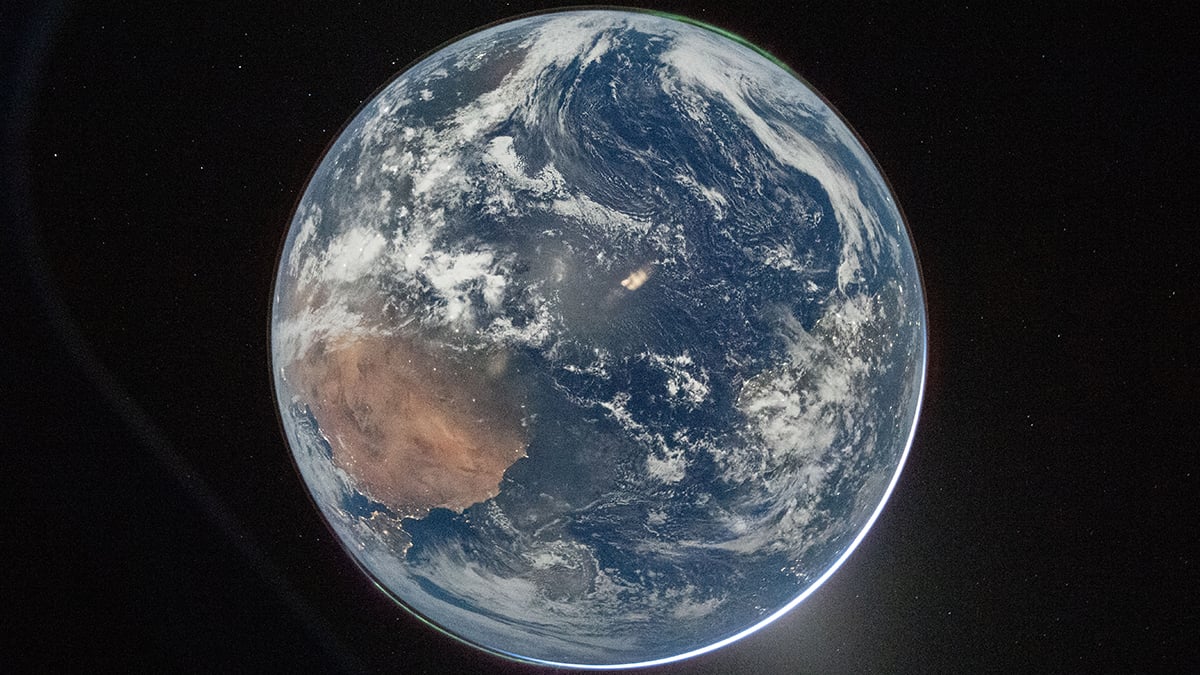
Commander Reid Wiseman captured one of the first released images during this phase of flight. The photograph shows the full disk of Earth. The planet is a pale blue, swirling with white clouds and glowing slightly lighter blue in places from reflected light.
From about 8 to 9 o’clock, a large brown landmass is Africa, with the Iberian Peninsula twinkling with lights just where the planet curves. At the 1 o’clock spot, we see the aurora glow in a thin green glow, just barely separated from the planet’s surface.
Looking through Orion’s windows into deep space
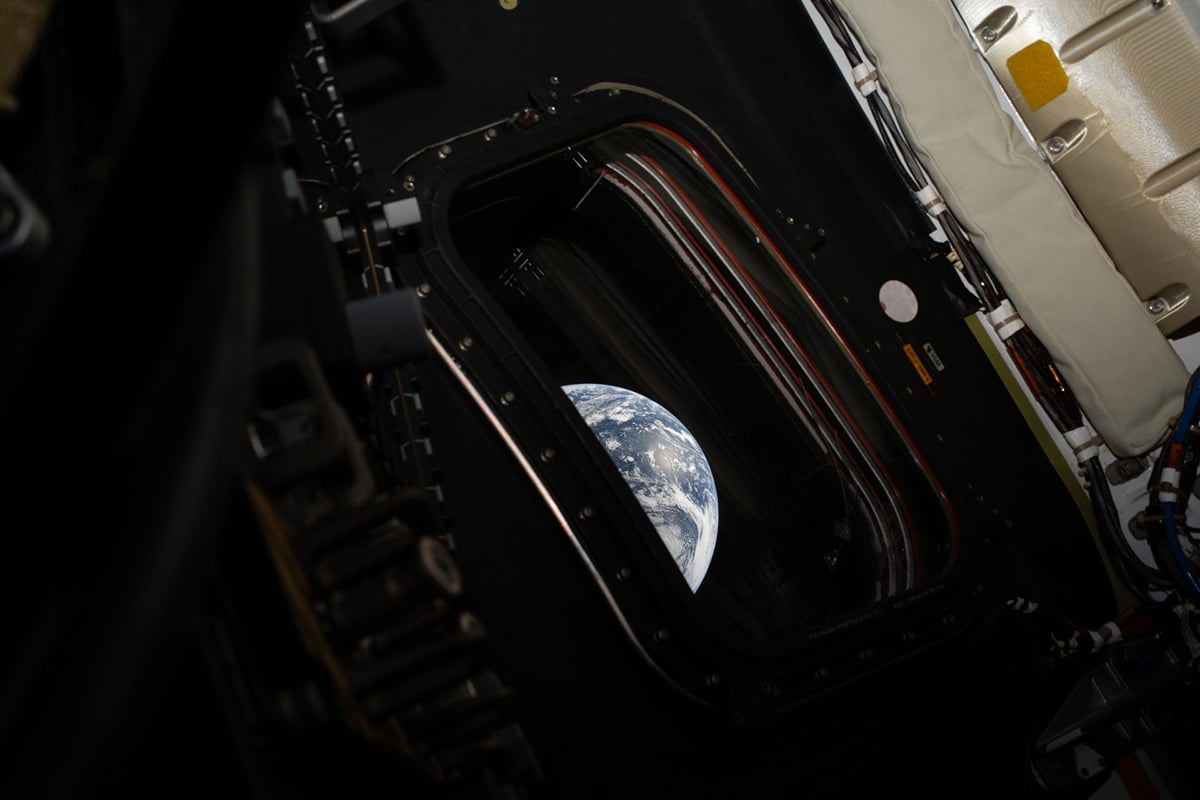
The forward windows of Orion play an essential role during the mission. They allow astronauts to monitor spacecraft orientation, observe celestial targets, and photograph both Earth and the Moon during flight.
Unlike many spacecraft windows designed only for occasional viewing, Orion’s windows support continuous observation tasks. Engineers designed them to withstand deep-space conditions while still providing wide viewing angles for the crew.
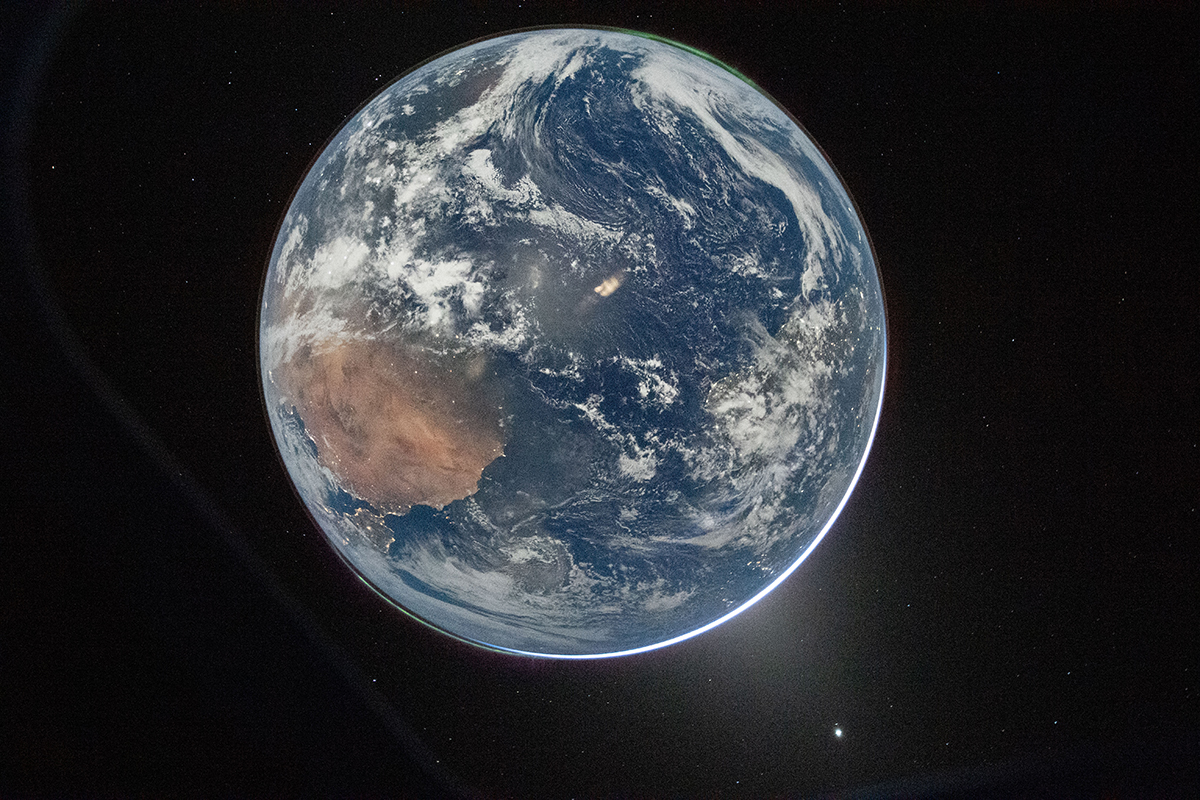
During the early hours of Artemis II, astronauts used handheld cameras to photograph Earth as it moved farther away. The visible portion of Earth shows broad cloud systems spread across the oceans. The curvature of the planet is unmistakable. A thin atmospheric rim outlines the edge of the globe. That blue arc marks the boundary between Earth and space.
Lighting in this image comes from sunlight falling across the planet at an angle. Because of this geometry, surface contrast appears strong. Clouds stand out sharply against darker ocean regions.
Credit: NASA/Reid Wiseman
Seeing Earth as one
Astronauts aboard the International Space Station see Earth from roughly four hundred kilometres above the surface. From that altitude, the planet fills their field of view like a moving map.
As Orion travels outward toward the Moon, Earth transforms into a complete object within a single frame. The curvature becomes unmistakable, and the atmosphere appears as a thin blue arc surrounding the planet. Large cloud systems stretch across entire oceans and continents.
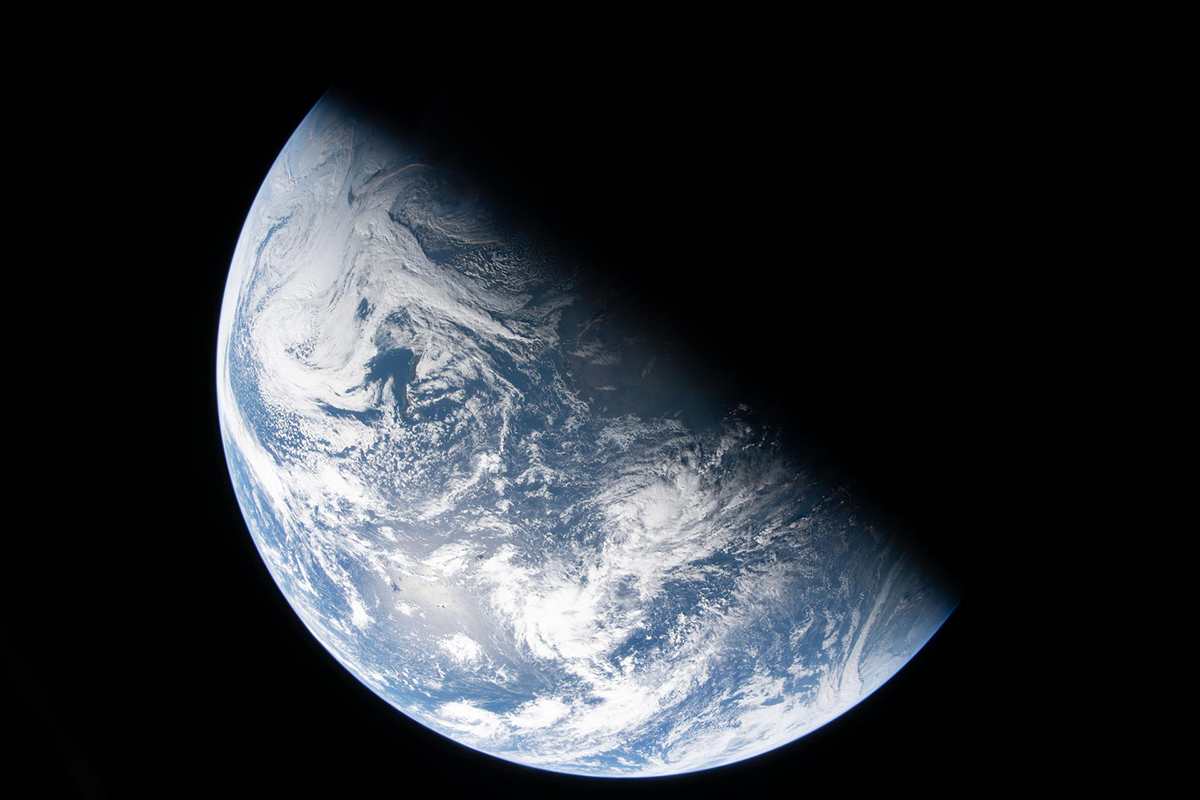
One of the photographs emphasizes the boundary between day and night on Earth. This boundary is known as the terminator line. In the Artemis II image, it cuts across the planet diagonally.
One-half of the Earth appears brightly illuminated. The other half fades gradually into darkness. This transition zone creates a strong contrast across the surface.
Dark side of the Earth
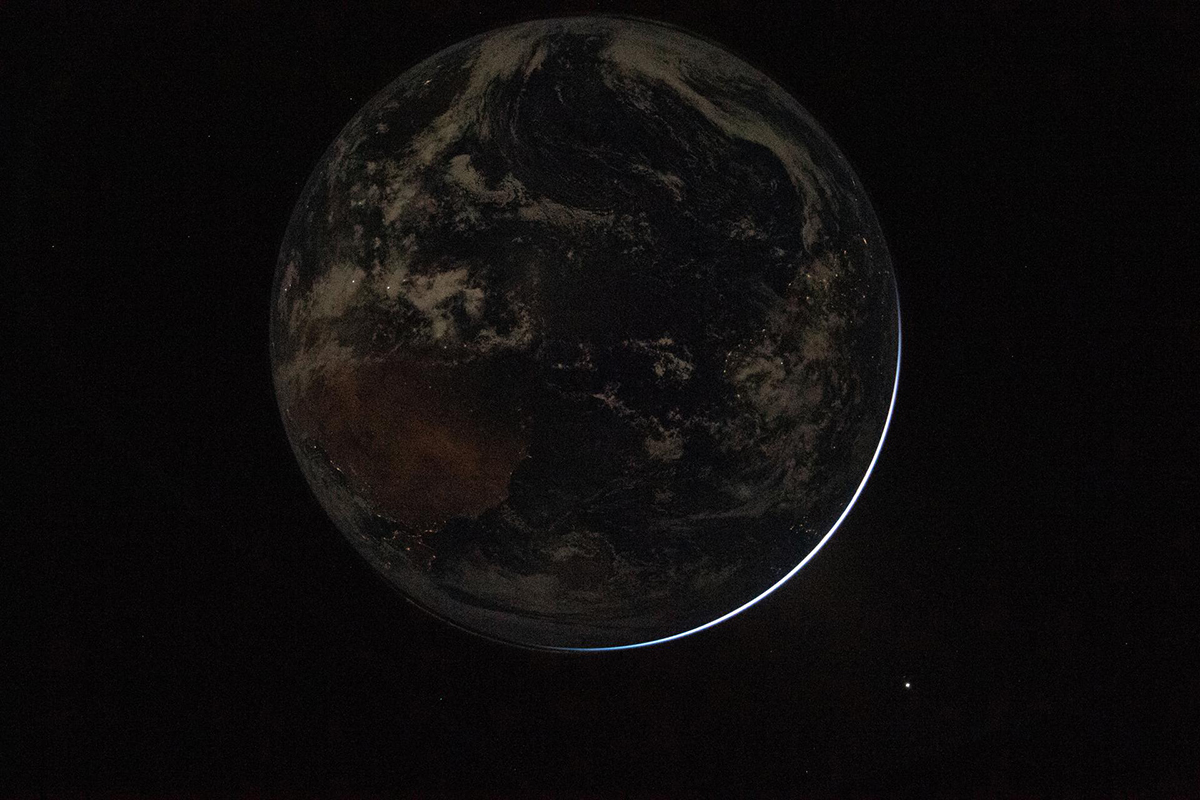
Another remarkable photograph shows the night side of Earth as seen from the crew cabin of the Orion spacecraft during the early hours of the Artemis II mission. Commander Reid Wiseman captured the image soon after the spacecraft completed its translunar injection burn and began moving steadily away from Earth on its path toward the Moon.
In this view, Earth lies almost directly between the spacecraft and the Sun. Because of this geometry, most of the planet appears dark. Only a thin arc of atmosphere glows along the edge of the disk where sunlight passes through the upper layers of the atmosphere.
Two auroral regions appear near opposite ends of the planet’s edge. These faint green glows form when energetic particles from the Sun interact with Earth’s magnetic field near the polar regions.
Clear skies!
More from the Artemis II Mission
- NASA Chooses Sony as Official Camera on Artemis Lunar Missions
- NASA’s Artemis II Lifts Off for the Moon: Images of the Launch
- Artemis II Astronauts Capture Historic Earth Images from Space
- Crew Portraits with Earth, and Moon Photos from Artemis II
- Artemis II Completes Historic Lunar Flyby: New Images of the Moon
- Artemis II Lunar Close-Up Images: NASA’s Lunar Science Goals
- Earthset, Earthrise, and Eclipse: Photos from Artemis II Lunar Flyby
- Artemis II Begins Final Return to Earth After Historic Lunar Flyby
- To the Moon and Back: NASA’s Artemis II Returns Safely to Earth
- NASA Releases 12,000 Photos from Artemis II Mission: Top Picks
See more from DIYPhotography.net on Google
Add DIYPhotography.net as a trusted source. This makes
our stories more likely to appear in your Google Search results.
 Add as a preferred source on Google

Soumyadeep Mukherjee
Soumyadeep Mukherjee is an award-winning astrophotographer from India. He has a doctorate degree in Linguistics. His work extends to the sub-genres of nightscape, deep sky, solar, lunar and optical phenomenon photography. He is also a photography educator and has conducted numerous workshops. His works have appeared in over 40 books & magazines including Astronomy, BBC Sky at Night, Sky & Telescope among others, and in various websites including National Geographic, NASA, Forbes. He was the first Indian to win “Astronomy Photographer of the Year” award in a major category.


Join the Discussion
DIYP Comment Policy
Be nice, be on-topic, no personal information or flames.