





















How a Young Star Launches Supersonic Jets: ALMA’s New Image of SVS 13
Dec 24, 2025
Soumyadeep Mukherjee
Soumyadeep Mukherjee is an award-winning astrophotographer from India. He has a doctorate degree in Linguistics. His work extends to the sub-genres of nightscape, deep sky, solar, lunar and optical phenomenon photography. He is also a photography educator and has conducted numerous workshops. His works have appeared in over 40 books & magazines including Astronomy, BBC Sky at Night, Sky & Telescope among others, and in various websites including National Geographic, NASA, Forbes. He was the first Indian to win “Astronomy Photographer of the Year” award in a major category.
Share:
Jets are a natural consequence of star formation. When gas collapses to form a young star, angular momentum builds rapidly. That momentum must be removed for accretion to continue. The result is the launch of narrow, high-velocity jets that expel material along the star’s rotation axis. These jets shape both the star and its environment. ESO’s latest Picture of the Week provides a detailed observational view of this process in action, centred on the young star SVS 13.
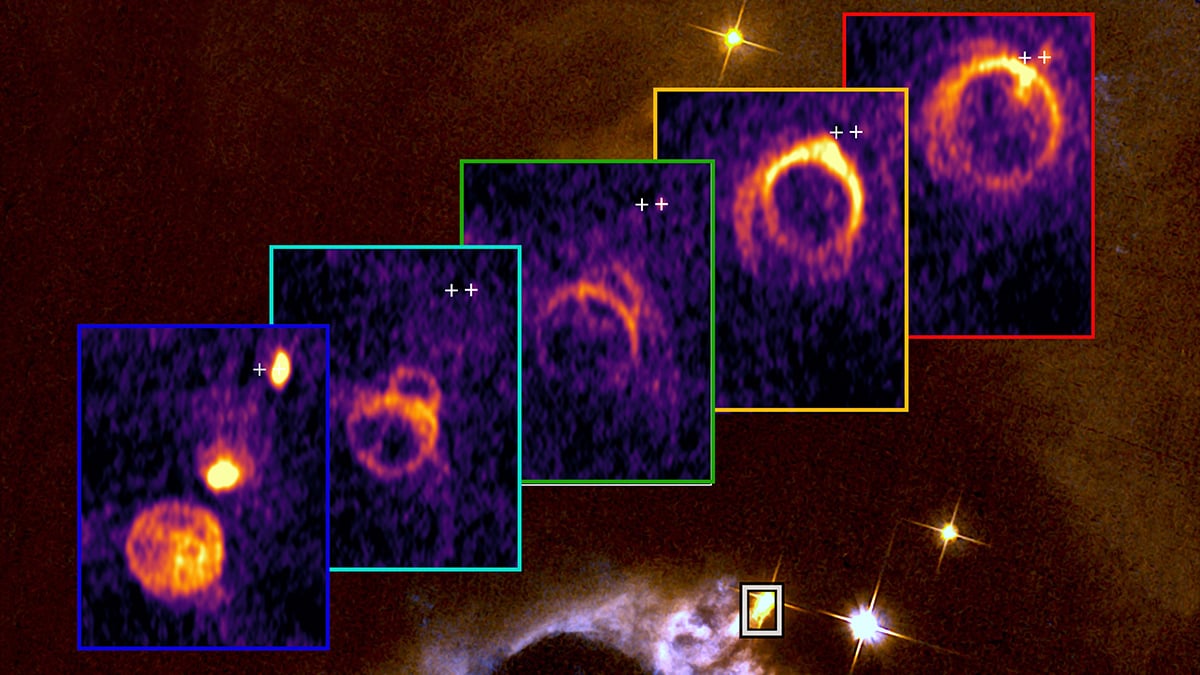
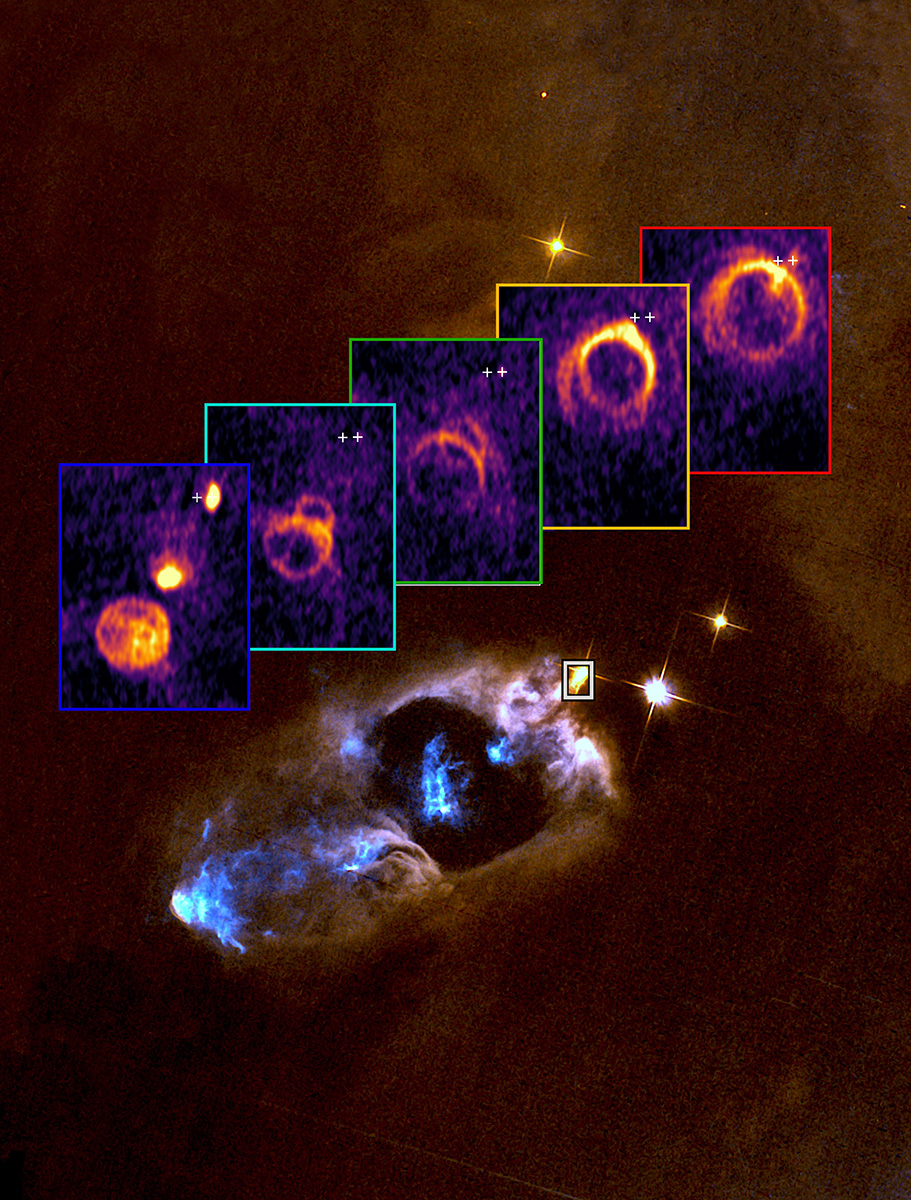
The image combines optical data from the NASA/ESA Hubble Space Telescope with velocity-resolved observations from the Atacama Large Millimeter/submillimeter Array, or ALMA. Together, these data sets reveal both the structure and motion of a powerful stellar jet. The result is not just an image, but a physical map of how gas moves, accelerates, and interacts during the earliest stages of stellar evolution.
SVS 13 and its star-forming environment
SVS 13 lies inside the NGC 1333 star-forming region, part of the Perseus molecular cloud complex. The region sits at a distance of roughly 1,000 light-years from Earth. It hosts dozens of young stellar objects, making it one of the most active nearby stellar nurseries. Dense gas, dust filaments, and energetic outflows dominate the region.
SVS 13 is still accreting mass. It remains embedded in its natal cloud and is surrounded by a rotating disc of gas and dust. This disc feeds material onto the star and also provides the raw material for future planet formation. The system is inherently unstable. Accretion proceeds in bursts rather than at a steady rate, and the surrounding environment reacts strongly to these changes.
The star is already energetic enough to drive a well-collimated jet. That jet extends outward from the system and interacts with the surrounding molecular cloud. These interactions leave visible and measurable signatures, making SVS 13 an ideal target for detailed study.
Why young stars produce jets
As gas spirals inward through a circumstellar disc, it spins faster. Without a way to shed angular momentum, accretion would stop. Jets provide an efficient solution to this problem. Magnetic fields threading the disc and star channel part of the inflowing material outward at high speed. This removes excess angular momentum and allows the remaining gas to fall onto the star.
Jets also regulate stellar growth. They limit the amount of mass the star ultimately gains. In systems like SVS 13, jet activity is not continuous. Instead, it reflects changes in the accretion rate. When accretion increases, jet power rises. When accretion slows, jet activity weakens.
This episodic behaviour leaves a record in the outflow. Each burst of jet activity pushes material outward, creating structures that can persist for thousands of years. Observing these structures allows astronomers to reconstruct the recent history of the system.
Hubble’s image of the jet
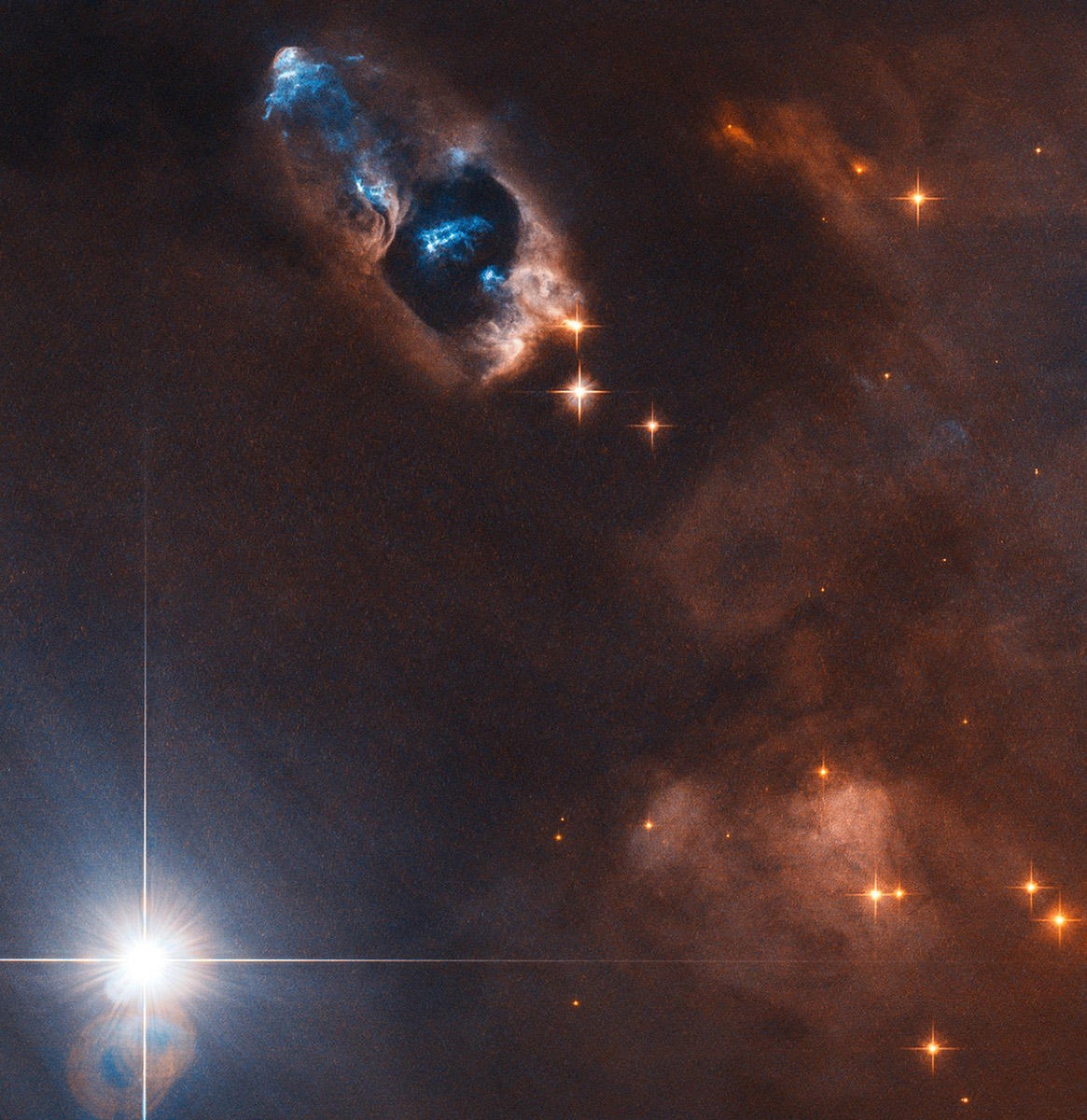
The base layer of ESO’s image comes from the Hubble Space Telescope. Hubble observes in visible and near-infrared wavelengths, which trace ionised and excited gas. In the SVS 13 image, Hubble reveals bright knots, arcs, and filaments aligned along the jet axis.
These features mark shock fronts. They form where fast-moving jet material collides with slower gas in the surrounding cloud. The collisions heat the gas and cause it to emit light. Hubble’s high spatial resolution shows these structures in sharp detail and outlines the cavities carved by repeated jet activity.
However, Hubble cannot see most of the jet’s mass. The bulk of the outflow consists of cold molecular gas. This material does not emit strongly at optical wavelengths. To observe it, astronomers must turn to millimetre and submillimetre observations.
ALMA’s velocity-resolved view of the jet
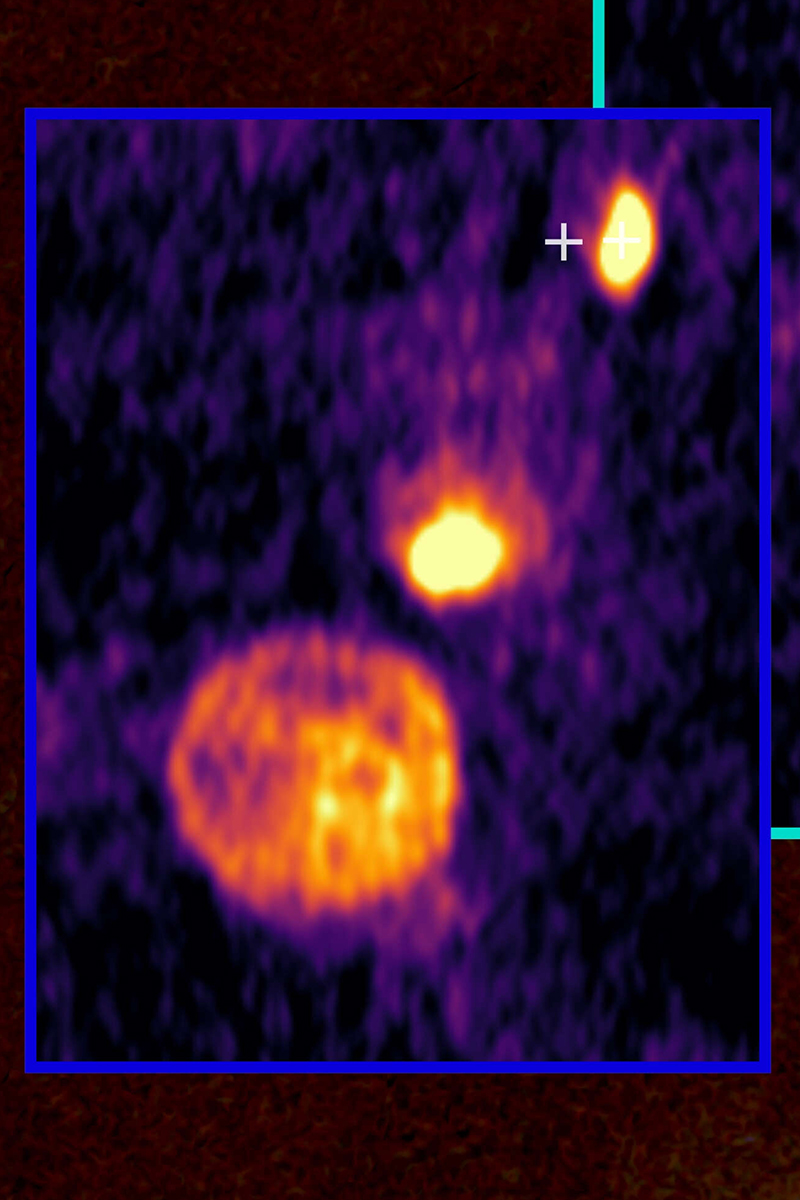
ALMA provides the missing piece. It detects radiation from cold molecules moving within the jet. By measuring Doppler shifts in this radiation, ALMA determines the speed of the gas along the line of sight. This allows astronomers to map motion directly. In the ESO image, ALMA data appear as a set of inset panels. Each panel isolates gas moving at a specific velocity range. Slower material, moving at about 35 kilometres per second, appears in red tones. Faster gas, reaching nearly 100 kilometres per second, appears in blue.
This method acts like velocity tomography. Instead of slicing the object by depth, astronomers slice it by speed. When combined, these slices reveal the jet’s three-dimensional structure. The result shows that the outflow is layered and highly organised rather than smooth and continuous. The ALMA data reveal shells and ring-like structures within the jet. These features trace past ejection events and their interaction with surrounding material. Such details are impossible to identify with optical data alone.
The Sun likely passed through a similar phase early in its history. It almost certainly launched jets while it was still accreting mass. Those jets shaped the early solar nebula and influenced the formation of planets. By studying systems like SVS 13, astronomers observe processes that once operated in our own neighbourhood.
Clear skies!
See more from DIYPhotography.net on Google
Add DIYPhotography.net as a trusted source. This makes
our stories more likely to appear in your Google Search results.
 Add as a preferred source on Google

Soumyadeep Mukherjee
Soumyadeep Mukherjee is an award-winning astrophotographer from India. He has a doctorate degree in Linguistics. His work extends to the sub-genres of nightscape, deep sky, solar, lunar and optical phenomenon photography. He is also a photography educator and has conducted numerous workshops. His works have appeared in over 40 books & magazines including Astronomy, BBC Sky at Night, Sky & Telescope among others, and in various websites including National Geographic, NASA, Forbes. He was the first Indian to win “Astronomy Photographer of the Year” award in a major category.
Join the Discussion
DIYP Comment Policy
Be nice, be on-topic, no personal information or flames.