





















Fiery Portrait of a Dying Star: JWST Unveils the Red Spider Nebula
Oct 28, 2025
Soumyadeep Mukherjee
Soumyadeep Mukherjee is an award-winning astrophotographer from India. He has a doctorate degree in Linguistics. His work extends to the sub-genres of nightscape, deep sky, solar, lunar and optical phenomenon photography. He is also a photography educator and has conducted numerous workshops. His works have appeared in over 40 books & magazines including Astronomy, BBC Sky at Night, Sky & Telescope among others, and in various websites including National Geographic, NASA, Forbes. He was the first Indian to win “Astronomy Photographer of the Year” award in a major category.
Share:

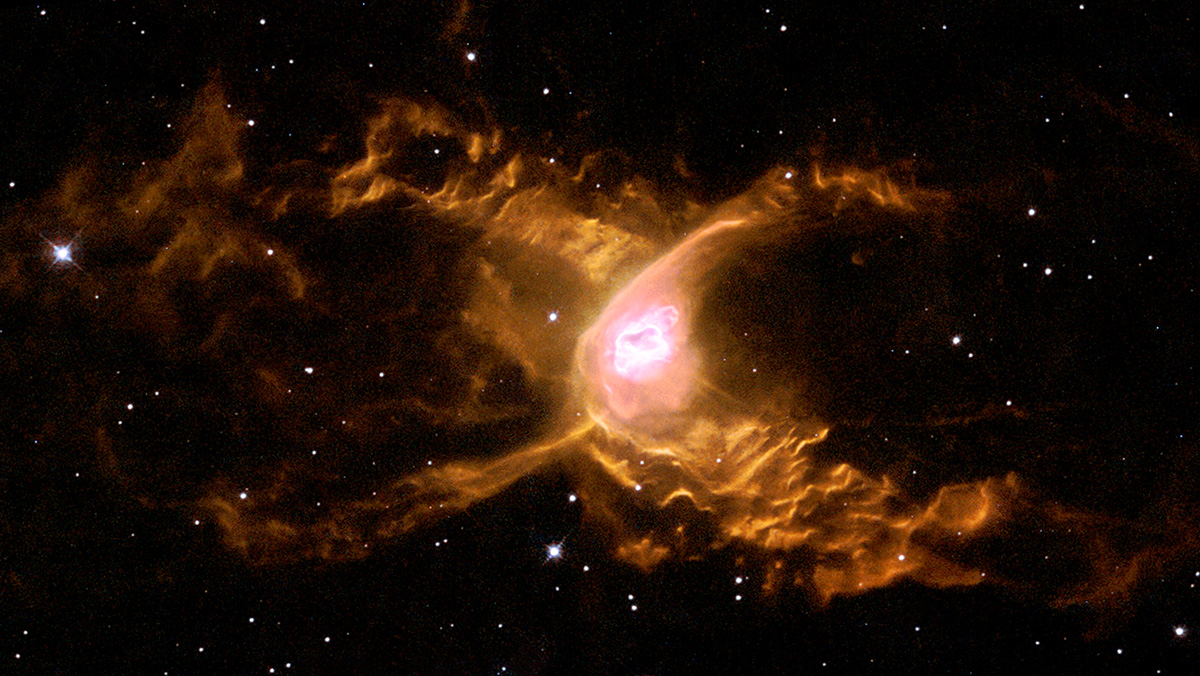
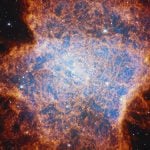
The James Webb Space Telescope has turned its sharp infrared eyes toward one of the Milky Way’s most dramatic sights: the Red Spider Nebula, also known as NGC 6537. The new image reveals an extraordinary scene of stellar death, captured in intricate detail.
This nebula lies in the constellation Sagittarius, about 3,000 light-years from Earth. It marks the final, violent breath of a dying star roughly the size of our Sun. JWST’s infrared view cuts through thick clouds of dust and gas to expose hidden structures, glowing lobes, shock fronts, and a faint but powerful central star at the nebula’s heart.
A star’s fiery farewell
Planetary nebulae like the Red Spider form when stars like our Sun run out of fuel. In their last phase, they swell into red giants, shedding their outer layers into space. What remains is a hot, dense core, a future white dwarf that emits intense ultraviolet radiation. That radiation lights up the expelled gas, making the nebula glow in beautiful colors.
In JWST’s new image, those layers form two large, curved lobes stretching out in opposite directions. The gas expands outward, shaped by stellar winds and magnetic fields. The nebula’s filaments appear smooth and arched, but they hide turbulence, motion, and heat. Astronomers believe the Red Spider’s lobes stretch across nearly three light-years, vast bubbles of matter racing into the darkness.

Seeing beyond visible light
Earlier telescopes, like Hubble, had already shown the Red Spider’s distinctive shape. But JWST sees deeper. Its Near-Infrared Camera (NIRCam) can detect wavelengths invisible to human eyes, revealing features hidden by dust.
JWST’s team used NIRCam filters centered at 1.64 µm, 2.12 µm, and 4.05 µm. Each wavelength highlights a different part of the nebula. The shortest wavelength traces ionized iron, showing the regions where fast winds collide with older shells of gas. The mid-infrared filter picks up molecular hydrogen, glowing in the cooler outer lobes. The longest wavelength shows ionized hydrogen, outlining the nebula’s inner structure close to the dying star.
The hidden heart of the red spider
At the center of NGC 6537 lies the remnant of a once-stable star. JWST’s sensitivity finally reveals it clearly. The central star appears unusually red, not because it is cool, but because it sits behind a dusty disc that blocks visible light. That disc, detected for the first time in such detail, glows faintly in the infrared.
Astronomers think the disc is what controls the nebula’s hourglass shape. Instead of gas flowing evenly in all directions, the disc funnels the ejected material into two opposite lobes. Over time, strong winds from the central star push this gas outward, creating the enormous wings seen in the image.
The JWST data also show faint jets curving through the nebula, forming an “S”-shaped trail of ionized iron. These jets likely mark episodes when the dying star released bursts of material at different angles, a sign of instability or perhaps the influence of a hidden companion star.

Signs of a companion star
Many planetary nebulae exhibit symmetrical shapes, and this symmetry often suggests a binary system. In the case of NGC 6537, astronomers suspect there might be a companion orbiting the central star. Its gravity could have helped form the dense disc and guide the outflows into opposing directions.
While JWST has not directly seen the companion, the structure of the nebula supports this theory. The curved jets and tight waist point toward a gravitational dance that shaped the gas into its present form. Future observations might confirm whether the Red Spider really hides two stars instead of one.
Tracing the layers of gas
JWST’s near-infrared data reveal the nebula’s internal structure like never before. The outer lobes shine with molecular hydrogen, showing cooler gas that has drifted far from the center. Closer in, the glowing filaments mark the locations where fast stellar winds collide with these layers, heating them and generating shock waves. The purple “S” seen in the image represents regions of ionized iron, created in those violent collisions.
Inside the lobes lies a compact, bright region of ionized hydrogen, the innermost layer of gas illuminated by ultraviolet light from the central star. This layered pattern tells astronomers how the star has been losing mass over time. The outer material was released thousands of years ago, while the inner zones come from more recent eruptions.
Every line and swirl in the image marks a step in the star’s slow death. For astronomers, these details help refine models of how low-mass stars evolve and how they shed material into space.
How JWST captured it
The field of view covers about 2.4 arcminutes, roughly one-fifteenth the apparent width of the Moon. Within that small patch, JWST captures both faint wisps of gas and the brilliant central region without losing detail. Orientation data show north is slightly to the left of the frame, with east toward the bottom. The nebula sits at right ascension 18h 05m 13.45s and declination −19° 50′ 30.38″, squarely within Sagittarius.
These details might seem technical, but they are important for research and follow-up studies. With them, astronomers can align JWST’s view with data from other observatories like ALMA, Chandra, and Hubble. Combining infrared, millimeter, and X-ray images creates a complete picture of how the Red Spider formed and continues to evolve.

In a few billion years, our own Sun will follow a similar path. It will swell, shed its outer layers, and leave behind a glowing shell like NGC 6537. Looking at the Red Spider Nebula is, in a sense, looking into the future of our solar system.
Clear skies!
See more from DIYPhotography.net on Google
Add DIYPhotography.net as a trusted source. This makes
our stories more likely to appear in your Google Search results.
 Add as a preferred source on Google

Soumyadeep Mukherjee
Soumyadeep Mukherjee is an award-winning astrophotographer from India. He has a doctorate degree in Linguistics. His work extends to the sub-genres of nightscape, deep sky, solar, lunar and optical phenomenon photography. He is also a photography educator and has conducted numerous workshops. His works have appeared in over 40 books & magazines including Astronomy, BBC Sky at Night, Sky & Telescope among others, and in various websites including National Geographic, NASA, Forbes. He was the first Indian to win “Astronomy Photographer of the Year” award in a major category.

Join the Discussion
DIYP Comment Policy
Be nice, be on-topic, no personal information or flames.