























Sharper, Faster, Wider: Askar Launches 60F and 91F 0.75× Reducers
Nov 25, 2025
Soumyadeep Mukherjee
Soumyadeep Mukherjee is an award-winning astrophotographer from India. He has a doctorate degree in Linguistics. His work extends to the sub-genres of nightscape, deep sky, solar, lunar and optical phenomenon photography. He is also a photography educator and has conducted numerous workshops. His works have appeared in over 40 books & magazines including Astronomy, BBC Sky at Night, Sky & Telescope among others, and in various websites including National Geographic, NASA, Forbes. He was the first Indian to win “Astronomy Photographer of the Year” award in a major category.
Share:
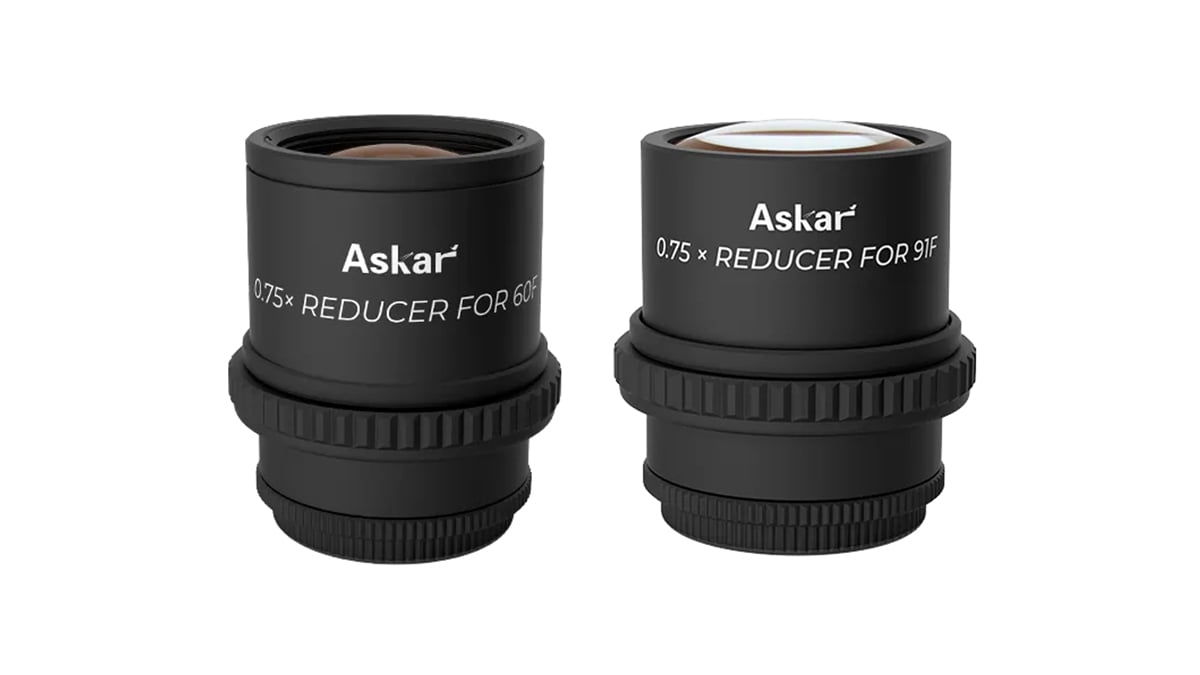
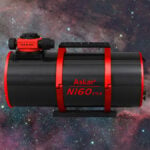
Astrophotographers always look for more speed, more detail, and cleaner stars across the frame. Small refractors already do much of that work, but they often need a little help to reach their full potential. That is exactly where SharpStar’s two new optics, the Askar 60F 0.75× reducer and the Askar 91F 0.75× reducer, step in. These accessories change how both telescopes behave in the field. They shorten focal lengths, widen the field of view, and deliver a flatter image circle that supports full-frame cameras. They also speed up both refractors to around f/5, which is fast enough to reshape a night under average seeing.
The two reducers share the same broad purpose, but they serve different audiences. The smaller 60F model suits wide-field imagers who travel light. The 91F version works for those who want more resolution without giving up portability.
A new push toward faster flat-field imaging
SharpStar designed both reducers with one theme in mind: fast, well-corrected imaging for modern sensors. The company’s decision to use a triplet optical design for each reducer already hints at that goal. A triplet gives more room to correct aberrations, especially when a telescope jumps to a lower focal ratio. Many simple reducers struggle with color correction or introduce field curvature. These two units aim to avoid that.
The built-in flattener element also tells the same story. Instead of offering a basic reduction system, both units combine reduction and flattening with a structure that supports a 44 mm image circle. That number matters because it covers the full diagonal of a full-frame sensor. An APS-C sensor fits easily inside it. A dedicated astro camera with a Micro Four-Thirds chip sits even more comfortably. SharpStar did not intend these reducers for small sensors alone. The company built them for everyone from full-frame mirrorless shooters to dedicated astro camera users.
Both reducers specify 55 mm of back-focus from the M48 thread. This is the industry’s standard camera spacing, which means most mirrorless cameras, DSLRs, and astro cameras fit easily with typical T-ring or tilt-plate spacing. You still need to check your adapters, but the system keeps things simple. When reducers demand niche spacing, the workflow gets messy. Here, SharpStar sticks to familiar numbers.
The most important change is speed. The 60F drops to 311 mm focal length at around f/5.1, and the 91F shifts to about 455 mm at f/5. Both retreat from their slower native focal ratios and open the door to shorter exposures, faster narrowband work, and wider compositions.
How does the reducer change the Askar 60F
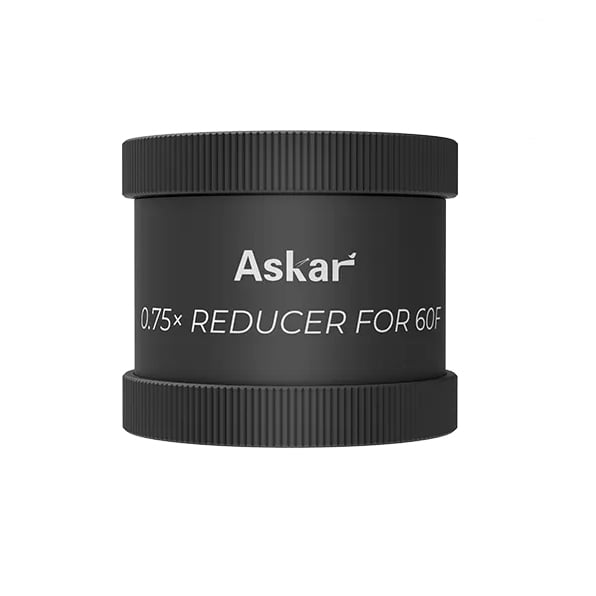
The Askar 60F is already known as a compact refractor with a native flat-field design. It sits at a modest focal length before reduction, making it an easy tool for large nebulae, star clouds, and Milky Way structures. But the new 0.75× reducer shifts the scope into a different category. The change to 311 mm creates a genuinely wide imaging system. It pushes the telescope toward a lens-like feel, yet keeps the clarity and contrast of a proper refractor.
Astrophotographers will notice the faster exposures immediately. At f/5.1, the scope collects more light per unit time, which helps when you shoot under imperfect skies or with a lightweight mount. Portable mounts often struggle with long focal lengths or slow optics. With the reducer, the 60F produces clean subframes with shorter tracking demands. That makes the setup more reliable during travel.

Because the reducer includes a flattener, the corners on a full-frame camera stay controlled. Many small refractors soften the edges when used with larger sensors. The 60F’s matched reducer helps clean that up. You will still need to check star shapes and focus on your first night out, but the optical design aims to keep the field sharp without extra accessories.
The result is an ultra-compact imaging tool that works best for expansive targets. Large emission nebulae, bright dust regions, star clouds, and Milky Way fields all benefit from this configuration. If you shoot mosaics, the faster focal ratio helps speed up the process of capturing each panel. If you shoot on a tracker in the desert or at high altitude, the entire setup stays simple and quick to balance.

What the Askar 91F looks like with its new 0.75× reducer
The Askar 91F sits in a different class from the 60F. It has more aperture, more native reach, and more potential resolution. But it also runs at a slower focal ratio without accessories. That is fine for high-precision imaging, but it can slow down night-to-night productivity if you shoot from locations where weather or time windows are unpredictable.
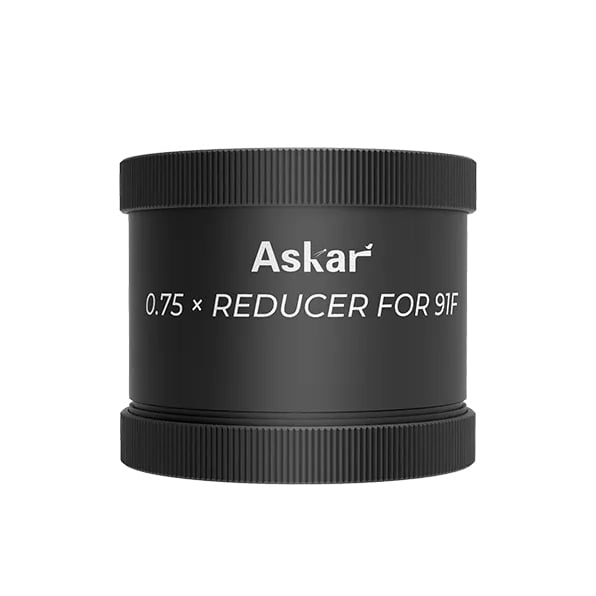
SharpStar’s new 0.75× reducer brings the 91F down to 455 mm and turns it into an f/5 system. That change increases flexibility. The telescope gains the ability to frame medium-sized nebulae while still resolving dense star fields. It no longer behaves like a narrow or mid-narrow instrument. Instead, it becomes a balanced, wide-to-medium tool that works well with modern sensors. The full-frame support plays a big role here. A 44 mm image circle means you can run the 91F with large sensors and still maintain usable stars across the field. With the reducer’s flattener element doing optical correction, you avoid the need for a separate flattener. The camera train becomes simpler, which many field imagers appreciate.

The reducer’s mechanical design uses M59×1 threading at the rear and an M48 filter interface at the camera side. The build is CNC-machined with front and rear caps. It weighs around 0.3 kg, which is reasonable for mid-level portable mounts. Travel imagers who want a bit more reach without carrying a large refractor will find this combination appealing. You get the speed of f/5 and the clarity of a larger aperture without extra complexity. With this setup, the 91F becomes a capable all-rounder. Wide nebula fields look clean, but the telescope still holds enough focal length to resolve cluster cores, dark lanes, and small gas structures. It feels more versatile than its native configuration and more forgiving for nights when you want to collect frames quickly.

Key specifications
Here are the key specifications of Askar 60F and 91F 0.75× reducers:
| 60F 0.75× Reducer | 91F 0.75× Reducer | |
| (After attaching) Focal length | 311mm | 455mm |
| (After attaching) Focal ratio | f/5.1 | f/5 |
| Lens Number | Triplet design | Triplet design |
| Back Focus | 55mm | 55mm |
| Weight | 0.2kg | 0.3kg |
| Rear-end thread type | M50*1 | M59*1 |

Price and availability
Both the Askar 60F and 91F 0.75× reducers are priced at $199. Currently, they are available for pre-order via online retailers.
SharpStar’s new 0.75× reducers for the Askar 60F and Askar 91F bring practical advantages to two already popular telescopes. They shorten focal lengths, speed up exposures, and maintain clean stars across full-frame sensors. They keep spacing straightforward and stay light enough for travel. Most importantly, they turn compact refractors into faster and more versatile imaging systems.

Clear skies!
See more from DIYPhotography.net on Google
Add DIYPhotography.net as a trusted source. This makes
our stories more likely to appear in your Google Search results.
 Add as a preferred source on Google

Soumyadeep Mukherjee
Soumyadeep Mukherjee is an award-winning astrophotographer from India. He has a doctorate degree in Linguistics. His work extends to the sub-genres of nightscape, deep sky, solar, lunar and optical phenomenon photography. He is also a photography educator and has conducted numerous workshops. His works have appeared in over 40 books & magazines including Astronomy, BBC Sky at Night, Sky & Telescope among others, and in various websites including National Geographic, NASA, Forbes. He was the first Indian to win “Astronomy Photographer of the Year” award in a major category.



Join the Discussion
DIYP Comment Policy
Be nice, be on-topic, no personal information or flames.