

















This is the Most Distant Galaxy Proto-supercluster Ever Photographed
Sep 9, 2026
Soumyadeep Mukherjee
Soumyadeep Mukherjee is an award-winning astrophotographer from India. He has a doctorate degree in Linguistics. His work extends to the sub-genres of nightscape, deep sky, solar, lunar and optical phenomenon photography. He is also a photography educator and has conducted numerous workshops. His works have appeared in over 40 books & magazines including Astronomy, BBC Sky at Night, Sky & Telescope among others, and in various websites including National Geographic, NASA, Forbes. He was the first Indian to win “Astronomy Photographer of the Year” award in a major category.
Share:
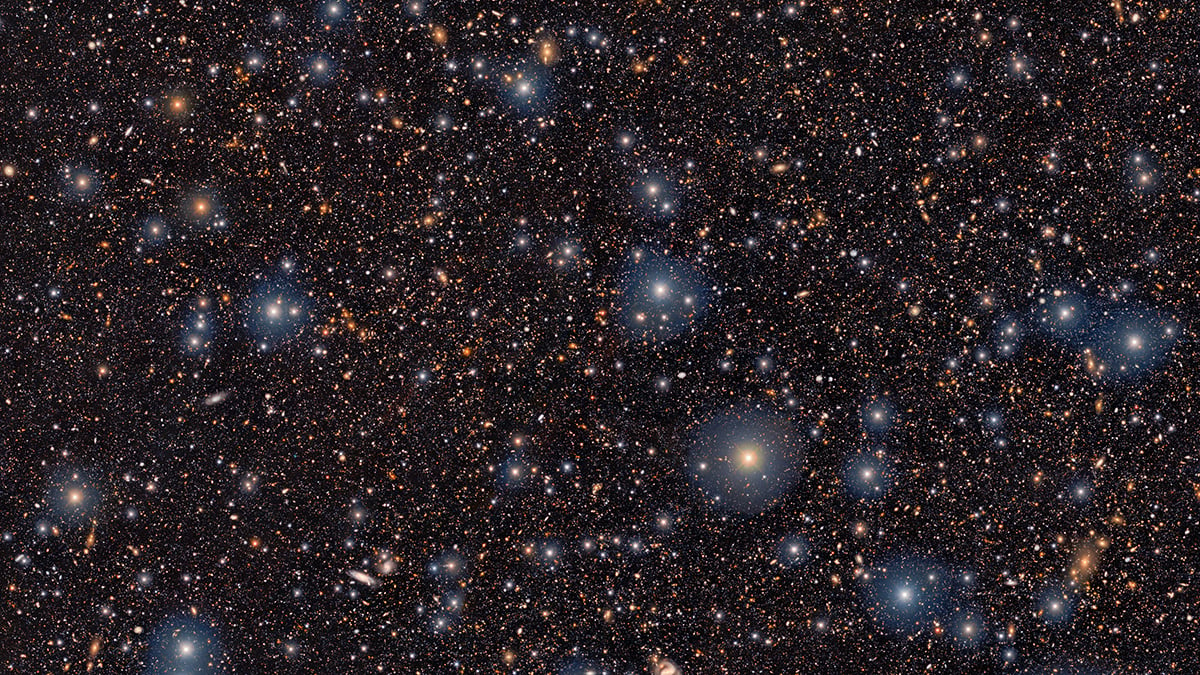
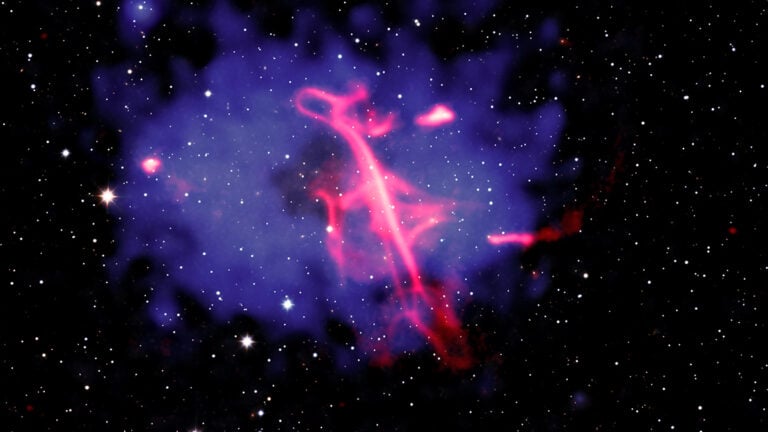
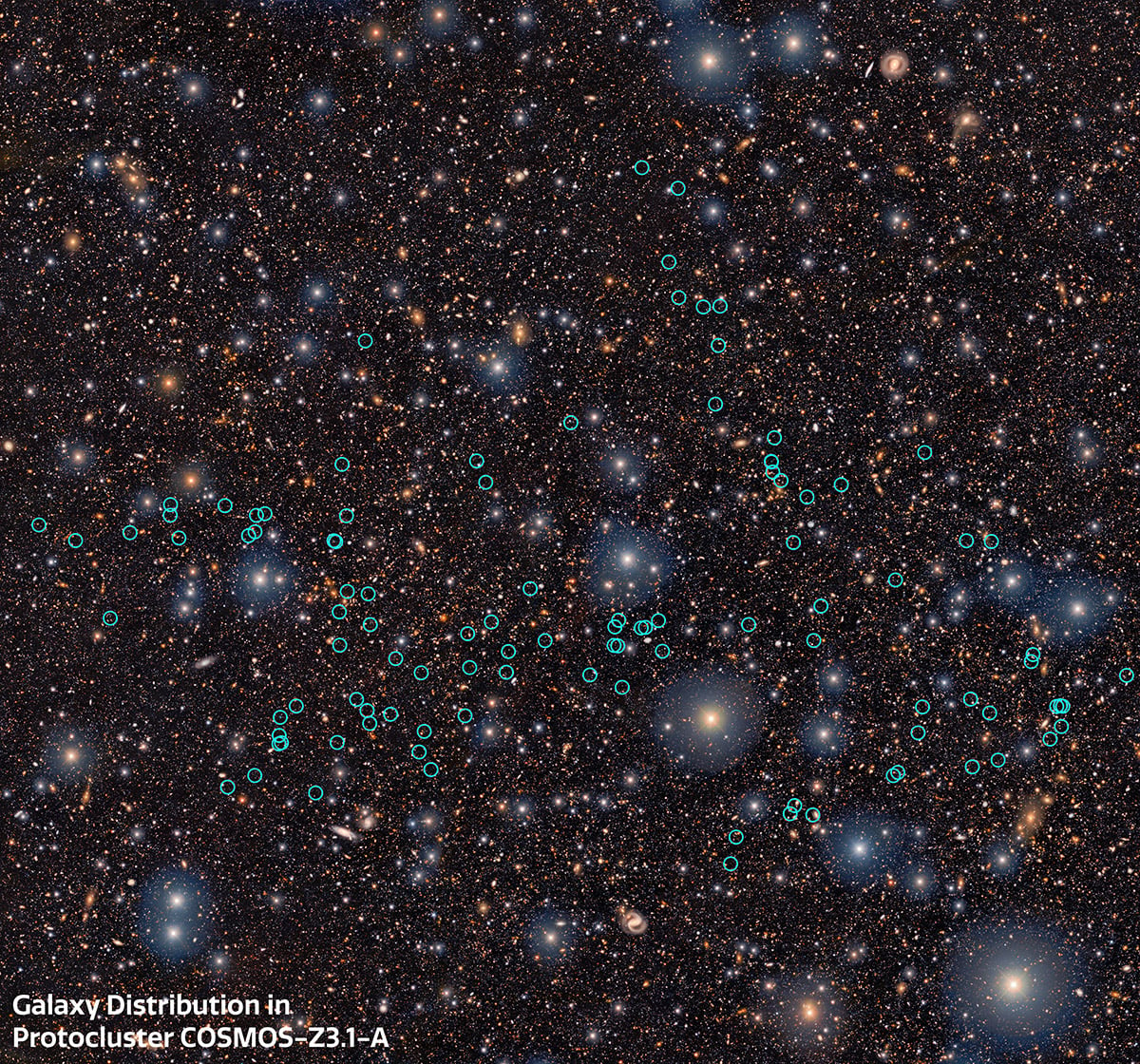
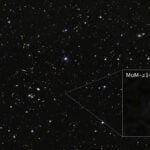
Astronomers have found a huge gathering of galaxies from a time when the Universe was less than three billion years old. The structure, called COSMOS-z3.1-A, lies more than 11 billion light-years away. It contains several dense concentrations of galaxies spread across a much larger region of space. The team estimates that the structure could eventually grow into an enormous galaxy cluster system. Its present mass is around 5,000 times that of the Milky Way.
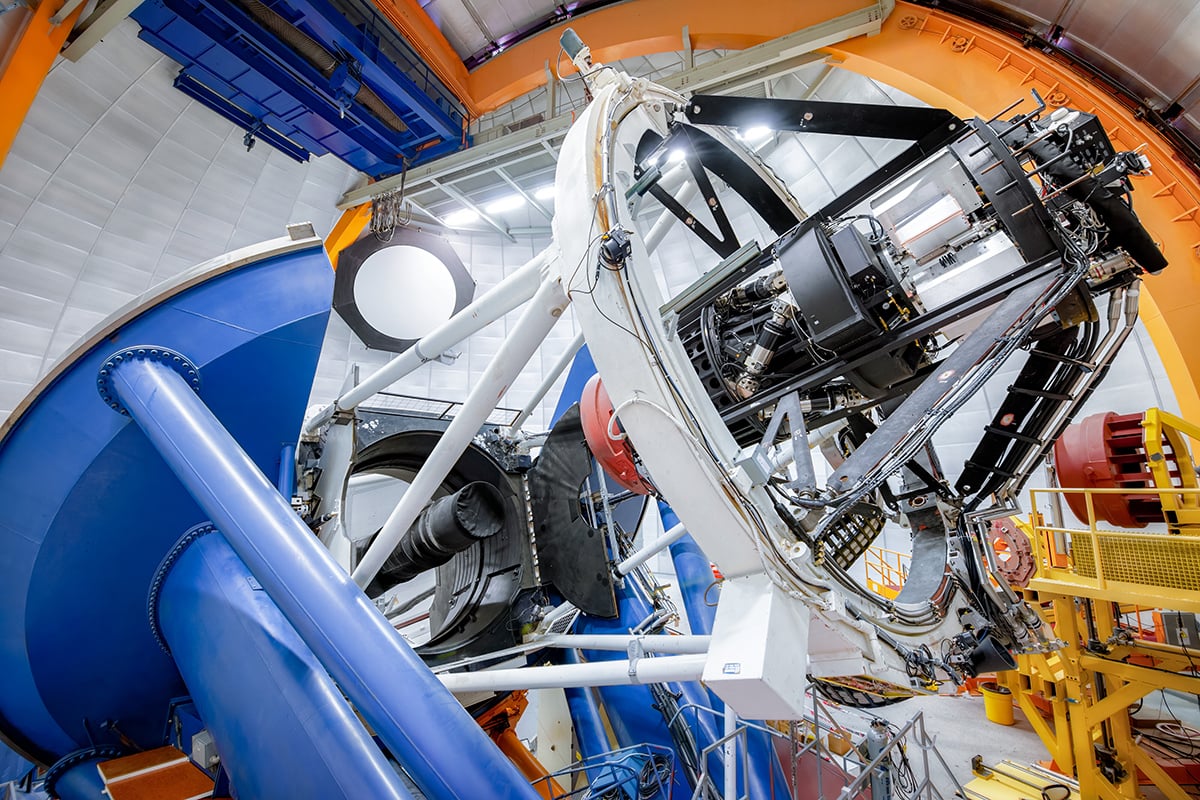
The image came from the One-hundred-deg2 DECam Imaging in Narrowbands survey, or ODIN. The survey uses the 4-meter Víctor M. Blanco Telescope at the Cerro Tololo Inter-American Observatory in Chile. Its main camera is the 520-megapixel Dark Energy Camera, also known as DECam.
A giant structure before the clusters had formed
Looking at a nearby galaxy cluster, we see a system that has had billions of years to evolve. Thousands of galaxies can occupy the same enormous gravitational environment, surrounded by hot gas and dominated by dark matter.
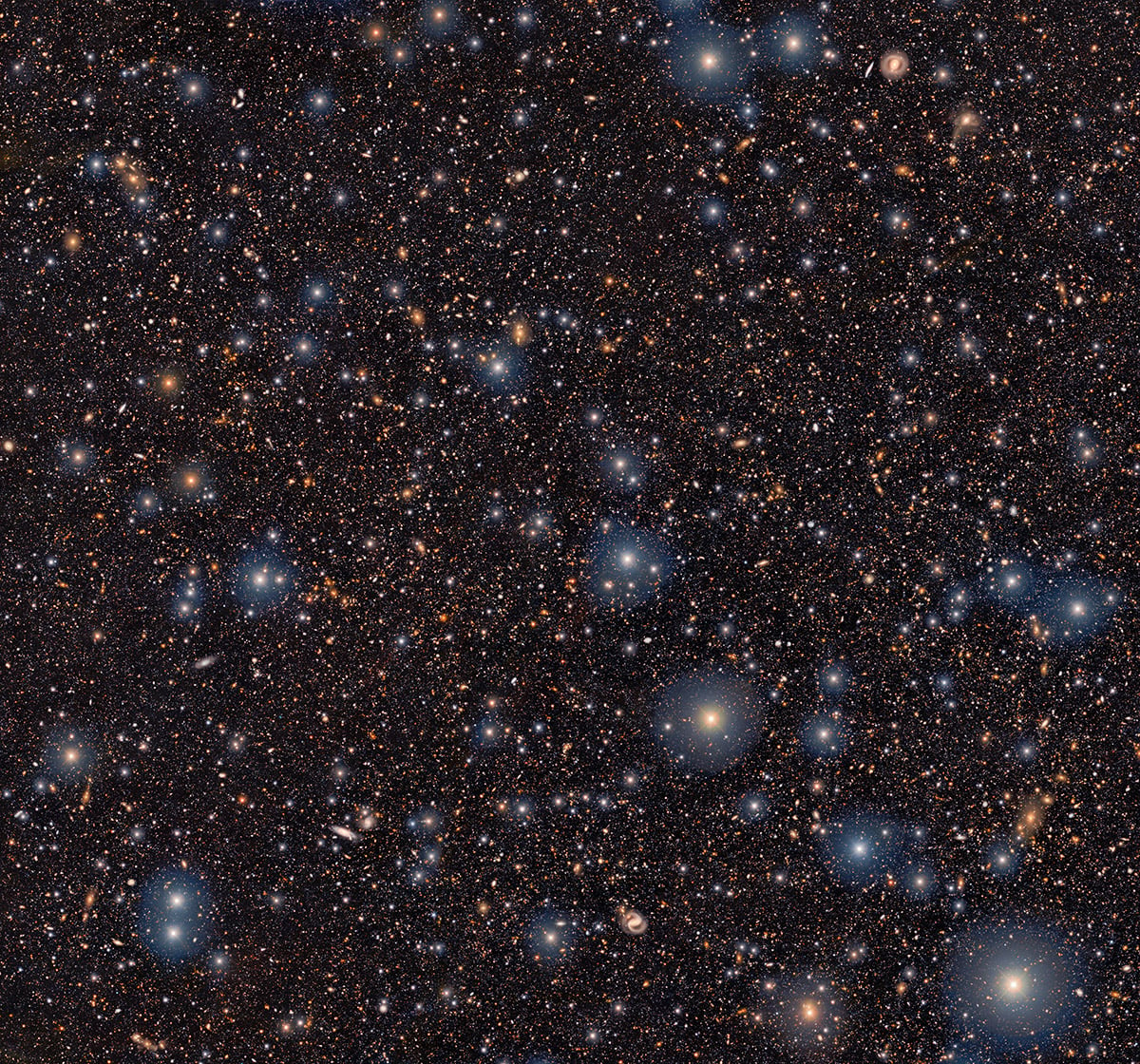
COSMOS-z3.1-A was at a much earlier point in the process. The researchers describe it as a proto-supercluster because several developing overdensities occupy the same large region without having settled into a single mature system.
The new study identified ten major density peaks within COSMOS-z3.1-A. A second structure in the same survey, COSMOS-z3.1-C, contains four such peaks. Both are spread across roughly 50 comoving megaparsecs and have elongated, irregular shapes rather than the rounded appearance that might be expected from a relaxed cluster.
DECam found the galaxies with narrow-band imaging
The observations were made with a camera designed to survey large areas of the sky. The Dark Energy Camera, or DECam, is mounted on the Blanco Telescope at Cerro Tololo. Its focal plane contains 62 science CCDs with a combined 520 megapixels, and it covers roughly three-square degrees of sky in one exposure.
ODIN uses its wide field in a different way from a conventional astronomical imaging project. Instead of relying on broad colour filters, the survey uses narrowband filters to pick out galaxies whose light contains a particular spectral signature.
One of the key targets is Lyman-alpha emission from hydrogen. The line has a wavelength of 121.6 nanometres when measured at its source. As the Universe expands, light travelling through space becomes stretched toward longer wavelengths. For galaxies at a known redshift range, the Lyman-alpha line arrives at a predictable shifted wavelength.
Astronomers can place a narrowband filter over that part of the spectrum and search for galaxies that become unusually bright through the filter. The method does not give a complete picture of every galaxy in the field, but it provides an efficient way to build large samples of galaxies at particular distances.
Revealing the structure with spectrospcopy
A photograph gives astronomers the position of a galaxy across the sky. It does not, by itself, tell them how far away that galaxy is. Two galaxies can appear almost side by side in an image while being separated by millions of light-years.
The research team found the solution with spectroscopy. Follow-up observations came from several facilities, including the Keck Observatory, Gemini, and the Dark Energy Spectroscopic Instrument (DESI). These observations provided precise redshift measurements for galaxies inside the two structures.
The researchers then combined the spectroscopic measurements with the larger photometric sample from ODIN. This gave them more galaxies to work with than spectroscopy alone would have provided.
They used a probabilistic reconstruction method to estimate the three-dimensional distribution of the galaxies. The team tested the method against the IllustrisTNG300-1 cosmological simulation and found that it performed better than approaches based solely on the spectroscopic sample.
Clear skies!
See more from DIYPhotography.net on Google
Add DIYPhotography.net as a trusted source. This makes
our stories more likely to appear in your Google Search results.
 Add as a preferred source on Google

Soumyadeep Mukherjee
Soumyadeep Mukherjee is an award-winning astrophotographer from India. He has a doctorate degree in Linguistics. His work extends to the sub-genres of nightscape, deep sky, solar, lunar and optical phenomenon photography. He is also a photography educator and has conducted numerous workshops. His works have appeared in over 40 books & magazines including Astronomy, BBC Sky at Night, Sky & Telescope among others, and in various websites including National Geographic, NASA, Forbes. He was the first Indian to win “Astronomy Photographer of the Year” award in a major category.

Join the Discussion
DIYP Comment Policy
Be nice, be on-topic, no personal information or flames.