

















NASA Shares 2026 Solar Eclipse Images from Ground, Air and Space
Aug 22, 2026
Soumyadeep Mukherjee
Soumyadeep Mukherjee is an award-winning astrophotographer from India. He has a doctorate degree in Linguistics. His work extends to the sub-genres of nightscape, deep sky, solar, lunar and optical phenomenon photography. He is also a photography educator and has conducted numerous workshops. His works have appeared in over 40 books & magazines including Astronomy, BBC Sky at Night, Sky & Telescope among others, and in various websites including National Geographic, NASA, Forbes. He was the first Indian to win “Astronomy Photographer of the Year” award in a major category.
Share:
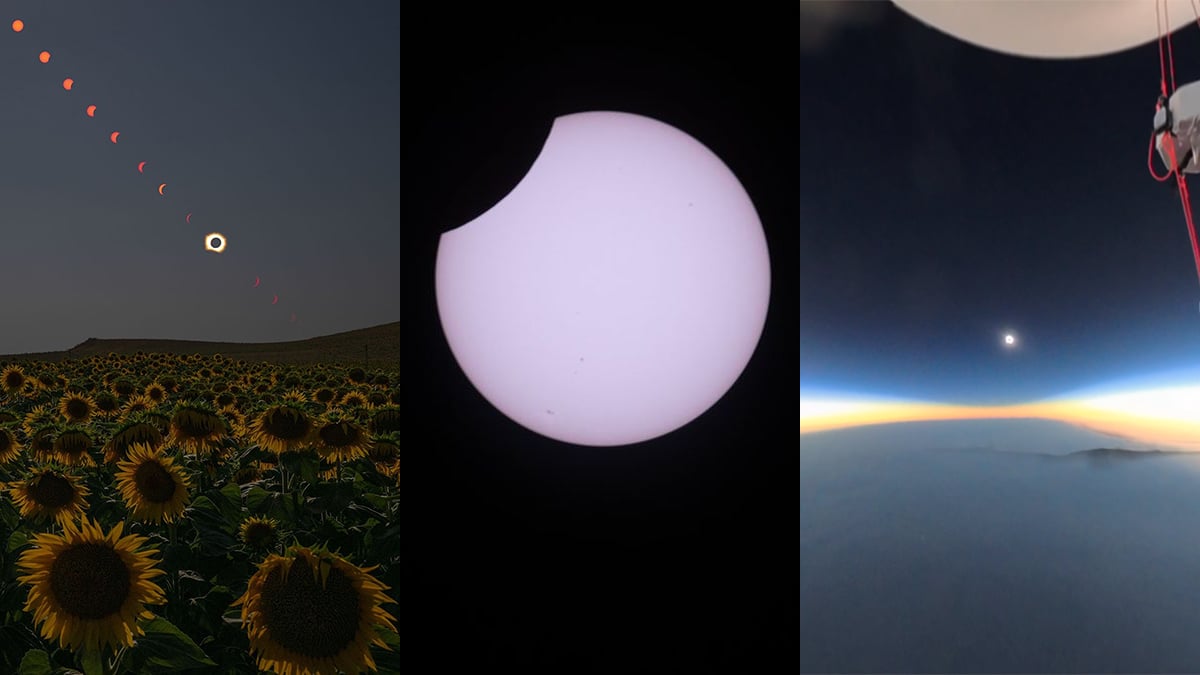
A total solar eclipse gives solar physicists a rare window for observation. For a few minutes, the Moon blocks the photosphere, making the much fainter solar corona visible. The corona contains extremely hot plasma shaped by the Sun’s magnetic field. Its structure changes as solar activity evolves, making eclipse observations useful for testing models of the solar atmosphere. And you might have already seen some of the best eclipse photos.
The August 12, 2026, total solar eclipse offered researchers several ways to study these regions. NASA teams photographed the event from the ground, from the International Space Station, and from high-altitude WB-57 research aircraft. Scientific balloons also collected measurements as the Moon’s shadow moved through Earth’s atmosphere.
Views of totality from Spain
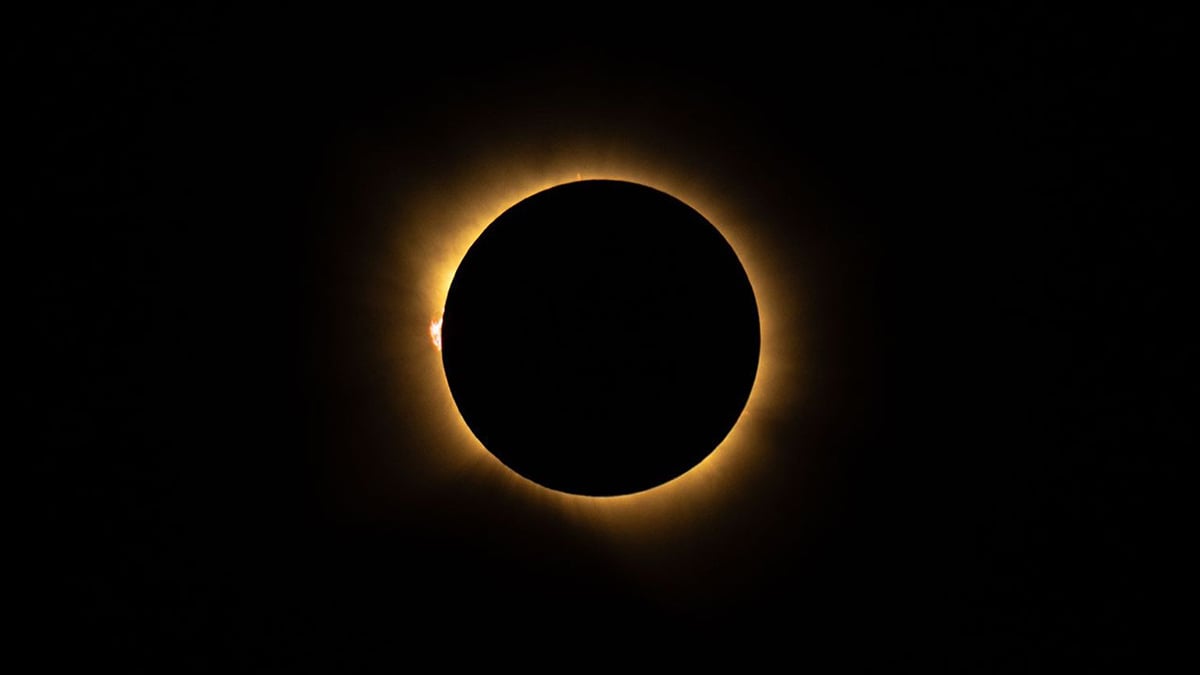
Some of the clearest photographs in NASA’s collection came from San Millán de los Caballeros in northwestern Spain. NASA photographer Bill Ingalls photographed the eclipse during its partial phases and totality. His images show the Moon gradually covering the solar disk before reaching complete coverage.
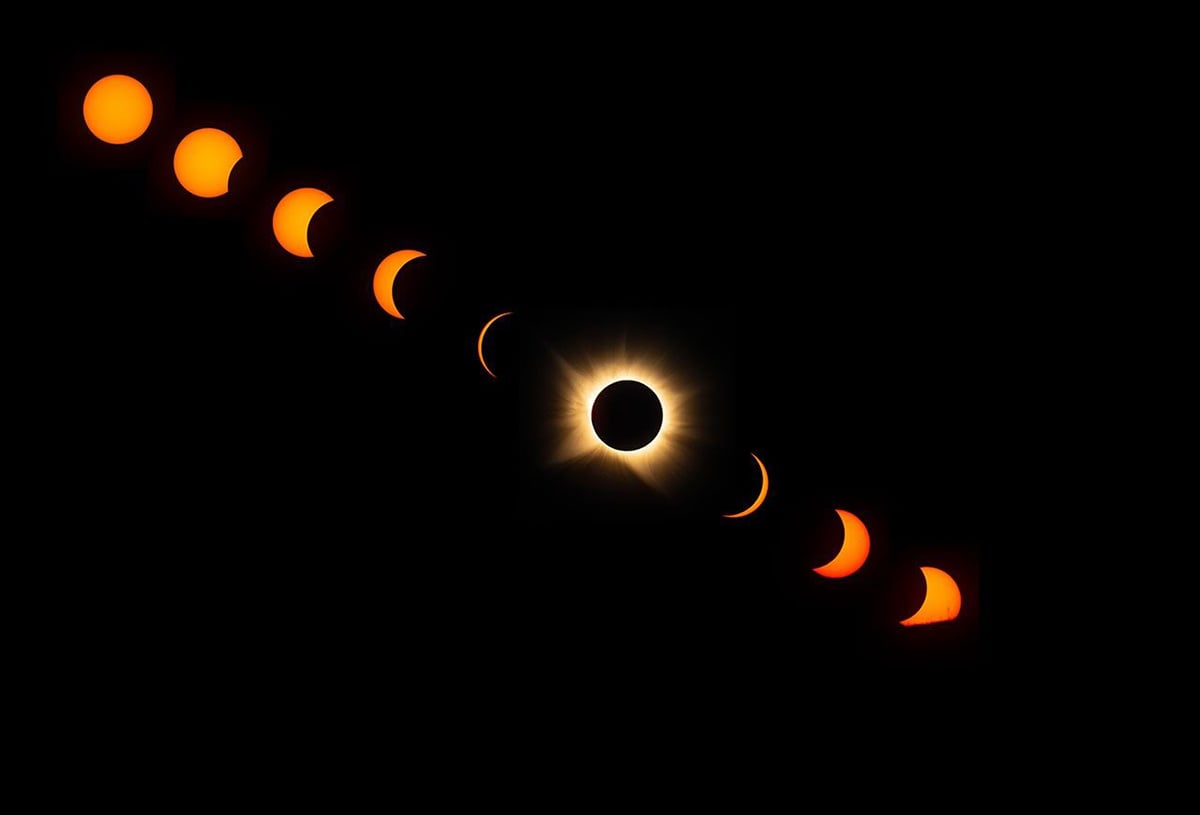
Ingalls’ photographs show several of the corona’s large-scale structures. Long streamers extend away from the Sun, while brighter regions appear closer to the lunar limb. These structures reflect the distribution of the Sun’s magnetic field and the movement of plasma through the corona.
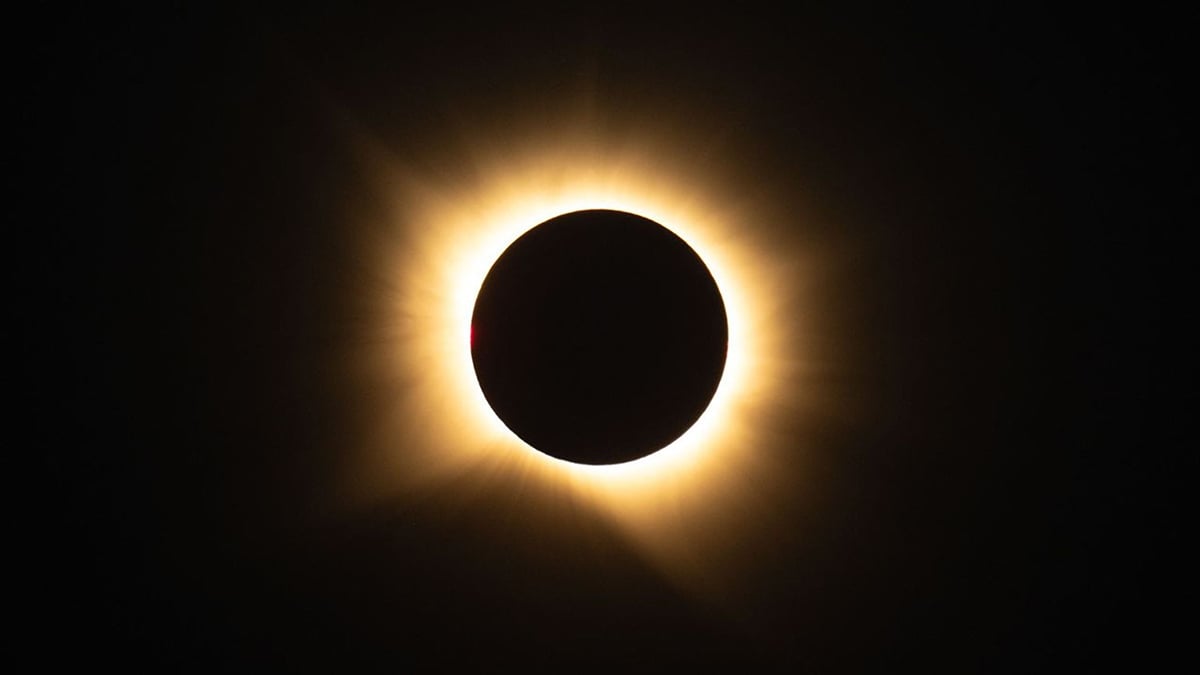
The images also reveal solar prominences along the edge of the Moon. These appear as reddish structures against the dark lunar disk. A prominence consists of relatively cool, dense plasma suspended above the solar surface by magnetic fields. During totality, its position near the limb makes it much easier to photograph.
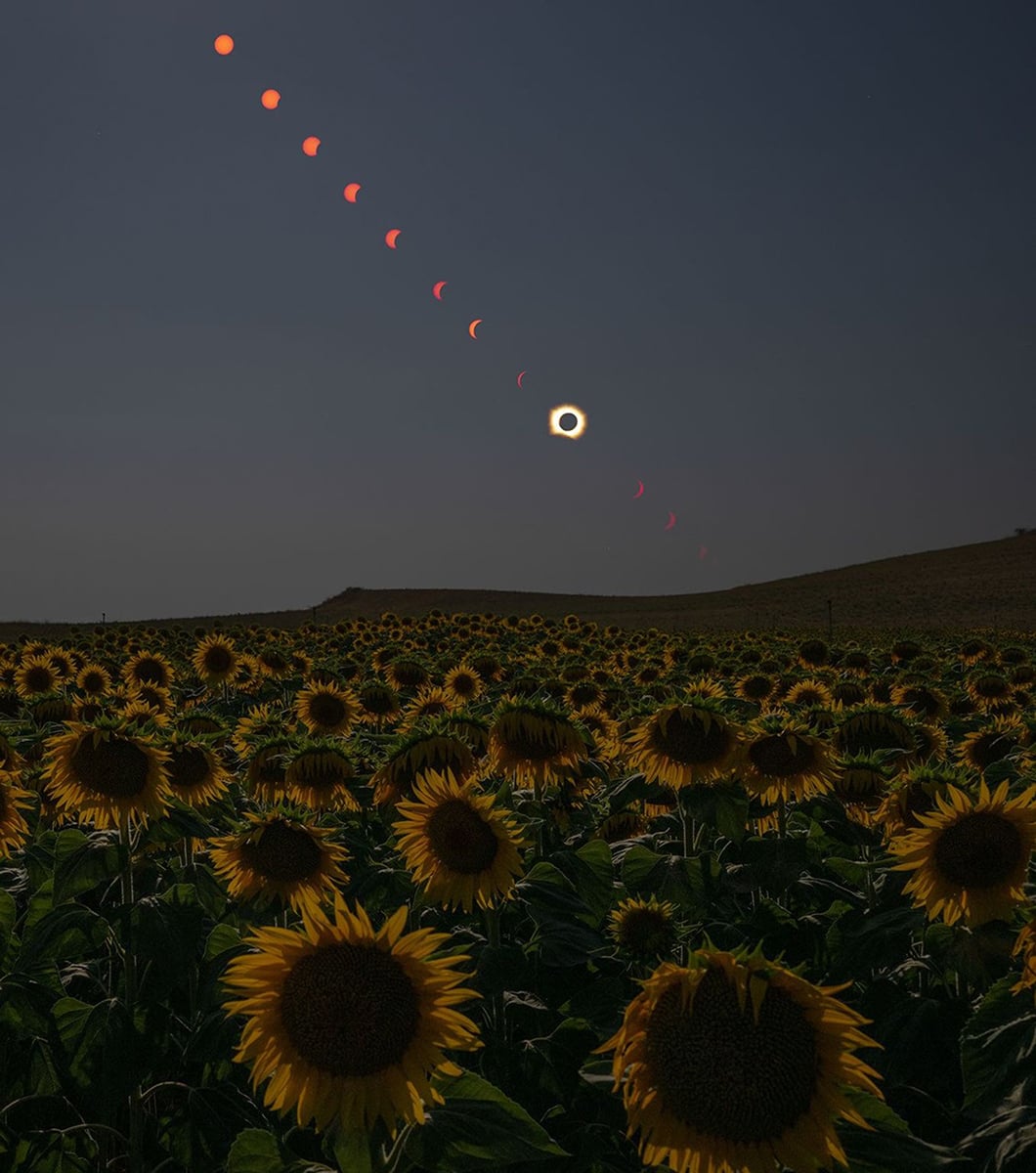
Ingalls also photographed the changing appearance of the Sun before and after totality. One sequence places the eclipse over a field of sunflowers, showing the progression from the unobscured Sun to the narrow crescent immediately before totality. The Sun then reappears in the opposite sequence as the Moon moves away.
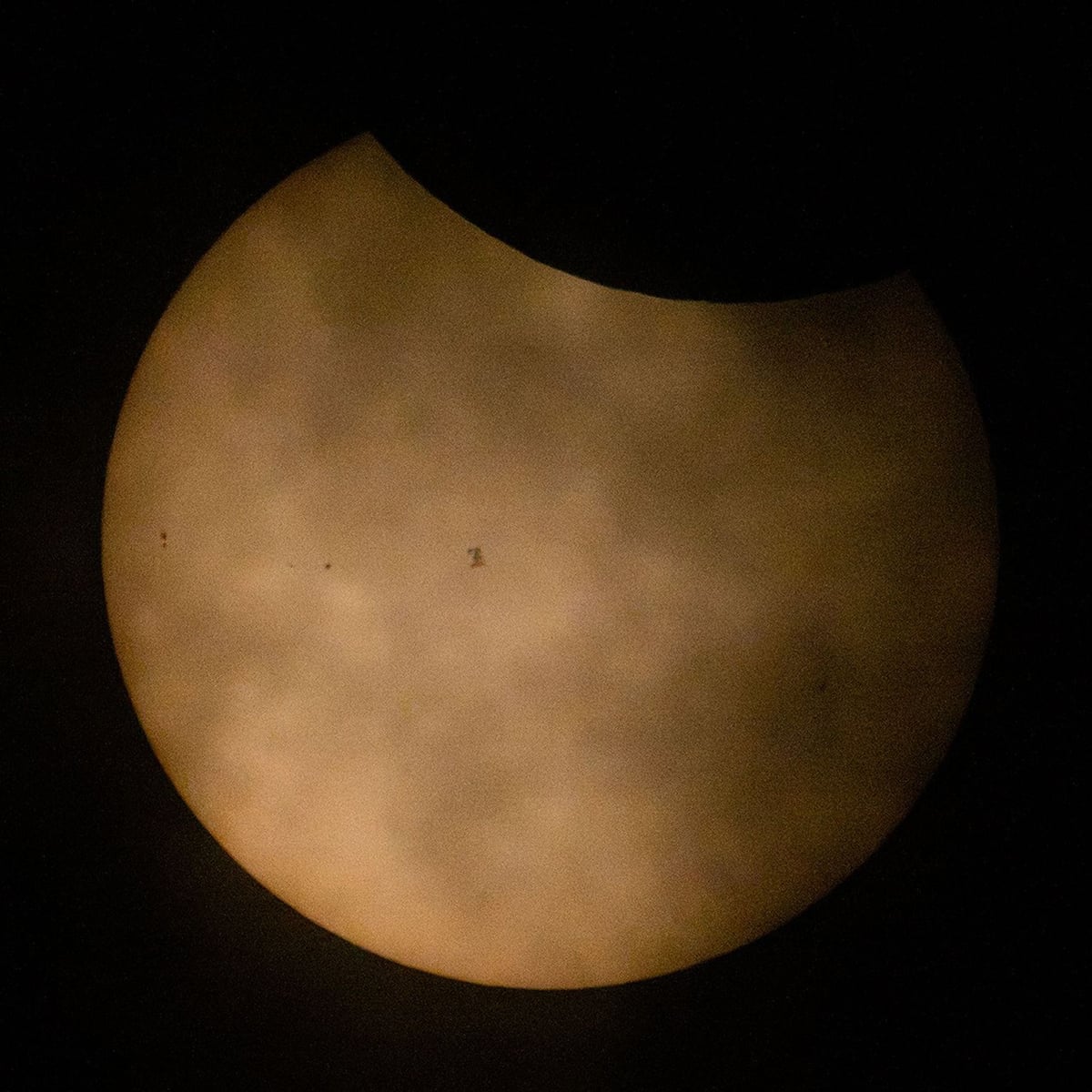
Another ground-based photograph came from Hodgdon, Maine, where NASA photographer Joel Kowsky recorded the International Space Station crossing the partially eclipsed Sun. The station appears as a small, sharply defined silhouette against the solar disk. Kowsky combined 12 individual frames to show its movement across the Sun.
Eclipse from the International Space Station
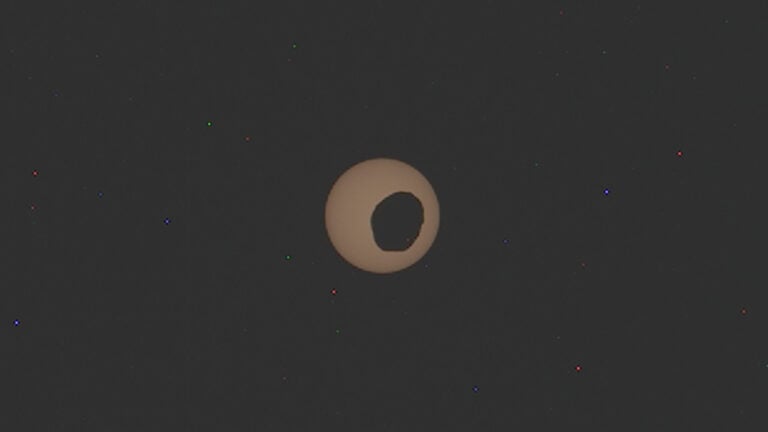
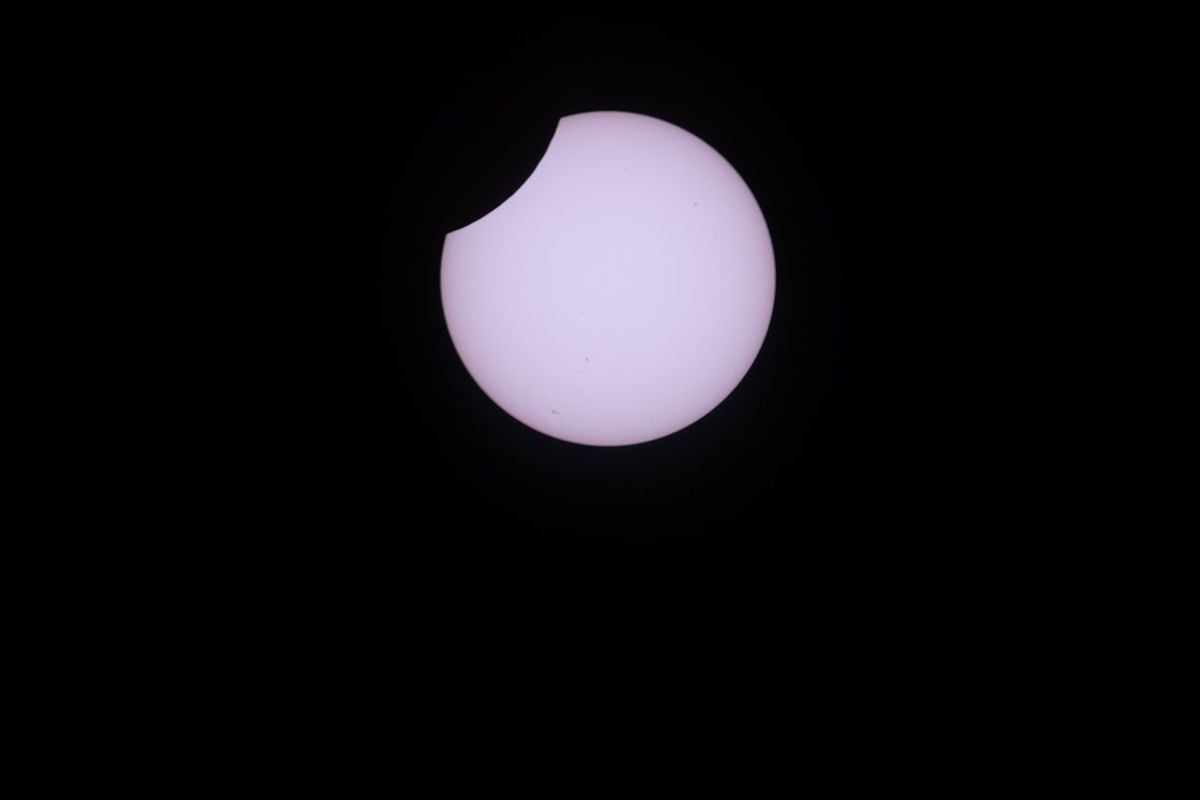
While photographers on Earth watched the Moon approach the Sun, NASA astronaut Jessica Meir observed the eclipse from the International Space Station. The station was about 262 miles above southern Quebec when she photographed the event. From that position, the Moon covered about 18 percent of the Sun.
The ISS photograph recorded the same astronomical event from a different position in space. The station was nowhere near the central path of the Moon’s shadow. Its occupants saw a partial eclipse while observers in Spain and other regions experienced totality.
NASA’s WB-57 aircraft and balloon recorded the eclipse
In addition to images from the ground and space, some of the specialized observations came from NASA’s WB-57F research aircraft. Two aircraft flew at roughly 50,000 feet during the eclipse, operating near Iceland. Their altitude gave the teams access to the eclipse above most of Earth’s atmosphere.
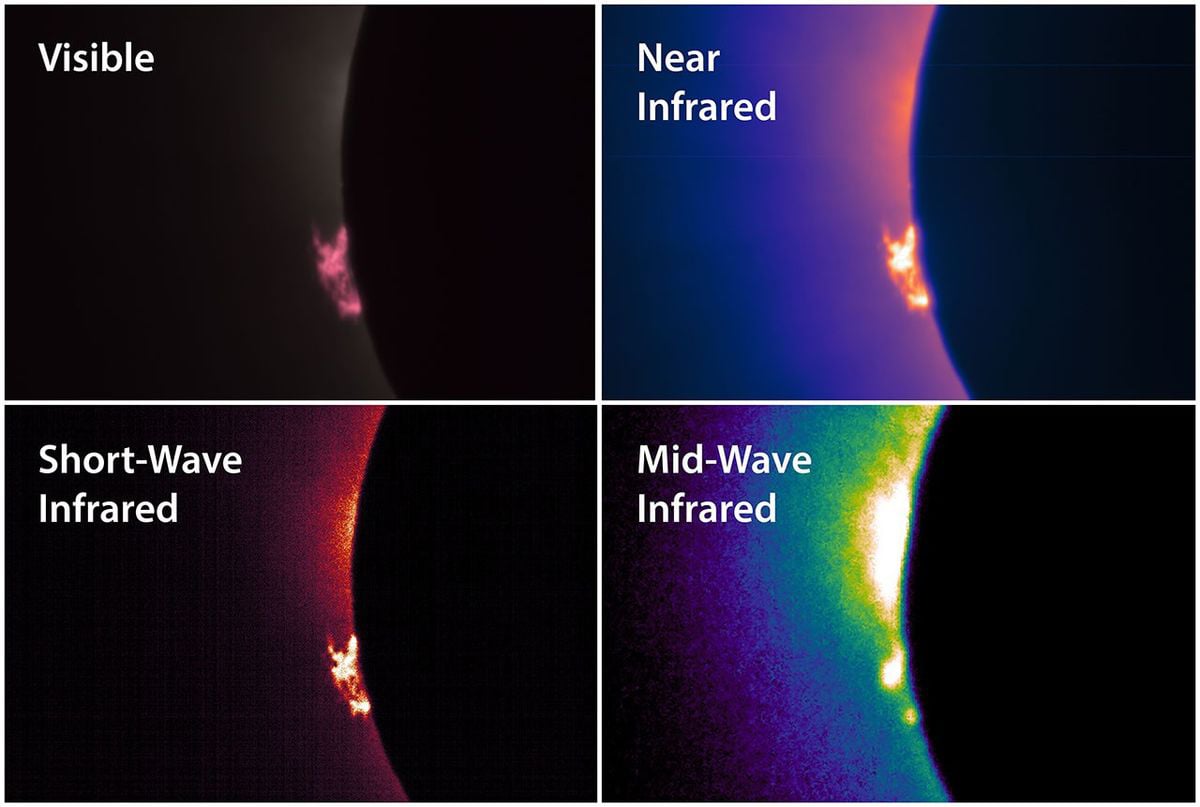
The aircraft carried instruments designed to study the solar corona and prominences. Their cameras observed the Sun at several wavelengths, including visible and infrared bands. This allowed scientists to examine structures that may look similar in a normal photograph but behave differently across the electromagnetic spectrum.
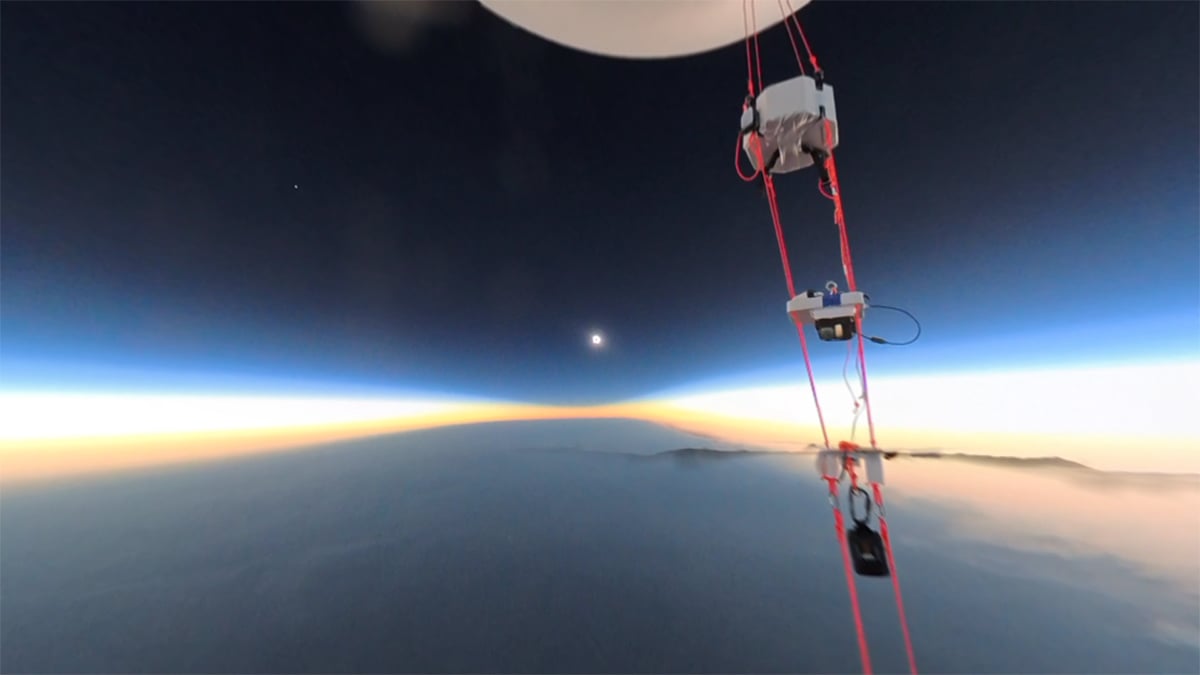
NASA also launched scientific balloons to study the effects of the eclipse on Earth’s atmosphere. The balloon observations addressed a different question from the aircraft measurements. Instead of focusing on the solar corona, the teams examined what happens when sunlight reaching Earth’s atmosphere changes rapidly.
Clear skies!
See more from DIYPhotography.net on Google
Add DIYPhotography.net as a trusted source. This makes
our stories more likely to appear in your Google Search results.
 Add as a preferred source on Google

Soumyadeep Mukherjee
Soumyadeep Mukherjee is an award-winning astrophotographer from India. He has a doctorate degree in Linguistics. His work extends to the sub-genres of nightscape, deep sky, solar, lunar and optical phenomenon photography. He is also a photography educator and has conducted numerous workshops. His works have appeared in over 40 books & magazines including Astronomy, BBC Sky at Night, Sky & Telescope among others, and in various websites including National Geographic, NASA, Forbes. He was the first Indian to win “Astronomy Photographer of the Year” award in a major category.



Join the Discussion
DIYP Comment Policy
Be nice, be on-topic, no personal information or flames.