
























James Webb Captures a Galaxy Cluster Still Under Construction
Jul 5, 2026
Soumyadeep Mukherjee
Soumyadeep Mukherjee is an award-winning astrophotographer from India. He has a doctorate degree in Linguistics. His work extends to the sub-genres of nightscape, deep sky, solar, lunar and optical phenomenon photography. He is also a photography educator and has conducted numerous workshops. His works have appeared in over 40 books & magazines including Astronomy, BBC Sky at Night, Sky & Telescope among others, and in various websites including National Geographic, NASA, Forbes. He was the first Indian to win “Astronomy Photographer of the Year” award in a major category.
Share:
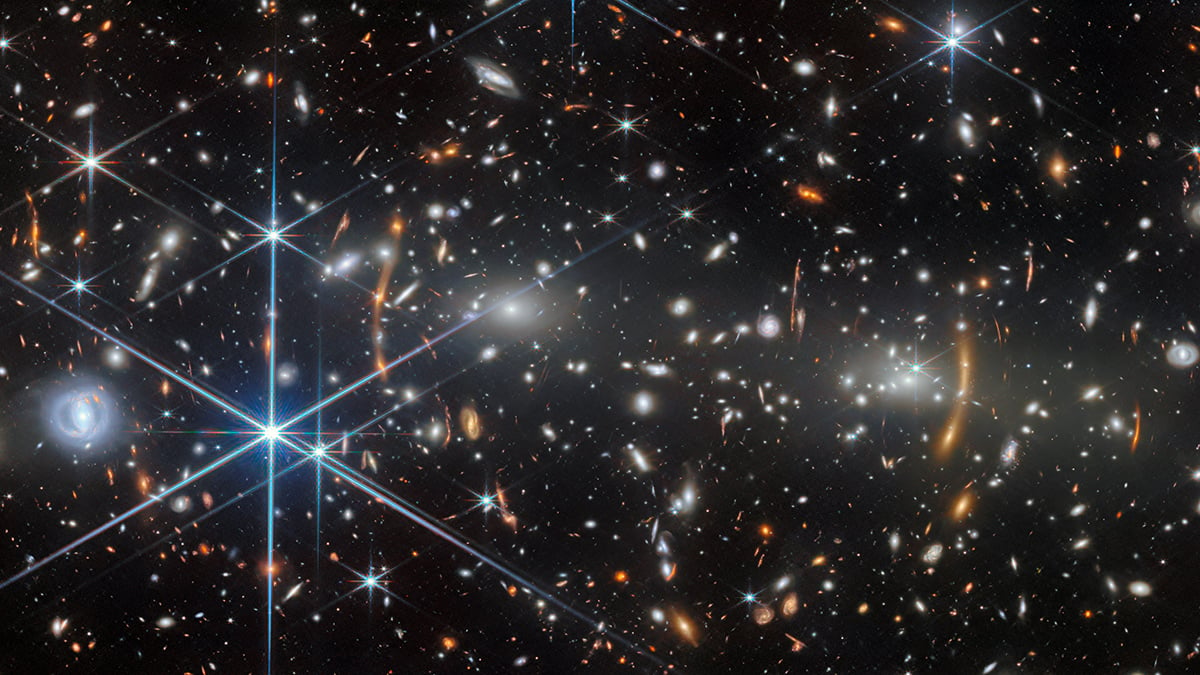
Galaxy clusters are the largest structures in the Universe held together by gravity. They did not appear fully formed after the Big Bang; they grew gradually as gravity pulled galaxies, gas, and dark matter into ever-larger systems. Even today, this process continues across the cosmos. The latest observation from the James Webb Space Telescope (JWST) shows a massive galaxy cluster in the middle of its long journey toward becoming a single, stable structure.
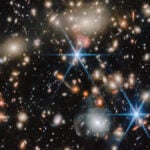
Released by the European Space Agency (ESA) as its July 2026 Picture of the Month, the new image captures MACS J0553.4−3342, a galaxy cluster located in the constellation Columba. The observation records one of the most energetic events in the Universe: a merger between two massive galaxy clusters. At the same time, it reveals the effects of gravitational lensing.
A galaxy cluster that is still growing
MACS J0553.4−3342 lies at a redshift of about 0.41, placing it roughly 4.4 billion light-years from Earth. In astronomy, looking farther into space also means looking farther back in time. The light collected by JWST began its journey long before complex life appeared on Earth. The telescope shows the cluster as it existed billions of years ago, preserving a chapter of cosmic history that can no longer be seen in the present-day Universe.
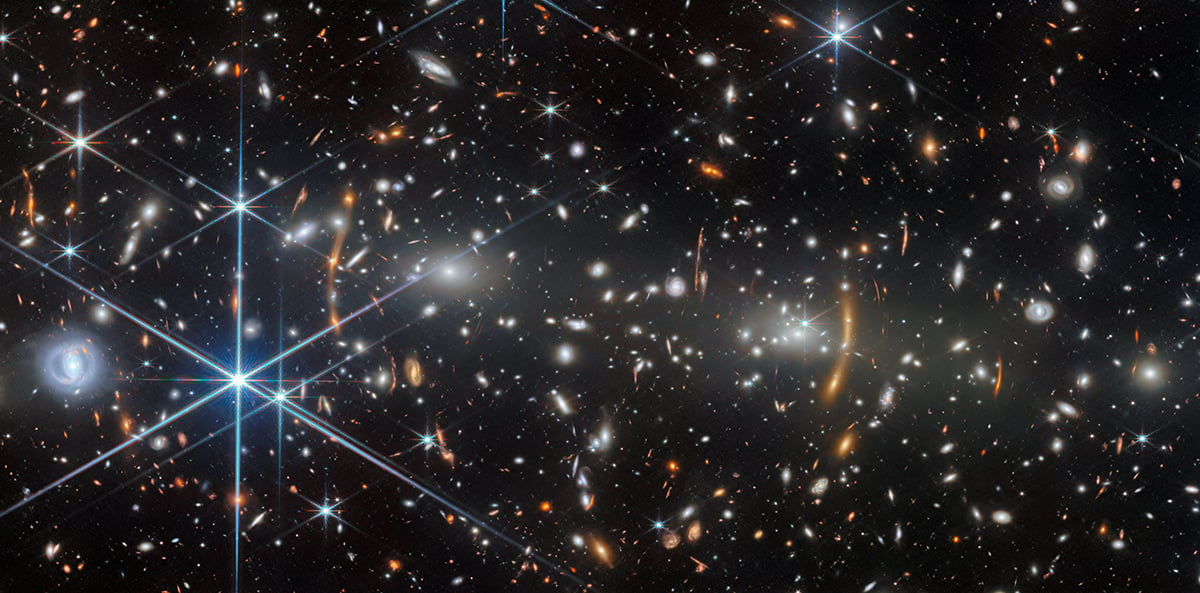
Unlike many well-known galaxy clusters, this one has not yet reached a calm, settled state. Observations indicate that it consists of two large subclusters with nearly equal masses. These two systems are moving together and slowly merging into one much larger cluster.
The real interaction between the galaxy clusters happens on much larger scales. Gravity begins to reform the entire system. Vast clouds of extremely hot gas collide and slow down. Invisible halos of dark matter overlap and influence the motion of everything around them. Over billions of years, the two separate clusters gradually merge and become one enormous gravitational system.
A view filled with thousands of galaxies
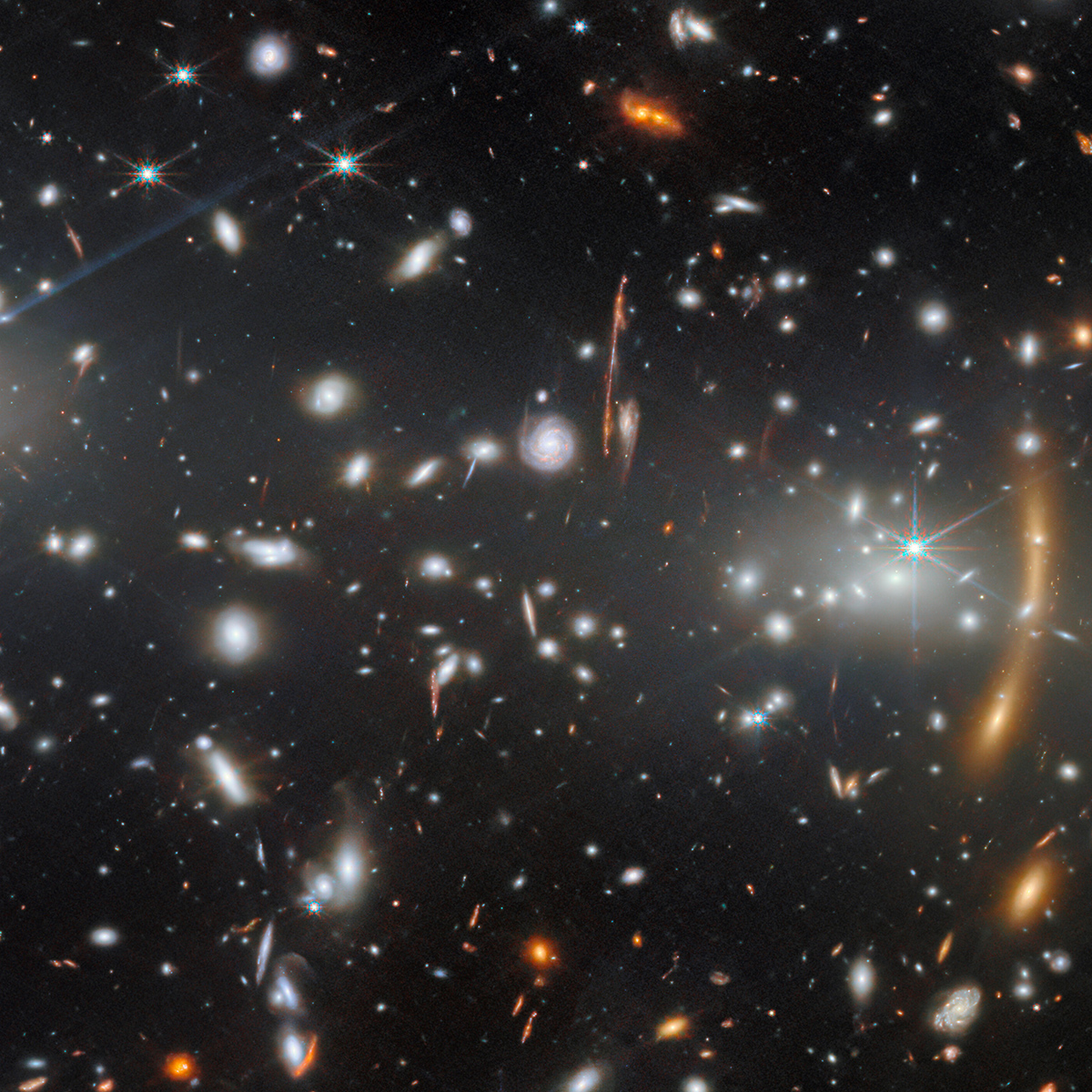
The brightest galaxies near the centre are the dominant members of MACS J0553.4−3342. Most are large elliptical galaxies filled with older stars. Over billions of years, repeated gravitational interactions have drawn these massive galaxies toward the centre of the cluster, where gravity is strongest.
Beyond these cluster members lies an even more remarkable population. JWST reveals thousands of background galaxies stretching across the field of view. Many appear small and reddish because their light has travelled for billions of years before reaching Earth. During that journey, the expansion of the Universe stretched the light into longer infrared wavelengths.
Every one of these background galaxies represents a different era in cosmic history. Some formed when the Universe was only a few billion years old. Others are even older. Together they create a layered view of the cosmos, with each object recording a different point in time.
Gravity becomes nature’s own telescope
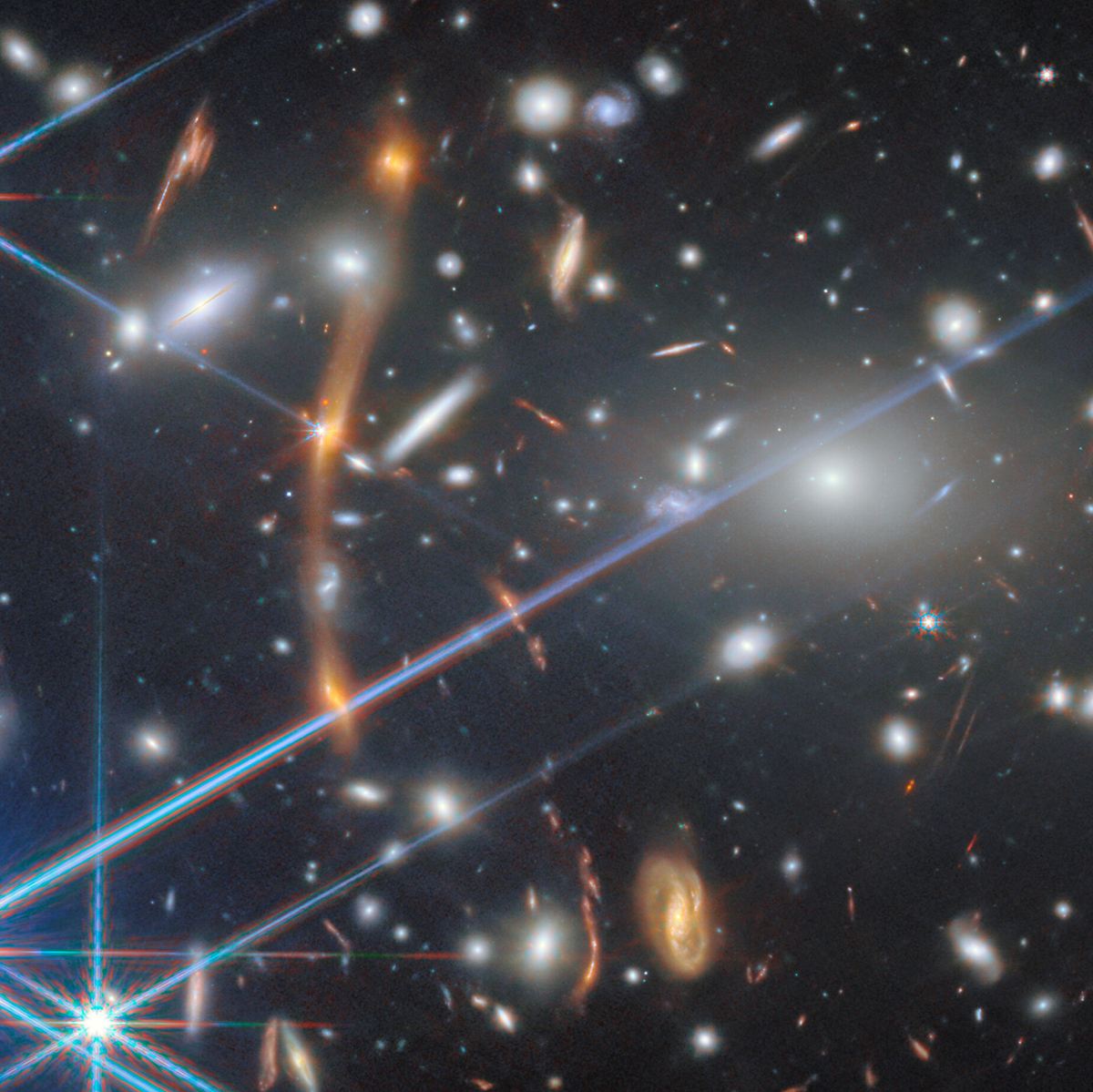
Within the image, several faint galaxies appear stretched into long, curved arcs around the cluster. These shapes are not unusual galaxies. They are the result of one of the most important predictions of Einstein’s theory of general relativity. Massive objects bend spacetime, and light follows those curves as it travels through the Universe. As MACS J0553.4−3342 contains an enormous amount of mass, it bends the light from galaxies located far behind it. This effect is known as gravitational lensing.
Gravitational lensing offers another important advantage. It magnifies distant galaxies that would otherwise remain too faint to detect. In effect, nature supplies an additional telescope that works alongside JWST‘s mirrors. The combination allows astronomers to study galaxies that formed during the earliest chapters of cosmic history.
Some of the faint background galaxies visible in this observation may eventually become targets for even deeper investigations. Future studies could reveal how the first generations of galaxies assembled only a few hundred million years after the Big Bang.
Clear skies!
See more from DIYPhotography.net on Google
Add DIYPhotography.net as a trusted source. This makes
our stories more likely to appear in your Google Search results.
 Add as a preferred source on Google

Soumyadeep Mukherjee
Soumyadeep Mukherjee is an award-winning astrophotographer from India. He has a doctorate degree in Linguistics. His work extends to the sub-genres of nightscape, deep sky, solar, lunar and optical phenomenon photography. He is also a photography educator and has conducted numerous workshops. His works have appeared in over 40 books & magazines including Astronomy, BBC Sky at Night, Sky & Telescope among others, and in various websites including National Geographic, NASA, Forbes. He was the first Indian to win “Astronomy Photographer of the Year” award in a major category.
Join the Discussion
DIYP Comment Policy
Be nice, be on-topic, no personal information or flames.