





















JWST’s View of Sagittarius B2: Our Galaxy’s Largest Star Factory
Sep 24, 2025
Soumyadeep Mukherjee
Soumyadeep Mukherjee is an award-winning astrophotographer from India. He has a doctorate degree in Linguistics. His work extends to the sub-genres of nightscape, deep sky, solar, lunar and optical phenomenon photography. He is also a photography educator and has conducted numerous workshops. His works have appeared in over 40 books & magazines including Astronomy, BBC Sky at Night, Sky & Telescope among others, and in various websites including National Geographic, NASA, Forbes. He was the first Indian to win “Astronomy Photographer of the Year” award in a major category.
Share:

The James Webb Space Telescope has revealed a new portrait of Sagittarius B2, the Milky Way’s largest stellar nursery. By using both its NIRCam and MIRI instruments, JWST captured a side-by-side look at the stars, dust, and gas inside this giant molecular cloud. The result is a detailed picture of how stars form in one of the most extreme environments in our galaxy.
Sagittarius B2: The Milky Way’s largest star-forming cloud
Sagittarius B2, often called Sgr B2, lies near the center of the Milky Way. It is the biggest and most active star-forming cloud in our galaxy. Although it contains only a fraction of the material in the central region, it produces a disproportionately high number of new stars.
Astronomers have long known that Sgr B2 is full of dense clumps, hot cores, ionised regions, and powerful masers. Radio telescopes have mapped its chemistry and structure for decades. Yet these observations left much unseen, especially the youngest stars buried inside. JWST’s infrared instruments can pierce that dust and reveal what earlier telescopes could not.
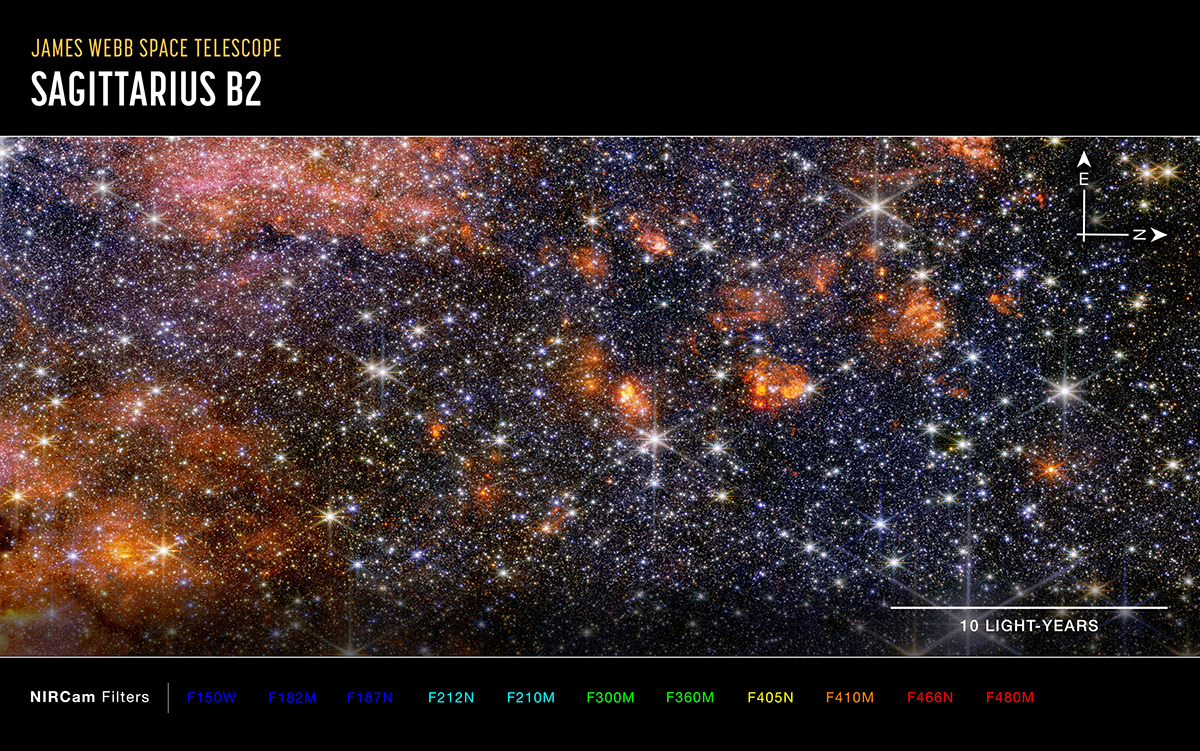
James Webb’s NIRCam view of Sagittarius B2
NIRCam, JWST’s near-infrared camera, looks through much of the dust that hides stars in visible light. In the new NIRCam image, the field is crowded with stars. Some shine brightly as massive young suns. Others appear faint, tucked inside the gas and dust.
The picture also shows dark filaments and knots of material. These are places where gas is collapsing to form new stars. By locating these faint objects and tracing their structures, astronomers can map the locations where active star formation is occurring. The clarity of NIRCam reveals far more stars than were previously visible, offering a sharper view of the cloud’s hidden population.
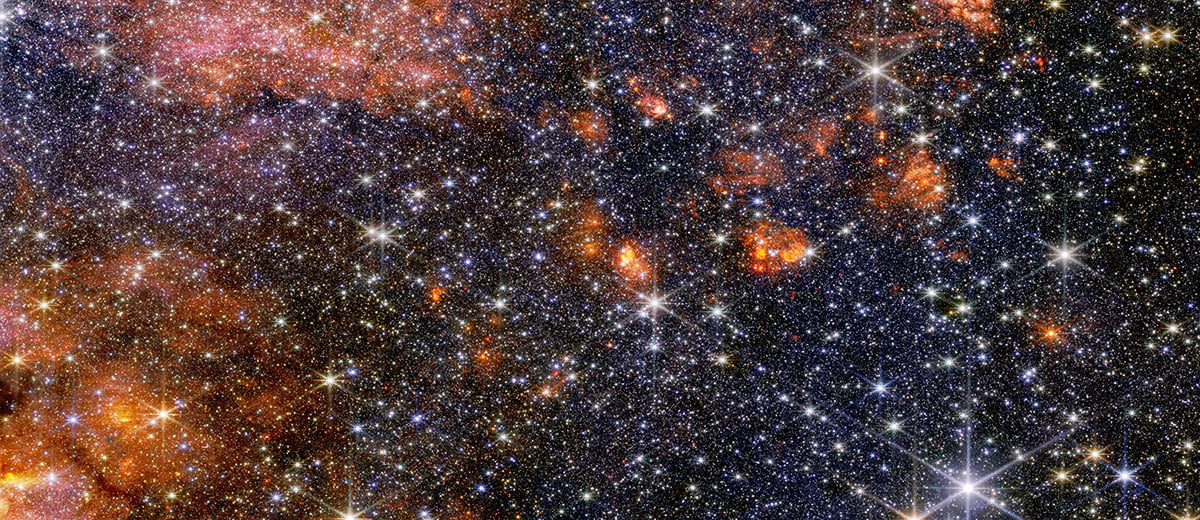
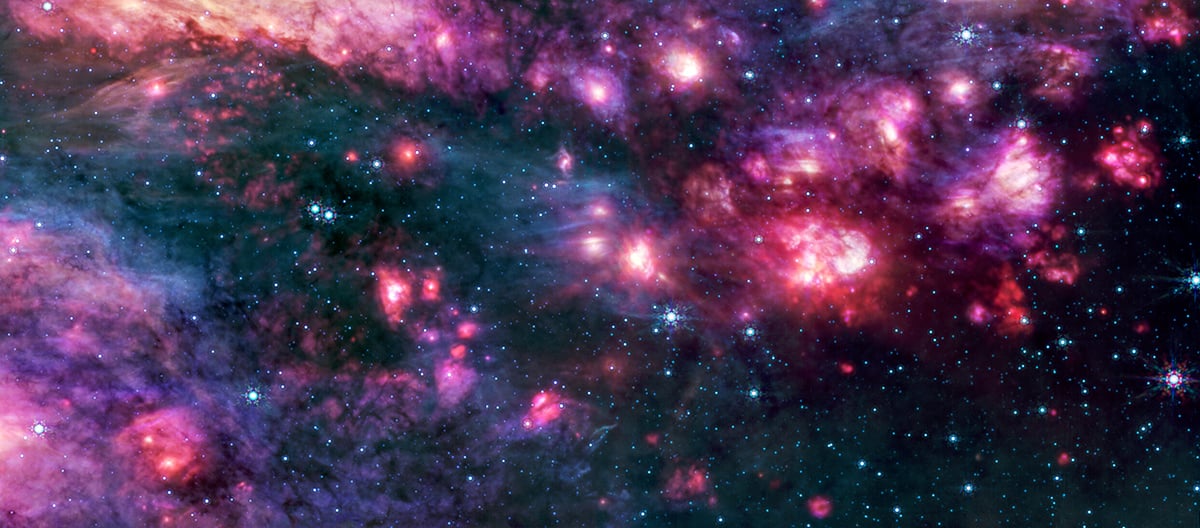
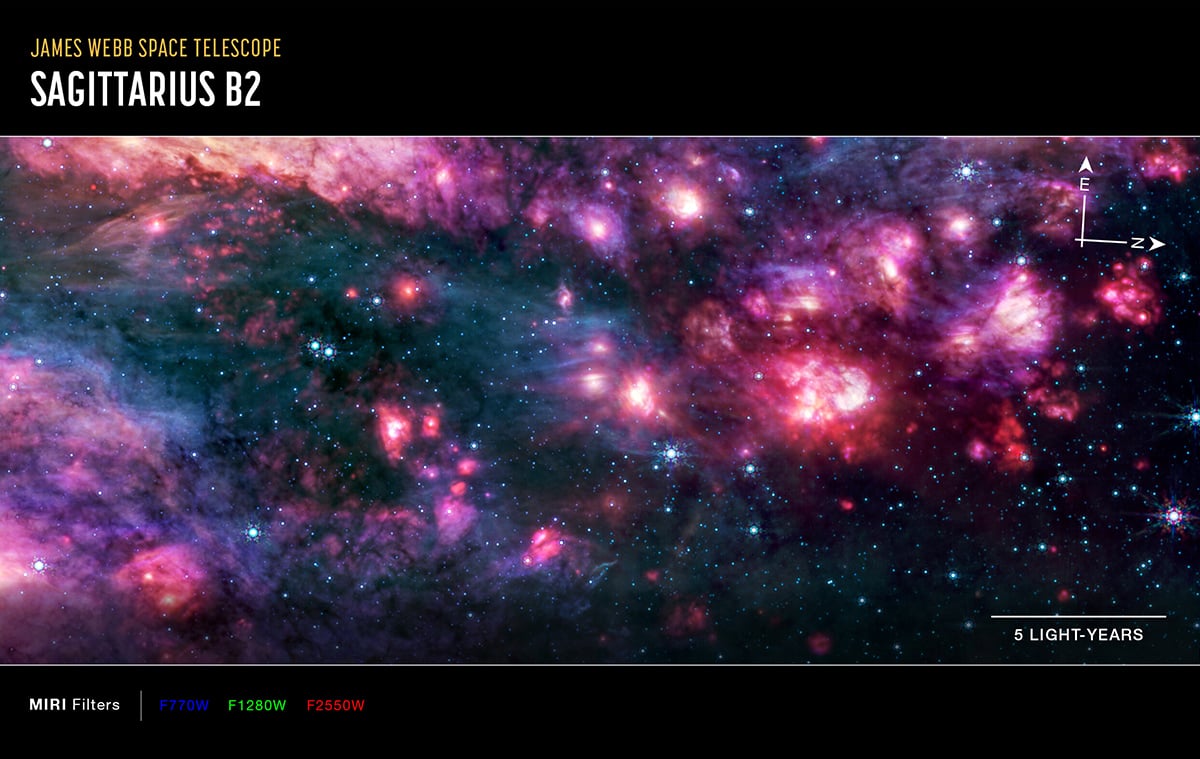
MIRI’s infrared image of Sagittarius B2’s dust and gas
MIRI, JWST’s mid-infrared instrument, tells a different story. Its image shows far fewer stars but highlights glowing dust and warm gas. Mid-infrared light traces heated dust grains and molecules excited by young stars.
The MIRI image reveals ridges, arcs, and shells of dust shaped by intense radiation and stellar winds. These structures are signs of feedback: the process where new stars push against and reshape the material around them. MIRI also captures light from specific molecules and small dust grains, giving clues about the chemistry inside this extreme environment.
NIRCam and MIRI together: A complete view of Sagittarius B2
The significance of these observations lies in the combination. NIRCam shows where the stars are forming. MIRI shows how the dust and gas respond. Side by side, the two images give astronomers a complete picture of the cloud.
With both views, researchers can separate foreground stars from embedded protostars. They can also measure how radiation from massive stars heats and disrupts the surrounding dust. Early studies already suggest that Sagittarius B2 contains more hidden young stars than expected, pointing to a higher rate of star formation than previous models predicted.
A new window into the Milky Way’s heart
The James Webb Space Telescope has already transformed our understanding of and perspective on the distant universe. With its new images of Sagittarius B2, it has turned that same power inward, revealing the hidden heart of our galaxy. The JWST observations are part of a project led by researchers at the University of Florida. Their goal is to study the Central Molecular Zone, the dense and turbulent region at the heart of the Milky Way.
The NIRCam and MIRI views show stars, dust, and gas as parts of a single, connected system. They highlight the birth of stars and the forces that shape their environment. When combined with radio and submillimetre maps from ground-based telescopes, the JWST data will create a multiwavelength model of the cloud. This model will show how stars form, how energy flows through the region, and how the environment compares to starbursts in other galaxies.
Clear skies!
See more from DIYPhotography.net on Google
Add DIYPhotography.net as a trusted source. This makes
our stories more likely to appear in your Google Search results.
 Add as a preferred source on Google

Soumyadeep Mukherjee
Soumyadeep Mukherjee is an award-winning astrophotographer from India. He has a doctorate degree in Linguistics. His work extends to the sub-genres of nightscape, deep sky, solar, lunar and optical phenomenon photography. He is also a photography educator and has conducted numerous workshops. His works have appeared in over 40 books & magazines including Astronomy, BBC Sky at Night, Sky & Telescope among others, and in various websites including National Geographic, NASA, Forbes. He was the first Indian to win “Astronomy Photographer of the Year” award in a major category.

Join the Discussion
DIYP Comment Policy
Be nice, be on-topic, no personal information or flames.