





















Founder Optics FOT106 Refractor: Precision in a Portable Package
Aug 22, 2025
Soumyadeep Mukherjee
Soumyadeep Mukherjee is an award-winning astrophotographer from India. He has a doctorate degree in Linguistics. His work extends to the sub-genres of nightscape, deep sky, solar, lunar and optical phenomenon photography. He is also a photography educator and has conducted numerous workshops. His works have appeared in over 40 books & magazines including Astronomy, BBC Sky at Night, Sky & Telescope among others, and in various websites including National Geographic, NASA, Forbes. He was the first Indian to win “Astronomy Photographer of the Year” award in a major category.
Share:

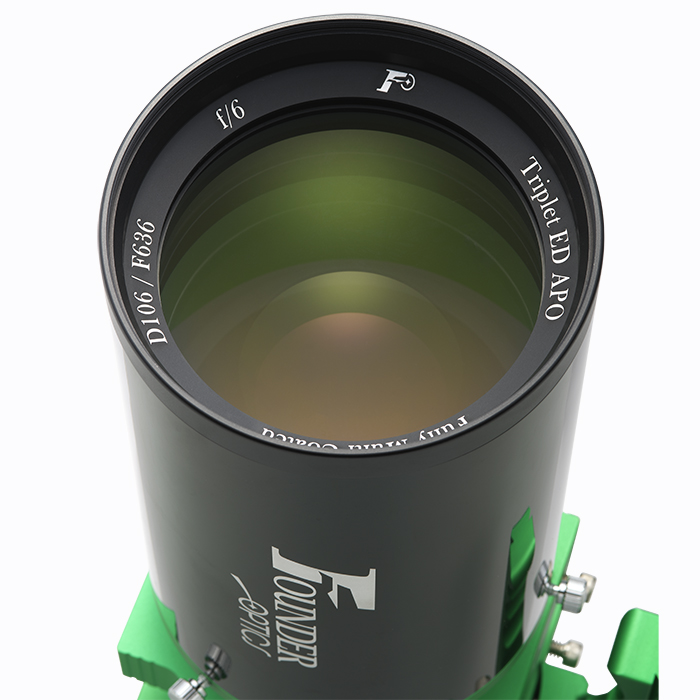
A good 4-inch class refractor is one of the most versatile telescopes an astrophotographer can own. It has enough aperture to reveal deep-sky detail, but remains light and compact enough for travel and mid-range mounts. The Founder Optics FOT106 fits squarely into this category, yet it aims to offer more than just portability. It combines a fast, well-corrected triplet objective with careful mechanical design, and comes as a complete, ready-to-use package. Designed in Japan and manufactured in Taiwan, the FOT106 is targeted at astrophotographers who want dependable optical performance without needing to purchase additional accessories. Its feature set and build quality reflect a deliberate focus on both optical precision and real-world usability.
Optical design: A triplet
The heart of the FOT106 is its 106 mm triplet apochromatic objective, operating at f/6 for a focal length of 636 mm. This is not a typical doublet or single-ED triplet; Founder Optics uses two different ED elements, S-FPL53 and S-FPL51, combined with a lanthanum element in a fully separated triplet configuration. The choice of glass is designed to address chromatic aberration across the visible spectrum while maintaining tight star shapes. A triplet with this glass combination offers more consistent correction than a doublet at this speed. It keeps colour fringes extremely low and holds focus across multiple wavelengths. For imagers, this means more accurate star colors and improved performance with both broadband and narrowband filters. For visual observers, it translates into clean, high-contrast planetary and deep-sky views.
A focuser that handles serious loads
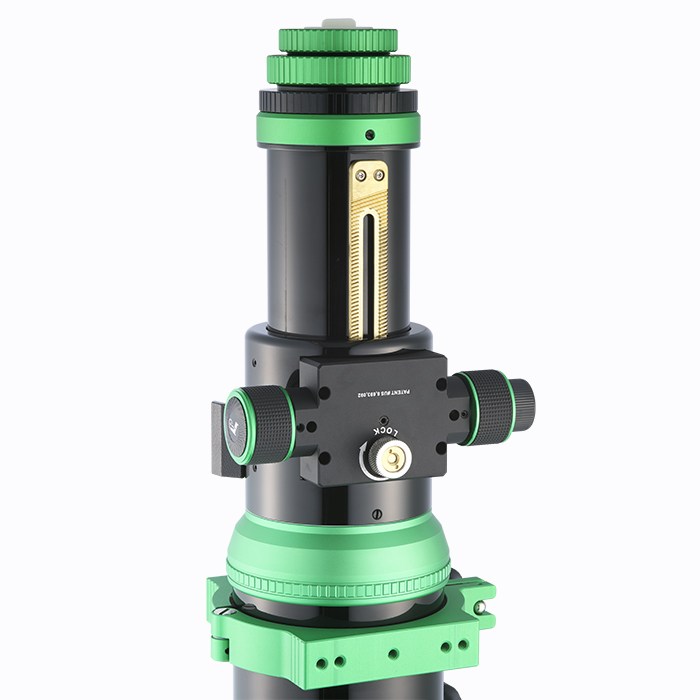
Founder Optics has put as much attention into the mechanics as the optics. The FOT106 features a 2.7-inch rack-and-pinion focuser built with a hybrid drive system. The drawtube is supported by eight ball bearings for smooth, linear movement under heavy loads, while the gear rack ensures no slip during focusing. This focuser is designed to carry up to 8 kg, which is enough for a filter wheel, off-axis guider, and a cooled full-frame camera without noticeable flex. The focuser includes a dual-speed control with a fine 1:11 reduction for precise adjustments, and a tension/lock system that secures focus for meridian flips or long exposures. Travel distance is a generous 95 mm, giving plenty of backfocus for different imaging setups. Behind the focuser is a built-in camera rotator, allowing easy framing without disturbing the rest of the imaging train.
A complete kit
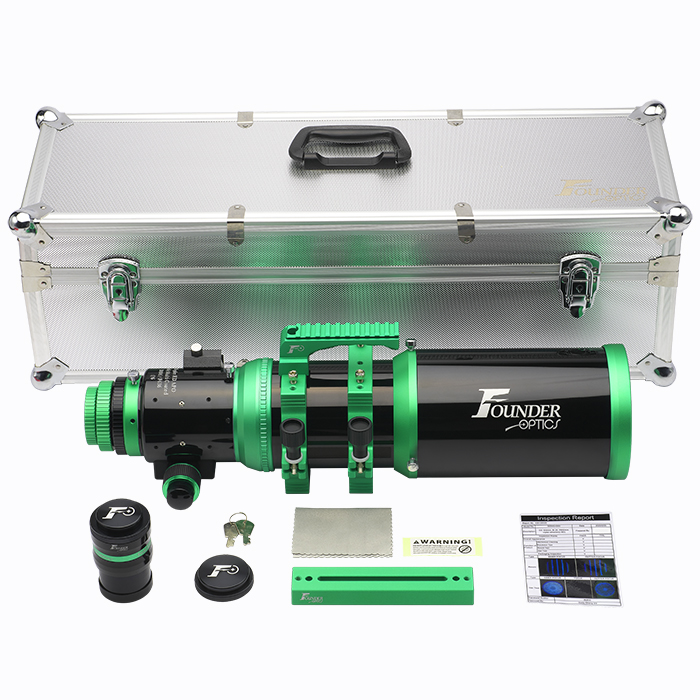
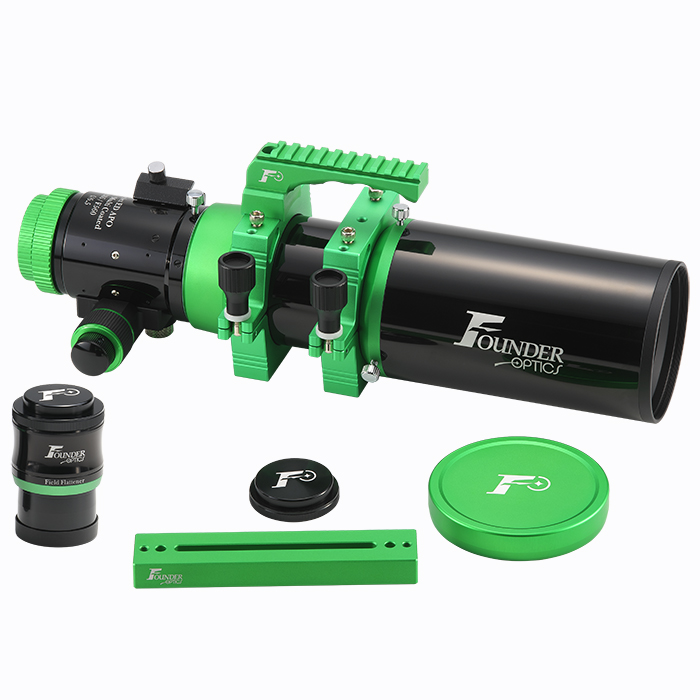
Many premium refractors are sold as bare optical tubes, leaving buyers to source flatteners, adapters, and rings separately. The FOT106 takes the opposite approach. Out of the box, it comes with CNC-machined rings, a handle, a Vixen-style dovetail plate, a finder shoe, and a dedicated field flattener. The flattener is designed specifically for this telescope and delivers a flat 44 mm image circle, enough to fully cover a full-frame sensor. It also includes both M42 and M48 threaded adapters for direct camera connection. The dew shield is retractable, sliding smoothly and locking in place with three evenly spaced screws. This ensures it stays extended during imaging and prevents accidental movement. The tube itself measures 557 mm with the shield retracted and 650 mm extended, and weighs 5.5 kg bare or 6.7 kg with rings. The finish is a high-quality anodizing that feels durable in the field.
Flat fields and flexible speed
For astrophotographers, a refractor’s usability depends as much on its field correction as its raw optics. The included flattener in the FOT106 package makes a significant difference. It corrects curvature across a full-frame sensor, maintaining tight, round stars to the edges. The fact that it’s designed specifically for the FOT106 means you avoid the trial-and-error that comes with generic flatteners. At its native f/6, the FOT106 is already relatively fast, making it possible to capture high-quality data in shorter exposures compared to slower systems. Founder Optics also offers an optional 0.8× reducer, which takes the focal length down to around 509 mm and speeds the system to f/4.8. This is particularly useful for large nebulae and wide-field mosaics. With the reducer, it becomes a wide-field instrument capable of capturing sweeping views of the Milky Way with pinpoint stars.
Key specifications
Here are the key specifications of the telescope:
| Optical System | 2 ED APO Triplet (3-elements Fully Separated Triplet) |
| Aperture | 106mm |
| Focal Length | 636mm |
| Focal Ratio | f/6 |
| Image Circle (with Field Flattener) | 44mm |
| Focuser | 2.7’’ Rack & Pinion Patented Focuser (Twist Lock) |
| Weight | OTA: 5.5kg; with Tube Ring: 6.7kg |
| Diameter of Main Tube | 113mm |
| Tube Length | Fully Retracted: 557mm; Fully Extended: 650mm |
Price and availability
The Founder Optics FOT106 Triplet APO Refractor is priced at $2,399 and is available to order via online retailers.
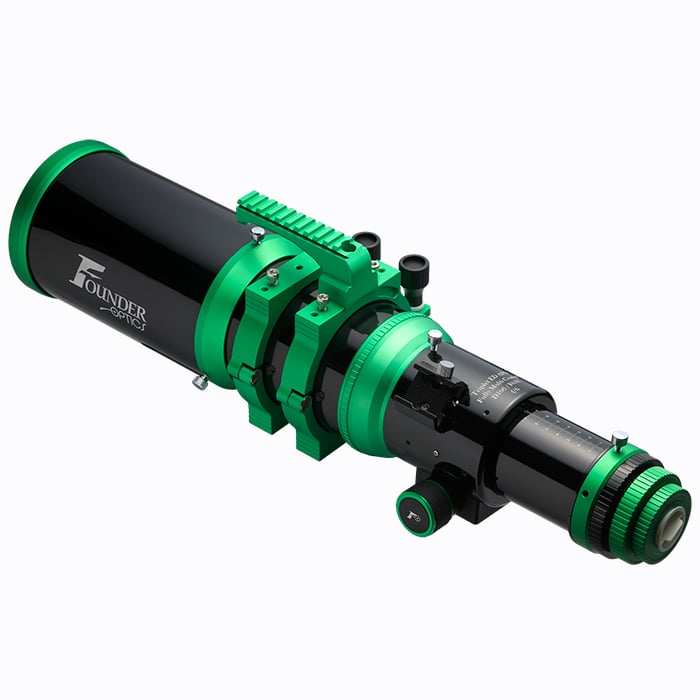
The Founder Optics FOT106 is a thoughtfully designed telescope that balances optical quality, mechanical strength, and user convenience. Its 106 mm triplet objective delivers sharp, well-corrected images, while the robust 2.7-inch focuser supports heavy imaging setups without compromise. The inclusion of a dedicated flattener, complete mounting hardware, and adapters makes it stand out in a market where many competitors ship as bare OTAs. At its native f/6, it offers a mix of speed and resolution. With the optional reducer, it becomes a wide-field powerhouse for large-scale astrophotography projects.
Clear skies!
See more from DIYPhotography.net on Google
Add DIYPhotography.net as a trusted source. This makes
our stories more likely to appear in your Google Search results.
 Add as a preferred source on Google

Soumyadeep Mukherjee
Soumyadeep Mukherjee is an award-winning astrophotographer from India. He has a doctorate degree in Linguistics. His work extends to the sub-genres of nightscape, deep sky, solar, lunar and optical phenomenon photography. He is also a photography educator and has conducted numerous workshops. His works have appeared in over 40 books & magazines including Astronomy, BBC Sky at Night, Sky & Telescope among others, and in various websites including National Geographic, NASA, Forbes. He was the first Indian to win “Astronomy Photographer of the Year” award in a major category.
Join the Discussion
DIYP Comment Policy
Be nice, be on-topic, no personal information or flames.