






















Founder Optics Draco 62: The Small Scope with Big Ambitions
Aug 3, 2025
Soumyadeep Mukherjee
Soumyadeep Mukherjee is an award-winning astrophotographer from India. He has a doctorate degree in Linguistics. His work extends to the sub-genres of nightscape, deep sky, solar, lunar and optical phenomenon photography. He is also a photography educator and has conducted numerous workshops. His works have appeared in over 40 books & magazines including Astronomy, BBC Sky at Night, Sky & Telescope among others, and in various websites including National Geographic, NASA, Forbes. He was the first Indian to win “Astronomy Photographer of the Year” award in a major category.
Share:
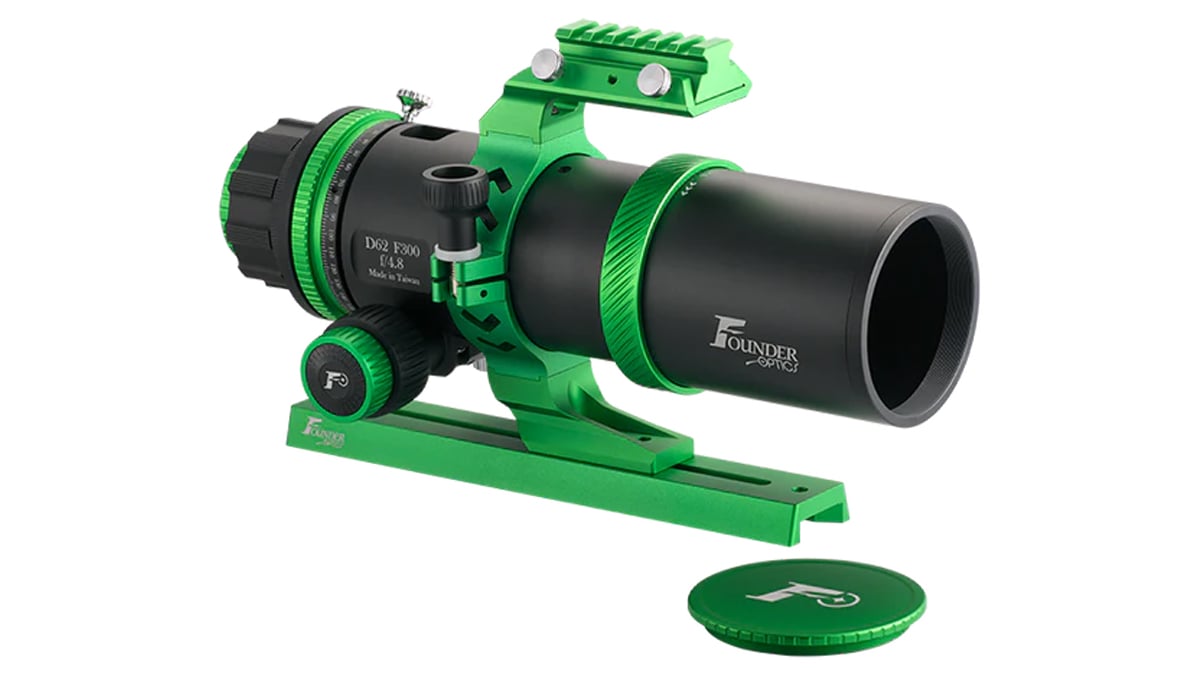
Astrophotography is about capturing light, detail, and wonder. But it also demands gear that performs under pressure. The new Founder Optics Draco 62 meets that challenge head-on. It combines portability, performance, and premium optics in one smart design.
Draco 62: Five elements of precision
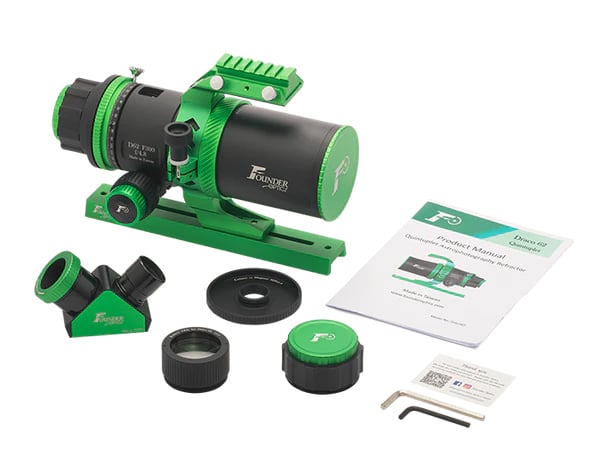
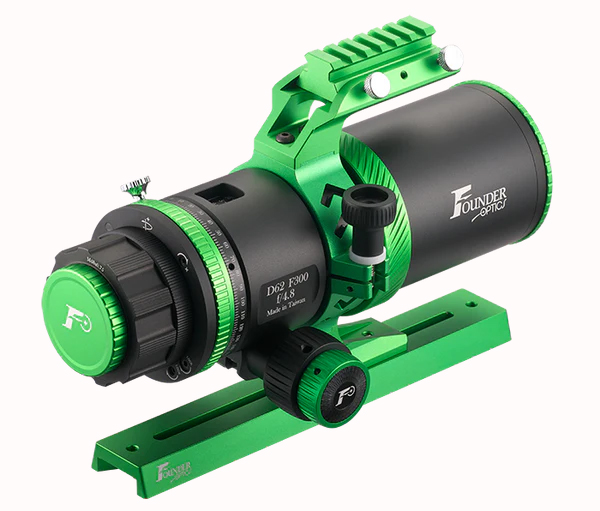
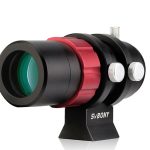
The Draco 62 is a quintuplet refractor telescope. It has a 62 mm aperture and a native focal length of 300 mm, which gives it a fast f/4.8 focal ratio. That’s ideal for wide-field astrophotography. It can capture large targets like the North America Nebula, Veil Nebula, or Milky Way regions with stunning clarity. It also includes a 0.83× reducer in the box. This takes the focal length down to about 250 mm, resulting in a blazing-fast f/3.9. You get a wide field of view and shorter exposure times, perfect for deep-sky imaging.
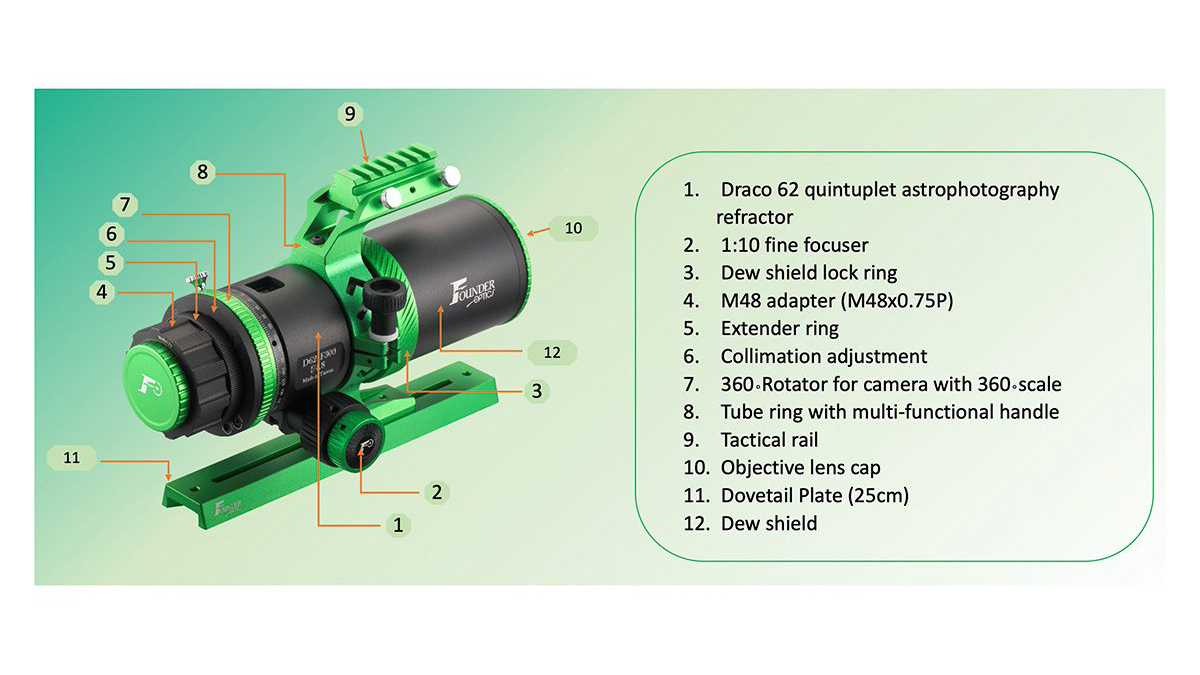
The Draco 62 uses five air-spaced elements in its optical design. This is rare in compact refractors. The optics include extra-low dispersion (ED) glass to reduce chromatic aberration. The result is pinpoint stars, high contrast, and sharp images across the frame. A 44 mm image circle supports full-frame and APS-C sensors. That’s a major advantage for DSLR and mirrorless users. Even astro cameras with large sensors will benefit from flat and clean edges. The Draco 62 uses multi-coating and hydrophobic treatment on its lenses. That keeps internal fogging to a minimum and improves transmission.
Weather-ready build and high-precision focuser
This telescope is more than a fair-weather friend. The Draco 62 is IP67 waterproof. Founder Optics fills the optical tube with nitrogen gas to prevent moisture from condensing inside. The body is sealed, and the build feels robust. But take note: the waterproofing protects internal elements only. You still need dew heaters or shields for the external front lens during humid nights.
The Draco 62 features a 2-inch dual-speed rack-and-pinion focuser. The fine adjustment knob uses a 10:1 ratio, giving you smooth and precise control. The focuser is solid. It supports heavy imaging trains without flexing. The rotation mechanism is also smooth and holds the imaging angle well. Founder Optics includes built-in support for ZWO EAF and FeatherTouch HSM motor focusers. You don’t need third-party adapters. This makes it perfect for automated focusing in advanced astrophotography setups.
Who is it for?
The Draco 62 is aimed at wide-field astrophotographers. Its key audience includes:
- Beginners upgrading from lenses
- Traveling imagers who need a portable rig
- Advanced users looking for a fast, wide-field scope
It’s not ideal for planetary imaging due to its short focal length. But for nebulae, large galaxies, and star fields, it’s an excellent choice.

Key specifications
Here are some of the key specifications of the telescope:
| Optical system | 5+2 =7 Elements, Quintuplet refractor+ 0.83x reducer |
| Aperture | 62mm |
| Focal length | 300mm |
| Focal ratio | f/4.8, f/3.9 (with 0.83 reducer) |
| Focuser | 2’’ Rack & Pinion, 1:10 fine focuser |
| Objective lens | Quintuplet, Air-spaced ED APO lens |
| Image circle | 44mm |
| Back focus distance | 55mm |
| Weight | 2.4kg (refractor), 3.2kg (tube ring, handle, tactical rail) |
Price and availability
The Draco 62 is priced around $1099 and is available to purchase via retailers like Agena Astro.
Final thoughts: A compact powerhouse
The Founder Optics Draco 62 is a well-designed, well-built telescope that offers serious value. It’s perfect for wide-field astrophotography. It’s ready for full-frame imaging. And it’s built for both travel and performance. Whether you’re upgrading from a DSLR lens or building a portable rig, the Draco 62 delivers. It makes astrophotography simpler, faster, and more rewarding. And with its included accessories, you’ll spend more time imaging, and less time shopping for parts.
Clear skies!
See more from DIYPhotography.net on Google
Add DIYPhotography.net as a trusted source. This makes
our stories more likely to appear in your Google Search results.
 Add as a preferred source on Google

Soumyadeep Mukherjee
Soumyadeep Mukherjee is an award-winning astrophotographer from India. He has a doctorate degree in Linguistics. His work extends to the sub-genres of nightscape, deep sky, solar, lunar and optical phenomenon photography. He is also a photography educator and has conducted numerous workshops. His works have appeared in over 40 books & magazines including Astronomy, BBC Sky at Night, Sky & Telescope among others, and in various websites including National Geographic, NASA, Forbes. He was the first Indian to win “Astronomy Photographer of the Year” award in a major category.

Join the Discussion
DIYP Comment Policy
Be nice, be on-topic, no personal information or flames.