





















A Storm of New Stars: Hubble’s Sharp New Look at NGC 1792
Dec 1, 2025
Soumyadeep Mukherjee
Soumyadeep Mukherjee is an award-winning astrophotographer from India. He has a doctorate degree in Linguistics. His work extends to the sub-genres of nightscape, deep sky, solar, lunar and optical phenomenon photography. He is also a photography educator and has conducted numerous workshops. His works have appeared in over 40 books & magazines including Astronomy, BBC Sky at Night, Sky & Telescope among others, and in various websites including National Geographic, NASA, Forbes. He was the first Indian to win “Astronomy Photographer of the Year” award in a major category.
Share:

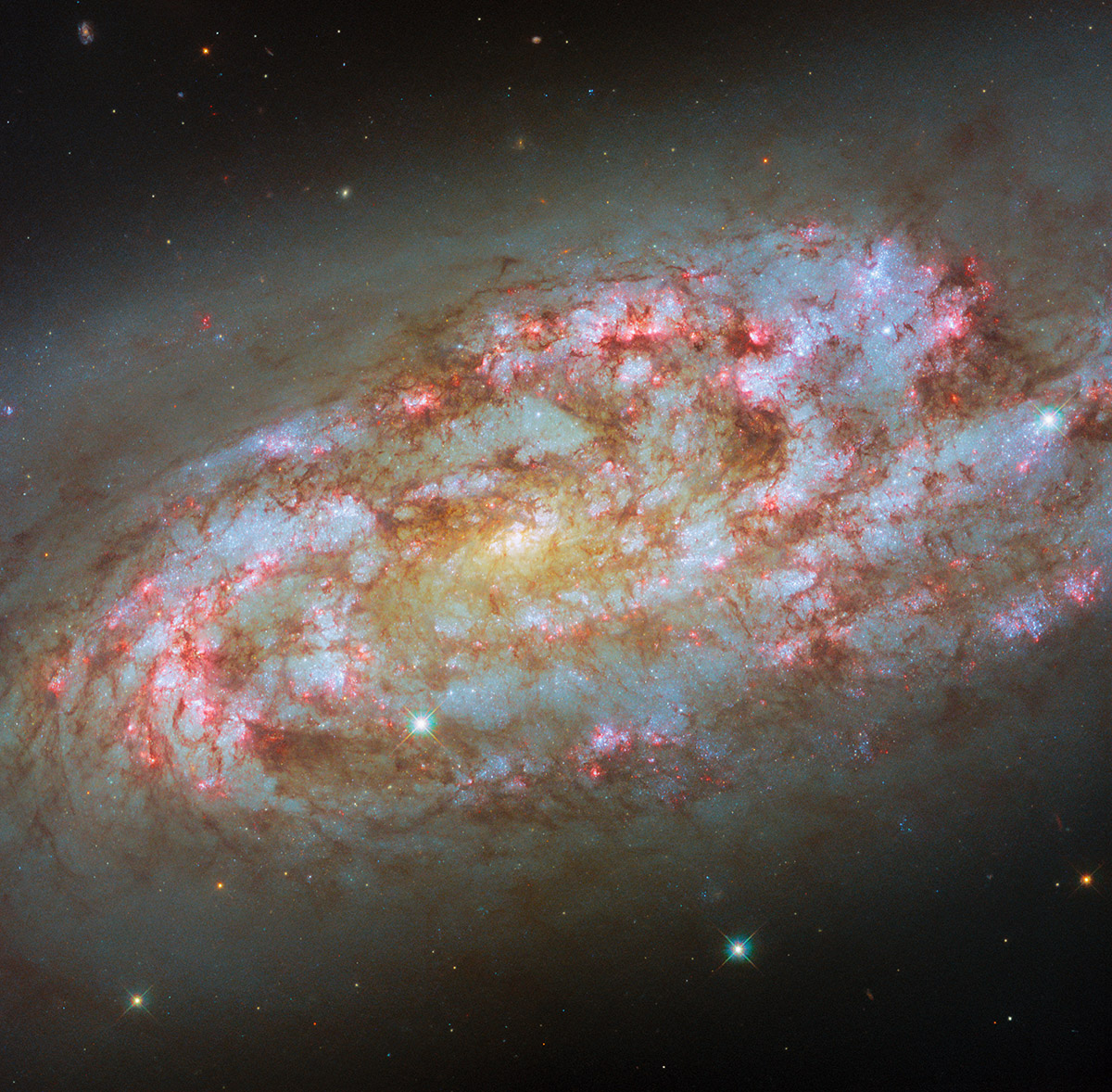
The Hubble Space Telescope has released a new image of NGC 1792, and it is one of those frames that pulls you in immediately. In the image, you see a messy spiral galaxy. Dust streaks slash across the disc. Blue clusters crowd the arms. Red knots flare throughout the spiral structure. It looks busy and unsettled. And that is exactly the point.
NGC 1792 is a galaxy in the middle of a star-forming surge. Astronomers call it a starburst galaxy, and Hubble’s latest data reveals that activity with unusual clarity. The 2025 release combines several sets of exposures and sharpens the view in a way earlier versions never managed. You can now follow the dust lanes more easily, trace smaller star-forming pockets, and pick out faint young clusters that were almost invisible before.
A lively spiral in a quiet constellation
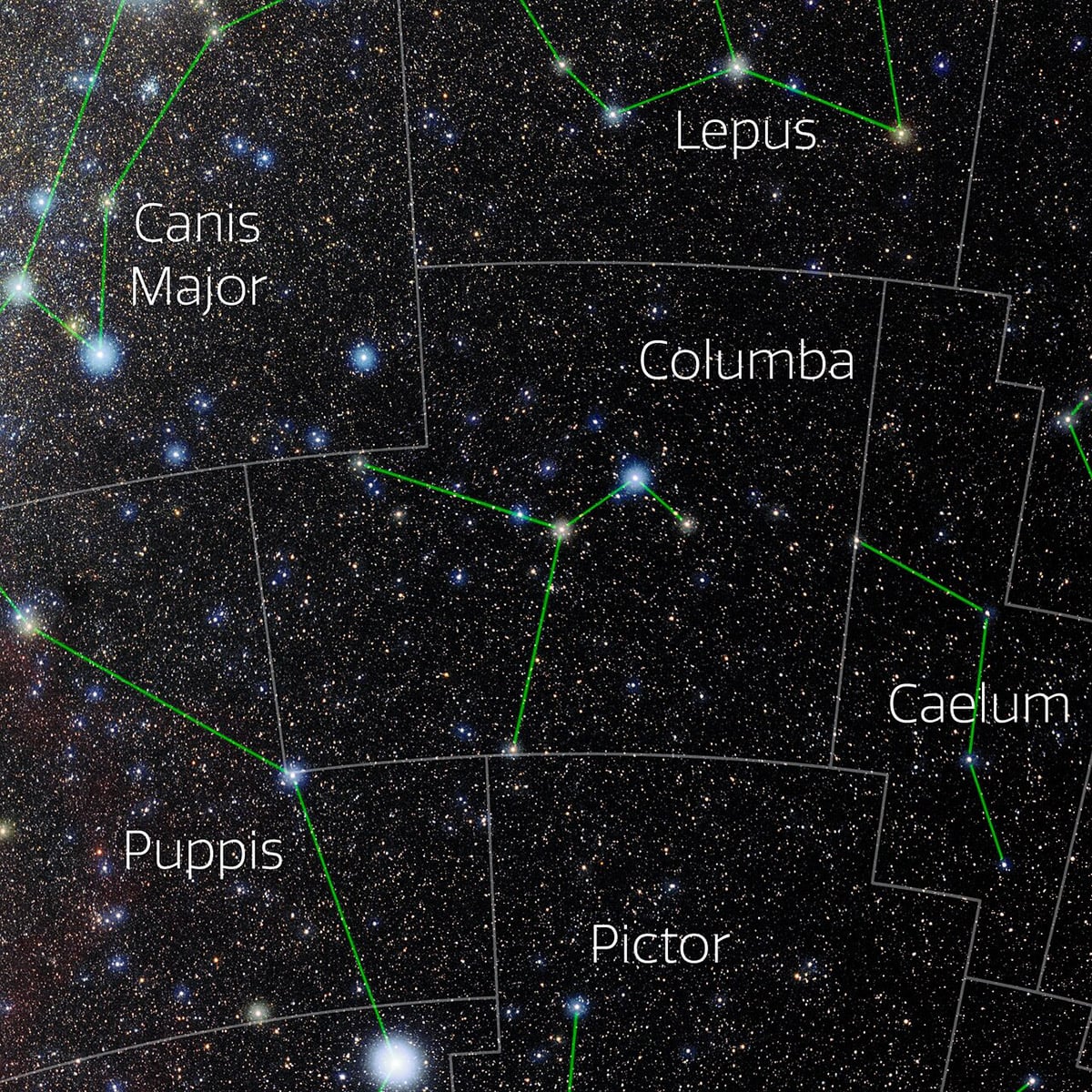
NGC 1792 sits in Columba, a faint southern constellation that does not usually attract much attention. It lies about 50 million light-years away, which makes it relatively close on the cosmic scale. The galaxy is slightly tilted towards us, giving the view a bit of depth. You can see the bright core, the uneven arms, and the strips of dust cutting across the disc.
The overall shape looks loose and patchy. It does not resemble the grand, sweeping spirals we often see in astronomy posters. Instead, it has the look of a system caught mid-process. Parts of the disc look brighter and thicker. Other areas seem shredded. These details are not random. They point to what the galaxy has been experiencing over time.
A galaxy caught in a star-forming surge
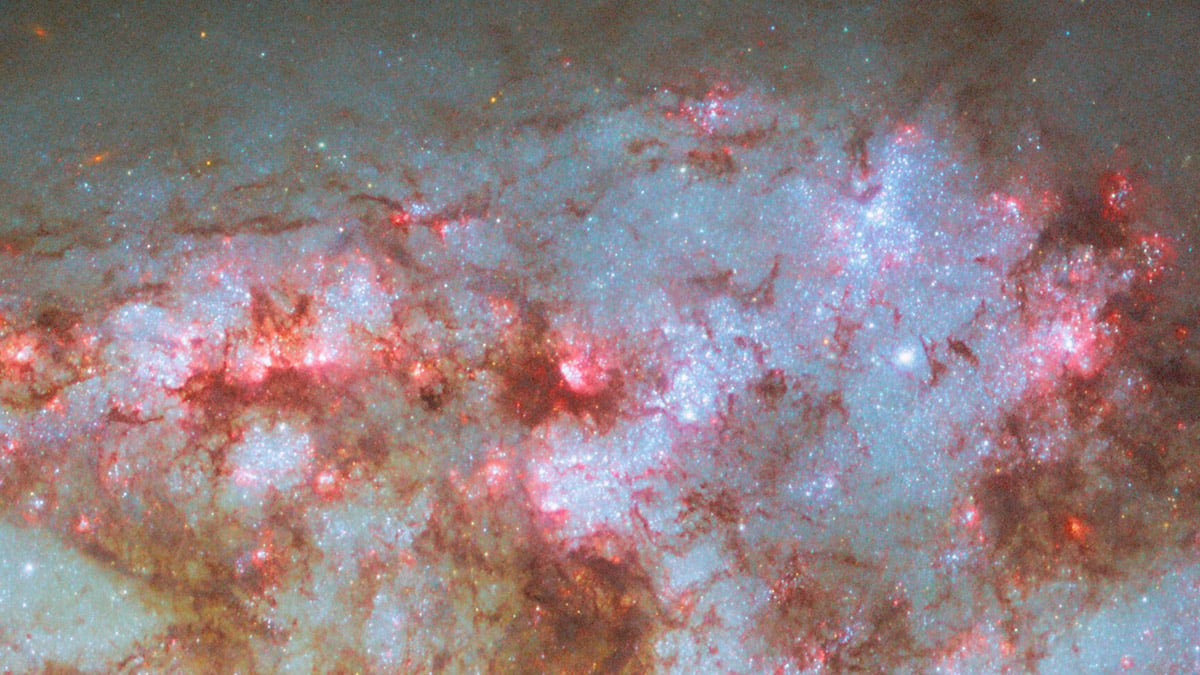
The most notable feature of NGC 1792 is its rapid star formation rate. Hubble’s image highlights this instantly. Young, hot stars show up as blue clumps. Hydrogen-alpha regions appear as red, glowing patches. Dust absorbs and scatters the light, creating darker streaks around the disc. Put these elements together, and you get a clear picture of a galaxy forming stars faster than usual.
Starburst galaxies like this one convert gas into stars at a rapid rate. That gas cools, collapses, and forms clusters. The youngest stars pump out ultraviolet radiation. That radiation ionises the surrounding hydrogen. Hubble picks up that ionised hydrogen in the form of red arcs and knots. These features indicate areas where star formation has occurred very recently, or is currently taking place.
NGC 1792 has a surprising number of these regions. They tell us that the galaxy is not only active but also sustained in that activity. This is not a brief, one-off flare. It is a broad-scale event involving large portions of the disc.
A little gravitational drama behind the scenes
With a galaxy forming stars at this pace, astronomers always ask the same question: Why now? In the case of NGC 1792, a likely answer sits nearby. The galaxy belongs to the same group as NGC 1808, a larger and more distorted spiral. Images of NGC 1808 show warped dust lanes and a twisted structure. Those distortions hint at gravitational interactions within the group. And those interactions probably involved NGC 1792 as well.
Tidal forces between galaxies can shuffle gas around. They can compress certain regions. They can push gas toward the centre or pull it into the arms. Even small shifts can trigger major bursts of star formation. Radio studies support this scenario. Observations show that NGC 1792’s supply of neutral hydrogen gas is uneven. Some of it appears displaced. Those irregularities match what astronomers expect from a past gravitational encounter.
What makes the new Hubble image different
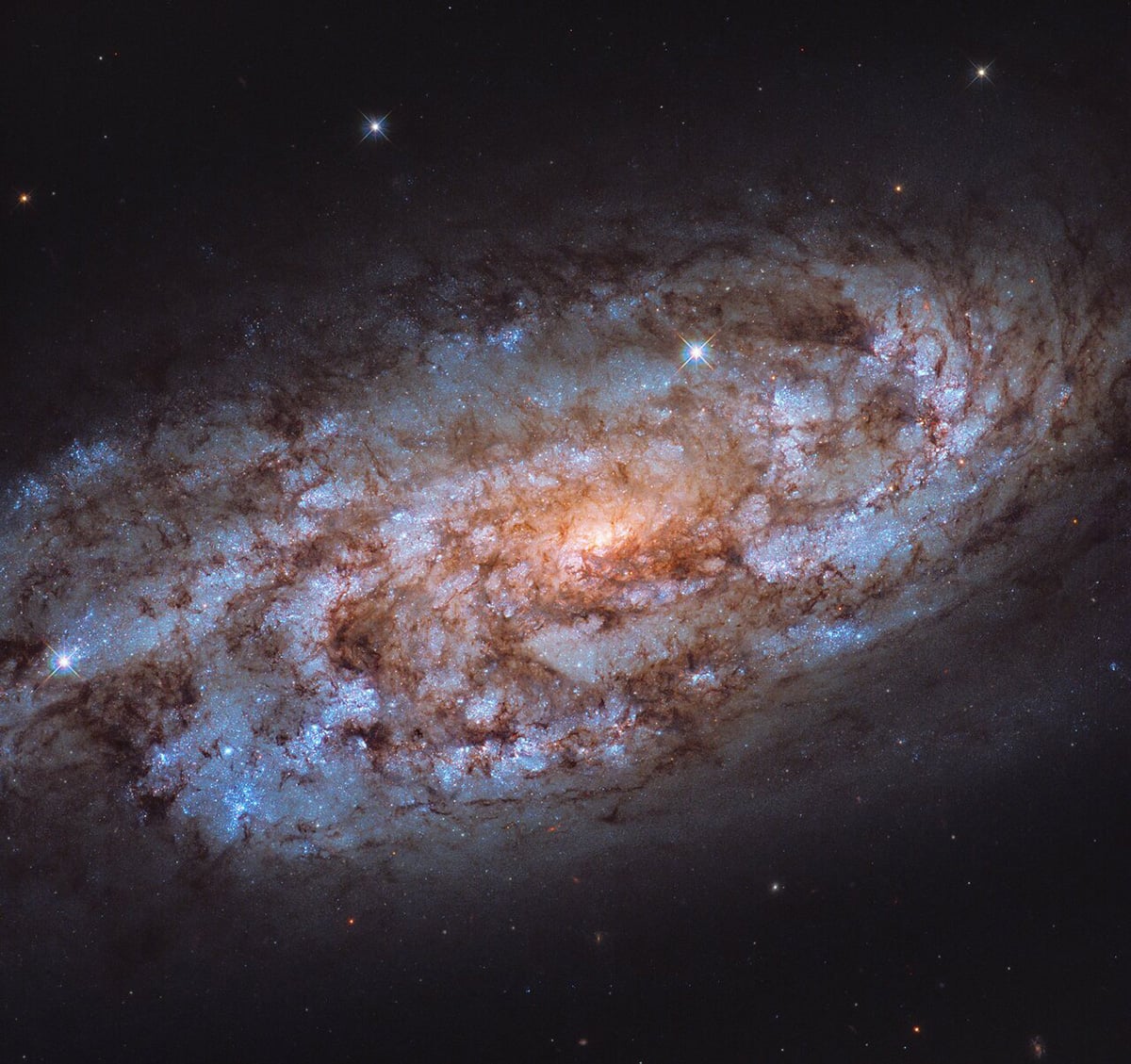
If you compare Hubble’s older image of NGC 1792 with the 2025 release, the difference is immediately visible. The new image is deeper. Fainter features emerge. The dust lanes have a more subtle contour. The blue clusters look better separated. According to the ESA/Hubble release, the team combined newer exposures with earlier data. That combination improves the final signal-to-noise ratio. Astronomers can now track features that were previously washed out.
This added depth helps researchers study smaller H II regions and low-brightness clusters. It also allows better alignment with radio and infrared maps. When scientists match features across wavelengths, they can piece together a more complete story of how gas moves and transforms inside the galaxy.
A galaxy shaped by gas, dust, and young stars
NGC 1792 is an excellent example of how different components of a galaxy interact. You see young stars lighting up regions around them, dust lanes absorbing light and carving shadows through the disc. You also see gas glowing under ultraviolet radiation. Galaxies are ecosystems. Stars form, shine, and die. Their winds and explosions push material around. New clouds collapse. More stars form. Over millions of years, these cycles sculpt the structure of a galaxy.
The new Hubble image captures a snapshot of one moment in that long process. It shows a galaxy in the middle of rapid growth, influenced by internal physics and external gravitational nudges.
NGC 1792 may not be as famous as the Whirlpool Galaxy or the Sombrero Galaxy, but it tells a story that is just as important. It shows how galaxies respond to small disturbances. It shows how dust and gas move through a spiral disc. And it shows how bursts of star formation can reshape the appearance of a galaxy.
Clear skies!
See more from DIYPhotography.net on Google
Add DIYPhotography.net as a trusted source. This makes
our stories more likely to appear in your Google Search results.
 Add as a preferred source on Google

Soumyadeep Mukherjee
Soumyadeep Mukherjee is an award-winning astrophotographer from India. He has a doctorate degree in Linguistics. His work extends to the sub-genres of nightscape, deep sky, solar, lunar and optical phenomenon photography. He is also a photography educator and has conducted numerous workshops. His works have appeared in over 40 books & magazines including Astronomy, BBC Sky at Night, Sky & Telescope among others, and in various websites including National Geographic, NASA, Forbes. He was the first Indian to win “Astronomy Photographer of the Year” award in a major category.


Join the Discussion
DIYP Comment Policy
Be nice, be on-topic, no personal information or flames.