
















Perseverance Captures Earth Passing Behind Phobos from Mars
Aug 9, 2026
Soumyadeep Mukherjee
Soumyadeep Mukherjee is an award-winning astrophotographer from India. He has a doctorate degree in Linguistics. His work extends to the sub-genres of nightscape, deep sky, solar, lunar and optical phenomenon photography. He is also a photography educator and has conducted numerous workshops. His works have appeared in over 40 books & magazines including Astronomy, BBC Sky at Night, Sky & Telescope among others, and in various websites including National Geographic, NASA, Forbes. He was the first Indian to win “Astronomy Photographer of the Year” award in a major category.
Share:
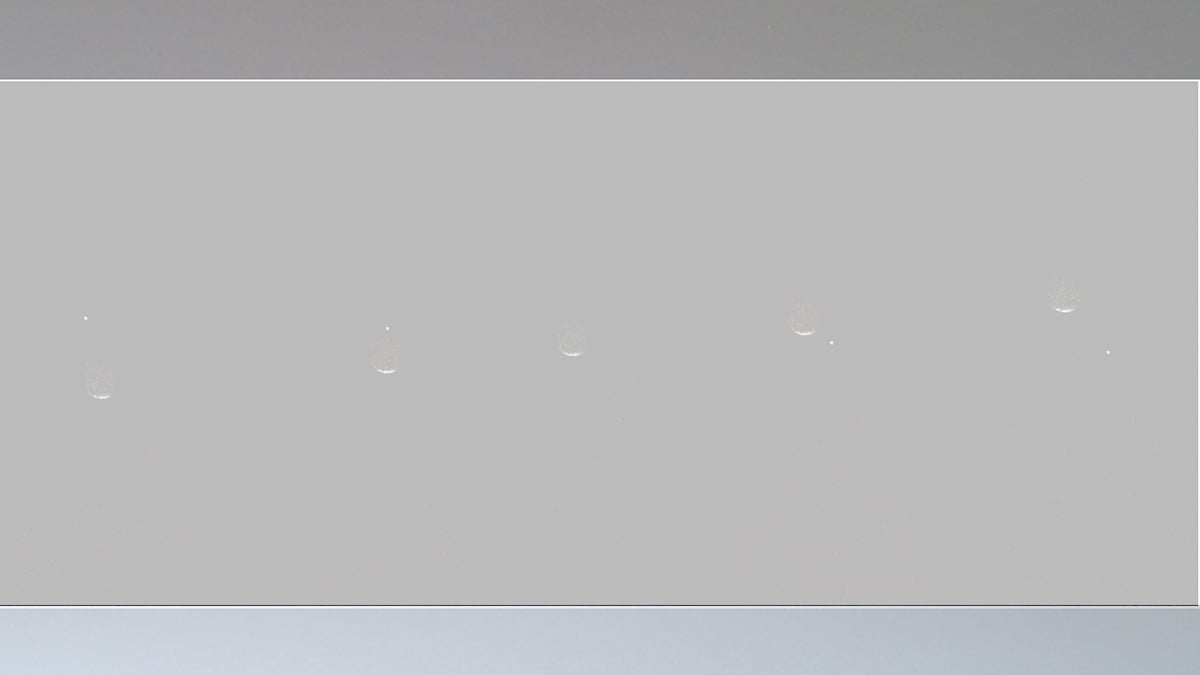
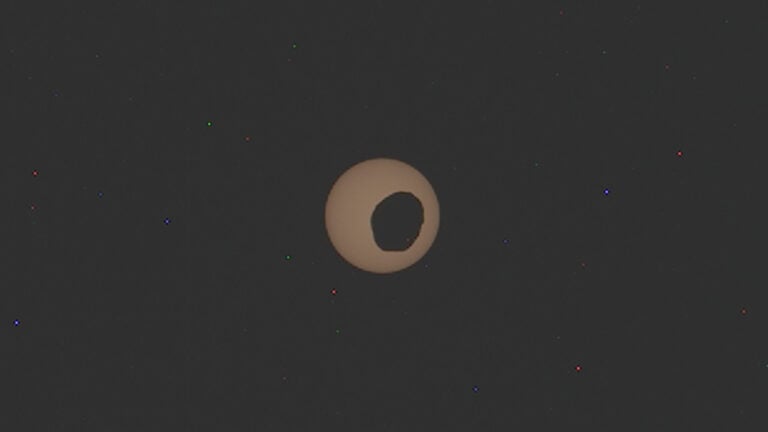
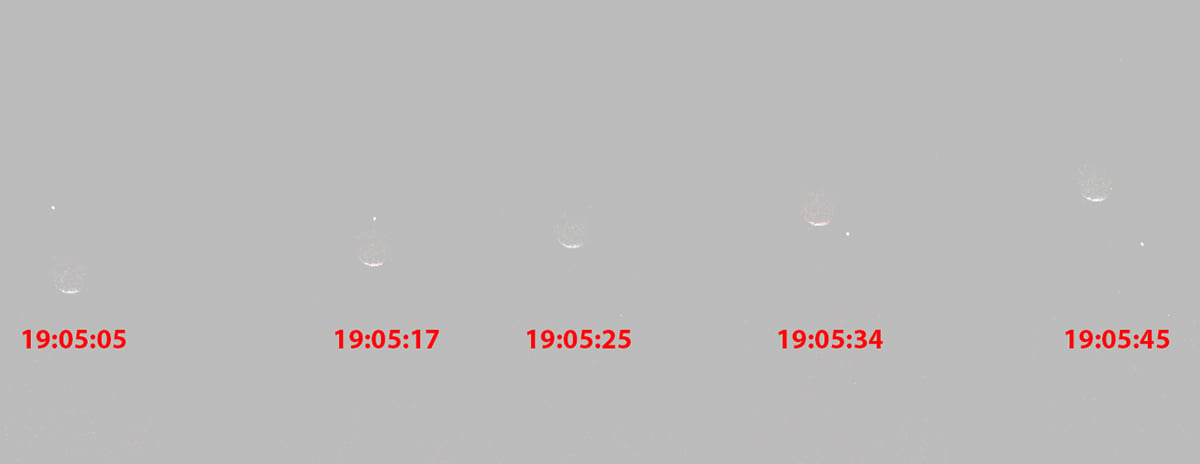
On July 2, 2026, the Perseverance rover pointed its Mastcam-Z cameras towards the evening sky above Jezero Crater. The rover was looking for a specific alignment. Earth was visible from Mars, and Phobos was also moving across the same part of the sky. A series of exposures captured the two bodies approaching each other, crossing paths, and then separating again.
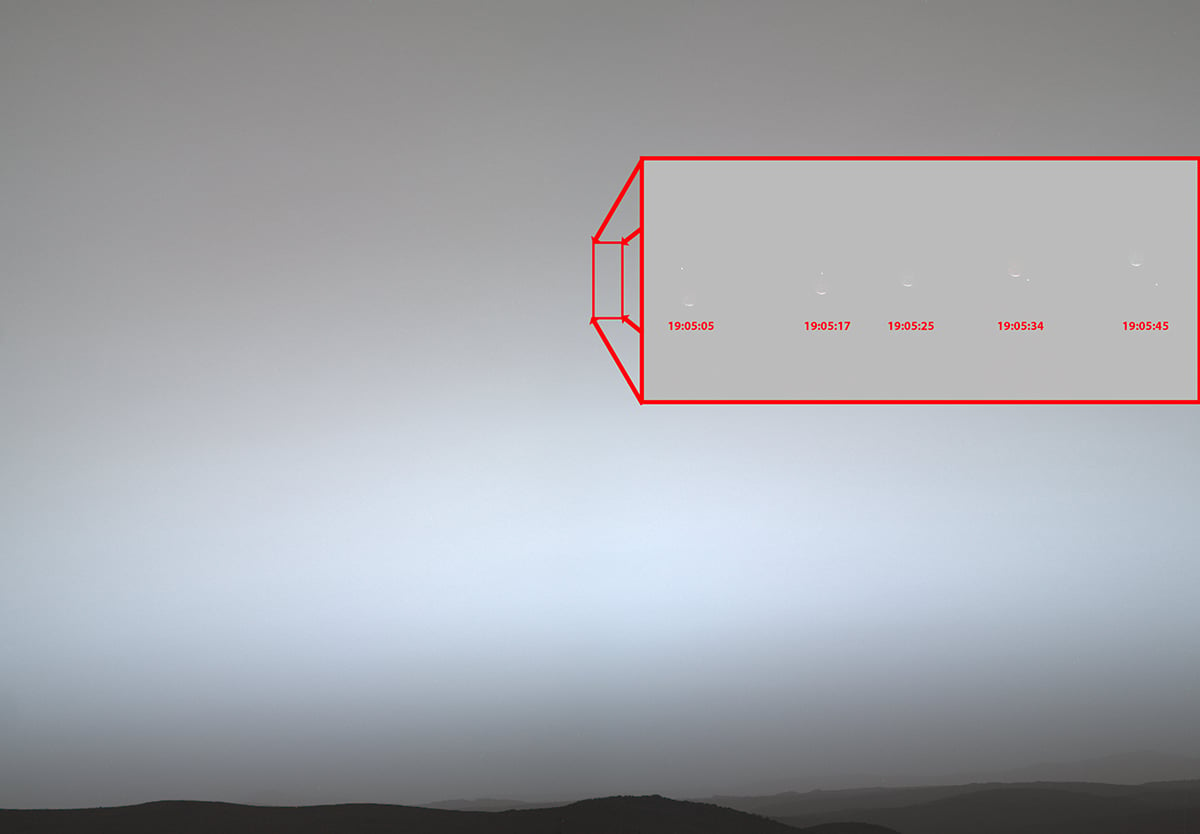
Earth appears as a tiny point of light moving across the images. Phobos crosses the same field in the opposite direction and briefly blocks the planet from view. NASA has released the sequence as a composite showing the occultation from the surface of Mars. The observation took place about 40 minutes after sunset at Perseverance’s location.
Phobos crosses Earth’s position in the Martian sky
An occultation occurs when one celestial object passes in front of another from the observer’s viewpoint. The two objects can be separated by an enormous distance. Their apparent positions have to overlap. That is what we get to see here.
Phobos was orbiting Mars while Earth remained far beyond the Red Planet. Perseverance saw both bodies in nearly the same direction for a short period. As Phobos moved across the sky, its apparent position caught up with Earth and covered it.
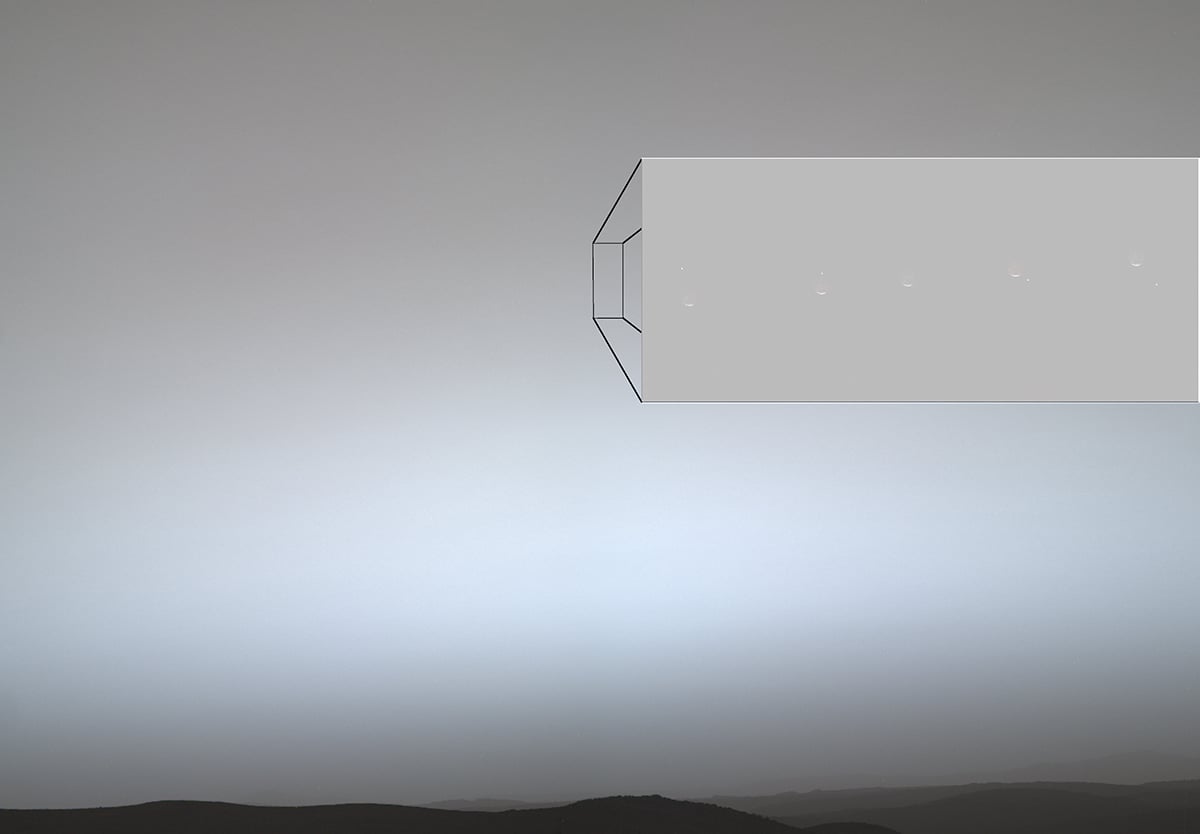
NASA’s images show the motion of the two objects in the Martian sky. Earth moves from the upper left towards the lower right. Phobos travels from the lower left towards the upper right. The five frames covering the occultation were taken within a short interval, so the movement of Phobos is easy to see.
The alignment would have looked different from another point on Mars. An observer several hundred kilometres away could have seen Phobos pass beside Earth instead of across it. The exact location of Perseverance inside Jezero Crater was part of the calculation when the observation was planned.
Distant Earth becomes a point of light
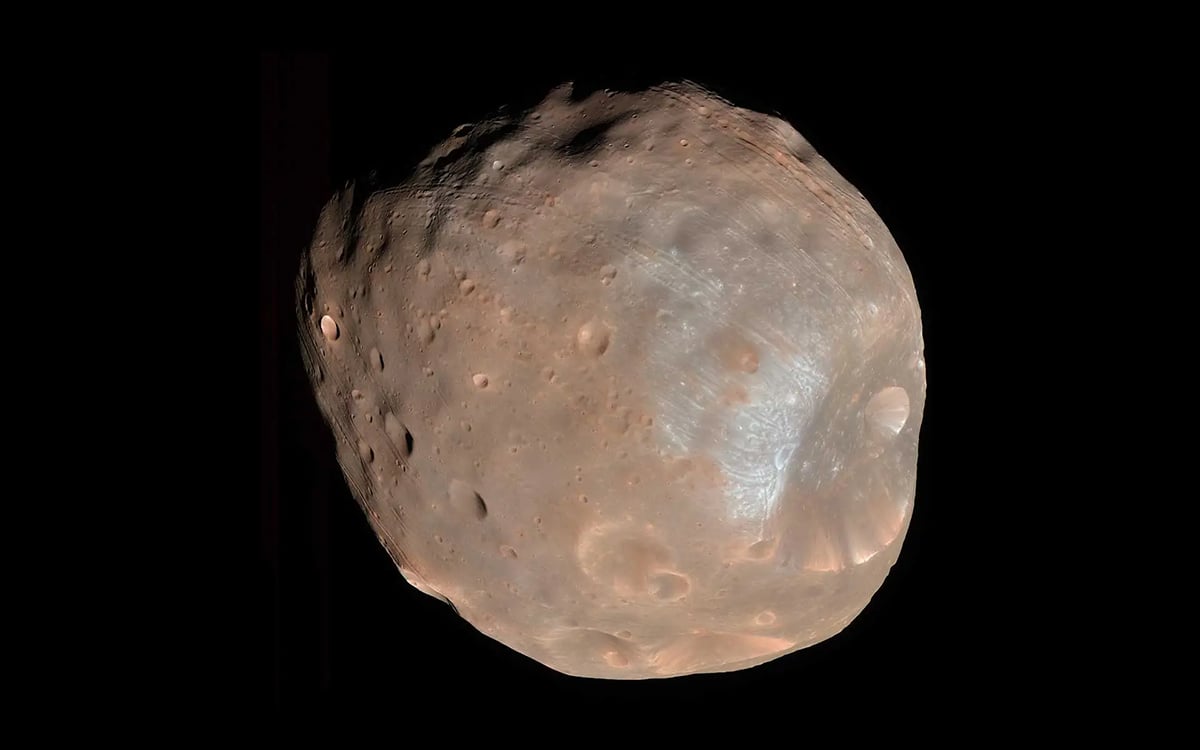
The physical sizes of the two bodies are very different. Earth is about 12,742 kilometers across. Phobos measures only about 27 by 22 by 18 kilometers. But Phobos looked much larger in the Mastcam-Z images. The reason is distance. Phobos was only thousands of kilometers from Perseverance. Earth was 314 million kilometers away. Angular size depends on both the physical size of an object and its distance from the observer.
Phobos is also unusually large in the Martian sky for such a small moon. NASA estimates that it appears about one-third as wide as Earth’s Moon appears from our planet. Its close orbit gives it a rapid apparent motion as it crosses the sky. The moon completes an orbit around Mars in less than eight hours. It can rise and set several times during a single Martian day.
Earth changes position much more slowly from the Martian surface. Its apparent movement comes from the changing positions of Earth and Mars as they travel around the Sun. During the few seconds covered by the occultation sequence, Phobos accounts for most of the visible movement.
The camera behind the image: Mastcam-Z
Perseverance recorded the occultation with Mastcam-Z, the rover’s pair of zoomable cameras. The instrument sits atop the rover’s mast and provides detailed views of rocks, sediment, and distant terrain around Jezero Crater.
Mastcam-Z has two cameras separated by about 24 centimeters. Their slightly different viewpoints allow the team to produce stereo images. The cameras can also zoom and focus on distant targets. NASA and the Mastcam-Z team have used the system for way more than landscape photography. The cameras have photographed the Sun, Phobos, and Deimos and have recorded Phobos crossing the solar disk.
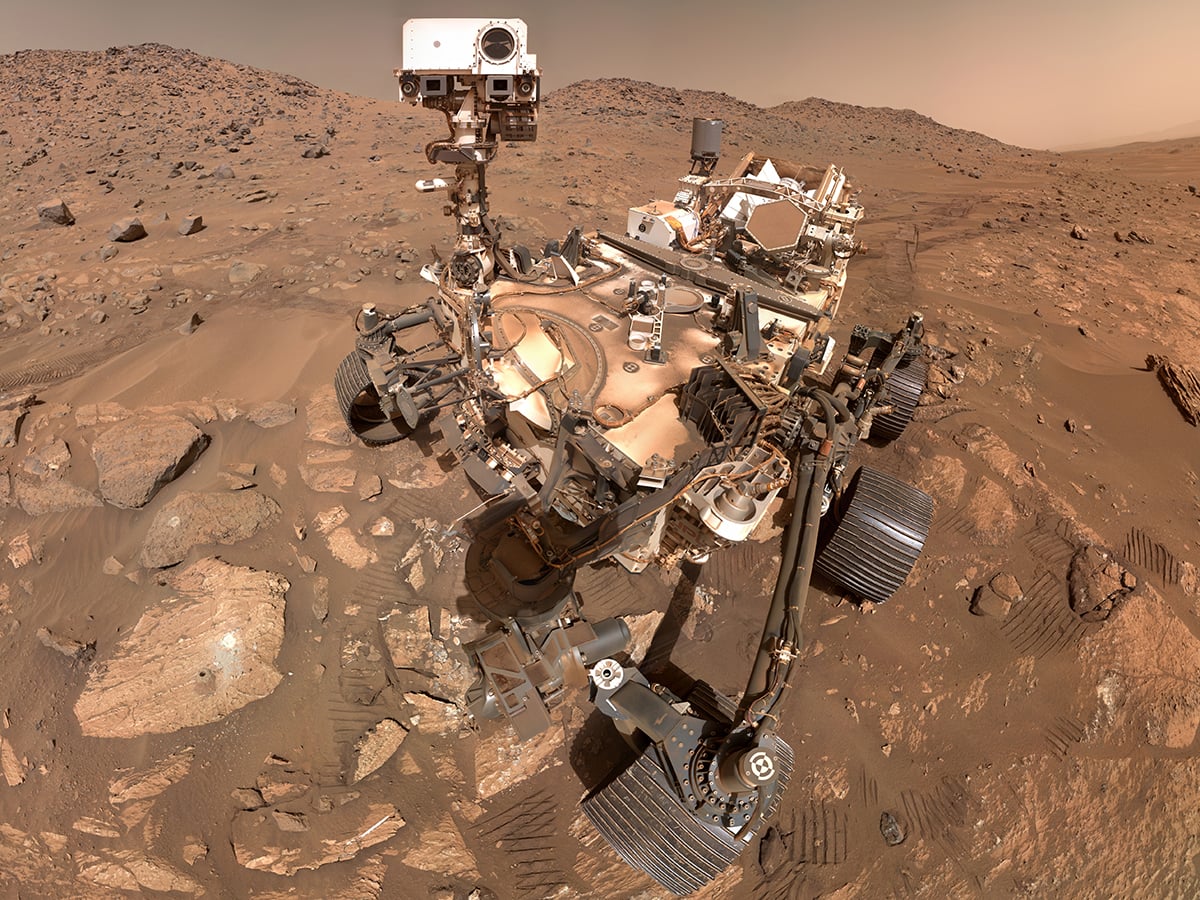
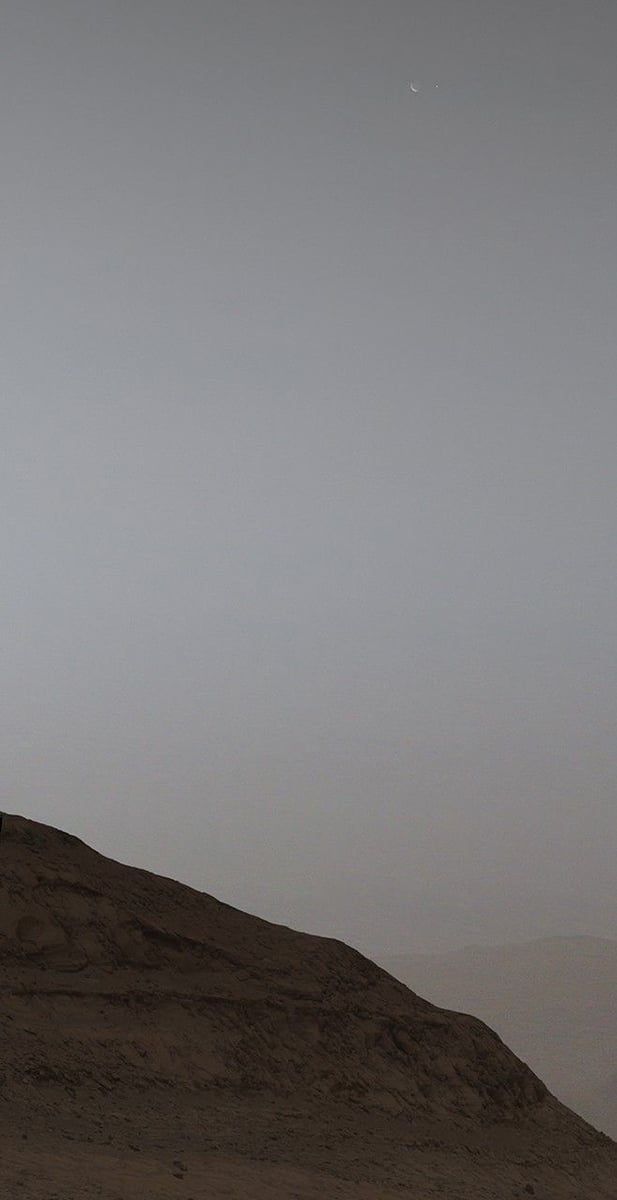
Perseverance photographed the occultation roughly 40 minutes after sunset. The Sun was below the local horizon, but its light was still scattering through the Martian atmosphere. The released composite does not retain that full background. The final image was processed to remove extraneous light and improve the visibility of Earth and Phobos.
Clear skies!
See more from DIYPhotography.net on Google
Add DIYPhotography.net as a trusted source. This makes
our stories more likely to appear in your Google Search results.
 Add as a preferred source on Google

Soumyadeep Mukherjee
Soumyadeep Mukherjee is an award-winning astrophotographer from India. He has a doctorate degree in Linguistics. His work extends to the sub-genres of nightscape, deep sky, solar, lunar and optical phenomenon photography. He is also a photography educator and has conducted numerous workshops. His works have appeared in over 40 books & magazines including Astronomy, BBC Sky at Night, Sky & Telescope among others, and in various websites including National Geographic, NASA, Forbes. He was the first Indian to win “Astronomy Photographer of the Year” award in a major category.
Related Posts
 Solar Eclipse on Mars: Perseverance Captures Phobos Crossing the Sun
 NASA’s Perseverance rover captures video of 1.2 miles tall dust devil on Mars
 Photographer captures the ISS passing in front of the Sun in this stunning image
 A Faint Smudge from Mars: Did Perseverance Really Capture Interstellar Comet 3I/ATLAS?
Join the Discussion
DIYP Comment Policy
Be nice, be on-topic, no personal information or flames.