




















This Image of Mars was Captured from a Distance of 5 million Kms
May 11, 2026
Soumyadeep Mukherjee
Soumyadeep Mukherjee is an award-winning astrophotographer from India. He has a doctorate degree in Linguistics. His work extends to the sub-genres of nightscape, deep sky, solar, lunar and optical phenomenon photography. He is also a photography educator and has conducted numerous workshops. His works have appeared in over 40 books & magazines including Astronomy, BBC Sky at Night, Sky & Telescope among others, and in various websites including National Geographic, NASA, Forbes. He was the first Indian to win “Astronomy Photographer of the Year” award in a major category.
Share:
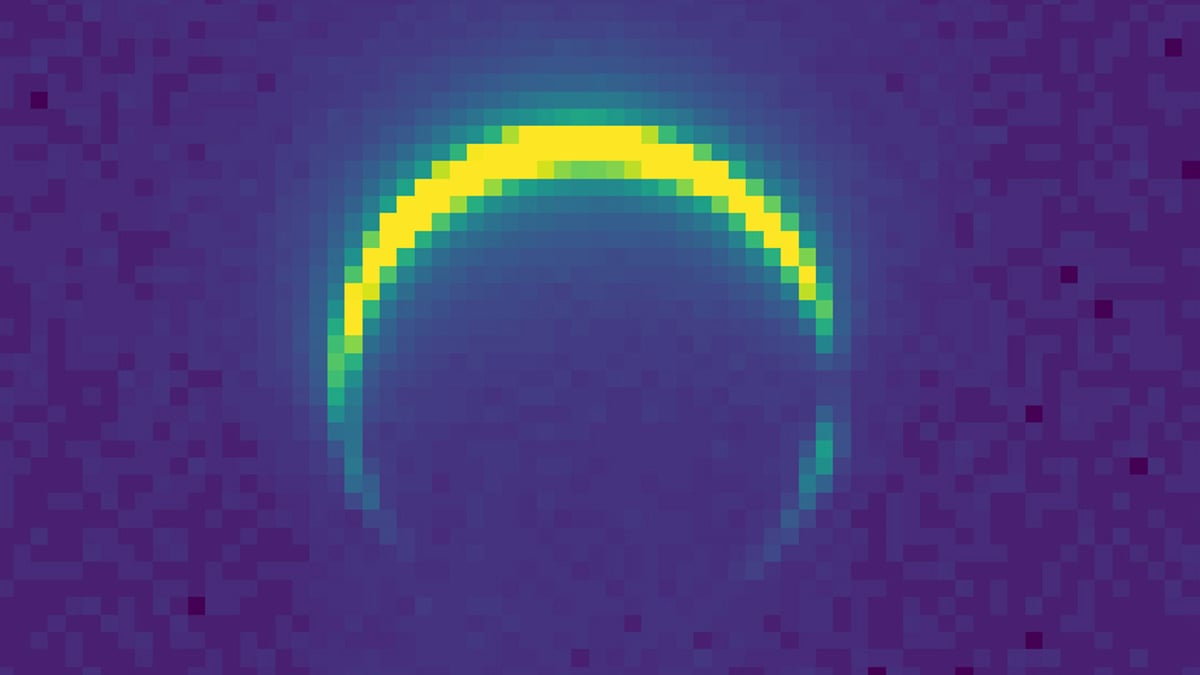
NASA’s Psyche spacecraft has recorded an unusual view of Mars while approaching the planet for a major gravity assist maneuver. The image, captured on May 3, 2026, shows Mars as a thin illuminated crescent surrounded by a faint atmospheric glow. Psyche acquired the observation from nearly 4.8 million kilometers away using its onboard multispectral imager.
The geometry of the encounter placed the spacecraft at a high phase angle relative to Mars and the Sun. As a result, sunlight illuminated only a narrow section of the planet’s disk while the rest remained in darkness. The observation arrived days before Psyche’s closest approach to Mars on May 15. During the flyby, the spacecraft will pass roughly 4,500 kilometers above the Martian surface. The maneuver will use the planet’s gravity to reshape the spacecraft’s trajectory and increase its heliocentric velocity.
A high-phase observation: Mars in an unusual form
Most spacecraft images show Mars as a partially illuminated disk or a fully sunlit globe. Psyche’s recent observation looks very different because of the spacecraft’s viewing geometry during approach. The spacecraft observed Mars from a steep angle relative to incoming sunlight. Consequently, only a small portion of the atmosphere and surface reflected sunlight toward the camera.
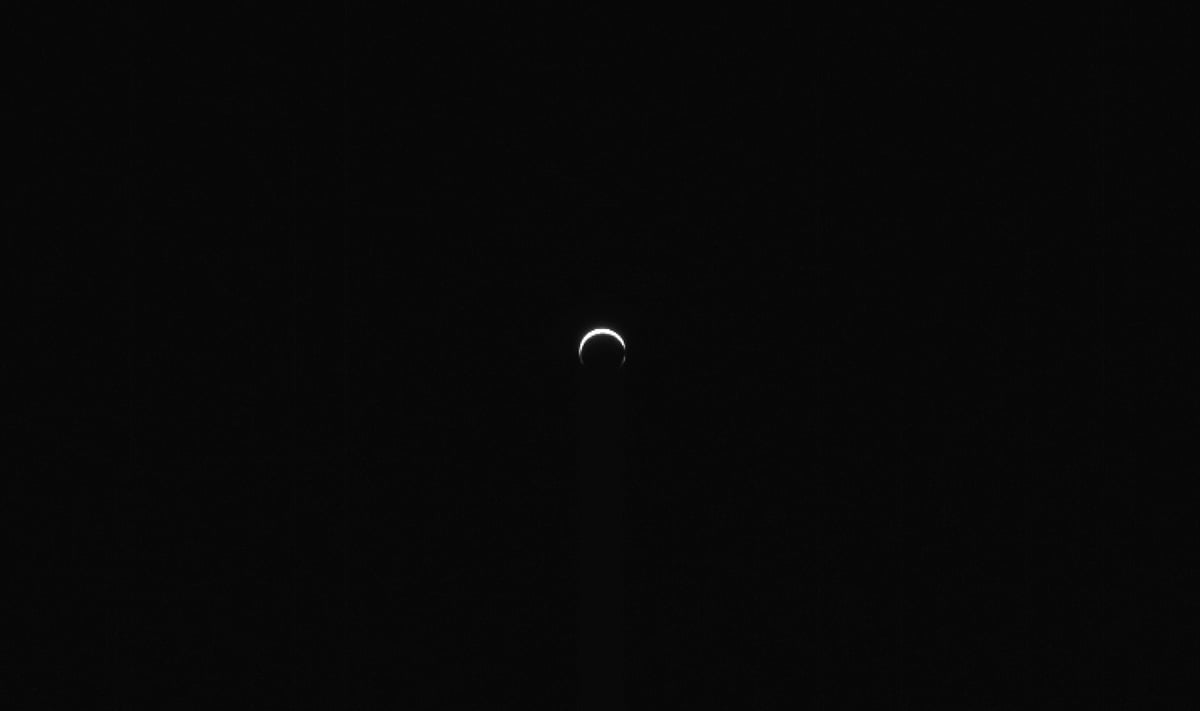
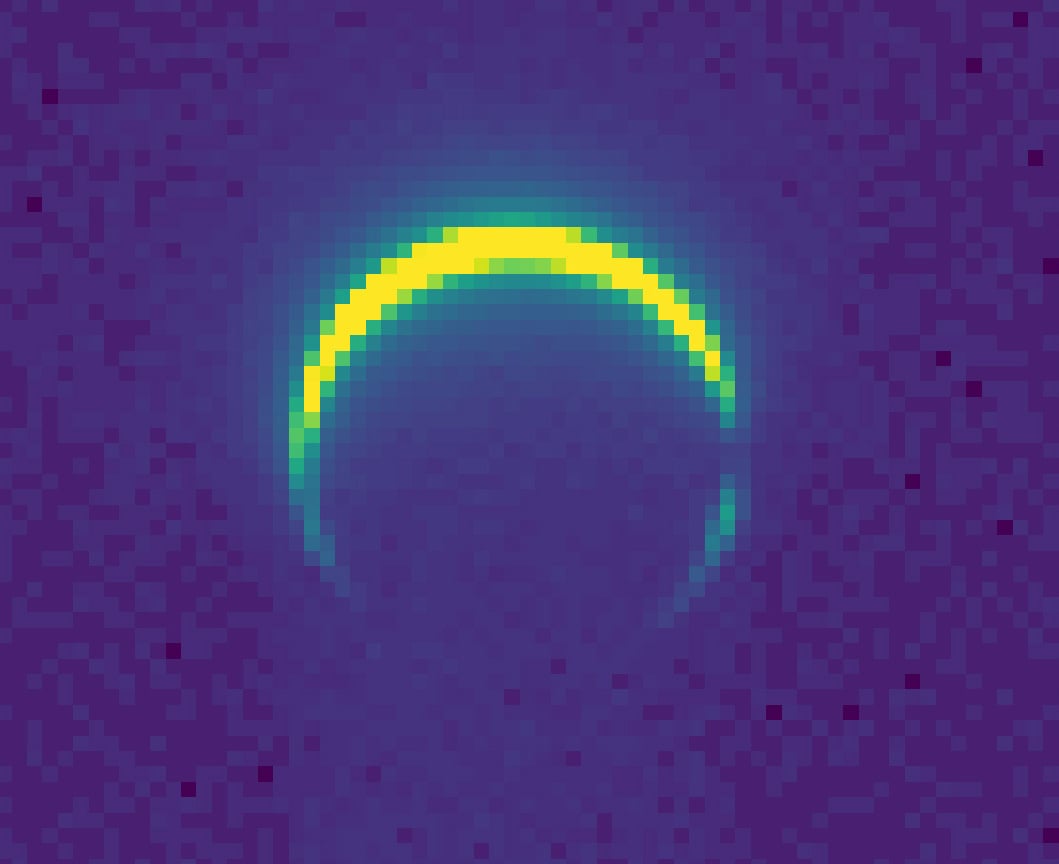
The image reveals a bright crescent extending along the edge of the planet. A diffuse glow also surrounds parts of the visible limb. According to NASA scientists, suspended dust particles in the Martian atmosphere scattered sunlight and produced the extended luminous arc visible in the final processed image. Mars frequently experiences atmospheric dust activity, ranging from local storms to planet-wide events. Even under relatively calm conditions, fine dust remains suspended in the atmosphere and strongly affects how sunlight propagates through the atmosphere.
Researchers also identified an interruption in the crescent near the northern polar region. Mission scientists suspect that winter clouds or atmospheric hazes near the polar cap blocked part of the scattered light. That interruption created a visible gap within the otherwise continuous atmospheric arc. The feature highlights how sensitive high-phase observations can be to atmospheric structure and seasonal weather patterns.
The Mars flyby: Redirecting the spacecraft toward the asteroid belt
The upcoming flyby represents one of the most critical phases of the Psyche mission. NASA planned the maneuver because the spacecraft requires additional energy and orbital adjustment to reach asteroid 16 Psyche efficiently. Instead of carrying enough propellant to perform the entire maneuver independently, Psyche will use Mars itself to alter the spacecraft’s trajectory.
Psyche will pass Mars at nearly 19,848 kilometers per hour during closest approach. The planet’s gravity will bend the spacecraft’s path and modify its orbital inclination relative to the plane of the Solar System.
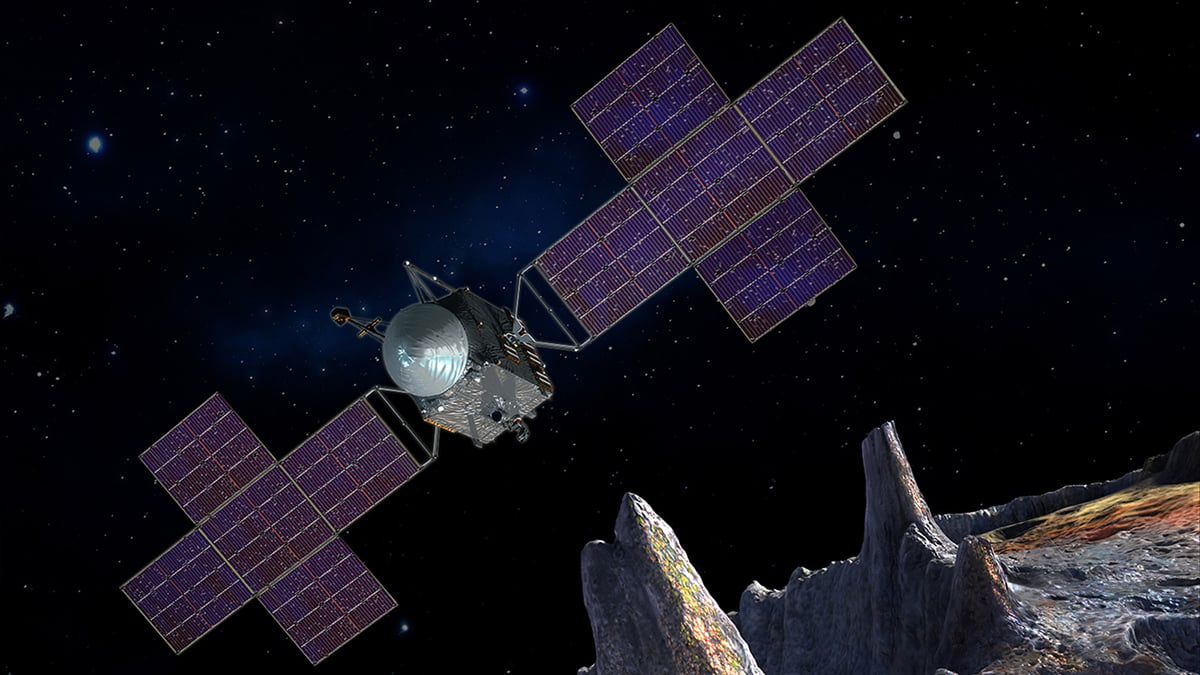
The maneuver will also help conserve xenon propellant used by the spacecraft’s Hall-effect thrusters. Electric propulsion systems operate efficiently over long durations, but interplanetary missions still face strict propellant limitations. Every kilogram saved during cruise operations increases operational flexibility later in the mission.
Asteroid Psyche: Clues About Planetary Cores
NASA launched the Psyche spacecraft in October 2023 aboard a Falcon Heavy rocket. The mission forms part of NASA’s Discovery Program, which supports lower-cost planetary science missions focused on high scientific return. Unlike previous asteroid missions that targeted rocky or carbon-rich bodies, Psyche aims for a metallic object that may preserve evidence from the earliest stages of planetary formation.
Asteroid 16 Psyche orbits within the main asteroid belt between Mars and Jupiter. Astronomers discovered the object in 1852, yet its composition remained uncertain for decades. Radar observations and spectral measurements later suggested unusually high metal content compared with many other asteroids.
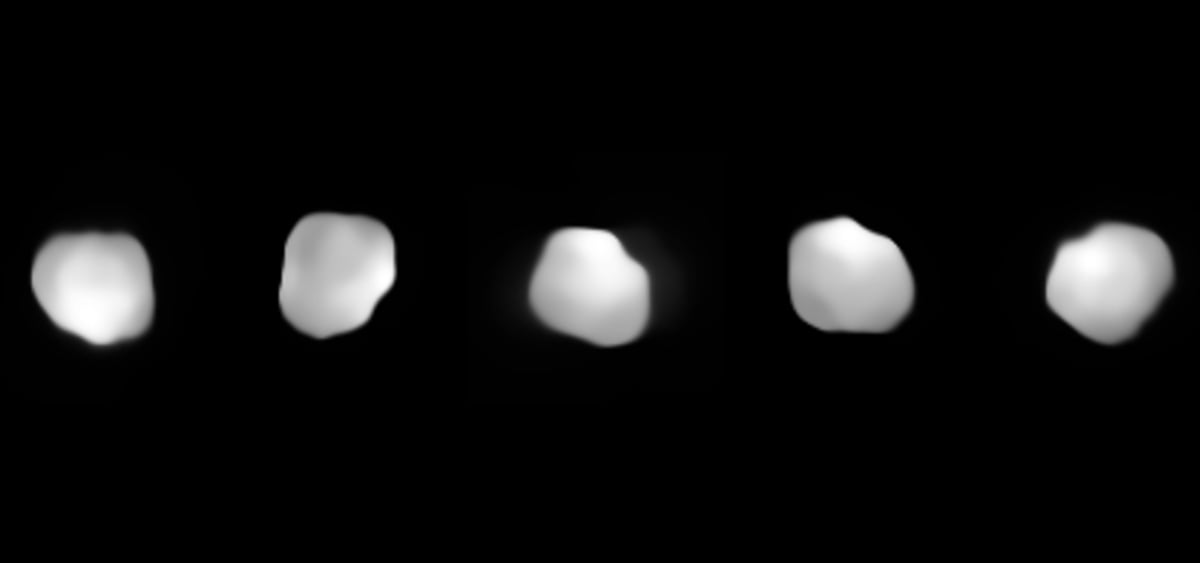
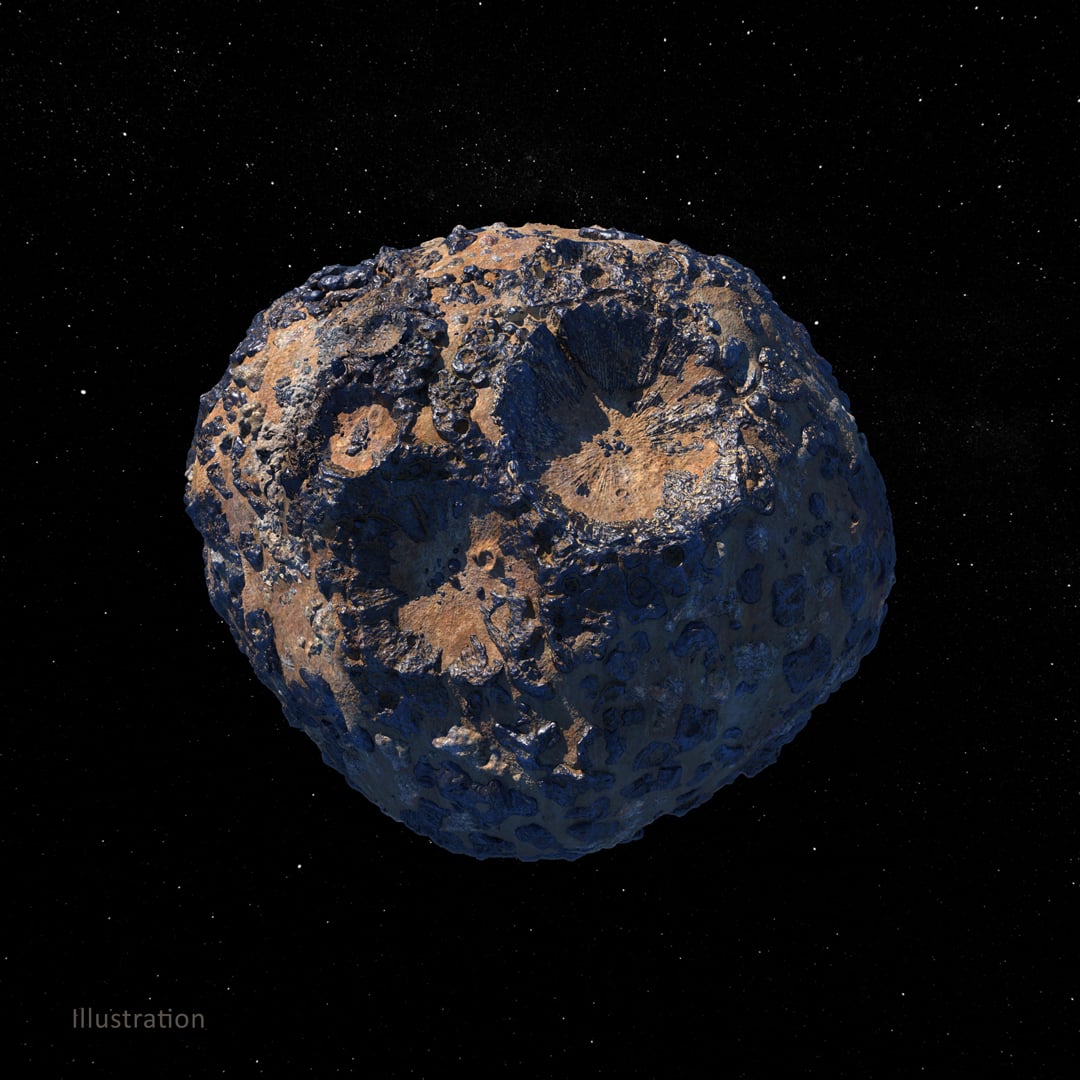
Scientists believe Psyche may contain large amounts of iron and nickel. One leading hypothesis proposes that the asteroid represents the exposed core of an ancient protoplanet destroyed during violent collisions early in Solar System history.
If asteroid Psyche truly represents a remnant planetary core, the mission could provide an unprecedented opportunity to study material similar to the deep interiors of terrestrial planets. Researchers cannot observe Earth’s metallic core directly because it lies thousands of kilometers beneath the crust and mantle. Psyche may offer a natural sample of that inaccessible region.
After arriving in 2029, the spacecraft will orbit the asteroid for approximately 21 months. During that period, the mission will map surface composition, measure gravity variations, search for remnant magnetism, and investigate surface geology. Together, those observations may reshape current ideas about how rocky planets formed during the Solar System’s earliest epoch.
Clear skies!
See more from DIYPhotography.net on Google
Add DIYPhotography.net as a trusted source. This makes
our stories more likely to appear in your Google Search results.
 Add as a preferred source on Google

Soumyadeep Mukherjee
Soumyadeep Mukherjee is an award-winning astrophotographer from India. He has a doctorate degree in Linguistics. His work extends to the sub-genres of nightscape, deep sky, solar, lunar and optical phenomenon photography. He is also a photography educator and has conducted numerous workshops. His works have appeared in over 40 books & magazines including Astronomy, BBC Sky at Night, Sky & Telescope among others, and in various websites including National Geographic, NASA, Forbes. He was the first Indian to win “Astronomy Photographer of the Year” award in a major category.


Join the Discussion
DIYP Comment Policy
Be nice, be on-topic, no personal information or flames.
One response to “This Image of Mars was Captured from a Distance of 5 million Kms”
“Really informative article and very easy to understand. The content was explained clearly and shared some useful insights. Thanks for sharing such valuable information, looking forward to reading more posts like this.”