




















Users are unhappy with the Canon R5mkII low light performance
Dec 9, 2024
Alex Baker
Alex Baker is a portrait and lifestyle driven photographer based in Valencia, Spain. She works on a range of projects from commercial to fine art and has had work featured in publications such as The Daily Mail, Conde Nast Traveller and El Mundo, and has exhibited work across Europe
Share:

Canon photographers had been eagerly awaiting the launch of the latest mirrorless body update, the EOS R5 Mark II. The Mark I was four years old already, and many photographers had been saving up to get the latest and greatest camera that Canon makes.
After the official sponsored reviews, we are now seeing real-world, everyday photographers who have used this camera for around a month, and the opinions are surprising and somewhat divided. Whilst many are extremely happy with the R5mkII’s performance, I have noticed a definite cohort of disappointed photographers commenting in forums or YouTube videos.
Newer, faster, better?
The original EOS R5 (touted as the mirrorless version of the popular EOS 5D series) did have some issues. These included a penchant for overheating when videoing for any length of time, throwing out random error codes willy-nilly, freezing in inopportune moments, and generally being a bit buggy and unreliable. So, I can understand why many R5 users were excited to hear about an update.
The R5 Mark II didn’t have many improved specs over the R5, however. Most notable were the promise of fixes to the overheating issues and the ability to record 8K Raw video at 60fps (only useful if shooting VR 180). At a price point of $4299 at the time of writing, you’d hope for a solid and reliable camera suitable for professional use.
Bear in mind that many of the photographers buying this camera body are professionals working in studios or as wedding photographers. They cannot afford to have a camera freeze or fail on them.
Photographers disappointed
I first noticed some of these disgruntled posts a couple of weeks ago when I was researching Canon camera bodies after a mishap with my EOS R. I had to buy a new one, and I was trying to decide between an R6 mark II, a secondhand R5, and a new R5 mark II. I quickly discounted the older R5, knowing that investing in newer technology is often a good plan if you can afford it. Those 45 megapixels and the ability to shoot VR 180 were tempting me towards the R5 mark II. However, the cost was definitely a deterrent.
At first, I noticed a few comparison videos between the original R5 and the R5mkII. “Everything is awesome,” people said until they started pushing up the ISO. And I’m not talking to excessive levels, either. It seems as though the R5mkII was losing quality from around ISO 1600 and upwards.
Now, one thing I loved about the R was its low noise at relatively high ISOs. I shoot concerts and events fairly frequently and also dabble in some night sky photography for fun, so low-light quality is important to me. Obviously, my ears pricked up, and I decided to investigate more.
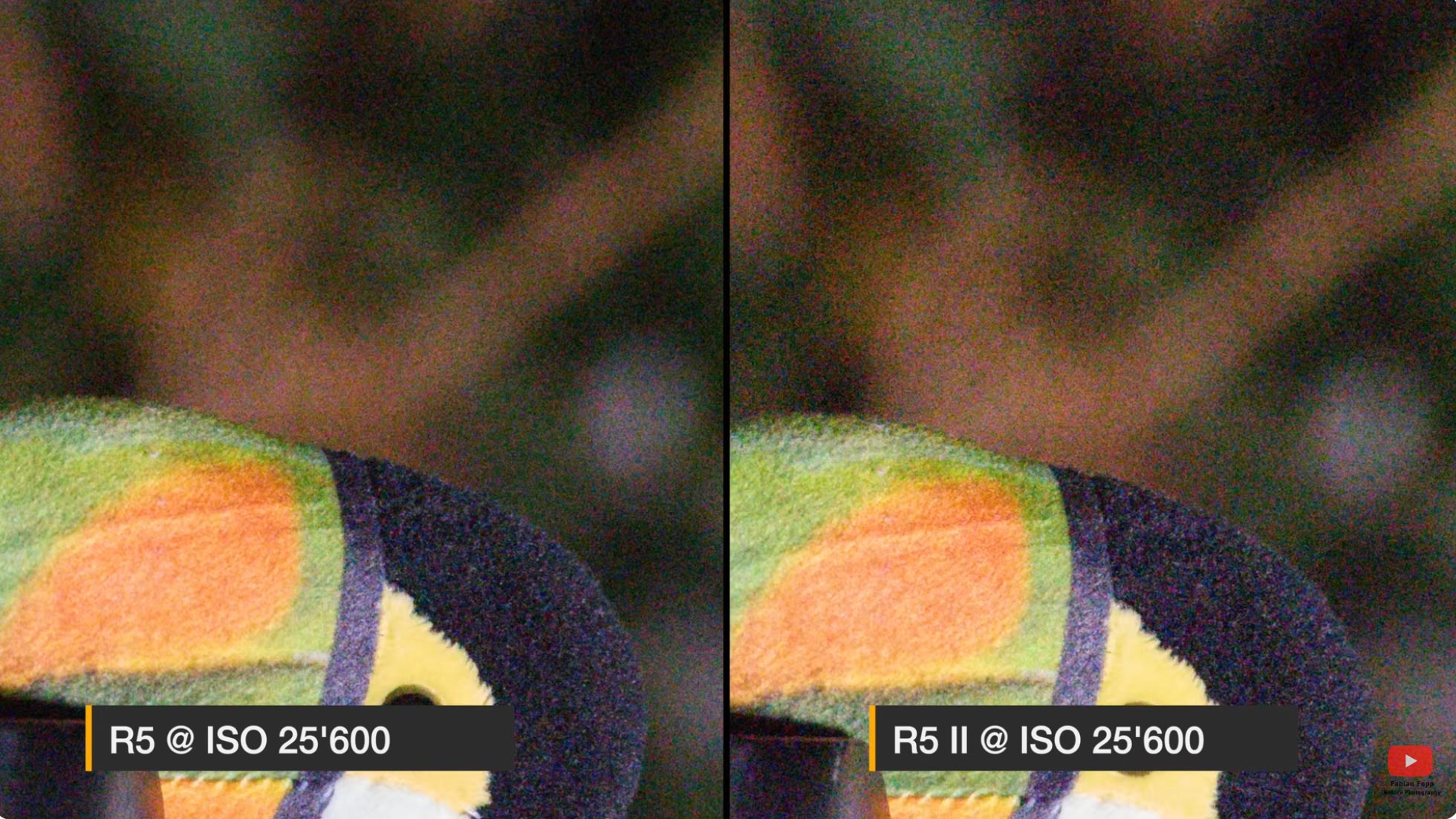
In this video, nature photographer Fabian Fopp did a test between the two camera bodies and noticed that there was a marked difference in noise levels at high ISOs (especially around the 25,000 level). The images were the same with both the electronic shutter and the mechanical shutter.
Ken Rockwell’s high ISO tests seem to agree with this, showing considerable issues with noise from around the ISO 25,600 as well. Compared with his previous tests of the EOS R5, the comparison is quite marked between the two camera bodies, with the R5mkII having far worse noise at high ISOs. Admittedly Rockwell shoots jpegs so that does need to be taken into account.
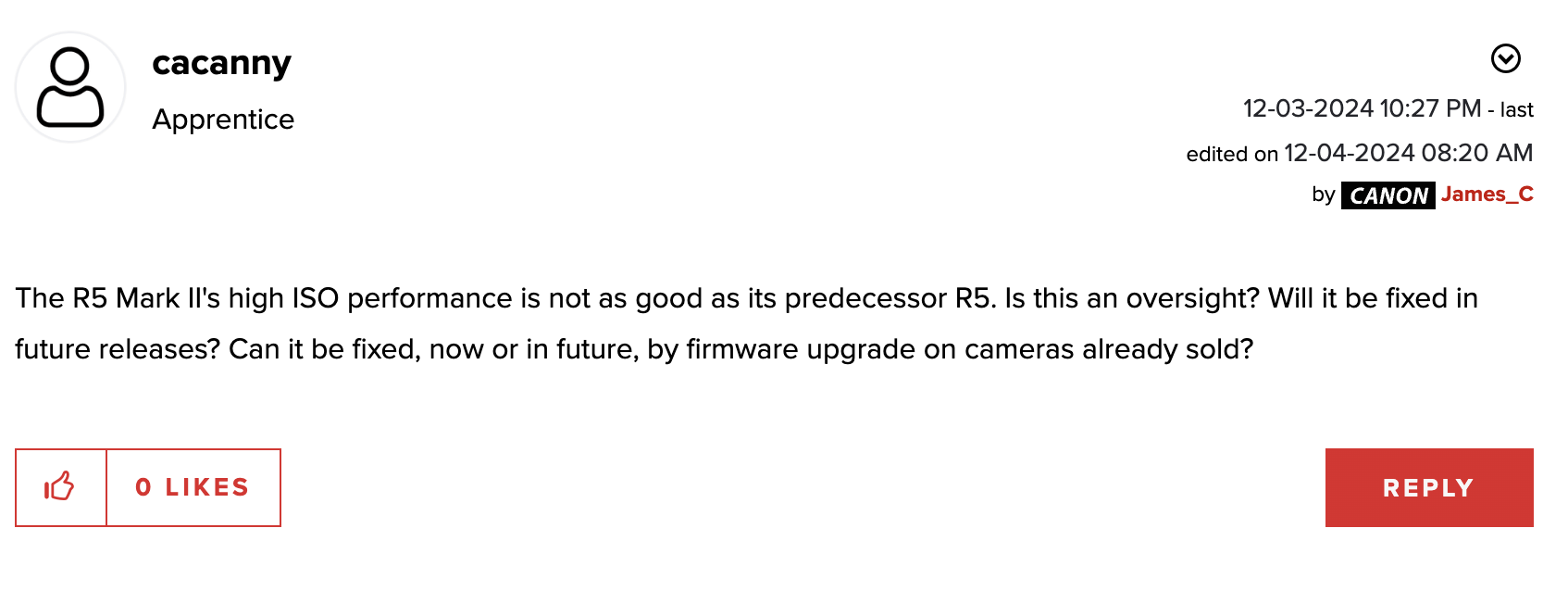
Once looking around camera forums and on subreddits, I began to find more posts corroborating these opinions about poor handling of low light.
Megapixels and low light explained
Now, you may be wondering who actually shoots at these high ISOs, but occasionally it is necessary. I do remember, on occasion, shooting at 25,000 ISO or close to there. However, I cannot imagine being in any situation (other than a stakeout) where I’d ever need an ISO as high as 102,400 and still expect to use the image for anything.
So why would the newer R5 mark II be worse in quality than the R5 (at least at high ISOs)? Well, it’s a little confusing because this camera uses a newer stacked sensor, the same one used in the EOS R3. This new sensor type is helpful in eliminating the rolling shutter effect that can occur with the older style sensors. This is particularly visible when panning sideways shooting video and can result in warped verticle lines (quite annoying and nearly impossible to correct in post). However, Canon also says that it should help eliminate noise when shooting in low light. Apparently, then, that’s not the case.
It seems that perhaps Canon has improved its video game at the sacrifice of its still photography users? Perhaps, and yet the R5 and R5mkII are very much marketed at still photographers who shoot some video. For true hybrid shooters the R5 C is still a better choice in my opinion (although that body lacks and in body stability).
Additionally, there’s a thought that higher megapixel sensors can actually result in lower quality low light sensitivity than lower megapixel sensors of the same size. This is in fact, a myth and has been debunked. So the 45 megapixel count of the R5 mark II has no effect on it’s low light caperbilities. Especially as the R5 is also a 45mp camera, it makes no sense that this is the reason.
These might be a better fit if you’re buying a Canon camera
Don’t get me wrong, I love shooting Canon (check out our guide to Canon’s best cameras), and I’m not about to trade in my lenses and jump ship anytime soon. I’ve also spoken directly to one photographer friend who shoots portraits mostly in studio with strobes, and she is absolutely delighted with the R5mkII. But then she’s not really shooting at high ISOs.
For nature photographers, sports photographers, event and concert photographers, and anyone who shoots a lot in low and challenging lighting conditions, you may want to hold off upgrading to the R5mkII just yet. It’s quite possible that this is a bug common with early rollouts, and a firmware update may well fix this issue over the coming months.
However, if you’re like me, and don’t need 45mp and want to save some serious cash, other options do exist. I’m very happy with my R6mkII, for example. It’s perfect for my everyday shooting needs, and if I need anything more, I am happy to rent.
Once again, before you splash out on the latest camera body, have a long think about your current and near-future needs. One thing is for sure: there will always be a newer camera body right around the corner. The real question to ask yourself is: do you actually need it?
We have reached out to Canon and will update this post when they respond.
See more from DIYPhotography.net on Google
Add DIYPhotography.net as a trusted source. This makes
our stories more likely to appear in your Google Search results.
 Add as a preferred source on Google

Alex Baker
Alex Baker is a portrait and lifestyle driven photographer based in Valencia, Spain. She works on a range of projects from commercial to fine art and has had work featured in publications such as The Daily Mail, Conde Nast Traveller and El Mundo, and has exhibited work across Europe
Related Posts
 Mythbusting: Megapixels don’t matter – fewer doesn’t mean better low light performance
 The next mirrorless medium format cameras may have 100MP sensors and great low light performance
 Adobe employees unhappy with company response to AI drama
 This hands-on review looks at Canon 1DX Mark III performance in real world use to shoot NFL
Join the Discussion
DIYP Comment Policy
Be nice, be on-topic, no personal information or flames.
7 responses to “Users are unhappy with the Canon R5mkII low light performance”
Certainly I can’t agree more that the R5M2 low light ISO above 12800 is unusable. I brought it for my trip and in the end, I used my R7 and the R5M2 take a back seat of acting as a spare body.
I’ve never paid any camera body at RRP price in all my past purchase. But the bell and whistle of the R5M2 plus my trip was just round the corner post the launch makes me rushed out to get it.
What make it worst that the camera even have issues recording shots SDXH V60 card. Using the V60 card, there will be random image corruption. What make it worst was that some was not even on high speed continuous shoot mode. I’ve share it here; https://community.usa.canon.com/t5/EOS-DSLR-Mirrorless-Cameras/EOS-R5-Mark-II-issues-with-colors-and-corrupted-images/m-p/517522/emcs_t/S2h8ZW1haWx8dG9waWNfc3Vic2NyaXB0aW9ufE00SEtMWUdCR0MyVU0yfDUxNzUyMnxTVUJTQ1JJUFRJT05TfGhL#M126549.
“However, I cannot imagine being in any situation (other than a stakeout) where I’d ever need an ISO as high as 102,400 and still expect to use the image for anything.”
I think that statement ignores the fact that images are quite usable after downsampling from 45 mp, which tends to eliminate noise. Yeah, it’s technically a waste of the high-res sensor. That’s a different issue than having a “usable image” IMO.
It’s not even the low light performance at issue. In my opinion the R5M2 is excessively and inconsistently noisy at all ISOs in all lighting. I’m saying that because for a brand new just released camera, it should be the best full frame out there noisewise. In reality it barely keeps up with or is worse than 4 year old cameras using older tech. I have no issues with anything else on the camera. Just the sensor noise. I doubt there’s a fix. Very disappointing.
Really? Jpeg noise performance is no measure of a cameras low light capabilities. This is just clickbait.
I love my EOSR but it lacks some features that I want in the EOSR 5MRKII. I was 90% sure that I was going to buy the markII, now I’m 60% sure. I photograph in every lighting conditions that there are. The EOSR does well in low light but if the EOSR5 MRKII is not up to snuff in that department, then I guess I’m back to research.
I’ve been using my first gen R6 since they were released and from time to time I consider upgrading for more megapixels (I had a 5D Mark IV previously and print pretty large so I find 30+ MP is good for a photographer like me). The problem is nothing, and I mean nothing, that I have tried has been close to my R6 for high ISO performance. You may not shoot at 102k ISO but I do. Not often, but it’s happened on occasion when I needed to freeze action in very dark locales. The high ISO on the R6 is mind blowing and I worry I won’t be able to find anything to replace it when it finally dies!
Unfortunately, this is what happens when amateur hobbyists purchase the latest and greatest pro cameras. They do “test shots” of their toe at 102k ISO and then claim the camera has bad high ISO performance. This then spreads all over the internet. It’s never shots from a train trip in India where you’re hanging out the window at dawn during a monsoon. When the shot is meaningful, getting the picture is what matters. It could be on your iPhone 8 or your Phase One.
While, yes, I can see differences between the R5 II and old R5 when blown up on a computer screen, there are literally no differences in print or at regular viewing distances.