











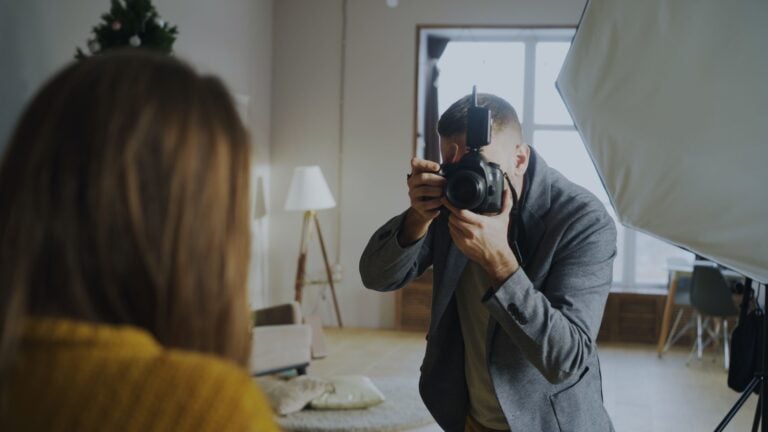





Tips and tricks for building a DIY home studio on a budget
Oct 11, 2016
John Aldred
John Aldred is a photographer with over 25 years of experience in the portrait and commercial worlds. He is based in Scotland and has been an early adopter – and occasional beta tester – of almost every digital imaging technology in that time. As well as his creative visual work, John uses 3D printing, electronics and programming to create his own photography and filmmaking tools and consults for a number of brands across the industry.
Share:

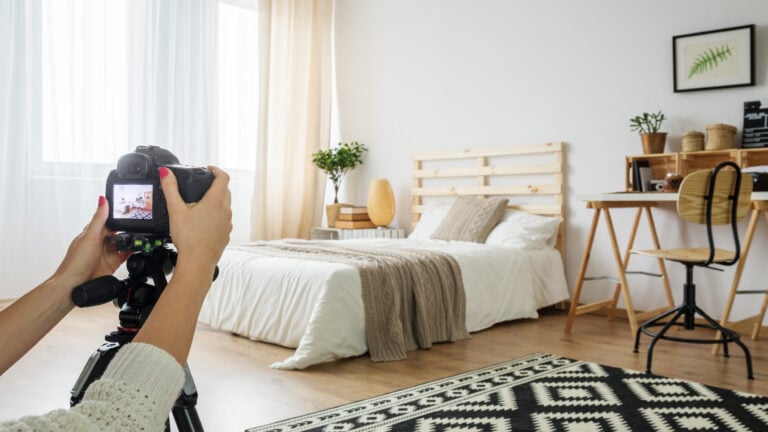
Building a studio in your home is the dream for many photographers. Assuming you can convince the rest of your family it’s a good idea, it can even become a reality. For those just getting into studio photography, building a home studio may be an afterthought to a home you already own. You may be very limited on space, so how can you make the most of it?
In this video, photographer Joe Edelman walks us through his home studio. While many of us might not be able to dedicate the space that Joe has, there’s always ways to make things feel bigger than they are. Joe shows us some of his space saving tips, as well as props and tools which serve multiple functions. No matter how large or small your studio, there are always ways to optimise your space and workflow.
It’s not a short quick tip video. It goes on for about fourteen and a half minutes, but it’s well worth watching through it all.
- 0:38 – Planning and preparing. Figuring out your needs.
- 1:43 – The makeup area
- 2:11 – Storage space and changing room
- 4:50 – Main shooting area
- 6:27 – Wall mounted lights
- 7:05 – Background storage
- 8:12 – Track system for hanging lights, reflectors and diffusers
- 11:52 – The Box
The first step is coming up with some kind of a plan. It’s a lot easier to figure out where everything’s going to go if you don’t try to just wing it. Knowing how much space you need for your shooting area and how much total space you have lets you arrange everything else much more easily.

The key areas Joe requires are for shooting, makeup, storage with a small changing room. And when he says small, he isn’t kidding. A few years ago I was working at a studio that had over 3,000 square feet of floor space, and a dressing room the size of a closet. I always wondered why it was so small, but listening to Joe’s explanation of why his is the size it is makes a whole lot of sense.
All of us want to look our best before we go in front of the camera. But, there’s no point wasting time in the changing room in front of a mirror straightening our clothes and fixing our hair if we’re going to go right into the MUA or hair stylist’s chair for the next half an hour. It’ll all have to be fixed again afterwards anyway. So, the changing room is small, and sparse, with no mirrors to speed up outfit changes.

Joe’s makeup area is a little larger than most I’ve seen. Even in a lot of commercial studios I’ve hired, the makeup area has basically been a table off to the side of the main shooting area. But, Joe’s makeup area serves a dual purpose, and also serves as an extension of the main shooting area.

Speaking of the shooting area, Joe’s is 23x12ft (7×3.6m) with a ceiling height a hair below 8ft (2.4m). It’s not a huge shooting area, and the ceilings are relatively low, but it’s still a very respectable space. You’ll see in the spin around the studio below, that mane of the lights are affixed to the ceiling and walls to help eliminate the need for light stands.

Getting rid of light stands and boom arms gives you a lot more flexibility in a permanent shooting area. It also means they’re not taking up valuable floor space or getting in the way.
Joe also fixed a sliding track where the shooting and makeup areas meet. From this, Joe can suspend lights, diffusers and reflectors for all kinds of different lighting scenarios. It can provide big soft window light, or it can be used to suspend frontal lights, shooting from within the makeup area.
There are plenty of great tips throughout the video, and you may want to watch some parts of it several times to see exactly how everything fits together to maximise the available space. The Box is an especially good idea. I have several units myself that each serve multiple purposes.
Have you built your own studio in your home? What other space saving tips do you have? Will you be implementing some of Joe’s ideas into your home studio? Let us know in the comments.

John Aldred
John Aldred is a photographer with over 25 years of experience in the portrait and commercial worlds. He is based in Scotland and has been an early adopter – and occasional beta tester – of almost every digital imaging technology in that time. As well as his creative visual work, John uses 3D printing, electronics and programming to create his own photography and filmmaking tools and consults for a number of brands across the industry.
Related Posts
 Home Studio Photography: Your Complete Guide To Building A Photography Studio At Home
 Quick DIY Tips To Boost Your Props And Set Building Game While Working On A Budget
 eBook: Your Complete Guide To Building A Photography Studio At Home
 Building my new video home studio to maximise space for multiple cameras
Join the Discussion
DIYP Comment Policy
Be nice, be on-topic, no personal information or flames.
2 responses to “Tips and tricks for building a DIY home studio on a budget”
First and last tip: own a big home.
It’s totally doable. I currently work from home as well. But the main problem for me is ceiling height. At 2.5 m, you simply can’t put a light up there – it’s too close to the subject. There are some tricks to get around that but none of them are perfect. But that’s not the only problematic light angle, raising a standard 45 degree softbox up, so that there’s a shadow under the model’s chin is also a problem. With increased height more and more light will reflect off the ceiling and spill like crazy. In short, there is a lot of problem solving in home studios. Starting next month I’ll be renting a real studio again.