





















Fujifilm GFX ETERNA 55 Cinema Camera Redefines Large-Format Filmmaking
Oct 1, 2025
Alysa Gavilan
Alysa Gavilan has spent years exploring photography through photojournalism and street scenes. She enjoys working with both film and mirrorless cameras, and her fascination with the craft has grown over the decades. Inspired by Vivian Maier, she is drawn to capturing everyday moments that often go unnoticed.
Share:

After months of speculation about the extent of its capabilities, Fujifilm has finally revealed the full details of the GFX ETERNA 55, its first dedicated large-format cinema camera.
The system, positioned squarely at the high end of professional filmmaking, combines a powerful medium-format sensor with flexible recording options and Fujifilm’s well-known color science.
The camera is expected to hit the market in October 2025, priced at $16,499.95. Alongside the camera, Fujifilm is introducing a GF 32-90mm T3.5 power zoom lens to establish its own ecosystem of dedicated cinema tools.
The release marks Fujifilm’s official entry into the high-end motion picture market, expanding its portfolio beyond still photography and hybrid cameras. The company positions ETERNA 55 for use in studios, commercial productions, and big-budget projects rather than casual creators.
This move signals not only its ambition to broaden its reach but also its confidence in competing in a market that has long been dominated by established players.
Large-Format Sensor and Recording Options
Fujifilm’s approach is not simply to pack in more pixels but to maximize how those pixels are used. At the core of the GFX ETERNA 55 is a 102-megapixel, 43.8 x 32.9 mm CMOS II HS sensor, about the same size found in Fujifilm’s GFX100 II. It is one of the largest sensors ever placed in a dedicated cinema body that enables true large-format cinematography for extraordinary detail and depth.
The camera also offers multiple recording formats, including GF open gate 4:3 at 48 frames per second, DCI 8K, anamorphic 8K with 2x squeeze, and Super35mm at 6.3K. This allows filmmakers the freedom to adapt to different productions.

Frame rate support is equally versatile, with up to 60 frames per second at 4K DCI resolution, and up to 120 frames per second in Full HD. These options are paired with a dual base ISO of 800 and 3200, which ensures the camera can perform in both controlled lighting environments and more challenging low-light conditions.
Color Science and Film Simulations
The GFX ETERNA 55 is proof that Fujifilm continues to lean heavily on color science as its strong selling points. The new camera has 20 built-in film simulation modes, including staples like PROVIA, Velvia, ASTIA, and Classic Chrome, as well as multiple ETERNA and Bleach Bypass options.
ACROS and black-and-white simulations are also available, which give filmmakers a diverse palette straight out of the camera.
Fujifilm has added support for up to 16 custom 3D LUTs that can be stored internally, allowing cinematographers to apply and preview looks during shooting, especially for productions that demand more flexibility. This is further complemented by downloadable LUTs for workflows involving F-Log2 or F-Log2 C, ensuring consistency from capture to post-production.
Processing Power and Recording Formats
On the processing side, the Fujifilm GFX ETERNA 55 is powered by the X-Processor 5 engine, which drives a robust selection of internal recording formats. The camera supports Apple ProRes 422 in HQ, standard, and LT variations, HEVC/H.265 10-bit 4:2:2, and lighter H.264 proxy files for easier editing.
While internal RAW recording is not included, which is a feature some professionals may find limiting, the camera does offer 12-bit RAW output over HDMI. This gives access to higher-end workflows with external recorders.
The GFX ETERNA 55 also offers an integrated electronic variable ND filter ranging from ND0.6 to ND2.1 to aid in on-set exposure management. This flexibility reduces the need for external filters and allows smoother control over exposure without altering depth of field or shutter settings.
Body Design and Hardware Features
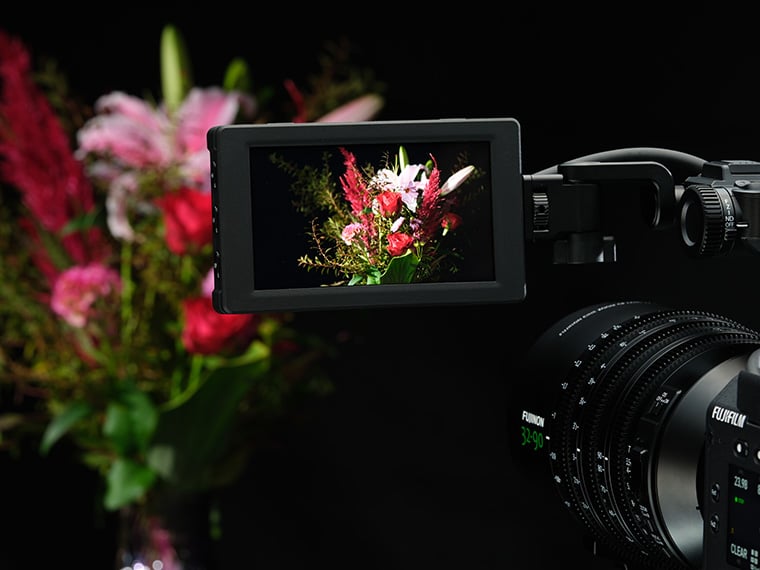
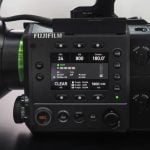
The hardware design of Fujifilm GFX ETERNA 55 emphasizes usability and professional integration. The body weighs approximately two kilograms and is fitted with dual displays. One is a three-inch onboard screen for camera controls and menus, while the other is a five-inch 2000-nit external LCD for high-visibility monitoring even under bright sunlight.
Media recording is handled through dual slots. There is a slot for CFexpress Type B cards suited for demanding high-resolution capture and another for SD cards when lighter formats are best.
Power, meanwhile, is supplied by Fujifilm’s NP-W235 batteries, with the option of external DC input for longer shoots to allow simultaneous power and charging.
New Lens Ecosystem
Fujifilm also introduced a GF 32-90mm T3.5 power zoom lens, as part of building an ecosystem around its cinema line. This lens combines servo-driven zoom with manual rings for aperture, focus, and zoom, giving operators both precise control and motorized convenience.
It features a built-in rocker switch for smooth zooming, making it a flexible option for narrative filmmaking, documentary work, or live productions. This lens is priced at $5,999.95.
A New Era for Fujifilm?
The full unveiling of the GFX ETERNA 55 shows that Fujifilm is ready to compete beyond its hybrid cameras and still photography systems. It is stepping into the cinema market with a tool that blends large-format imaging, versatile recording, and its distinct approach to color.
The camera is unlikely to become common in small productions, given its price and the storage demands of 8K recording. Still, it sets a new benchmark for what filmmakers can expect from Fujifilm. For the company, this is not just about entering a new category. It is about redefining its place in the industry and proving that it can meet the standards of global cinema.
[Images: Fujifilm]
See more from DIYPhotography.net on Google
Add DIYPhotography.net as a trusted source. This makes
our stories more likely to appear in your Google Search results.
 Add as a preferred source on Google

Alysa Gavilan
Alysa Gavilan has spent years exploring photography through photojournalism and street scenes. She enjoys working with both film and mirrorless cameras, and her fascination with the craft has grown over the decades. Inspired by Vivian Maier, she is drawn to capturing everyday moments that often go unnoticed.
Related Posts
 Fujifilm GFX Eterna Cinema Camera Offers 4K Open Gate & Dual Base ISO
 Everything you want to know about the FujiFilm GFX ETERNA Cinema Camera
 Why “Dune” Cinematographer Greig Fraser Turned to Fujifilm GFX Eterna
 Get that 4×5 large format look by photographing the ground glass of a large format camera
Join the Discussion
DIYP Comment Policy
Be nice, be on-topic, no personal information or flames.