























Ground-based Telescope Captures the Fastest Star in the Milky Way
Aug 20, 2026
Soumyadeep Mukherjee
Soumyadeep Mukherjee is an award-winning astrophotographer from India. He has a doctorate degree in Linguistics. His work extends to the sub-genres of nightscape, deep sky, solar, lunar and optical phenomenon photography. He is also a photography educator and has conducted numerous workshops. His works have appeared in over 40 books & magazines including Astronomy, BBC Sky at Night, Sky & Telescope among others, and in various websites including National Geographic, NASA, Forbes. He was the first Indian to win “Astronomy Photographer of the Year” award in a major category.
Share:
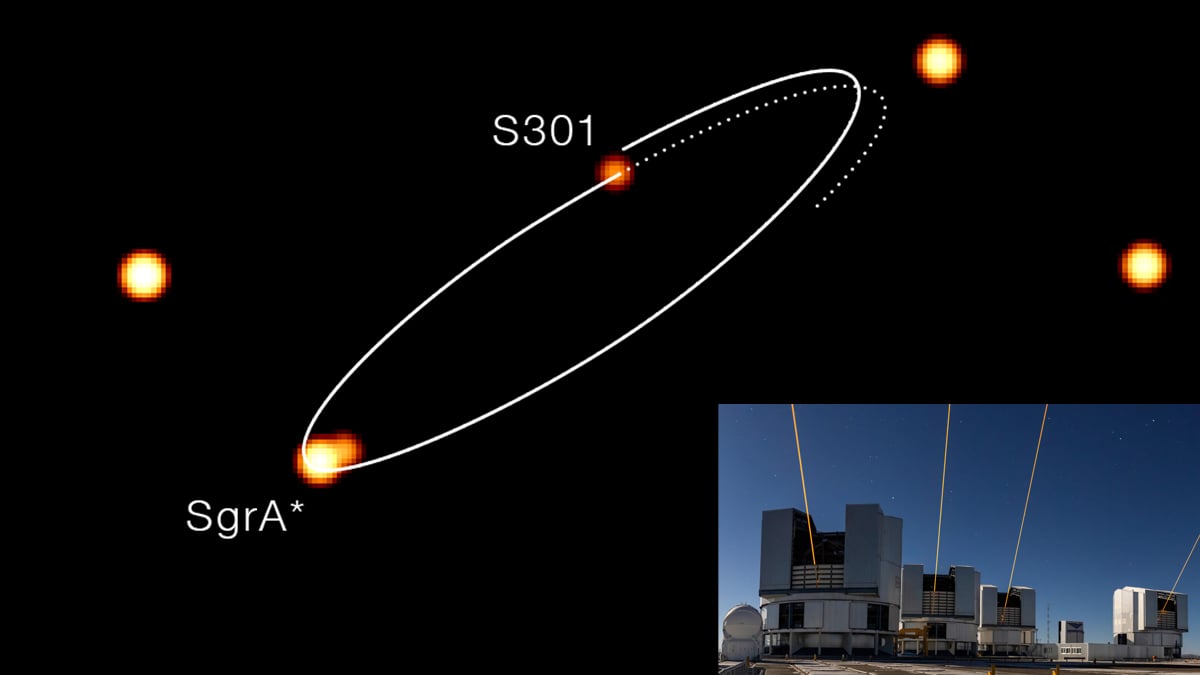
Astronomers have discovered the fastest known star in the Milky Way. Named S301, the star races around Sagittarius A*, the supermassive black hole at the center of our galaxy. It reaches a speed of about 25,000 kilometers per second during its closest approach. That is more than 8% of the speed of light. The star passes so close to Sagittarius A* that its orbit is affected by the black hole‘s rotation.
The discovery was made with the European Southern Observatory’s Very Large Telescope Interferometer (VLTI), using the GRAVITY instrument and its upgraded GRAVITY+ system. The observations could eventually allow astronomers to determine the spin of Sagittarius A*, something that has remained difficult to measure despite decades of observations of the Galactic Center.
S301 is the fastest star found in the Milky Way
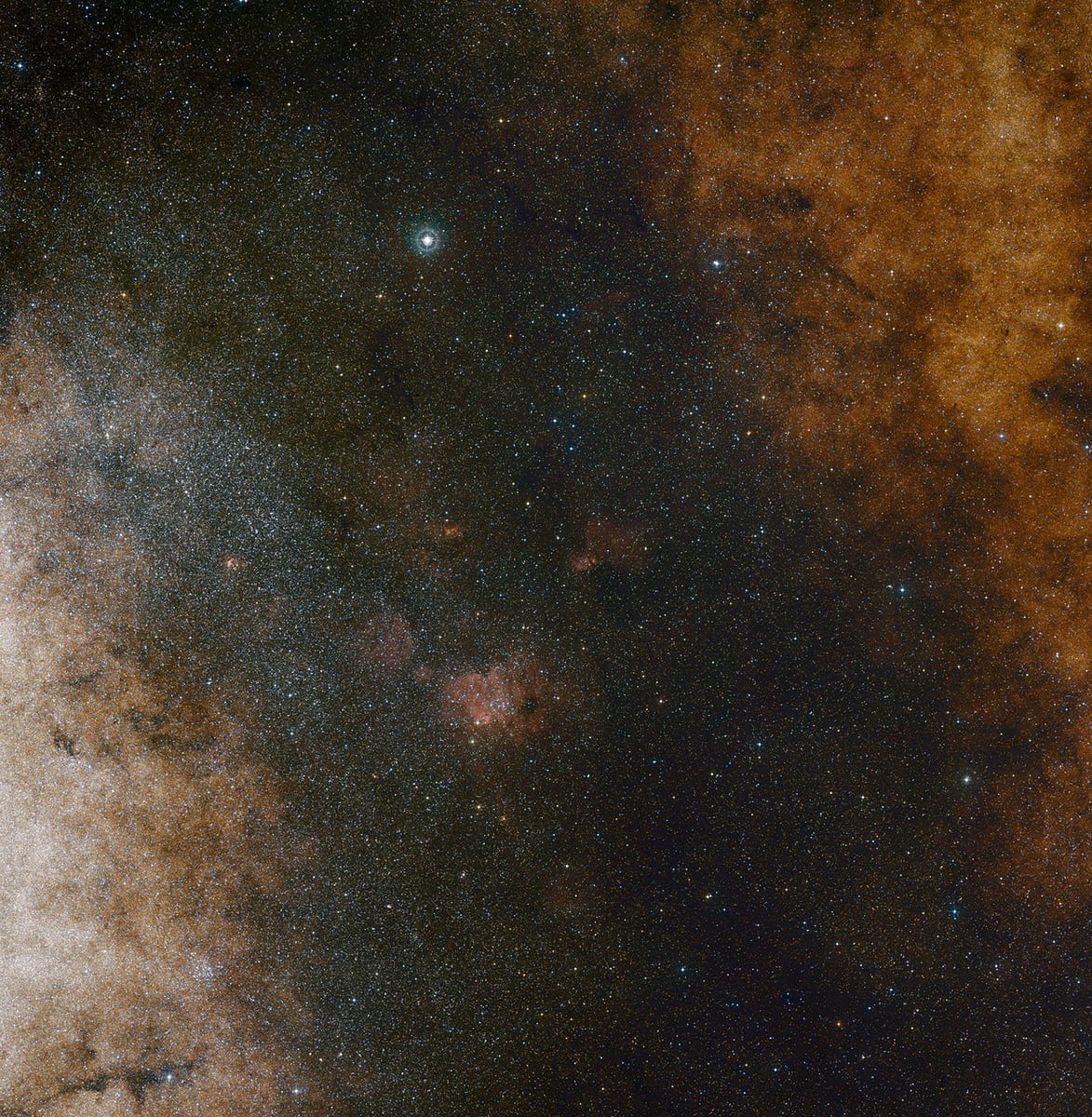
Sagittarius A* has a mass of about four million times that of the Sun and lies around 27,000 light-years from Earth. It is surrounded by a dense population of stars that orbit the black hole at enormous speeds. Astronomers have used some of these stars as probes of gravity for many years, with the star S2 providing some of the best-known measurements.
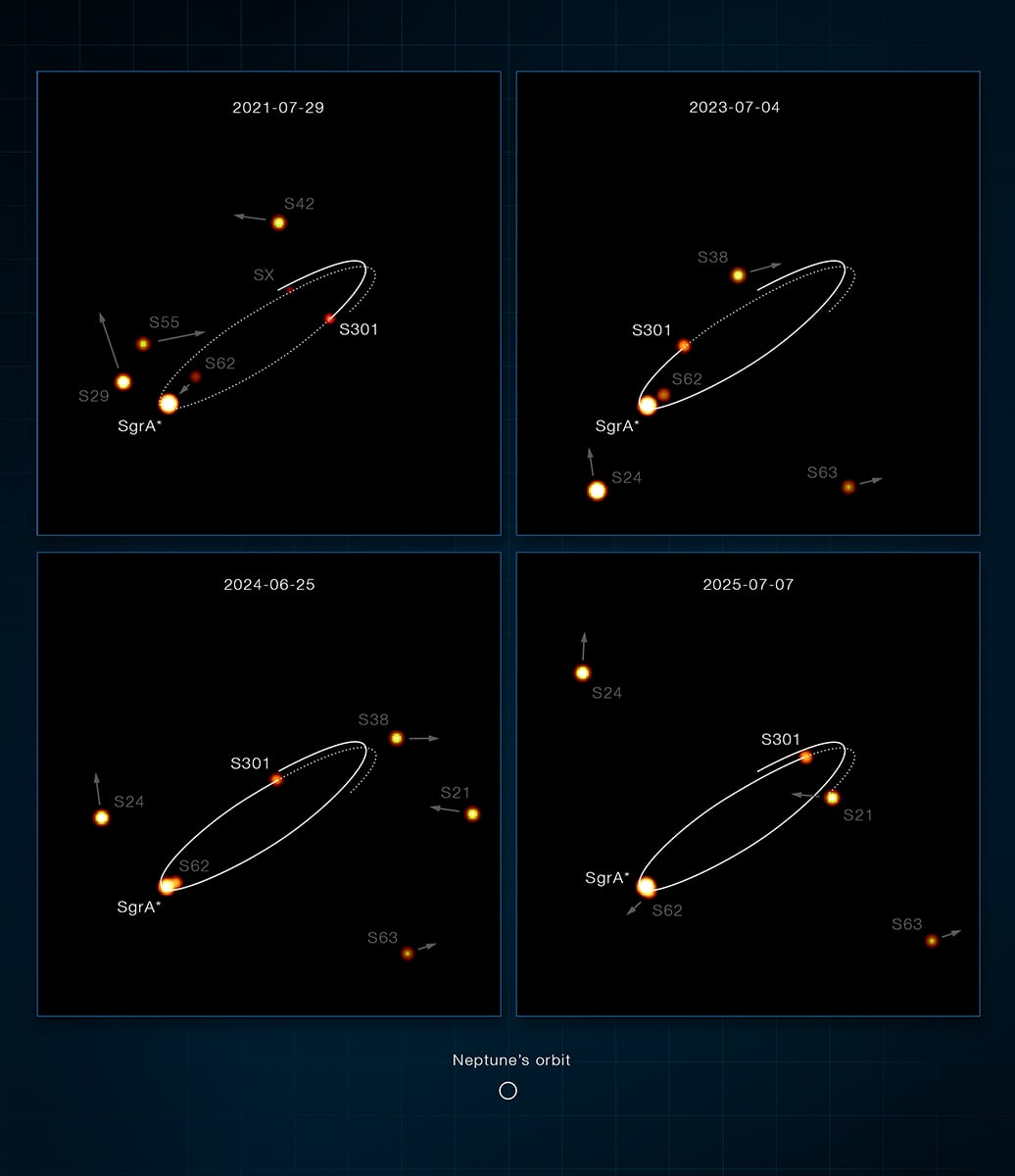
S301 has added a much more extreme orbit to that collection. The star takes about 8.7 years to complete one revolution around Sagittarius A*. Its path is highly elongated rather than close to circular. The calculated eccentricity is around 0.982, meaning that the star spends most of its time relatively far from Sagittarius A* before making a rapid plunge towards its closest point.
S301 reached pericenter in early 2023. At that point, its orbital velocity reached approximately 25,000 km/s. That corresponds to more than eight percent of the speed of light. It is the highest orbital speed measured for a star in the Milky Way.
The star also approaches Sagittarius A* more closely than any other known star. Its pericentre distance is about 1.78 billion kilometres, or approximately 12 astronomical units. For comparison, Saturn orbits the Sun at an average distance of about 9.5 astronomical units.
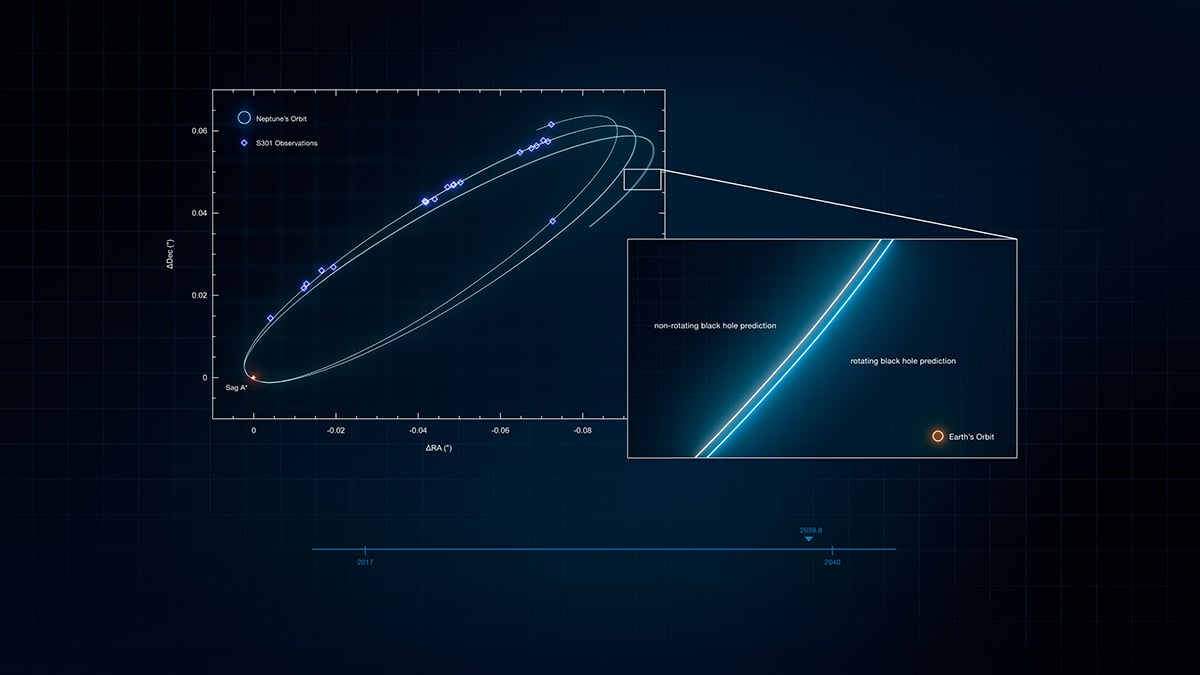
S301 can reveal the black hole’s spin
The most important part of the discovery is not S301’s speed. It is the way its orbit responds to the spacetime surrounding Sagittarius A*. A non-rotating black hole produces a strong gravitational field, but a rotating black hole has an additional effect. General relativity predicts that a rotating body drags the surrounding spacetime. This phenomenon is called frame dragging, and the resulting orbital effect is often described as Lense-Thirring precession.
The effect is tiny when an object remains far from the black hole. S301 gets much closer, so the predicted change becomes very significant. As the star moves around Sagittarius A*, the orientation of its orbital plane should slowly shift. Astronomers can calculate the orbital changes expected from the black hole’s mass. They can then search for the smaller changes caused by its rotation.
GRAVITY had to separate S301 from the Galactic Centre
Observing S301 was rather difficult. The region around the black hole is extremely crowded, and S301 is extraordinarily faint. ESO estimates that the star appears about two billion times fainter than Betelgeuse as seen from Earth. At the distance of the Galactic Centre, even a star moving at such extreme speeds can be difficult to distinguish from neighboring objects.
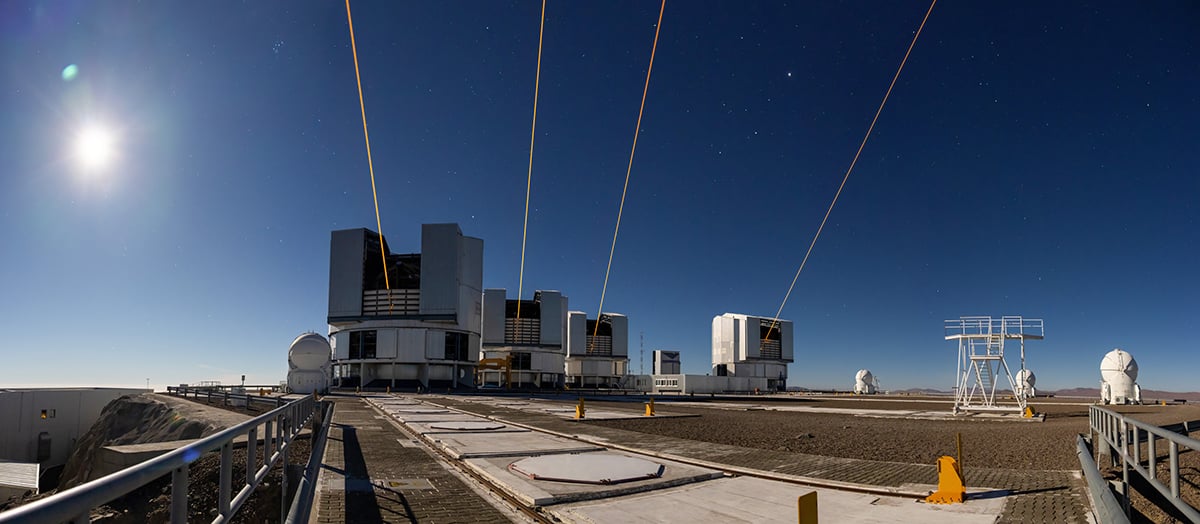
The team used the VLTI at ESO’s Paranal Observatory in Chile. The facility combines the light collected by four 8.2-metre Unit Telescopes. This interferometric technique gives astronomers an angular resolution far greater than they could obtain from one telescope alone. ESO says the VLTI can provide about 15 times the spatial resolution of a single 8-metre telescope.
The GRAVITY instrument was designed in part to study the immediate surroundings of Sagittarius A*. It combines the light from the four telescopes and measures the positions of faint objects with very high precision. GRAVITY+ builds on this capability with upgrades that improve sensitivity and atmospheric correction.
The team first detected S301 in spring 2023. Researchers then searched archival observations for earlier appearances of the same star. They found evidence extending back to 2017, allowing them to reconstruct much of the star’s orbital motion.
Clear skies!
See more from DIYPhotography.net on Google
Add DIYPhotography.net as a trusted source. This makes
our stories more likely to appear in your Google Search results.
 Add as a preferred source on Google

Soumyadeep Mukherjee
Soumyadeep Mukherjee is an award-winning astrophotographer from India. He has a doctorate degree in Linguistics. His work extends to the sub-genres of nightscape, deep sky, solar, lunar and optical phenomenon photography. He is also a photography educator and has conducted numerous workshops. His works have appeared in over 40 books & magazines including Astronomy, BBC Sky at Night, Sky & Telescope among others, and in various websites including National Geographic, NASA, Forbes. He was the first Indian to win “Astronomy Photographer of the Year” award in a major category.
Related Posts
 Space and Ground-Based Observatory Telescopes That Transformed Our View of the Cosmos
 2025 Milky Way Photographer of the Year Breaks New Ground with View From Space
 James Webb telescope captures a distant galaxy just like the Milky Way
 ALMA Captures Star Birth Beyond the Milky Way for the First Time
Join the Discussion
DIYP Comment Policy
Be nice, be on-topic, no personal information or flames.