



















James Webb Opens a ‘Treasure Chest’ Filled with Young Stars
Aug 7, 2026
Soumyadeep Mukherjee
Soumyadeep Mukherjee is an award-winning astrophotographer from India. He has a doctorate degree in Linguistics. His work extends to the sub-genres of nightscape, deep sky, solar, lunar and optical phenomenon photography. He is also a photography educator and has conducted numerous workshops. His works have appeared in over 40 books & magazines including Astronomy, BBC Sky at Night, Sky & Telescope among others, and in various websites including National Geographic, NASA, Forbes. He was the first Indian to win “Astronomy Photographer of the Year” award in a major category.
Share:
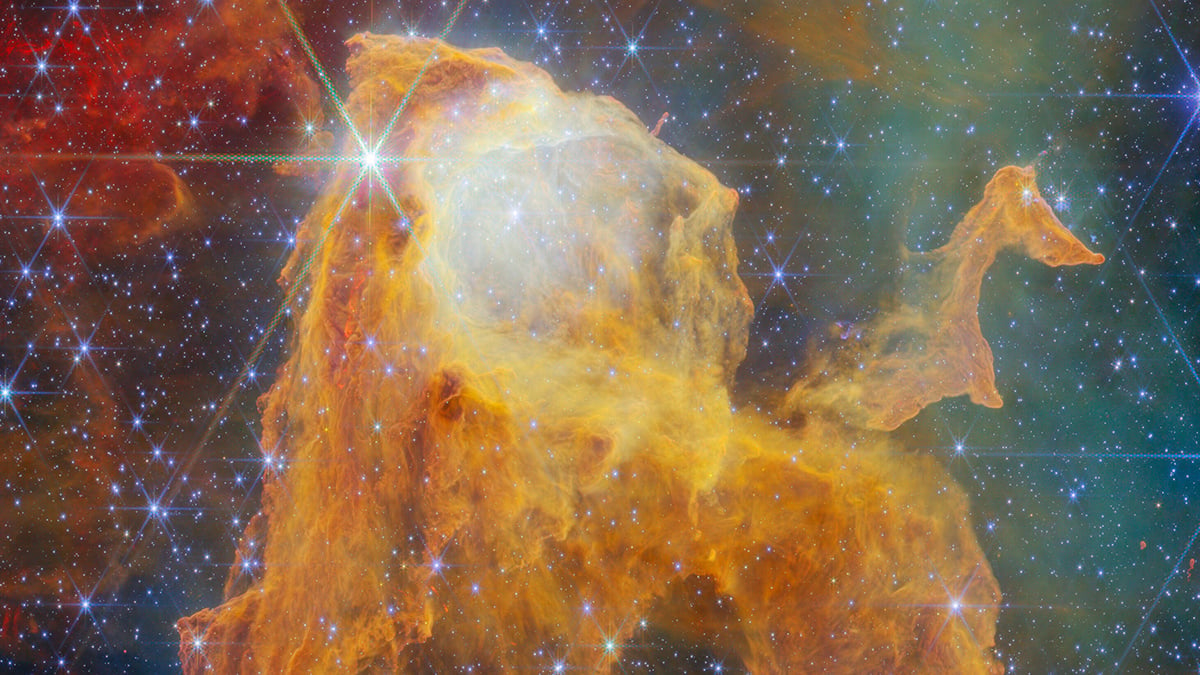
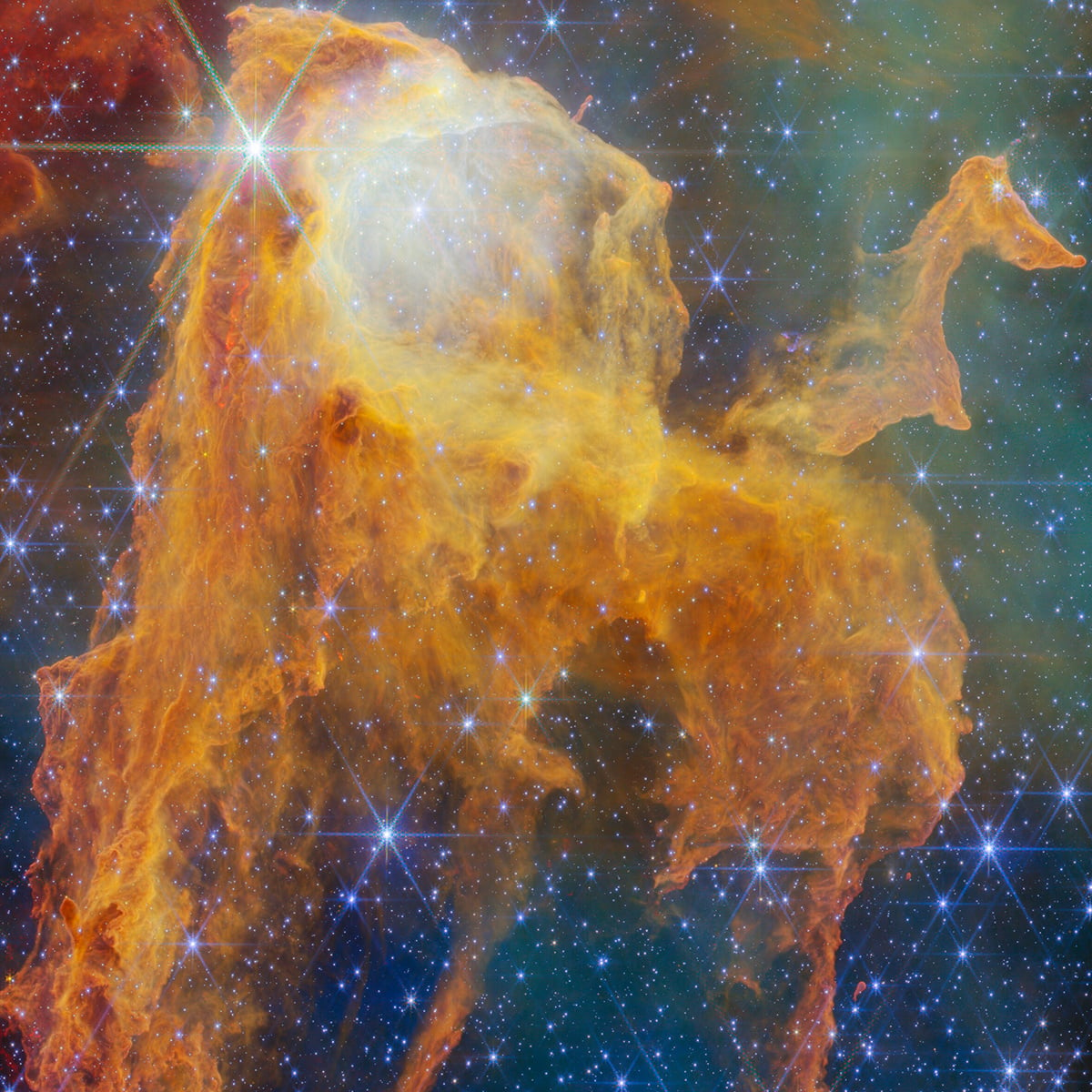
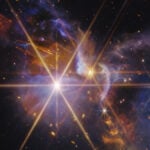
Deep inside the Carina Nebula, a young cluster of stars is fighting its way out of the cloud that gave it birth. The region is packed with gas, dust, and intense radiation from massive stars. That makes it a difficult place to study with visible-light telescopes. In its latest image, the James Webb Space Telescope has looked into this environment at infrared wavelengths and revealed the structure in great detail. Its colors trace different wavelengths of infrared light, including emission from molecular hydrogen and ionized iron.
The target is a compact cloud known as the “Treasure Chest”, a cometary globule about 7,500 light-years from Earth. JWST‘s Near-Infrared Camera, or NIRCam, has picked out roughly 70 young stars inside the cloud. Among them is an O-type star with about 19 times the mass of the Sun. The cluster is estimated to be around 1.3 million years old.
Inside a turbulent stellar nursery in Carina Nebula
The Carina Nebula is one of the most active star-forming regions in the Milky Way. It stretches across roughly 260 light-years and contains a huge population of young stars and protostars. Several extremely massive stars also live within it. Their radiation creates an environment that is very different from the quieter regions where stars like the Sun formed.
The Treasure Chest sits within this larger complex. Its dense gas and dust form a compact structure surrounded by more diffuse material. Astronomers classify it as a cometary globule, a type of cloud that often develops a dense head and an elongated tail under the influence of nearby massive stars.
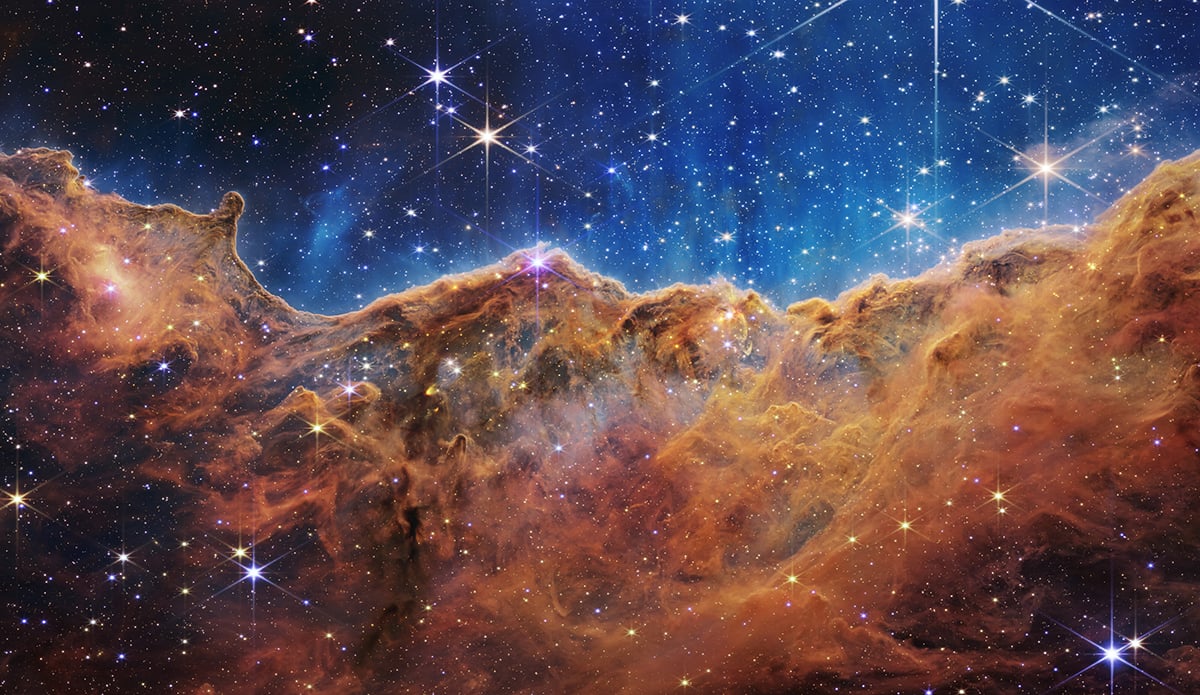
The name comes from its appearance in images. The dense portion resembles an open chest, with a brighter interior surrounded by darker material. JWST‘s infrared view makes the analogy more prominent because it can detect young stars through dust that blocks much of their visible light.
The cluster inside the globule contains about 70 stars. Its most massive member is an O-type star, weighing roughly 19 times the mass of the Sun. O-type stars are among the hottest and most luminous stars known. Their ultraviolet radiation can ionize nearby gas, while their stellar winds carry large amounts of material away from the star.
Infrared light reveals what visible telescopes miss
The biggest obstacle in this region is dust. Star-forming clouds contain enormous amounts of it, and the particles scatter or absorb visible light. A cluster can remain almost invisible at optical wavelengths even when its stars are producing plenty of radiation.
Infrared light behaves differently. Longer wavelengths can travel through dusty regions with much less obstruction. JWST was designed to take advantage of this property, allowing NIRCam to examine regions that remain hidden from optical telescopes.
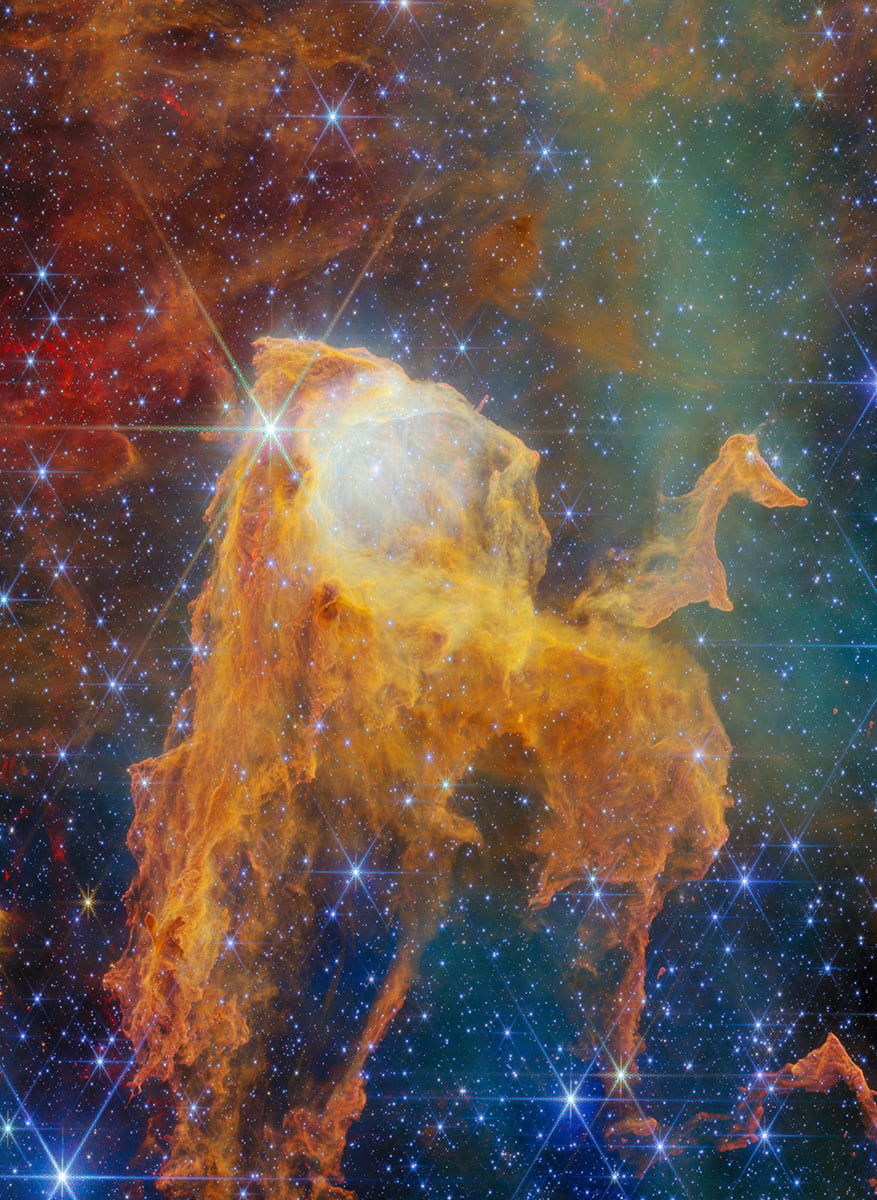
The Treasure Chest image combines four NIRCam wavelength bands. The observations include broadband filters centered at approximately 1.62 and 4.44 microns, along with narrower bands centered at 1.64 and 4.7 microns. Each wavelength highlights different materials and physical processes within the cloud.
The 1.64-micron observations trace emission from ionised iron, or Fe II. The 4.7-micron observations trace molecular hydrogen. These emissions can reveal hot or shocked gas associated with young stellar activity. The broadband observations add information about the stars and the dusty environment surrounding them.
Powerful stars are carving away the cloud
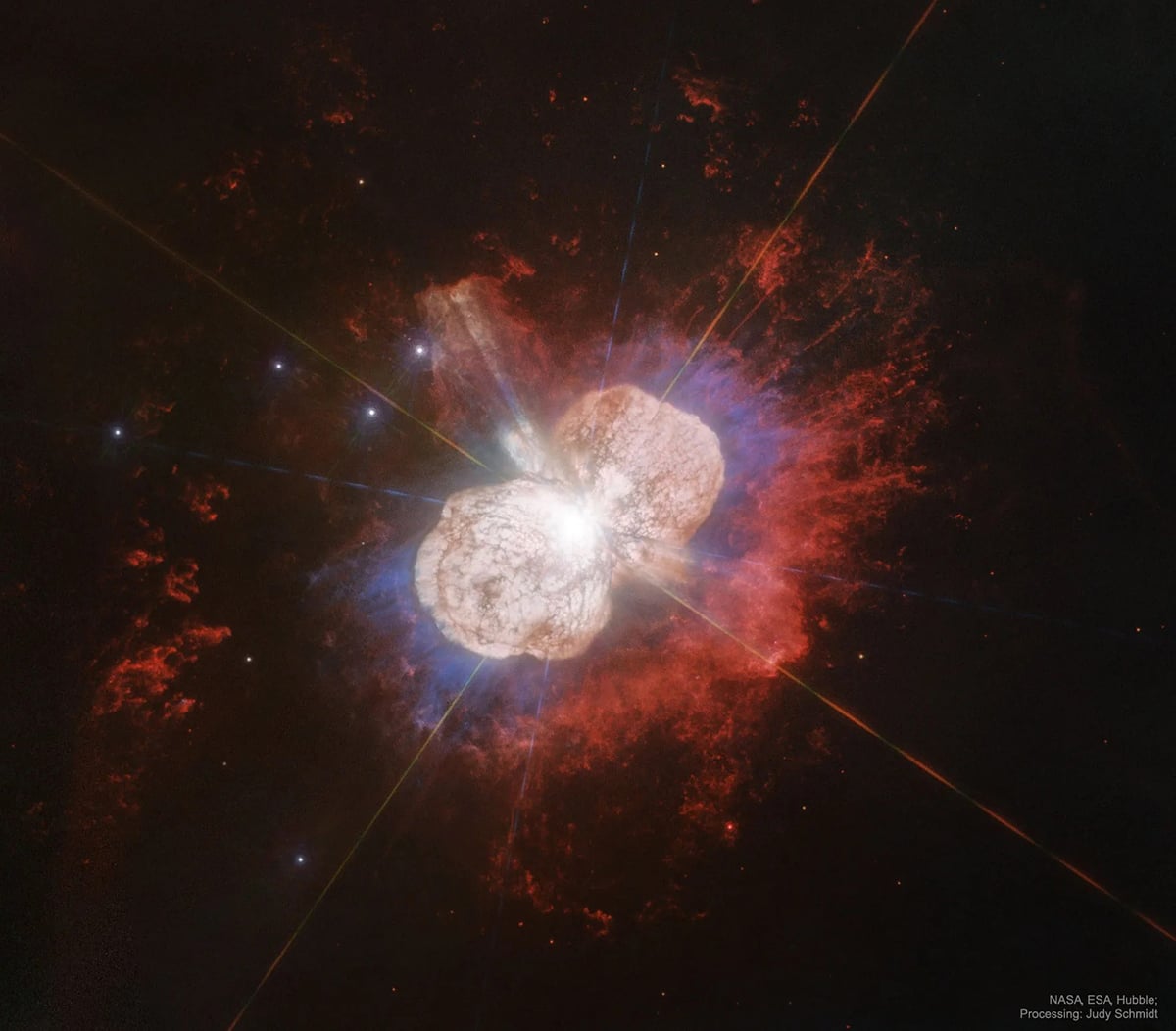
The Treasure Chest has another important influence nearby. About 39 light-years away in the sky lies Eta Carinae, one of the most extreme stellar systems in the Milky Way. Eta Carinae contains at least two stars. The more massive component has a mass of roughly 100 times the mass of the Sun and produces about five million times the Sun’s luminosity. Such a star releases enormous amounts of ultraviolet radiation and drives powerful winds into the surrounding nebula.
The nearby Trumpler 16 cluster adds further sources of energetic radiation. Several massive stars within the cluster contribute to the intense environment surrounding the Treasure Chest. Their combined influence helps explain the globule’s unusual shape. Radiation heats the exposed surface of the cloud and ionises its gas. Stellar winds then push material away from the illuminated regions. Lower-density gas disappears more rapidly, leaving behind denser pockets that resist erosion.
Astronomers call this process stellar feedback. It is one of the major forces that links the lives of stars to the evolution of their surroundings. The Treasure Chest sits within this complicated environment. The massive stars around it are helping to expose the young cluster, but they are also destroying part of the cloud that surrounds it.
Clear skies!
See more from DIYPhotography.net on Google
Add DIYPhotography.net as a trusted source. This makes
our stories more likely to appear in your Google Search results.
 Add as a preferred source on Google

Soumyadeep Mukherjee
Soumyadeep Mukherjee is an award-winning astrophotographer from India. He has a doctorate degree in Linguistics. His work extends to the sub-genres of nightscape, deep sky, solar, lunar and optical phenomenon photography. He is also a photography educator and has conducted numerous workshops. His works have appeared in over 40 books & magazines including Astronomy, BBC Sky at Night, Sky & Telescope among others, and in various websites including National Geographic, NASA, Forbes. He was the first Indian to win “Astronomy Photographer of the Year” award in a major category.

Join the Discussion
DIYP Comment Policy
Be nice, be on-topic, no personal information or flames.