




















The “Golden Comet” has Broken Apart: C/2025 K1 ATLAS Photos
Nov 20, 2025
Soumyadeep Mukherjee
Soumyadeep Mukherjee is an award-winning astrophotographer from India. He has a doctorate degree in Linguistics. His work extends to the sub-genres of nightscape, deep sky, solar, lunar and optical phenomenon photography. He is also a photography educator and has conducted numerous workshops. His works have appeared in over 40 books & magazines including Astronomy, BBC Sky at Night, Sky & Telescope among others, and in various websites including National Geographic, NASA, Forbes. He was the first Indian to win “Astronomy Photographer of the Year” award in a major category.
Share:
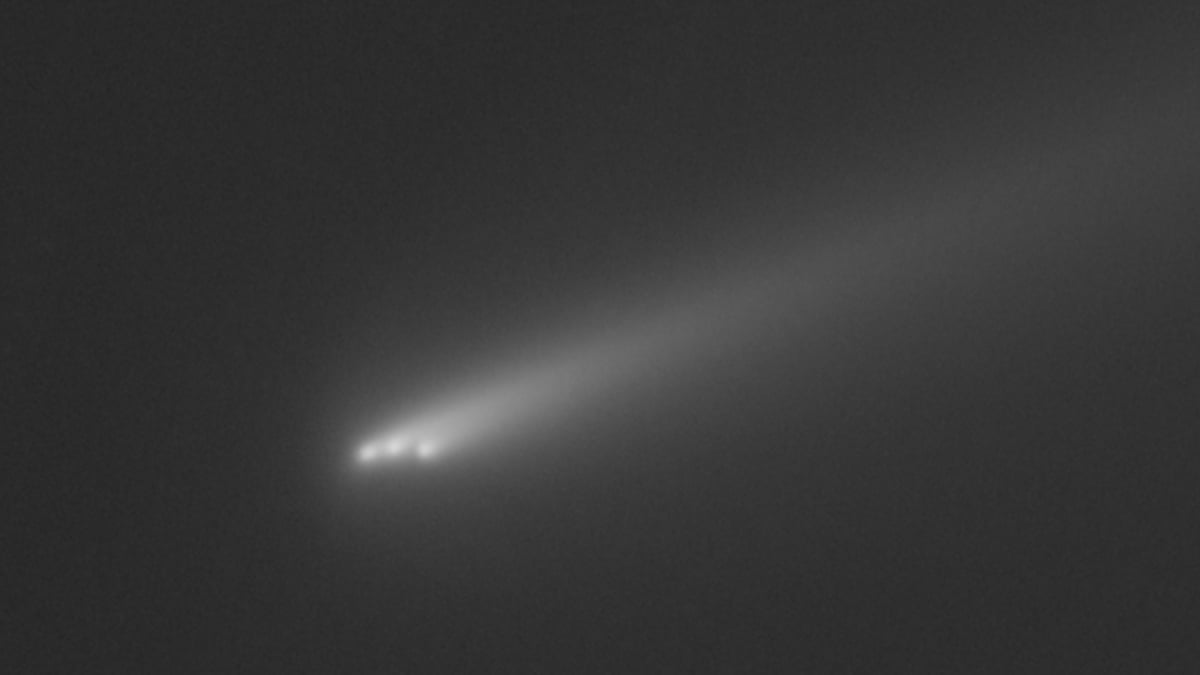
Comet C/2025 K1 (ATLAS) has captured the attention of both amateur stargazers and professional astronomers. It is a surprise visitor from the distant Oort Cloud, and its recent behavior is anything but ordinary. Emerging with a golden glow, surviving a close solar pass, and now fragmenting, the comet is unfolding a dramatic story in real time.
Discovery and origins
Astronomers first spotted the comet in May 2025, thanks to the ATLAS (Asteroid Terrestrial-impact Last Alert System) survey. They immediately recognized that something special was happening. Its orbit suggested that it was a dynamically new comet, possibly making one of its first trips into the inner Solar System.
Because of this, scientists treated it with caution and wonder. New comets often harbor primordial material, and they can behave erratically. Observers around the world pointed telescopes at the object. Night after night, they tracked its motion, brightness, and tail.
Comet C/2025 K1 swept extremely close to the Sun on October 8, 2025, reaching about 0.334 astronomical units from it. That is a very close approach, and a dangerous one for a fragile comet. Many expected the nucleus to break apart under intense solar heating.
To the relief of many, the comet survived the perihelion. It emerged from its solar encounter still intact. This alone was remarkable. It showed resilience. It defied the odds. And for scientists, that was a gift: a living sample of a long-period comet after its most stressful encounter.
The strange, golden chemistry
After perihelion, observers noted an unusual color. The comet shone with a warm golden tint. This was not the typical green or blue glow that many comets display. Spectroscopic observations soon revealed why.
Researchers measured extremely low amounts of carbon-bearing molecules such as C₂ (diatomic carbon) and CN (cyanogen) in its coma. These molecules usually dominate a comet’s glow and provide the familiar green color. But in C/2025 K1, they are severely depleted. The lack of these gases means the reflected sunlight highlights the dust more. That gives the comet its golden hue.
Scientists from professional observatories, publishing through platforms like The Astronomer’s Telegram and peer-reviewed journals, confirmed this unusual chemical makeup. The data strongly suggest that the comet’s nucleus has very little volatile carbon left near the surface. That is a surprising characteristic, especially for a dynamically new comet.
Fragmentation: The nucleus breaks apart
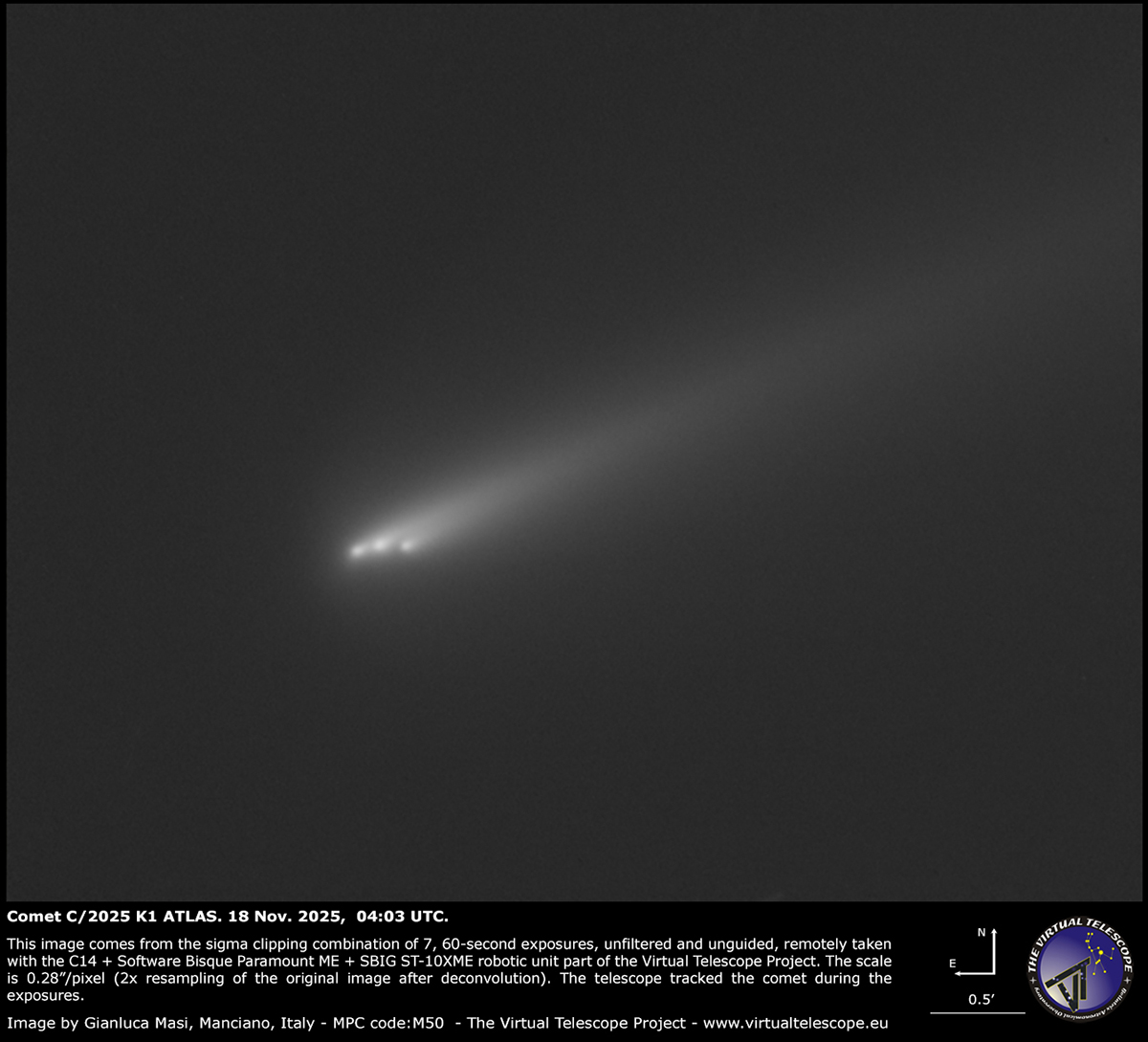
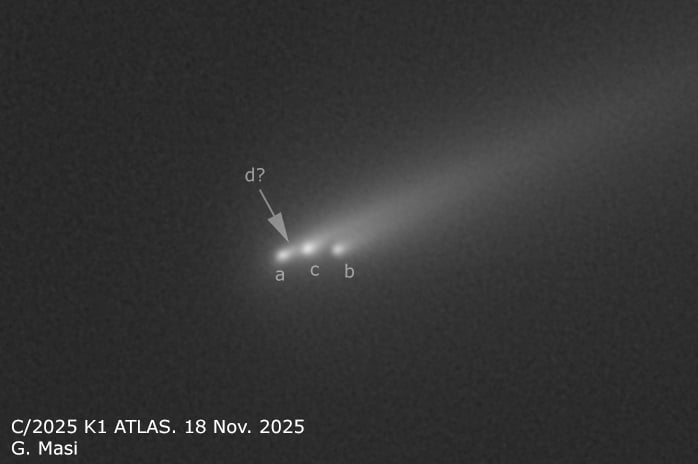
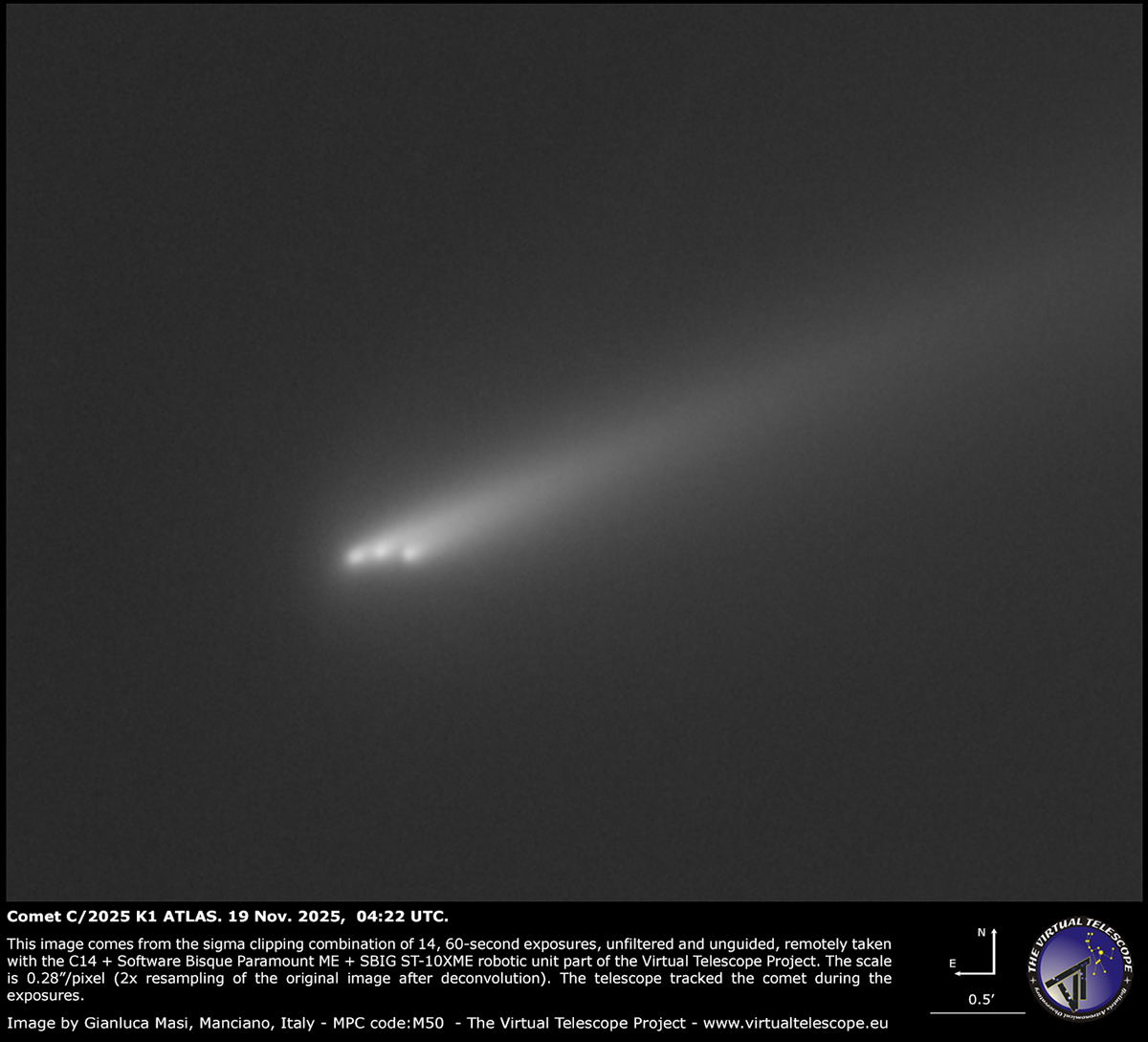
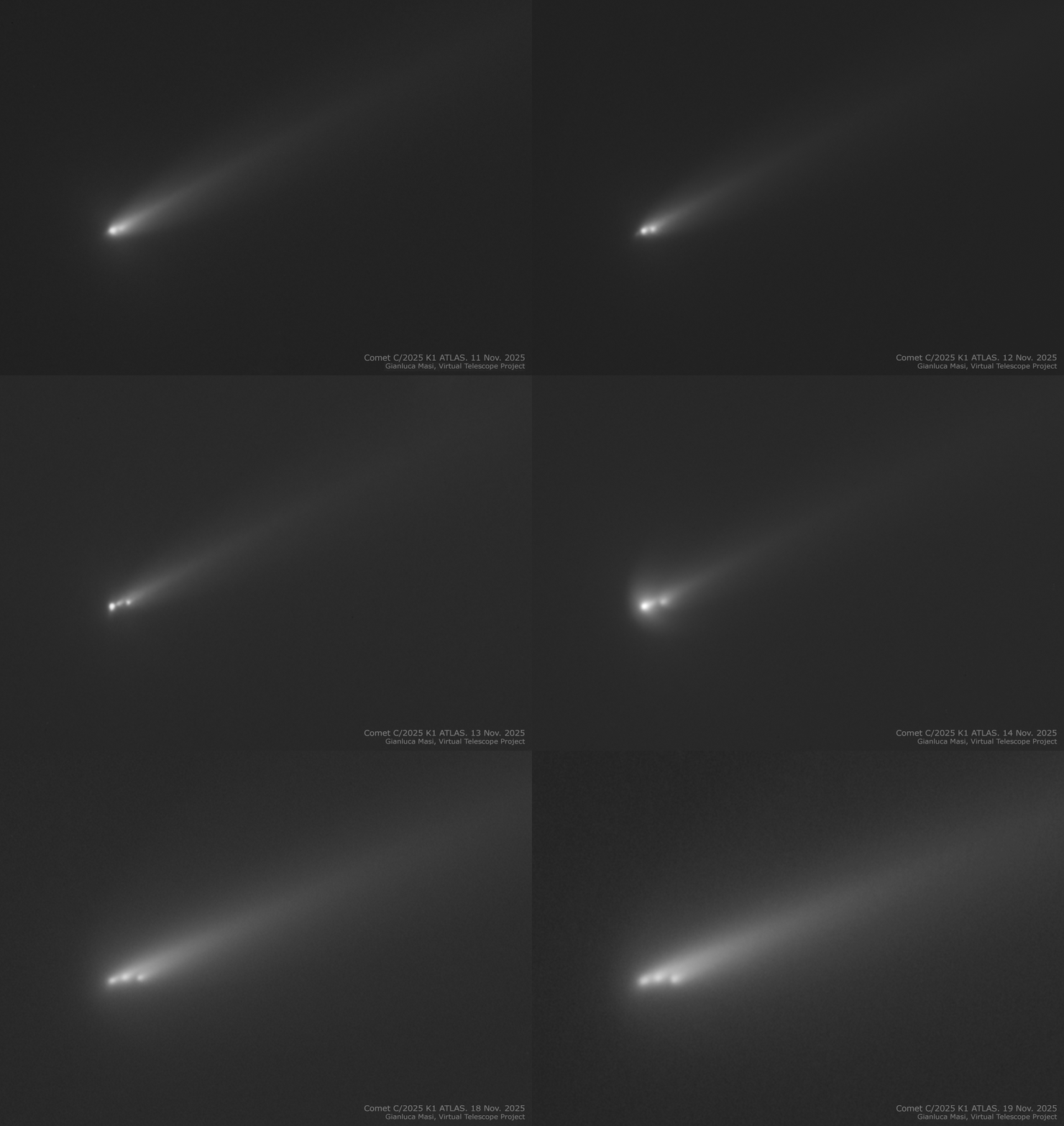
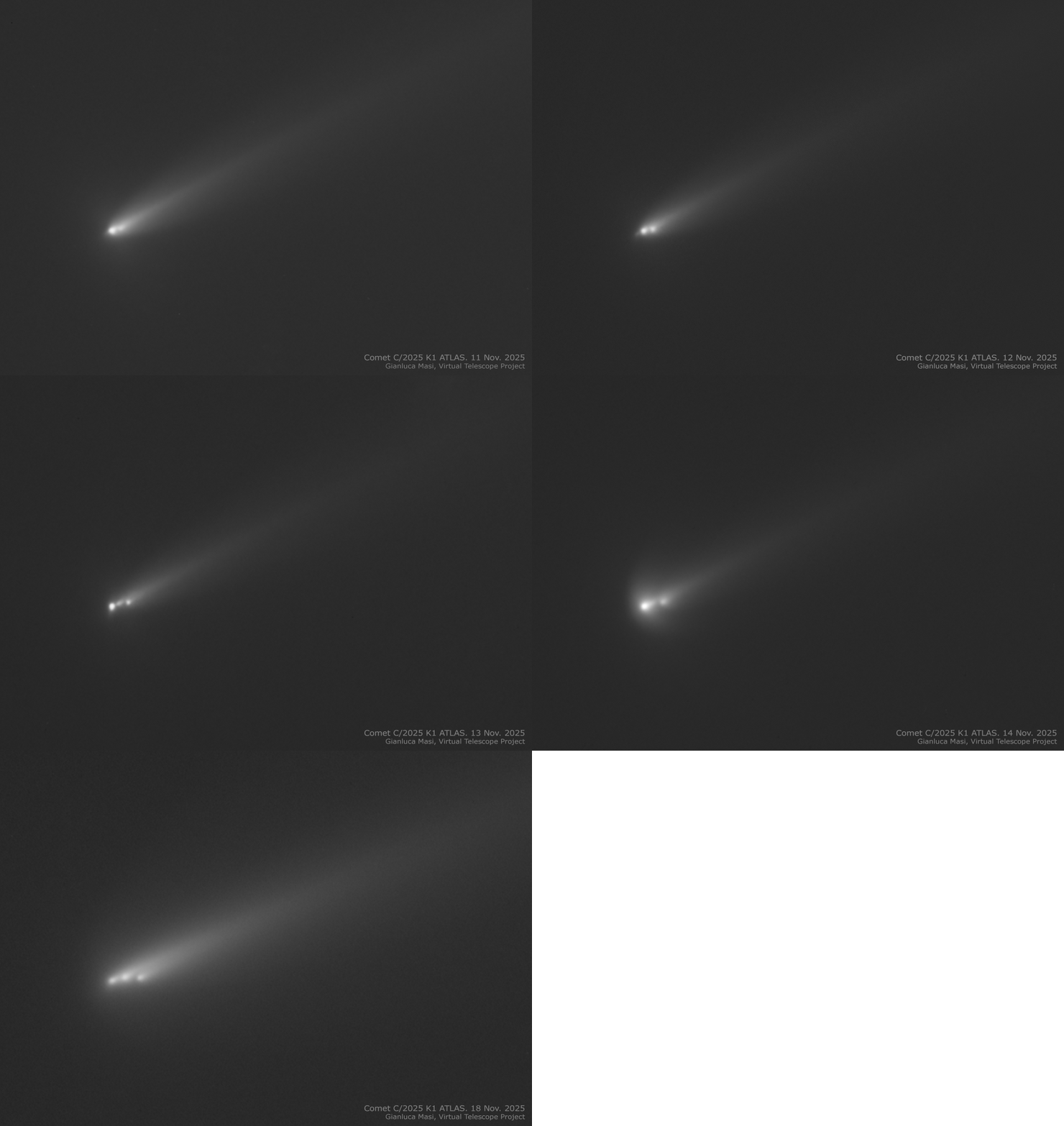
Mid-November brought the most dramatic development. Telescopes began to resolve multiple condensations at the comet’s core. On November 11 and 12, images from the Virtual Telescope Project revealed at least two bright centers inside the coma. Over the following nights, further frames showed three distinct fragments. Some observers even report a possible fourth, though that remains tentative.
The Virtual Telescope team used a Celestron C14 mounted on a robotic rig to take repeated 60-second exposures between November 11 and 19. They processed those frames into a time-lapse animation. In the animation, the fragments clearly move away from one another, showing real-time separation. The motion is slow but steady. The drift is measurable.
Other observatories confirmed the fragmentation. At Asiago Observatory in Italy, astronomers using a 1.82-meter telescope recorded three pieces by November 11. Their measurements estimate that one pair of fragments is separating at roughly 2,000 kilometers. This continued splitting signals internal stress. The comet’s nucleus seems to be too weak to stay together under solar heating.
Observing and photographing the drama
Observers and astrophotographers now have a golden opportunity. The fragmented comet moves slowly, but its pieces shift every night. That motion makes for compelling time-lapse sequences. It also encourages repeated imaging.
To capture the fragments, you do not necessarily need a professional observatory. A good amateur setup can work. The Virtual Telescope project used a mid-sized Schmidt–Cassegrain telescope. If you have a telescope in the 8- to 14-inch range, you can attempt to resolve the brighter fragments under dark skies. A stable equatorial mount helps for long exposures. Stacking frames improves faint tail and coma detail. Shorter exposures preserve sharper fragment cores.
If you want to document fragment separation, take images on consecutive nights. Use reliable ephemeris tools like TheSkyLive or local astronomy software. These sources provide accurate coordinates, brightness estimates, and trajectory predictions. Many observers also submit their position measurements to the Minor Planet Center (MPC). That kind of data helps refine the orbits of the fragments. Your observations can contribute to genuine scientific research.
Because the comet is still relatively bright (magnitude estimates in the range of 9–11 for the main pieces), binoculars or small telescopes from dark locations may catch at least the brightest fragment or the elongated coma. If you are a photographer, try both wide-field images and close-up high-magnification shots. Mixing these approaches will show both motion and fracturing.
A cosmic story unfolding
No one knows exactly how C/2025 K1 will behave next. Its future depends on its internal structure. It may continue to fragment. Some pieces could fade as their volatile reserves dwindle. Others might experience renewed outbursts if fresh ice becomes exposed. Its coma could become more asymmetric. It could develop extended dust or gas tails from separate fragments.
Researchers plan to monitor the fragments night after night. They want to track their orbits, speeds, and light curves. They will try to obtain spectra of each fragment. That might uncover chemical differences. Such data would refine our models of cometary structure. Amateur observers are also critical to this effort. Every reported position helps map fragment paths and refine orbits. Reporting to the Minor Planet Center remains vital. Photos, astrometry, and brightness estimates support the global effort.
Depending on how the comet evolves, we may witness behaviors rarely seen in new comets. We might catch fresh outbursts or detect fadeouts. Each event will teach us more about the nature of comet nuclei, the forces that hold them together, and how they react when exposed to intense solar radiation.
Clear skies!
See more from DIYPhotography.net on Google
Add DIYPhotography.net as a trusted source. This makes
our stories more likely to appear in your Google Search results.
 Add as a preferred source on Google

Soumyadeep Mukherjee
Soumyadeep Mukherjee is an award-winning astrophotographer from India. He has a doctorate degree in Linguistics. His work extends to the sub-genres of nightscape, deep sky, solar, lunar and optical phenomenon photography. He is also a photography educator and has conducted numerous workshops. His works have appeared in over 40 books & magazines including Astronomy, BBC Sky at Night, Sky & Telescope among others, and in various websites including National Geographic, NASA, Forbes. He was the first Indian to win “Astronomy Photographer of the Year” award in a major category.


Join the Discussion
DIYP Comment Policy
Be nice, be on-topic, no personal information or flames.