


















Dwarf Mini Smart Telescope Launched: A Pocket-Sized Powerhouse for Astrophotography
Oct 27, 2025
Soumyadeep Mukherjee
Soumyadeep Mukherjee is an award-winning astrophotographer from India. He has a doctorate degree in Linguistics. His work extends to the sub-genres of nightscape, deep sky, solar, lunar and optical phenomenon photography. He is also a photography educator and has conducted numerous workshops. His works have appeared in over 40 books & magazines including Astronomy, BBC Sky at Night, Sky & Telescope among others, and in various websites including National Geographic, NASA, Forbes. He was the first Indian to win “Astronomy Photographer of the Year” award in a major category.
Share:

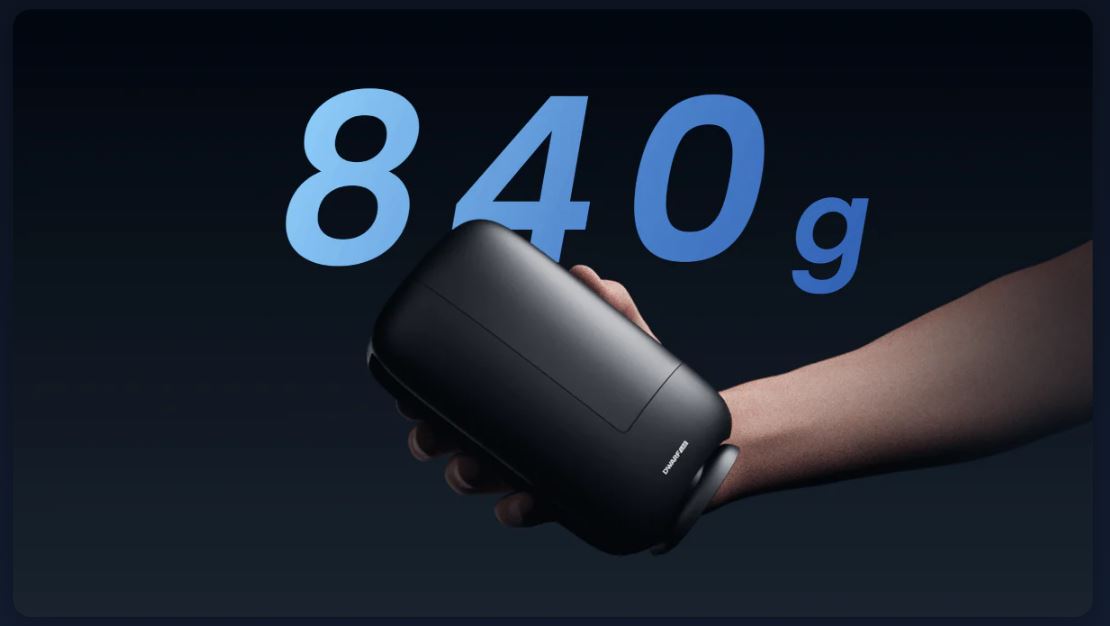
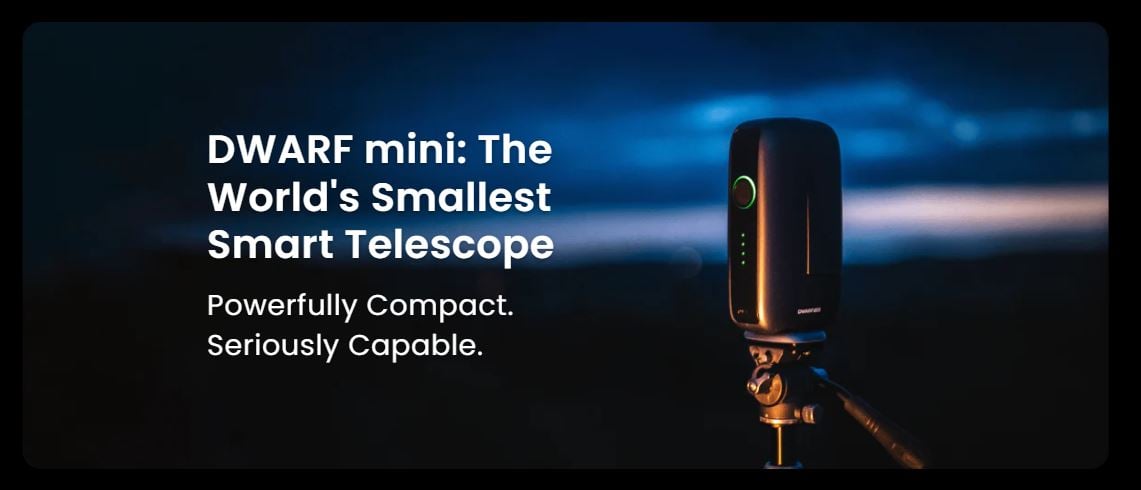
Astrophotography has always lived at the intersection of patience and precision. From setting up mounts to aligning optics, even a simple wide-field shot of the Milky Way can turn into a night-long process. The Dwarf Mini Smart Telescope arrives to change that. Built by DwarfLab, it promises to deliver the core experience of deep-sky imaging in a package small enough to fit in your hand. Weighing only 840 grams, this miniature observatory brings serious imaging power, intelligent tracking, and automation that make astrophotography accessible anywhere, anytime.
Compact engineering with cosmic intent
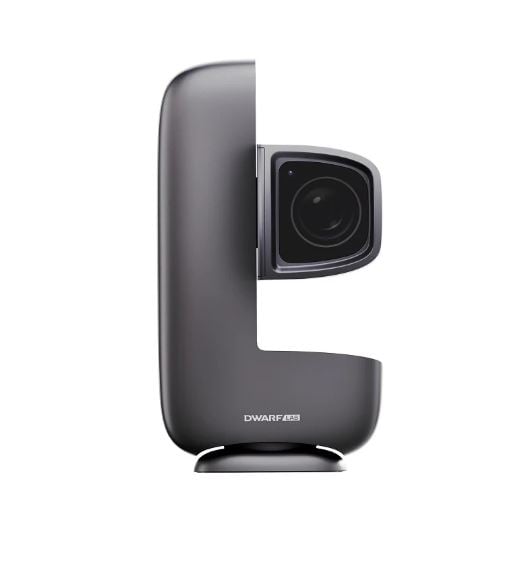
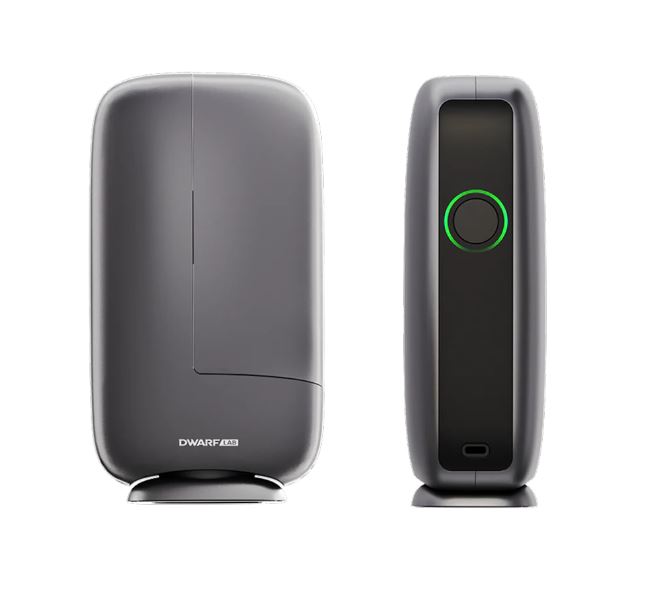
At first glance, the Dwarf Mini doesn’t look like a telescope at all. It’s a smooth, rectangular device with rounded corners, clearly designed for mobility. Yet, inside this tiny chassis lies a sophisticated optical system and an intelligent brain that takes care of the most challenging aspects of night-sky imaging.
Portability is its defining feature. The entire setup weighs just 840 grams, including optics, sensors, motors, and internal computing. DwarfLab describes it as an “ultra-portable smart telescope”, capable of being tripod-mounted and ready to shoot within 90 seconds. That means no balancing heavy mounts, no counterweights, and no fumbling with alignment tools. You can travel light, stop under a clear sky, and be imaging within minutes.
Flexibility in movement is another strong point. The telescope’s 360-degree base rotation and 225-degree lens tilt allow you to target almost any area of the sky without repositioning your tripod. This mechanical freedom, combined with app-based control, makes it easy to track celestial objects as they drift across the heavens.
The optics and sensor: Tiny body, serious hardware
Inside the Dwarf Mini lies a sensor that plays a central role in its imaging capability: Sony’s IMX662. This 1/2.8-inch CMOS sensor is a back-illuminated design with 2.9-micron pixels, known for high sensitivity and low noise, two qualities that make a huge difference when capturing faint light from stars and nebulae.
The optical system pairs that sensor with a telephoto lens that effectively delivers a wide-to-medium field of view, perfect for bright deep-sky targets such as the Orion Nebula, the Pleiades, or larger galaxies like Andromeda. The Dwarf Mini also supports RAW imaging, preserving the full bit depth from the sensor for later editing. RAW capture is essential for astrophotography, as it allows control over tone curves, contrast, and color balance during post-processing without compression loss. The device can capture up to 5-megapixel RAW frames, a sweet spot for balancing data size and image detail.
Another key feature is its 90-second exposure capability in Equatorial (EQ) Mode. For most small telescopes, tracking errors begin to blur stars after just a few seconds, but the Dwarf Mini’s intelligent mount compensates precisely. Ninety seconds per frame gives astrophotographers enough integration time to pull out faint nebular structures without star trails, a major achievement for such a small mount.
Filters that make the sky pop
DwarfLab has also equipped the Dwarf Mini with a set of built-in and optional filters that target specific astrophotography needs.
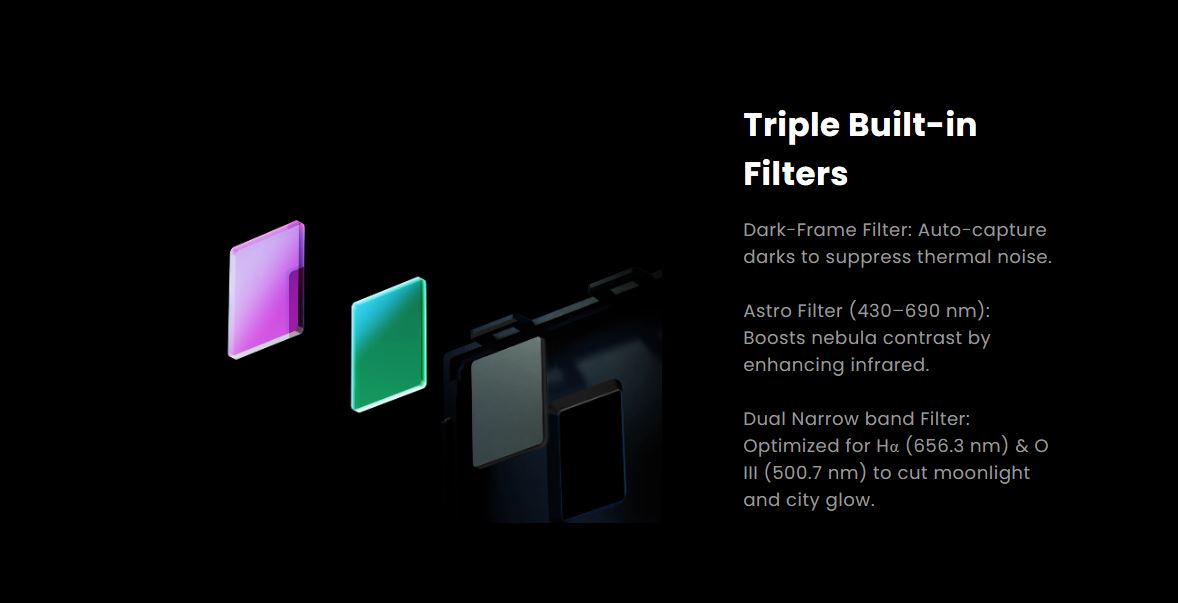
- Dark-Frame Filter: Automatically captures dark frames to help subtract sensor noise, thermal patterns, and hot pixels from long exposures. This automation removes one of the most tedious manual steps in deep-sky imaging.
- Astro Filter (430–690 nm): This built-in filter boosts nebular contrast by blocking excessive blue and infrared wavelengths, giving crisper results even under light-polluted skies.
- Dual Narrow-Band Filter: Optimized for H-alpha (656.3 nm) and O III (500.7 nm) emission lines, this optional filter dramatically enhances emission nebula detail. It also reduces the effect of moonlight and urban glow, allowing imaging even under less-than-ideal conditions.
With these filters, the Dwarf Mini extends its usability far beyond simple star-field photography. You can tackle bright nebulae like Lagoon, North America, or Rosette with enhanced definition, something rarely achievable in small, automated systems.
Intelligent automation: From setup to stacking
Smart telescopes live and die by their software, and DwarfLab’s system is at the heart of what makes the Dwarf Mini stand out. The device is controlled entirely through the DwarfLab App, available for both iOS and Android. Once connected via Wi-Fi, the app turns your phone or tablet into a control center. You can select targets, initiate alignment, start exposures, and even view live stacking progress, all in real time.
The telescope’s built-in GoTo system can automatically slew to major celestial objects. Once it locks on, it begins auto-tracking to compensate for Earth’s rotation. When you enable EQ Mode, it follows stars with the accuracy needed for long exposures.
Post-capture, the software performs auto-stacking, combining multiple short exposures to increase signal-to-noise ratio and dynamic range. It even supports multi-night stacking. This allows you to continue imaging the same target over several sessions and merge the data into a deeper composite. DwarfLab calls this workflow “One-Tap Processing”, emphasizing simplicity. The app can also generate dark, bias, and flat frames automatically. This feature brings calibration capabilities usually found in professional workflows to a portable device.
Who it’s made for
The DWARF mini is aimed at astrophotographers who value convenience, automation, and mobility. It is suited for people who:
- Frequently travel to dark-sky sites
- Want a self-contained telescope that fits in a small bag
- Prefer to spend time shooting rather than setting up
- Need a teaching or demonstration tool for students
It’s also an excellent secondary rig for seasoned astrophotographers who want to capture wide-field scenes or timelapses while their main telescope tracks a different object. Beginners, on the other hand, will appreciate how forgiving it is. There’s no need to master polar alignment, calibration frames, or manual focus. The DWARF mini takes care of all that. You just pick a target and start shooting.
Price and availability
The Dwarf Mini smart telescope is priced at $399. It is now available for pre-order via the official website.
The Dwarf Mini Smart Telescope represents an evolution of astrophotography. It takes a process that once required skill, patience, and a car full of equipment and condenses it into a device that fits in your hand. With the combination of Sony IMX662 sensor, automated EQ tracking, RAW capture, and intelligent stacking, it offers a real path to deep-sky imaging for travelers, beginners, and educators. With its 840-gram body, dual rotation axes, and battery-powered portability, it truly is a pocket observatory.
Clear skies!
See more from DIYPhotography.net on Google
Add DIYPhotography.net as a trusted source. This makes
our stories more likely to appear in your Google Search results.
 Add as a preferred source on Google

Soumyadeep Mukherjee
Soumyadeep Mukherjee is an award-winning astrophotographer from India. He has a doctorate degree in Linguistics. His work extends to the sub-genres of nightscape, deep sky, solar, lunar and optical phenomenon photography. He is also a photography educator and has conducted numerous workshops. His works have appeared in over 40 books & magazines including Astronomy, BBC Sky at Night, Sky & Telescope among others, and in various websites including National Geographic, NASA, Forbes. He was the first Indian to win “Astronomy Photographer of the Year” award in a major category.
Related Posts
 The Feiyu Pocket 2S is the world’s first detachable wearable pocket sized gimbal
 The YoloBox Mini is an all-in-one pocket-sized live stream solution with a built-in touch screen display
 The Nitecore BB Mini is a pocket-sized blower for cleaning your lenses with wind output of 40mph
 There is now a pocket-sized controller for the Blackmagic Pocket Cinema Camera 4K
Join the Discussion
DIYP Comment Policy
Be nice, be on-topic, no personal information or flames.