
























Svbony SV238 Off-Axis Guider: A Precise Solution for Reliable Deep-Sky Guiding
Oct 26, 2025
Soumyadeep Mukherjee
Soumyadeep Mukherjee is an award-winning astrophotographer from India. He has a doctorate degree in Linguistics. His work extends to the sub-genres of nightscape, deep sky, solar, lunar and optical phenomenon photography. He is also a photography educator and has conducted numerous workshops. His works have appeared in over 40 books & magazines including Astronomy, BBC Sky at Night, Sky & Telescope among others, and in various websites including National Geographic, NASA, Forbes. He was the first Indian to win “Astronomy Photographer of the Year” award in a major category.
Share:
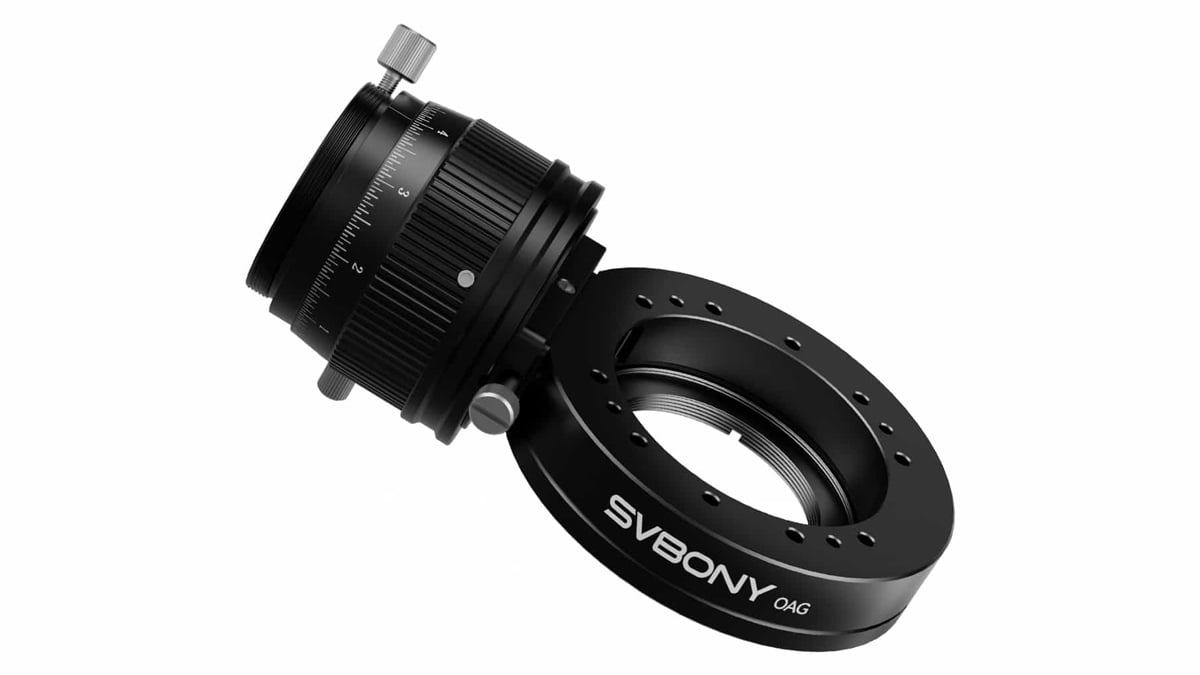
Astrophotography demands precision. Long exposures and narrow fields mean even tiny tracking errors can blur stars and ruin an image. Many imagers rely on separate guide scopes, but those setups sometimes introduce a subtle problem: flexure between the two optical paths. The Svbony SV238 Off-Axis Guider takes a different approach. It picks off a small portion of light from the same optical path as your main camera, allowing the guide camera to correct mount movement with perfect alignment.
The role of an off-axis guider in astrophotography
Before diving into details, it’s worth revisiting why off-axis guiders (OAGs) exist. In a traditional guiding setup, a small guide scope sits on top of the main telescope. It tracks a star and tells the mount how to adjust. For short focal lengths, this method works well. However, at longer focal lengths, such as 1000 mm or more, even slight flexing between the guide scope and the main scope causes the two optical paths to drift apart. That drift translates into elongated stars and distorted nebulae.
An OAG avoids that by using the same telescope for both imaging and guiding. A tiny prism located near the edge of the light path reflects a small amount of starlight to a guide camera. Since both cameras share the same optical axis, there’s no flexure. The result is tighter guiding and sharper images during long exposures. The Svbony SV238 follows this principle but adds clever mechanical refinements to make setup easier and accuracy better.
Design and construction: Small body, solid engineering
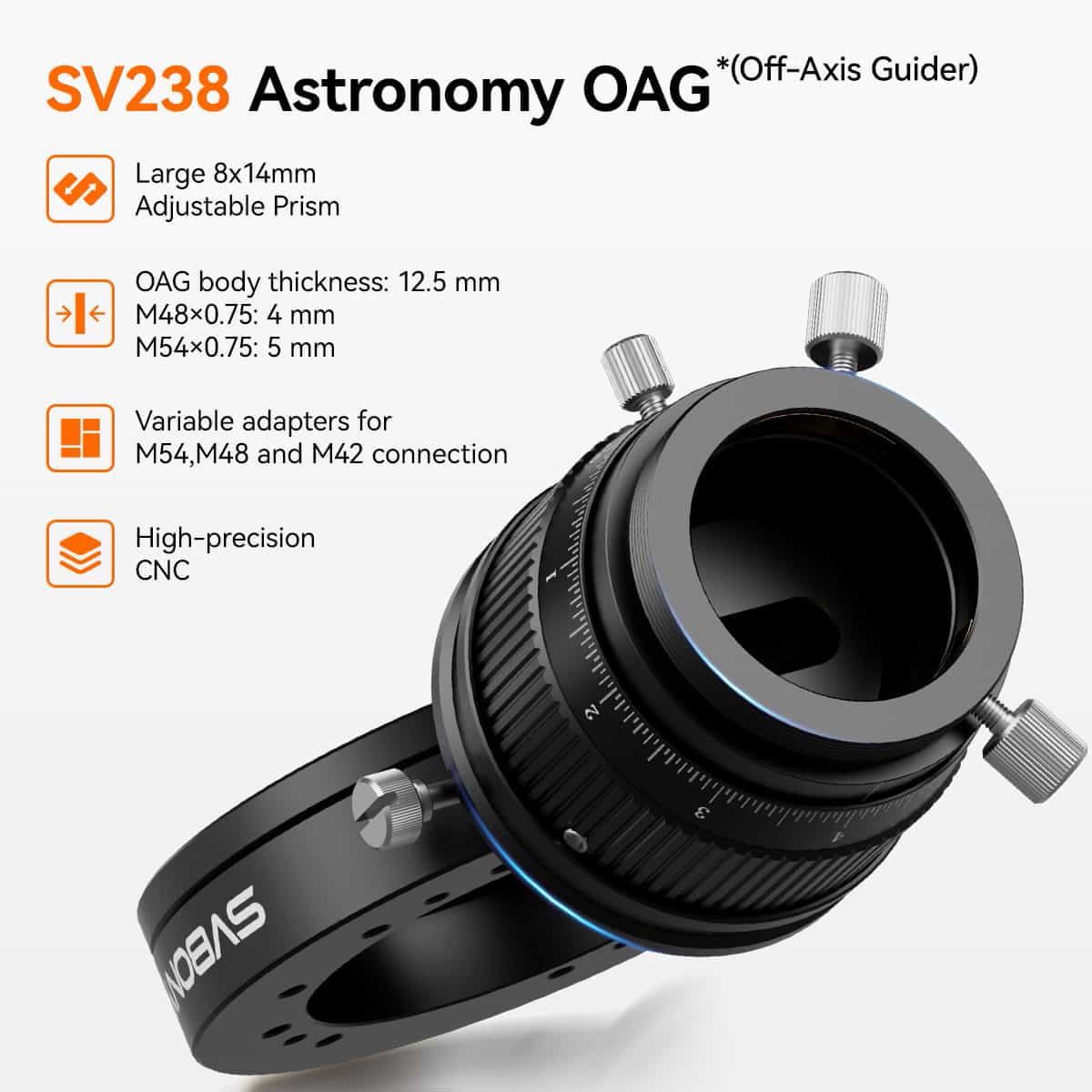
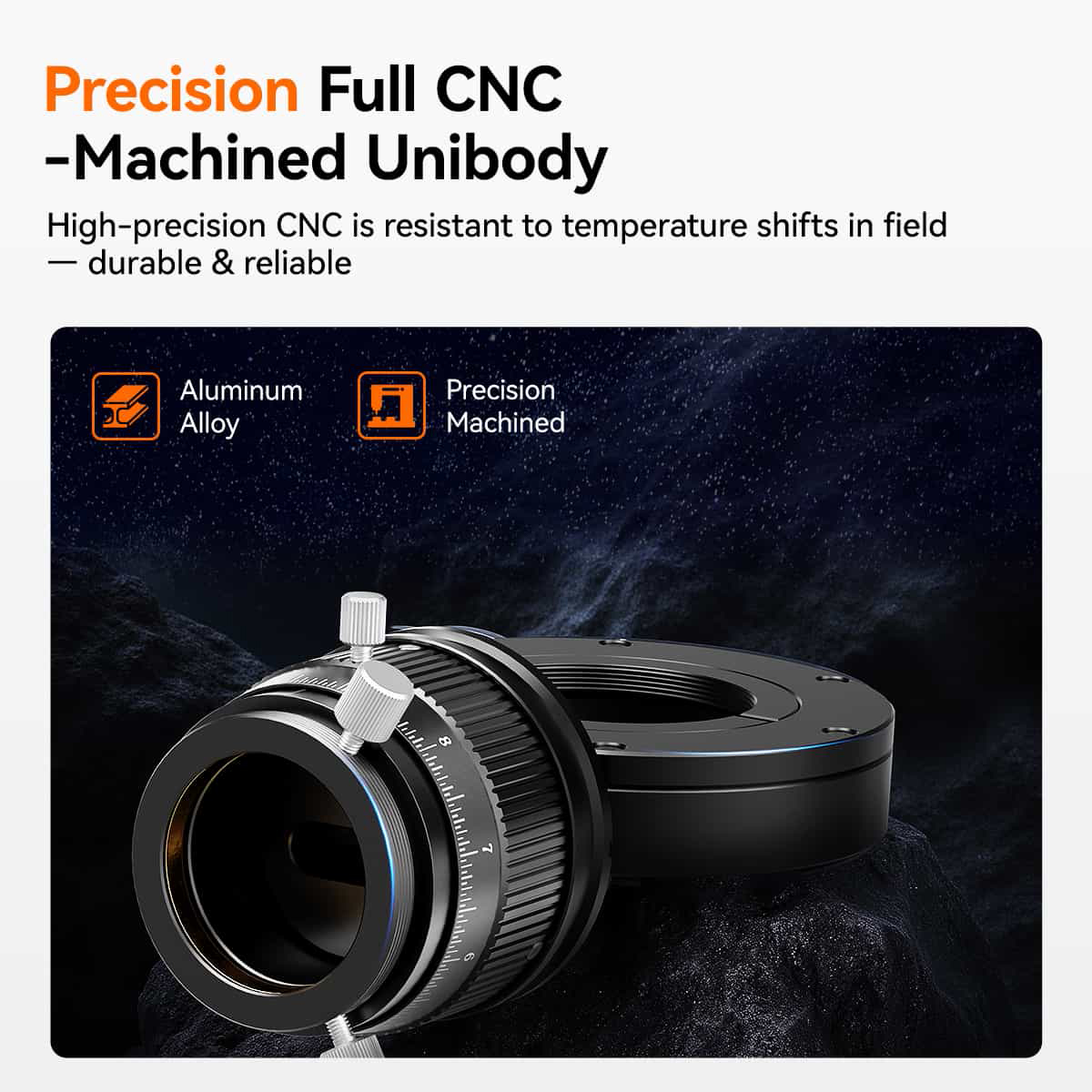
The SV238 immediately feels well-made. Its entire body is CNC-machined aluminum, anodized for protection and rigidity. This is important because even small mechanical shifts can ruin alignment. The machining keeps tolerances tight, ensuring the prism and camera adapters stay exactly where you set them.
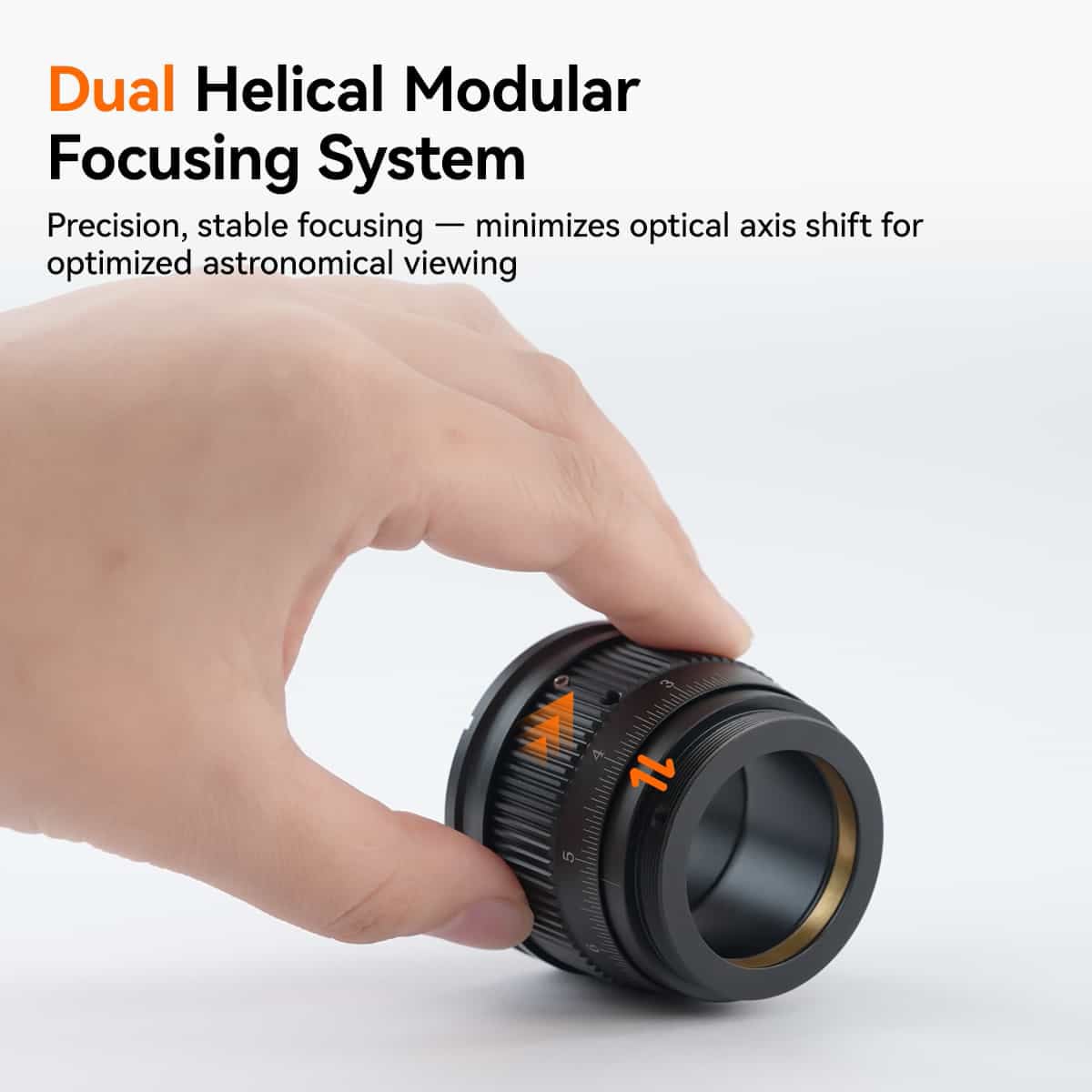
One highlight of this guider is its dual helical focuser for the guide camera. Focus adjustment on OAGs is notoriously delicate. You must match the focus point of the guide camera with that of the imaging camera. The SV238’s helical focuser makes that process smoother. Instead of loosening and tightening screws repeatedly, you simply twist the focuser ring to move the guide camera in or out by fractions of a millimeter. Once focus is perfect, you can lock it securely.
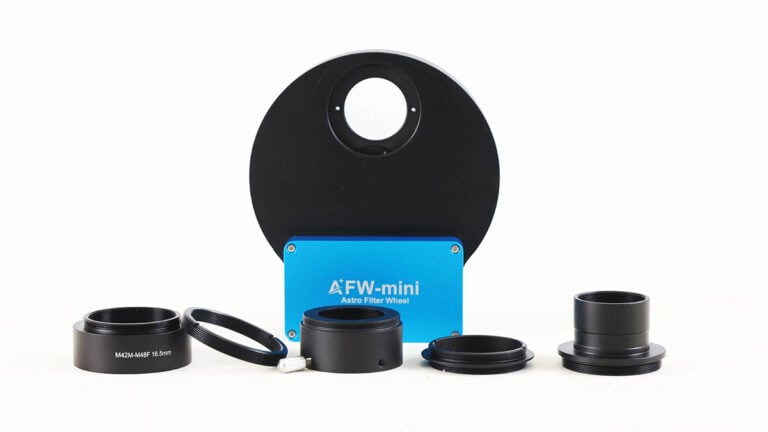
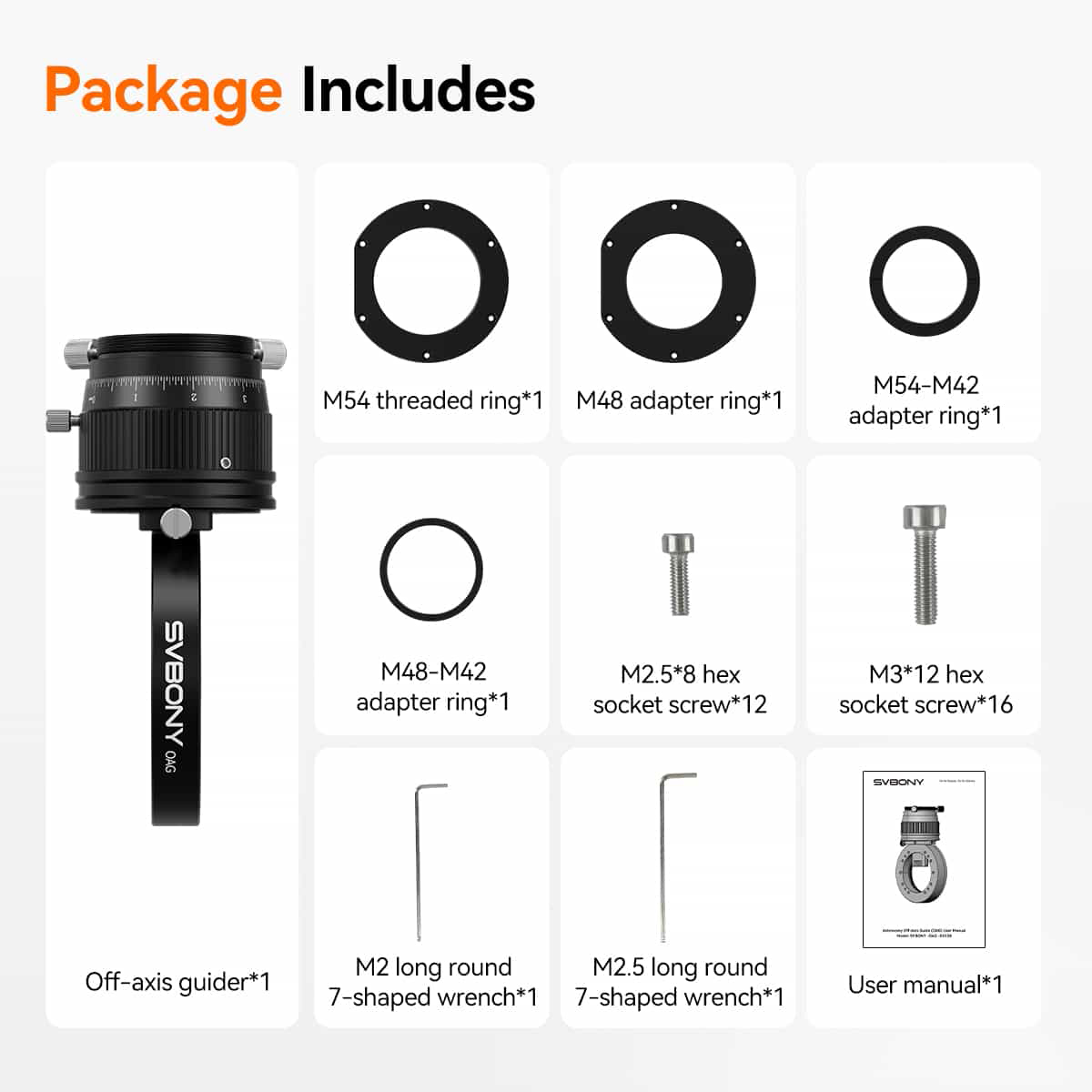
The guider also includes thread adapters in M42, M48, and M54 sizes, allowing it to integrate with most imaging setups. Whether you use a cooled camera, a filter wheel, or a field flattener, the SV238 can usually sit between them without needing custom adapters. This flexibility is one of its major strengths. The entire assembly is slim and compact, which helps maintain proper back-focus spacing, something that becomes vital when you use reducers or flatteners that require precise distances to the camera sensor.
The 8×14 mm prism
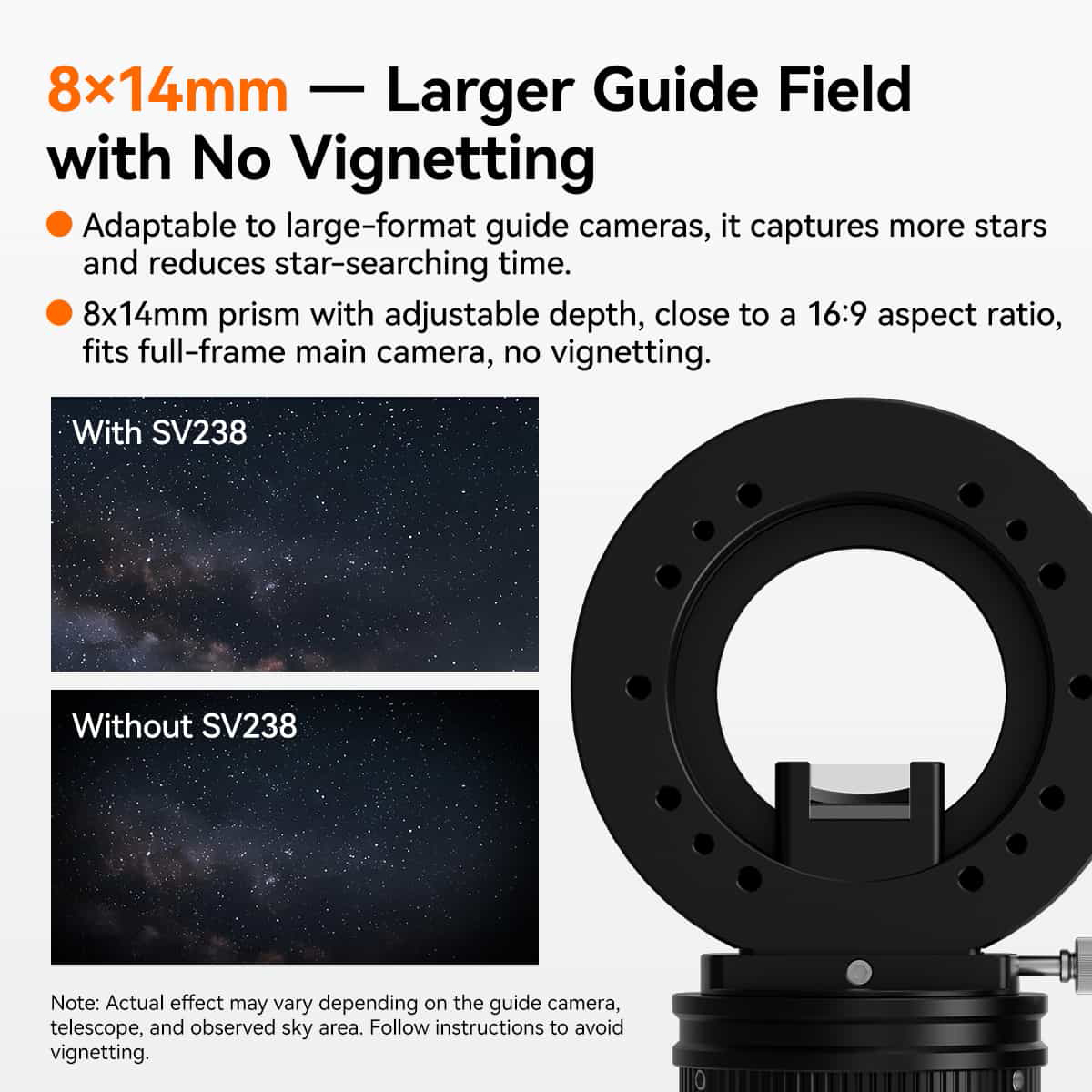
The prism is the heart of any off-axis guider. It’s what redirects light from the telescope’s optical path to the guide camera. The SV238 uses a large 8×14 mm prism, which is one of the larger sizes available in this price range. A bigger prism increases the field of view for the guide camera. That means more stars to choose from for guiding, especially valuable when you’re imaging narrow fields like galaxies or planetary nebulae. On many smaller OAGs, finding a suitable guide star can be frustrating, particularly with long focal lengths or narrowband filters. The SV238’s larger prism helps reduce that problem.
Svbony also allows you to adjust the prism height. This adjustment lets you set how much of the telescope’s light cone the prism intercepts. Push it too far in, and you risk shadowing or vignetting on the main camera’s sensor. Pull it too far out, and you may not catch enough light for the guide camera. The SV238’s design lets you fine-tune that balance so both cameras perform optimally. The company lists the OAG as suitable for APS-C and smaller sensors. That’s a reasonable specification, since larger full-frame sensors often extend closer to the prism’s edge, where obstruction could appear. Users with full-frame cameras can still experiment, but should check for corner shadows.
Focus and adjustment
One of the biggest challenges with any OAG is getting both cameras in focus at the same time. The SV238 addresses this with two features that stand out: the adjustable prism and the dual helical focuser.
When you first assemble the imaging train, the guide camera might not focus at the same point as the imaging camera. Instead of adding or removing spacers, you can adjust the focuser directly. The smooth helical mechanism lets you reach exact focus with minimal effort. Once aligned, both cameras stay locked in place thanks to solid mechanical tension.
Svbony’s design aims to make this process repeatable. If you dismantle your setup between sessions, common for people who travel or shoot from multiple locations, you can reinstall the SV238 and quickly return to the same focus point without long trial and error. This saves valuable setup time. The SV238 supports M42, M48, and M54 threads on both sides. That covers almost all modern astrophotography systems. You can attach it directly to a field flattener or focal reducer, and then connect your filter wheel or camera on the other side.
Price and availability
The Svbony SV238 Off-Axis Guider is priced at $129.99 and is available via the official website.
Svbony has built its reputation by offering accessible astrophotography gear without compromising too much on quality. The SV238 follows that approach. It brings features found in higher-priced OAGs, like a large prism and dual focuser, into a more affordable bracket.
The Svbony SV238 Off-Axis Guider is a well-balanced, thoughtfully engineered accessory for deep-sky astrophotography. The large 8×14 mm prism, adjustable prism height, dual helical focuser, and solid build quality show that Svbony has paid attention to real-world imaging problems.
Clear skies!
See more from DIYPhotography.net on Google
Add DIYPhotography.net as a trusted source. This makes
our stories more likely to appear in your Google Search results.
 Add as a preferred source on Google

Soumyadeep Mukherjee
Soumyadeep Mukherjee is an award-winning astrophotographer from India. He has a doctorate degree in Linguistics. His work extends to the sub-genres of nightscape, deep sky, solar, lunar and optical phenomenon photography. He is also a photography educator and has conducted numerous workshops. His works have appeared in over 40 books & magazines including Astronomy, BBC Sky at Night, Sky & Telescope among others, and in various websites including National Geographic, NASA, Forbes. He was the first Indian to win “Astronomy Photographer of the Year” award in a major category.


Join the Discussion
DIYP Comment Policy
Be nice, be on-topic, no personal information or flames.