

























Perseverance Rover Photographs the “Clearest Sign Yet” of Life on Mars
Sep 12, 2025
Soumyadeep Mukherjee
Soumyadeep Mukherjee is an award-winning astrophotographer from India. He has a doctorate degree in Linguistics. His work extends to the sub-genres of nightscape, deep sky, solar, lunar and optical phenomenon photography. He is also a photography educator and has conducted numerous workshops. His works have appeared in over 40 books & magazines including Astronomy, BBC Sky at Night, Sky & Telescope among others, and in various websites including National Geographic, NASA, Forbes. He was the first Indian to win “Astronomy Photographer of the Year” award in a major category.
Share:

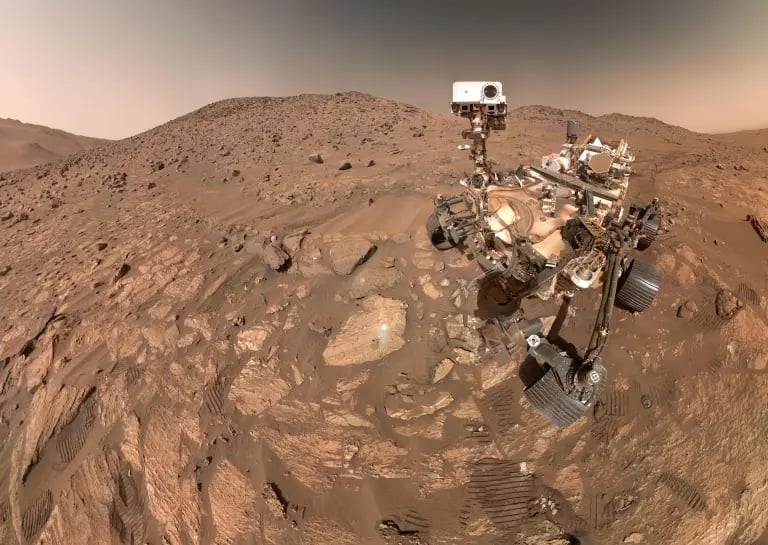
NASA has revealed a finding from the Perseverance rover that is capturing the attention of the scientific community. The rover’s analysis of a Martian rock in Jezero Crater has uncovered what researchers are calling the clearest sign yet of a potential biosignature on Mars. The discovery centers on a cached rock core, nicknamed Sapphire Canyon, that shows a remarkable combination of minerals, chemistry, and textures. While scientists are careful not to claim proof of life, the discovery represents the most compelling evidence so far in the ongoing search for traces of ancient biology on the Red Planet.
The rock that could change the story of Mars
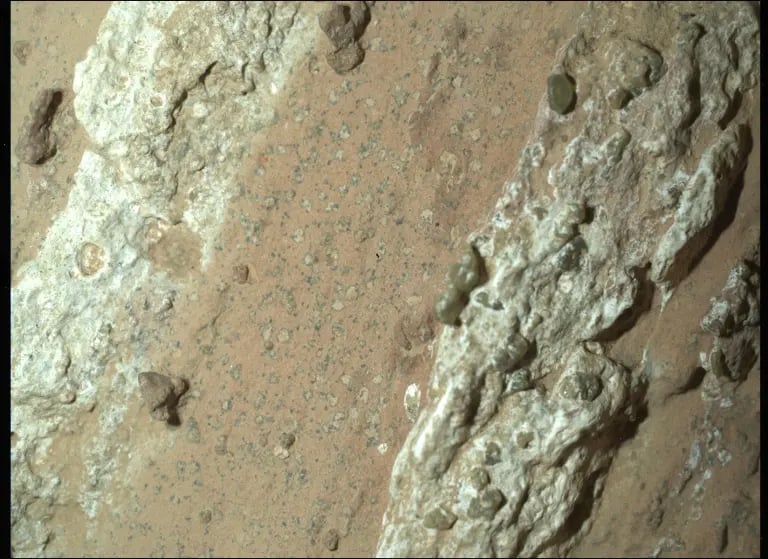
In mid-2024, Perseverance drilled into a layered mudstone outcrop called Cheyava Falls in Jezero Crater’s Bright Angel formation. The core sample extracted from this rock, now sealed in its titanium tube, has been named Sapphire Canyon. At first glance, the rock looks like a reddish, fine-grained stone. But under Perseverance’s high-resolution instruments, scientists saw unusual dark and light spots across its surface. NASA describes them as “leopard spots” and “poppy seeds.” These patterns are signs of chemical reactions that could be biologically relevant.
A mix of minerals and organics
The most striking feature of Sapphire Canyon is its unusual chemistry. The rock contains two iron-rich minerals: vivianite, an iron phosphate, and greigite, an iron sulfide. These appear together with organic carbon, sulfur, oxidized iron, and phosphorus. On Earth, this combination is strongly associated with environments where microbes thrive. The textures of the minerals suggest redox fronts, places where chemical reactions happen at boundaries between different conditions. Microbes on Earth often use such boundaries to extract energy. Add to this the presence of clay and silt, which are known to preserve delicate chemical signals, and you get a rock that looks very much like it has recorded ancient habitability.
Scientists are excited
The discovery checks several important boxes. First, the minerals appear in clear association with organic material, which strengthens the case for a life-related process. Second, the mudstone context is critical. Fine-grained sediments can trap and preserve traces of organic chemistry far better than coarse rocks. Third, the absence of evidence for extreme heating or acidic alteration means the signals we see are likely ancient and not erased by later processes. For planetary scientists, this is exactly the kind of rock they hoped Perseverance would find when it landed in Jezero Crater.
Why caution is still necessary
Despite the excitement, researchers stress a key point: potential does not equal proof. Similar minerals and textures can form without life. Vivianite and greigite, for example, can precipitate from chemical reactions in groundwater under the right conditions. The “spots” on the rock could also be the result of non-biological processes, such as mineral precipitation fronts driven purely by chemistry. Even though organics were detected, their origin is not yet clear; they could be ancient Martian, delivered by meteorites, or formed by abiotic pathways. NASA scientists underline this by calling the finding a “potential biosignature” rather than direct evidence of life.

Bringing samples home
The Sapphire Canyon core now joins Perseverance’s carefully stored sample collection. NASA’s long-term goal is to bring these samples back to Earth through the Mars Sample Return program, a joint NASA-ESA campaign. Only in terrestrial laboratories can scientists run the full battery of tests needed to confirm or rule out a biological origin. Techniques such as isotopic analysis, advanced microscopy, and contamination control simply cannot be carried out on a rover. Mars Sample Return has faced funding and schedule challenges, but missions like this discovery underscore its importance. Until the samples arrive, Perseverance will continue to seek more cores that might preserve other signs of life.
Clear skies!
See more from DIYPhotography.net on Google
Add DIYPhotography.net as a trusted source. This makes
our stories more likely to appear in your Google Search results.
 Add as a preferred source on Google

Soumyadeep Mukherjee
Soumyadeep Mukherjee is an award-winning astrophotographer from India. He has a doctorate degree in Linguistics. His work extends to the sub-genres of nightscape, deep sky, solar, lunar and optical phenomenon photography. He is also a photography educator and has conducted numerous workshops. His works have appeared in over 40 books & magazines including Astronomy, BBC Sky at Night, Sky & Telescope among others, and in various websites including National Geographic, NASA, Forbes. He was the first Indian to win “Astronomy Photographer of the Year” award in a major category.


Join the Discussion
DIYP Comment Policy
Be nice, be on-topic, no personal information or flames.
2 responses to “Perseverance Rover Photographs the “Clearest Sign Yet” of Life on Mars”
Meanwhile, the search for new DIY projects on diyphotography.net continues.
Hi Arthur, sorry that you were looking for DIY projects and related articles, but couldn’t find them. We have a huge selection of such articles on our website and you can find them here: https://www.diyphotography.net/category/diy/