






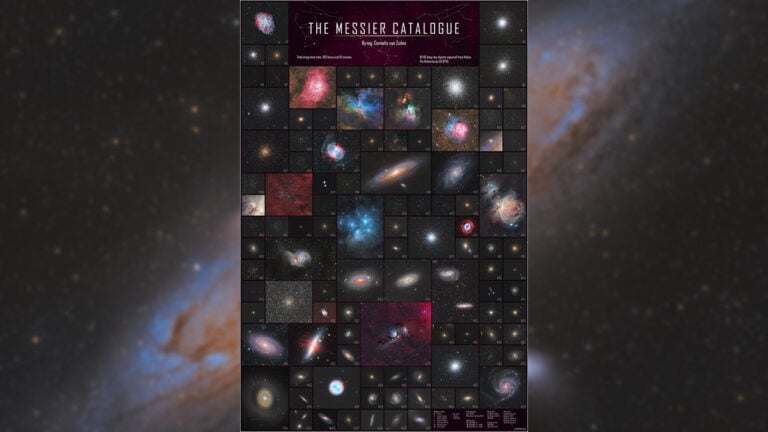













Askar launches new refractor telescope: 91F Flat-Field
Aug 18, 2025
Soumyadeep Mukherjee
Soumyadeep Mukherjee is an award-winning astrophotographer from India. He has a doctorate degree in Linguistics. His work extends to the sub-genres of nightscape, deep sky, solar, lunar and optical phenomenon photography. He is also a photography educator and has conducted numerous workshops. His works have appeared in over 40 books & magazines including Astronomy, BBC Sky at Night, Sky & Telescope among others, and in various websites including National Geographic, NASA, Forbes. He was the first Indian to win “Astronomy Photographer of the Year” award in a major category.
Share:

Askar has expanded its line of imaging-friendly refractors with the introduction of the 91F Flat-Field APO. This telescope is designed to remove one of the most persistent barriers for astrophotographers: the need for separate flatteners and exact backfocus calculations. By integrating the corrector directly into the optical system, the 91F promises clean star shapes across a full-frame sensor while remaining compact and easy to operate. It is marketed as both an astrograph and a capable visual instrument, offering versatility at a competitive price point.
Flat field optics
At the heart of the 91F is a four-element, air-spaced APO design. Three elements sit up front, and one element sits at the rear. One of those elements is ED glass that helps control color. The built-in corrector delivers the flat field, so no external flattener is required. Askar states that the system supports 44 mm full-frame imaging with strong star shape performance in the field corners. For many users, that means straightforward pairing with popular full-frame astronomy cameras and DSLRs. It also means fewer threaded joints and fewer places for tilt to creep in.
Native focal length sits at 609 mm. At f/6.7, you get a practical speed for broadband targets and for narrowband work. It will not match the raw speed of a very fast reducer. It does offer clean geometry and simple connections, which many imagers value more. If you prefer long integrations over complexity, the 91F’s optical plan makes sense. The field size supports large nebulae and broad galaxy fields. It also handles mosaics with less curvature drift between panels.
Mechanical design
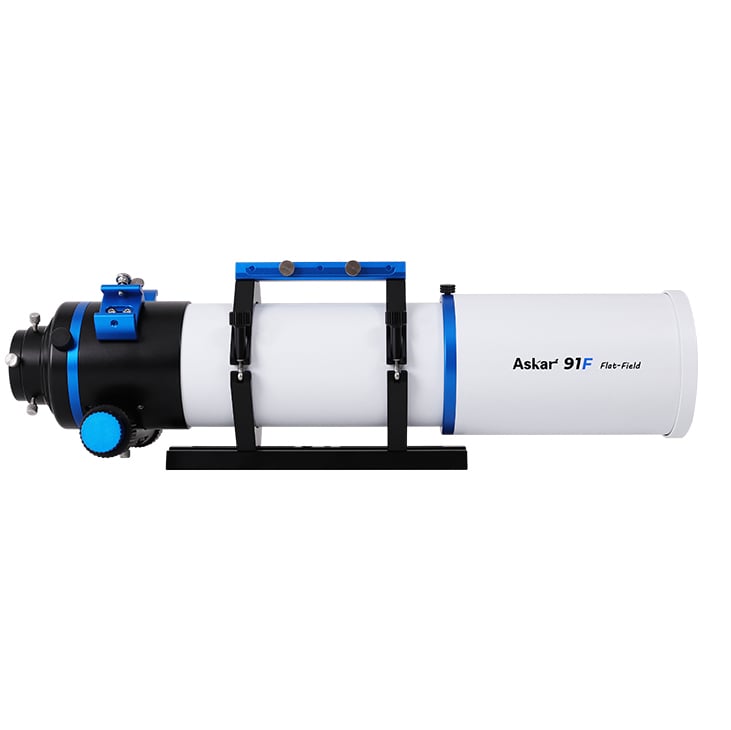
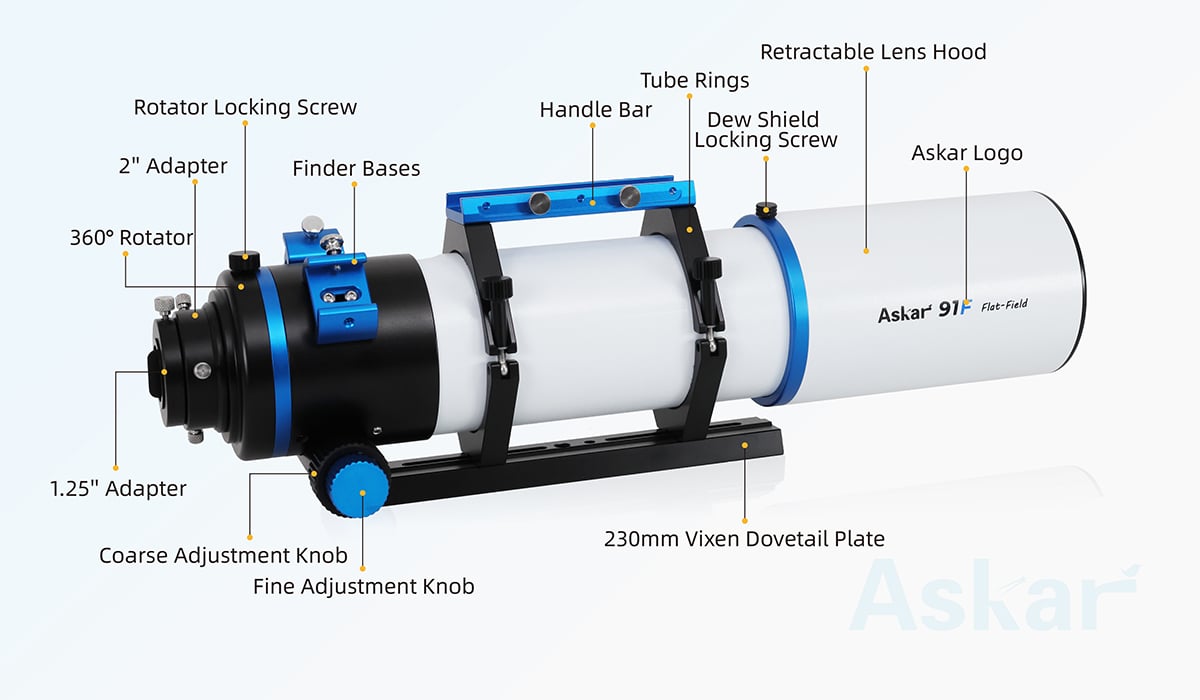
The tube follows the company’s recent industrial design. There is a retractable dew shield to trim the length during transport. The interior carries a matte treatment to suppress stray light. The finish uses Askar’s blue-and-white color scheme with CNC-machined parts. The handle is 130 mm long and accepts a finder base. Two additional finder bases sit on both sides of the focuser. Those extra mounting points help with guide scopes, mini-computers, or a secondary finder without moving hardware mid-session. The dovetail is a 230 mm Vixen-style plate with both 1/4-20 and 3/8-16 threaded holes. That lets you mount on a photographic tripod for terrestrial use if needed. It also improves balance options on smaller equatorial mounts.
Askar equips the 91F with a 3-inch rack-and-pinion focuser. It is a dual-speed unit with a 1:10 fine knob. A 360-degree, scaled rotator sits at the rear. That rotator helps frame without unlocking tube rings. It also lets you return to a known angle for repeatable framing across nights. The rear end includes 2-inch and 1.25-inch visual adapters. Askar lists a total length of 513 mm with the dew shield retracted and a 1.25-inch adapter attached. Fully extended with photographic adapters, the listed length is 636 mm. Net weight for the optical tube is 3.92 kg. Gross weight, which includes tube rings and the dovetail, is 4.52 kg.
A refractor that still welcomes visual observing
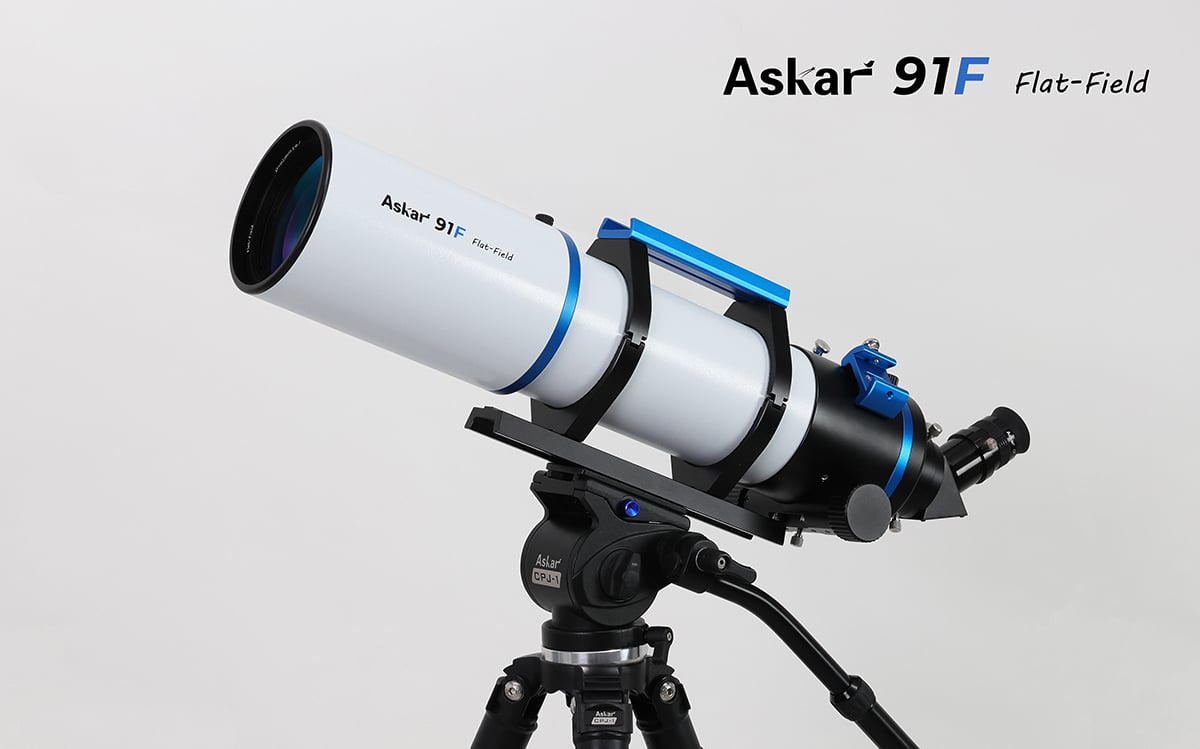
Many astrographs treat visual use as an afterthought. The 91F ships with visual parts in the box. Askar includes a 1.25-inch erecting prism diagonal, a 20 mm eyepiece, and an 8 mm eyepiece. The company quotes 30× with the 20 mm and 76× with the 8 mm. Those are reasonable starter magnifications for daytime scenes and wide-field night views. The erecting prism provides correct-orientation views, which helps when you use the scope for birding or landscapes. The visual adapters also include both 1.25-inch and 2-inch options. That gives you an easy path to your existing eyepieces and to larger low-power oculars.
The focuser’s fine control helps with high-power focus. The 360-degree rotator helps you set a comfortable eyepiece angle on an equatorial mount. The dual finder bases let you add a straight-through finder and a mini-guidescope at the same time. That can support a mixed imaging and visual session without re-rigging. The 230 mm Vixen plate is long enough to balance different configurations. It also bolts straight to many photo heads for casual terrestrial use.
Key specifications
Here are the key specifications of the telescope:
| Aperture | 91mm |
| Focal ratio | f/6.7 |
| Focal length | 609mm |
| Objective lens | Quadruplet air-spaced APO(including one ED glass) |
| Image circle | 44mm |
| Net weight | 3.92kg |
| Gross weight (Including tube ring&dovetail plate) | 4.52kg |
| Standard package items | A 91F OTA, a pair of tube rings, a handle, a 230mm Vixen dovetail plate, a set of photographic adapters, a 1.25-inch erecting prism, an 8mm eyepiece, and a 20mm eyepiece |
Price and availability
The Askar 91F refractor telescope is priced at $999 and is available via online retailers.
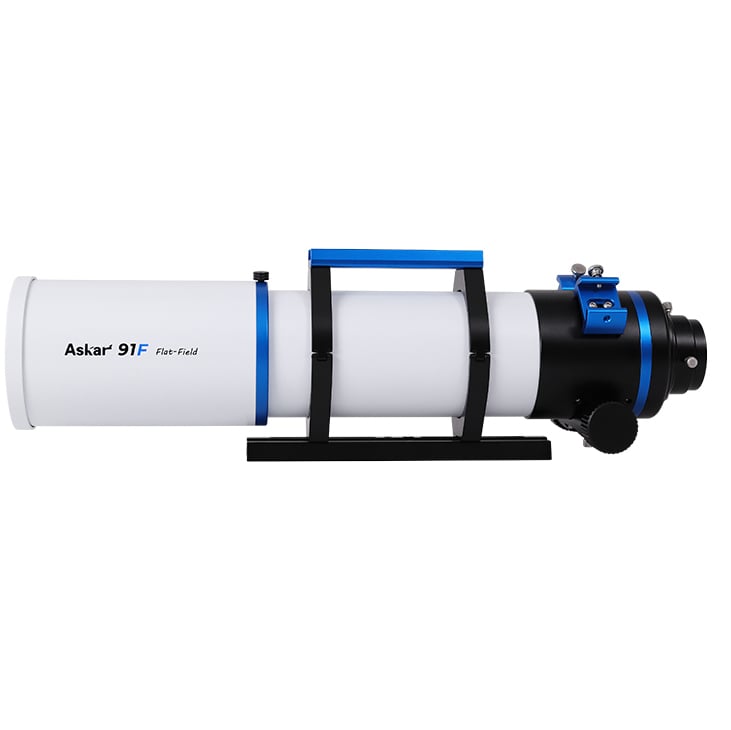
Askar built the 91F for people who want to image more. The optical train is simple, and the mechanics are practical. The package is complete enough that you can go outside on night one. You get full-frame coverage, a flat field, and a focuser that suits modern cameras. You also get a kit that works in daylight with the supplied erecting prism and eyepieces. For many imagers, that combination is exactly what they need.
Clear skies!
See more from DIYPhotography.net on Google
Add DIYPhotography.net as a trusted source. This makes
our stories more likely to appear in your Google Search results.
 Add as a preferred source on Google

Soumyadeep Mukherjee
Soumyadeep Mukherjee is an award-winning astrophotographer from India. He has a doctorate degree in Linguistics. His work extends to the sub-genres of nightscape, deep sky, solar, lunar and optical phenomenon photography. He is also a photography educator and has conducted numerous workshops. His works have appeared in over 40 books & magazines including Astronomy, BBC Sky at Night, Sky & Telescope among others, and in various websites including National Geographic, NASA, Forbes. He was the first Indian to win “Astronomy Photographer of the Year” award in a major category.


Join the Discussion
DIYP Comment Policy
Be nice, be on-topic, no personal information or flames.