






















Zoom Lenses vs. Fixed Lenses: The Showdown That’s Now Out of Focus
Nov 12, 2025
David Prochnow
Our resident “how-to” project editor, David Prochnow, lives on the Gulf Coast of the United States in Ocean Springs, Mississippi. He brings his expertise at making our photography projects accessible to everyone, from a lengthy stint acting as the Contributing How-To Editor with Popular Science magazine. While you don’t have to actually build each of his projects, reading about these adventures will contribute to your continued overall appreciation of do-it-yourself photography. A collection of David’s best Popular Science projects can be found in the book, “The Big Book of Hacks,” Edited by Doug Cantor.
Share:

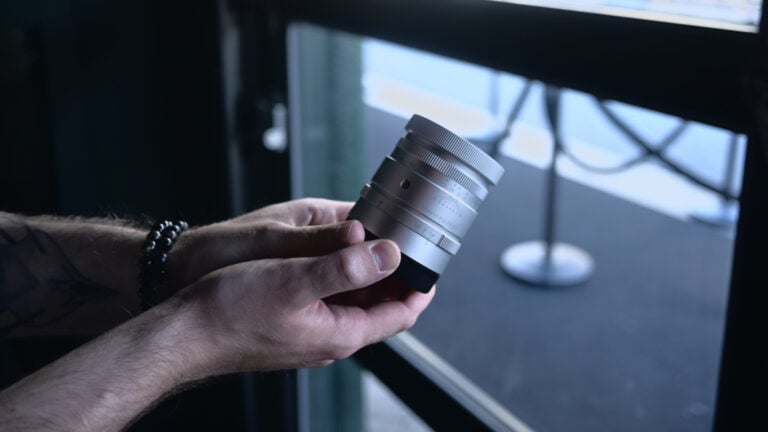
Ah, yes — the great photographic cage match: zoom lenses versus fixed lenses. A rivalry as old as photography itself; it has been fought in comment sections, debated in photography forums, and occasionally resulted in awkward confrontations at camera club meetings.
One side insists that zoom lenses are the Swiss Army knife of the camera world, while the other group swears that fixed (also sometimes referred to as “prime”) lenses are the holy grail of sharpness, low-light excellence, and photographic soul. But in 2025, one has to ask: does any of this really matter anymore, or are we all just focusing in on our own insecurity?

Let’s start with the zoom crowd. These folks are the multitaskers of photography. The “I want it all in one lens” types. Their motto? Why move your feet when you can twist your wrist? With a zoom, you can photograph a bird in the sky, a squirrel on the ground, and your friend awkwardly eating a hot dog, all without leaving your comfy seat. Convenience is the name of the game. But with great convenience comes great… dare we say, compromise. The image might be a little softer, the shutter speed a little slower, the aperture a little smaller, and your camera possibly a little bit heavier.

Then there are the prime lens purists. These are the photographers who scoff at those lazy “zoomers” and proudly say things like, “I zoom with my feet.” They’ll defend their f/1.4 aperture to the death, as if the creamy bokeh alone justifies the strain from running around to get that perfect perspective. Sure, primes are sharp, fast, low-light wonders, but frequently switching lenses feels less like art and more like a cardio workout.
It’s the Best Lens in the Eye of the Beholder
The most basic knock against the zoom lens has always been that its optical variability is not how a photographer naturally sees the world. Unless you’re the Six-Million Dollar Man with a bionic left eye.
And now, thanks to modern sensors, AI sharpening, advanced optical formulations, and smartphone wizardry, even the most basic lens, whether it’s a zoom or fixed, can produce jaw-dropping results. So maybe the real question isn’t which lens is better. Rather, it’s why are we still arguing about it. Whether you use a zoom, prime lens, or just shoot on your smartphone, the best lens is the one that helps you tell your story…and gets the shot.
Enjoy.
See more from DIYPhotography.net on Google
Add DIYPhotography.net as a trusted source. This makes
our stories more likely to appear in your Google Search results.
 Add as a preferred source on Google
Filed Under:
Tagged With:

David Prochnow
Our resident “how-to” project editor, David Prochnow, lives on the Gulf Coast of the United States in Ocean Springs, Mississippi. He brings his expertise at making our photography projects accessible to everyone, from a lengthy stint acting as the Contributing How-To Editor with Popular Science magazine. While you don’t have to actually build each of his projects, reading about these adventures will contribute to your continued overall appreciation of do-it-yourself photography. A collection of David’s best Popular Science projects can be found in the book, “The Big Book of Hacks,” Edited by Doug Cantor.
Related Posts
 The CamFi ZF is a remote controlled zoom and focus unit for timelapse and macro focus stacking
 Wide-angle lenses are not “landscape lenses” – All lenses are landscape lenses
 Fujifilm Unveils Much Anticipated X100T Fixed Lens; Also Reveals Two New Lenses
 Sigma officially presents four new lenses: an ART zoom, two ART primes, and a Contemporary zoom
Join the Discussion
DIYP Comment Policy
Be nice, be on-topic, no personal information or flames.